
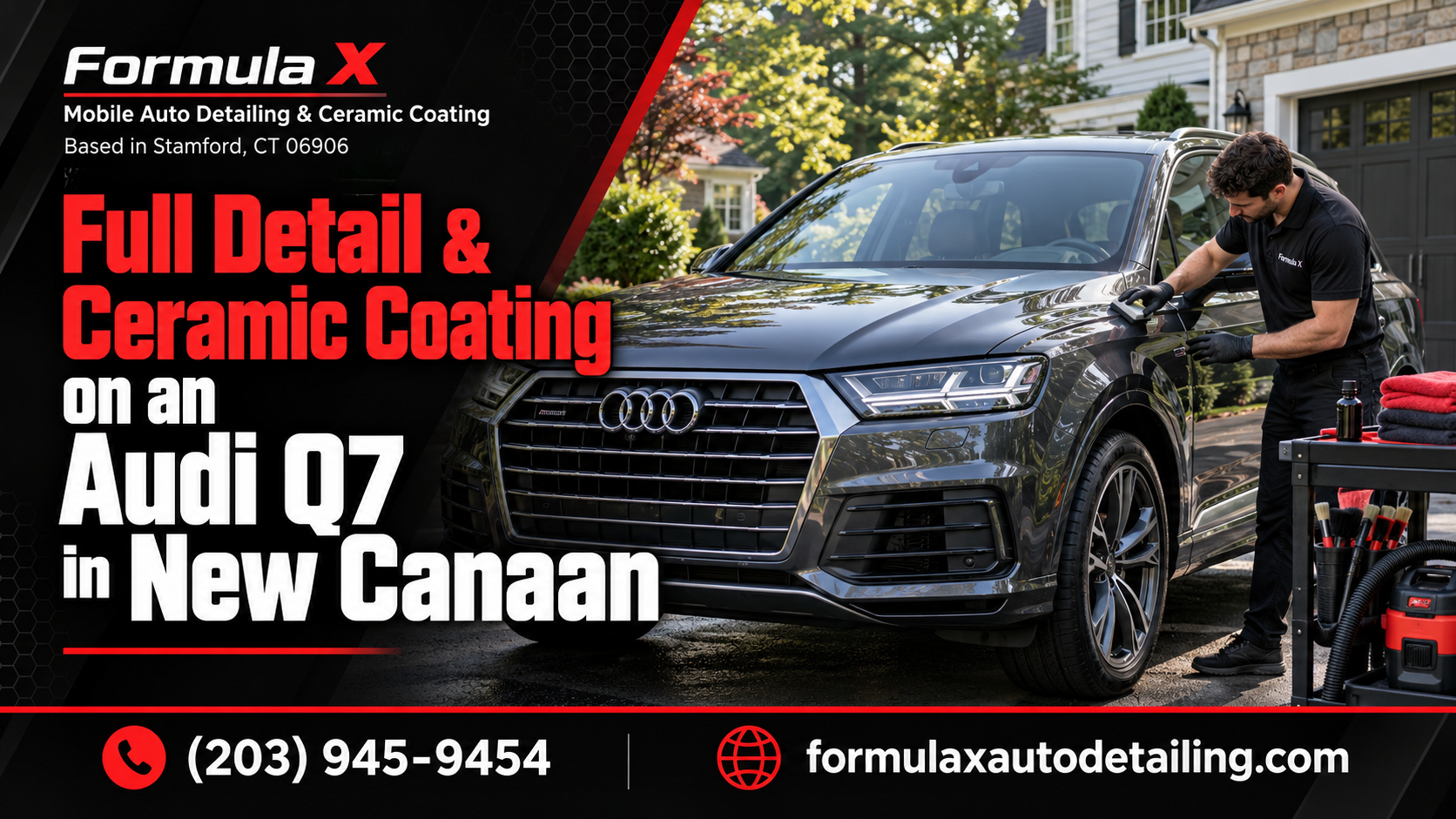
Formula X Mobile Auto Detailing & Ceramic Coating · Full Detail & Ceramic Coating Guide
An Audi Q7 is a big, heavy, three-row SUV that tends to get used hard: school runs, Merritt Parkway commutes, ski trips, and winters on salted roads. A full detail followed by a ceramic coating is one of the most popular ways to reset one and make it easier to keep clean. It also has more rules than most owners realize. Audi’s own owner’s manual sets a pressure-washer distance, lists the seals, sensors, and camera lenses not to spray, tells owners never to treat the windshield with water-repelling coatings, and says never to use steam cleaners on leather or textiles. Those rules shape what a good full detail and coating should look like. This guide covers Audi paint, sensors and cameras, glass, wheels, roof rails, the cabin, New Canaan conditions, the full detail process, paint correction, Formula X’s Ceramic Pro packages, and aftercare. Formula X Mobile Auto Detailing & Ceramic Coating is based at 48 Union St, Stamford, CT 06906, and can be reached at (203) 945-9454.
What does a full detail and ceramic coating involve on an Audi Q7 in New Canaan?
A full detail and ceramic coating on an Audi Q7 means cleaning the cabin and exterior thoroughly, decontaminating the paint, correcting swirls where the paint needs it, and then bonding a ceramic coating to the clean, corrected clear coat. On a Q7 that work has to follow Audi’s owner’s manual: keep pressure-washer spray at least 16 inches (40 cm) away and off seals, sensors, and camera lenses, keep any coating, film, or adhesive off sensors and cameras, leave water-repelling coatings off the windshield, and clean leather and textiles without steam or stiff brushes. A coating makes salt, brake dust, and road film easier to wash off. It doesn’t stop stone chips, and it doesn’t replace regular washing.
The Audi guidance quoted here comes from the owner’s manual for the 2025 Audi Q7, the second-generation model. Audi’s newsroom describes the 2027 Q7 as an all-new third generation, and earlier Q7s may differ too, so look up the manual for your exact vehicle through Audi’s official owner’s manual portal, which works from your VIN. Coating package details come from Formula X’s Ceramic Pro package cards.
Not a price list: Formula X quotes ceramic coatings and paint correction after seeing the vehicle, because the condition of the paint decides how much prep is needed. The only prices in this guide are Formula X’s published detailing package starting prices.
Why an Audi Q7 Needs a Detailing Plan, Not Just a Bottle
Quick answer: The coating chemistry is the same as on any vehicle. What’s different is the vehicle: a large painted surface with a tall roof, driver-assistance sensors and cameras front, rear, and on the mirrors, a camera behind the windshield, big wheels that collect brake dust, roof rails, a three-row cabin with leather or textile seats, and an owner’s manual with specific cleaning instructions for nearly all of it.
Ceramic coatings are liquid products that bond to clear coat and cure into a thin, slick, chemical-resistant layer. On a Q7, the coating step is the simplest part of the job. The planning around it, and the full detail that comes first, is where good and poor results separate.
A lot of paint
Audi’s 2025 manual lists the Q7 at about 199.6 inches long and roughly 68.5 inches tall. That’s a lot of surface to wash, decontaminate, polish, and coat, and a roof you can’t reach from the ground.
Sensors and cameras
Depending on equipment, the manual lists ultrasonic sensors, radar sensors at the corners and in the grille, peripheral cameras in the mirrors and grille, a rearview camera, and a camera behind the windshield.
Pressure limits
Audi says to keep a pressure washer at least 16 inches (40 cm) away, never use cone or high-pressure nozzles, and keep the water at or below 140°F (60°C).
No water repellent on the windshield
The manual says the windshield must not be treated with water-repelling coating agents, because they can cause glare and wiper chatter.
No steam on leather or textiles
Audi’s care section says never to use steam cleaners, brushes, or hard sponges on natural leather, textiles, artificial leather, or microfiber.
Wax, or something like it
Audi recommends hard wax at least twice a year once water stops beading on clean paint. A ceramic coating takes over that protective role, which changes the routine.
None of this makes a full detail or coating risky. It means the detailer should know where the Q7’s hardware is, follow Audi’s cleaning table, and adjust the plan before any product touches the vehicle. It also means a few lines on a standard package card, like steam cleaning or coating every window, need a conversation first on this particular SUV.
What Audi’s Owner’s Manual Says About Care and Cleaning
Quick answer: Audi’s 2025 Q7 manual says to rinse off heavy deposits first, remove bird droppings, tree sap, and road salt quickly, wash from the top down with a soft sponge and solvent-free products, keep pressure-washer spray at least 16 inches (40 cm) away and off seals, tires, hoses, sensors, and camera lenses, avoid washing in direct sunlight, wash the underbody once road salt stops being used for the season, and dry the brakes with a few careful applications afterward.
Audi opens its care chapter with a line every Q7 owner should know: regular, proper care helps maintain the vehicle’s value, and it can also be a requirement when submitting warranty claims for corrosion damage and paint defects on the body. The rest of the chapter reads like a detailing checklist.
“The longer that deposits such as insects, bird droppings, tree sap or road salt remain on the vehicle, the more the surface can be damaged. High temperatures such as those caused by sunlight increase the damaging effect.” — Audi Q7 owner’s manual (2025)
| Manual point | What it says | Why it matters for a full detail and coating |
|---|---|---|
| Heavy deposits | Rinse off heavy deposits with plenty of water before washing | Grit dragged across paint during the wash causes the marring a coating then locks in |
| Stubborn deposits | Bird droppings and tree sap are best removed with plenty of water and a microfiber cloth | Soften and lift, don’t scrub; sap etching should be assessed before coating |
| Hand washing | Top down, soft sponge or cleaning brush, solvent-free products | Sets the baseline for prep washing and for washing after coating |
| Pressure washers | At least 16 in (40 cm) away; never at seals on side windows, doors, hood, luggage compartment lid, or sunroof, or at tires, rubber hoses, insulating material, sensors, camera lenses, or the laser scanner | Every rinse in the process has to respect these zones |
| Nozzles and temperature | Never use cone nozzles or high-pressure nozzles; water no hotter than 140°F (60°C); no pressure washer on snow or ice | Rules out aggressive “blasting” of wheel wells and grilles |
| Direct sun | Don’t wash in direct sunlight; don’t polish or wax in direct sunlight | Prep, polishing, and coating need shade or a garage |
| Sponges | Don’t use insect-removing sponges, kitchen sponges, or similar items | Abrasive pads have no place on Q7 paint |
| Underbody | Wash the underside once road salt stops being used for the season | A coating doesn’t cover the underbody; spring rinsing still matters |
| Brakes | Braking may be delayed after washing; dry the brakes with a few careful applications | Part of every wash routine, coated or not |
| Engine compartment | Never direct a stream of water onto electrical or electronic components | Engine-bay cleaning is a separate, careful job |
| Where to wash | Only wash in facilities designed for the purpose, to keep oily water out of the sewer system | Plan where a mobile prep wash happens and how runoff is handled |
Paint care, according to Audi
Audi’s cleaning table tells owners to rinse spilled fuel off paint immediately, remove insects, droppings, sap, and road salt by dampening them and lifting them with microfiber, and remove cosmetics and sunscreen right away with a mild soap solution, defined in the manual as no more than two tablespoons of neutral soap in a quart (1 liter) of water. When water no longer beads on clean paint, Audi says to treat it with hard wax at least twice a year. When the paint has lost its shine even though it’s protected, Audi says to use a suitable polish and then a paint protectant if the polish didn’t contain one. It also warns not to polish away rust spots and to have corrosion handled by an Audi dealer or service facility.
That last part is worth repeating: a ceramic coating doesn’t fix corrosion or seal over rust. If an inspection turns up bubbling or rust, it gets repaired first.
Audi Paint: Clear Coat, Metallic Finishes, and Matte
Quick answer: Most Q7s wear a base coat for color under a clear coat for gloss and protection, which is the layer that gets washed, polished, and coated. Many Audi colors are metallic or pearl effect paints, where flakes in the base coat change how swirls and haze show up. Audi also publishes separate rules for matte finish paint: no polish, no hard wax, no protective wax, and only special matte cleaners. Confirm the finish and the paint code before any machine polishing.
Modern factory paint on an SUV like the Q7 is a layered system. Color comes from the base coat, which on many Audi colors includes metallic or pearlescent pigment. A clear coat on top gives the gloss and takes the daily abuse: wash marring, bird droppings, sap, salt film, and UV. Paint correction removes a very thin layer of that clear coat to level swirls and scratches, and a ceramic coating bonds to it afterward. Everything in a full detail and coating happens in the clear coat, which is why its thickness and condition matter so much.
| Finish | What you see | Polishing | Coating approach |
|---|---|---|---|
| Solid color with clear coat | Even color, sharp reflections; swirls show clearly on dark colors | Yes, when correction is needed | Standard ceramic coating after wash, decontamination, and any correction |
| Metallic or pearl with clear coat | Sparkle or color shift in sunlight; haze can hide in the flake | Yes, with careful inspection under good light | Standard coating; finishing polish matters for clarity |
| Matte finish paint (where fitted) | Soft, diffused reflections | Never, per Audi’s matte instructions | Only products made for matte paint; ask before anything is applied |
| Gloss black trim and badges | Deep black that mars easily | Very light, if at all | Gentle cleaning first; coat only if suitable |
| Decorative decals or film | Graphics, wraps, or paint protection film | Audi says not to polish decorative decals | No pressure washing of decals; film-compatible products only |
Audi’s matte paint rules
Audi’s manual covers matte finish paint separately. It says to remove dust and large particles first, take off insects, grease, and fingerprints with a special matte paint cleaner applied with microfiber and light pressure, then rinse and wash with a neutral shampoo and a soft microfiber cloth. It warns against polishing agents and hard wax, says never to use protective wax because it can destroy the matte effect, and says not to put stickers or magnetic signs on matte-painted parts. Matte paint is uncommon on a Q7, but if yours has it, the standard gloss full detail and coating plan doesn’t apply.
Find the paint code and measure first
- Check the paint name on the window sticker or build documents, and the paint number on the vehicle data label.
- Note any repainted panels. A used Q7 may have had bumpers or doors refinished, and refinished panels can behave differently under a polisher.
- Measure paint thickness before heavy correction. DeFelsko’s guide to automotive paint inspection explains how paint meters help detect refinished areas and why readings vary from panel to panel.
- Look at the paint under strong, angled light to see swirls, holograms from past machine polishing, and etching from droppings or sap.
Don’t guess the finish. Polishing matte paint or a satin film can permanently add shine to it. If there’s any doubt about what’s on your Q7, no machine polishing happens until it’s confirmed.
Sensors, Cameras, Parking Aids, and the MMI Screens
Quick answer: Audi says sensors, cameras, and the areas around them must not be obstructed or painted, and that attachments, stickers, adhesive, paint, or similar materials must not be applied to sensors or extend into their field of view. Sensors get a soft cloth with a solvent-free cleaner, camera lenses a soft cloth with an alcohol-free cleaner, and never warm or hot water on a frozen lens. For a coating job that means mapping the hardware, masking it during polishing, keeping coating off it, and testing the systems afterward.
A Q7’s driver-assistance hardware is spread around the body. Depending on equipment, Audi’s manual lists front and side ultrasonic sensors, radar sensors at the front corners and in the radiator grille, peripheral cameras in the exterior mirrors and the grille, a night vision camera in the grille on vehicles that have it, a camera behind the windshield, and at the rear a rearview camera in the luggage compartment lid, radar sensors at the rear corners, and rear and side ultrasonic sensors. The manual also notes that some sensors are installed under vehicle components and can’t be seen from the outside.
“Attachments, stickers, adhesive, paint or similar objects must not be applied to sensors or extend into the visual field of the sensors and cameras.” — Audi Q7 owner’s manual (2025)
Audi doesn’t mention ceramic coatings by name in that warning. This guide won’t claim a coating is harmless to sensors, because Audi doesn’t say so. The cautious approach is to treat sensor faces, camera lenses, the grille radar area, and the windshield camera area as no-coat zones.
A sensor-safe full detail and coating
- Map the hardware. Find the parking sensors, corner radar areas, grille radar and camera, mirror cameras, rear camera, and windshield camera before the wash begins.
- Rinse correctly. No pressure-washer spray aimed at sensors or camera lenses, and at least 16 inches (40 cm) of distance everywhere else.
- Mask before polishing. Compound dust and pad contact shouldn’t reach sensor faces or lenses.
- Keep coating off sensors and lenses. Wipe any overspray before it cures.
- Clean them the Audi way. Soft cloth with a solvent-free cleaner for sensors; soft cloth with an alcohol-free cleaner for camera lenses; no abrasives.
- Fold the mirrors back out. Audi says mirrors with peripheral cameras must be folded out fully for the cameras to work correctly.
- Test afterward. Check the parking aid display and camera views before the work is called finished.
The MMI screens and controls
The interior side of the electronics has its own rules. Audi says the displays and instrument cluster must be switched off and cooled before cleaning, and the MMI has a screen-cleaning mode for this under SETTINGS > Display & Brightness > MMI > Screen cleaning. Displays and the trim around them must not be cleaned with dry methods, because they can scratch, and Audi recommends a soft cloth with LCD cleaner. Fluids must not get into the gaps between the instrument cluster and its trim, or into the controls. Controls get a soft brush, then a soft cloth with the mild soap solution.
The BMW X5 scratch repair guide covers how bumper sensors affect paint work on another German SUV, and the Range Rover Sport ceramic coating guide shows a similar sensor-safe approach on a Land Rover.
Windshield, Glass, and Wipers
Quick answer: Audi’s 2025 Q7 manual says the windshield must not be treated with water-repelling windshield coating agents, because in wet, dark, or low-sun conditions they can cause increased glare, which raises the risk of an accident, and they can cause wiper blade chatter. Formula X’s Gold and Silver Ceramic Pro cards include Ceramic Pro Rain on all windows. On a Q7, the sensible plan is to leave the windshield out and decide about the side and rear glass separately.
Glass coatings make rain bead and roll off, and many drivers like that. On a Q7, Audi has taken a clear position on the windshield, and it’s the one place in this guide where the manufacturer’s instruction directly overrides a line on a package card.
“The windshield must not be treated with water-repelling windshield coating agents.” — Audi Q7 owner’s manual (2025)
| Glass | Audi guidance | Sensible plan |
|---|---|---|
| Windshield | No water-repelling coating agents; camera behind the windshield; wipers off before a car wash | Clean and decontaminate; don’t apply a rain-repellent coating |
| Door windows | Plastic scraper in one direction only; no warm or hot water on ice | Glass coating is an option to discuss |
| Rear window | No stickers on the defogger heating wires inside | Exterior coating possible; protect the wires when cleaning inside |
| Exterior mirrors | Plastic scraper only; no hot water on ice; fold with the power function | Gentle cleaning; watch the mirror cameras |
| Windows with decorative decals | No ice scraper on decals | Clean around decals gently |
| Interior glass | Glass cleaner, then wipe dry | Clean, don’t coat |
Wipers during glass work
- Switch the wipers off before washing. Audi says to do this before a car wash so they don’t switch on unexpectedly and damage the wiper system.
- Check for frozen blades in winter before turning the wipers on.
- Clean the blades with a soft cloth and glass cleaner, as Audi’s cleaning table recommends.
For the client to confirm: The “Ceramic Pro Rain on all windows” line comes from Formula X’s package cards. Because Audi’s manual rules out water-repelling coatings on the Q7 windshield, confirm with Formula X at booking that the windshield will be left uncoated, and whether you want the side and rear glass done.
Wheels, Brake Dust, and Tailpipes
Quick answer: Audi says to clean road salt off the wheels with water and brake dust with an acid-free special cleaning solution, never to use paint polish or other abrasive materials on the wheels, and to repair chips or scratches in the wheels’ protective layer immediately. Exhaust tailpipes get water and, if needed, a stainless-steel cleaner. Formula X’s Gold Ceramic Pro card includes one layer of Ceramic Pro on the wheels.
Q7 wheels are large and open-spoked, so brake dust and winter brine are always on display. A wheel coating makes that easier to rinse off; it doesn’t change Audi’s rules on what touches the wheels.
| Item | Audi guidance | What it means for the detail |
|---|---|---|
| Road salt on wheels | Water | Rinse often in winter, coated or not |
| Brake dust | Acid-free special cleaning solution | No acid wheel cleaners during prep or maintenance |
| Polish and abrasives | Never use paint polish or other abrasive materials on the wheels | Wheels are cleaned and decontaminated, not machine-polished like paint |
| Chips and scratches | Damage to the wheels’ protective layer must be repaired immediately | Curb rash is noted at inspection; a coating doesn’t seal it |
| Tires and rubber hoses | Don’t aim a pressure washer at them | Wheel-well rinsing at a distance |
| Exhaust tailpipes | Water for road salt; stainless-steel cleaner if necessary | Clean when cool; no chrome products on trim |
| Decorative trim | Mild soap solution; stainless-steel cleaner if necessary; never chrome care products | Gentle products on brightwork and window trim |
Wheel coating questions to ask
- Faces only, or barrels too? Barrels collect the most brake dust but are the hardest to reach without removing the wheels.
- Which cleaner afterward? Stick with acid-free products, as Audi specifies.
- What about curb rash? Audi says protective-layer damage should be repaired right away; that’s a wheel repair, not a detailing step.
Formula X’s ceramic coatings page explains the coating service in general, and exterior car detailing covers the wash-and-protect side of the job.
Roof Rails, Roof Racks, and Reaching the Roof
Quick answer: Audi’s 2025 Q7 manual lists a maximum permissible roof load of 220 lbs (100 kg), says roof racks may only be mounted at the specified locations, and says the roof rack and attachments must be removed before an automatic car wash. For a full detail and coating, take crossbars and carriers off beforehand, clean the rails with gentle products, and make sure the detailer has a safe way to reach the roof.
At roughly 68.5 inches tall before you add rails, the Q7’s roof is above eye level for most people. It’s also the panel that bakes in the sun, collects pollen and sap under trees, and gets the least attention in a quick wash. In a full detail and coating, the roof gets the same wash, decontamination, inspection, and coating as the hood.
| Roof item | Audi guidance | Detailing approach |
|---|---|---|
| Roof load | Maximum permissible roof load 220 lbs (100 kg), including the rack, attachments, and cargo | Nobody leans on the roof or rests equipment on it |
| Roof racks | Mount only at the specified locations; check bolts before every trip; remove before an automatic car wash | Take crossbars and boxes off before the appointment so the roof and rails can be cleaned and coated |
| Rails and trim | Decorative parts get mild soap solution or stainless cleaner; never chrome care products | Gentle cleaning; coat only with a suitable product |
| Panoramic roof (if fitted) | Don’t aim a pressure washer at sunroof seals; make sure the roof doesn’t contact roof cargo when open | Rinse at a distance; hand-clean the glass and seals |
Reaching the roof safely
- Use a proper step or platform, never the door sills, tires, or the roof rails.
- Keep the ladder off the paint. A ladder leaning against a door or fender will mark it.
- Don’t stretch across the roof from one side. Working it from both sides keeps pressure even and avoids missed spots.
- Re-mount the rack correctly afterward, at the locations Audi specifies, and check the bolts.
For the client to confirm: Ask Formula X whether you should remove crossbars, bike racks, or a cargo box before the appointment, or whether the team will handle it. This guide doesn’t assume either way.
The Interior Half of a Full Detail, the Audi Way
Quick answer: Audi’s cleaning table covers every cabin surface: vacuum textiles, lift water-based stains with an absorbent cloth and mild soap solution, use leather-specific removers on natural leather and condition it regularly, clean seat belts with mild soap and let them dry before they retract, and never use steam cleaners, brushes, or hard sponges on leather, textiles, artificial leather, or microfiber. Formula X’s Gold detailing card lists interior steam cleaning, so ask how it will be adapted for a Q7’s seats.
A full detail isn’t just the paint. A Q7 cabin with three rows gets crumbs in seat tracks, salt on the carpets, scuffs on door panels, smudges on the MMI screens, and spills in the cup holders. Audi’s manual is unusually specific about how each surface should be cleaned.
| Surface | Audi’s recommendation | What to avoid |
|---|---|---|
| Natural leather | Fresh stains: cotton cloth and mild soap solution; dried stains: leather-safe stain remover; regular conditioning cream that protects from light | Solvents, floor polish, shoe polish, spot remover; steam cleaners, brushes, hard sponges; seat heating to dry the seat |
| Textiles, artificial leather, microfiber | Vacuum; absorbent cloth and mild soap for water-based stains; mild soap and blotting for oil-based stains; special stain remover for ink or similar | Leather care products, solvents, polishes, spot remover; steam cleaners, brushes, hard sponges |
| Seat belts | Mild soap solution; let them dry before they retract | Removing them to clean; chemicals, corrosive fluids, solvents, sharp objects |
| Plastic parts | Damp cloth; mild soap or detergent-free plastic cleaner for heavier dirt | Harsh solvents |
| Displays and instrument cluster | Switched off and cool; soft cloth with LCD cleaner; MMI screen-cleaning mode | Dry cleaning methods; fluid in the gaps |
| Interior glass | Glass cleaner, then wipe dry | Stickers on the rear defogger wires |
The steam question
Formula X’s Gold detailing card lists interior steam cleaning, leather treatment, and carpet shampoo, and its Bronze Interior card lists steam cleaning and carpet and upholstery shampoo. Steam and extraction are common, effective tools for carpets, mats, and hard plastics. Audi’s manual, though, says never to use steam cleaners, brushes, or hard sponges on natural leather, textiles, artificial leather, or microfiber, and not to use seat heating to dry a seat. On a Q7, that means asking which surfaces will see steam and which will be cleaned by hand with the methods Audi lists. This guide doesn’t describe how Formula X adapts its process for Audi seats; that’s a booking-time question.
Cabin details worth mentioning at booking
- Third-row use. If the third row gets regular use, say so; it often needs as much work as the second row.
- Pets. Formula X’s package cards note an extra charge for pet hair.
- Heavy soil or spills. The cards also note extra charges for heavy soil.
- Leather color and finish. Light leather shows dye transfer from dark clothing; perforated leather needs care to keep liquid out of the holes.
- Child seats. Remove them before the appointment and reinstall them yourself per the seat maker’s instructions.
Formula X’s interior car detailing page lists what interior work includes, and the Range Rover interior detailing guide goes deeper on luxury leather cabins.
New Canaan Conditions: Salt, Trees, and Long Driveways
Quick answer: Connecticut DOT pre-wets road salt with corrosive magnesium chloride and recommends washing cars after storms, including the undercarriage. New Canaan is wooded, so pollen, sap, leaves, and bird droppings are a constant from spring to fall, and the Merritt Parkway and local roads carry brine all winter. A coating helps all of that wash off painted panels more easily; it doesn’t protect the underbody or remove the need to wash.
A 2014 report from the Connecticut General Assembly’s Office of Legislative Research describes the state DOT pre-wetting road salt with magnesium chloride, notes that those chlorides are corrosive, and says DOT recommends motorists wash their cars after snowstorms, including the undercarriage. Audi’s manual makes the matching point: the longer road salt stays on the vehicle, the more damage it can do, and the underbody should be washed once the salt season ends.
New Canaan is inland rather than on the shoreline, but it has its own challenges. Mature trees over driveways and roads mean sap and pollen in spring and summer, leaves and tannin stains in fall, and more bird droppings than an open lot. Audi’s instruction for all of these is the same: dampen with water and lift with microfiber, and don’t leave them sitting in the sun.
| Season | What lands on a New Canaan Q7 | What a coating does | What still has to happen |
|---|---|---|---|
| Winter | Salt brine, slush, sand | Helps salt film release in a wash | Regular rinsing; underbody wash, per DOT and Audi |
| Spring | Pollen, sap, bird droppings | Makes deposits easier to lift | Prompt removal with water and microfiber |
| Summer | Sap, insects, sun | Some resistance to staining | Wash out of direct sun; remove insects quickly |
| Fall | Wet leaves, tannin stains, grime | Easier rinsing | Don’t let wet leaves sit on paint or in cowl areas |
Where wash water goes
The Long Island Sound Partnership explains that wash water from driveways carries soap, grit, and grease into storm drains that lead to streams and eventually the Sound. Audi’s manual likewise says to wash only where facilities are designed for it, to keep oily water out of the sewer system. For a driveway appointment in New Canaan, that’s a reason to plan where the prep wash happens, keep chemical use measured, and ask how runoff will be handled.
Formula X’s New Canaan mobile car detailing page and Ceramic Pro coatings in New Canaan page cover service in town.
The Full Detail and Ceramic Coating Process, Step by Step
Quick answer: A full detail and coating on a Q7 usually runs inside out and top down: inspection and photos, interior clean, wheels and tires, a safe hand wash, iron decontamination and clay, inspection under good light, any paint correction, a panel wipe, masking, the coating itself, and a final inspection with a sensor and camera check. The exact order and timing depend on the package and the paint’s condition.
Every detailer has a slightly different order, but the logic is consistent: get the dirtiest work done before the paint is perfect, and don’t coat anything that hasn’t been inspected.
- Walk-around and inspection. Note chips, curb rash, repainted panels, sap etching, and the finish, and photograph anything that matters.
- Confirm the plan. Windshield excluded, sensor and camera zones, which surfaces get coated, and how the interior seats will be cleaned.
- Interior first. Vacuum all three rows, clean plastics, glass, and screens the way Audi describes, treat carpets and mats, and clean and condition leather by hand.
- Wheels, tires, and wheel wells. Acid-free wheel cleaner, soft brushes, and rinsing at a distance.
- Pre-rinse. Plenty of water to remove heavy deposits, as Audi instructs, keeping 16 inches (40 cm) away and off seals, sensors, and lenses.
- Hand wash. Top down, soft mitt, solvent-free shampoo, out of direct sun.
- Decontaminate. Iron decontamination and a light clay bar, as Formula X’s Ceramic Pro cards list, on gloss paint.
- Dry and inspect. Soft microfiber or filtered air, then a close look under strong light.
- Correct if needed. Machine polishing to reduce swirls and marring on gloss paint, never on matte paint or decals.
- Panel wipe. Remove polishing oils so the coating bonds.
- Mask. Sensors, cameras, the grille radar area, the windshield, and any trim not being coated.
- Coat. Panel by panel, in shade or a garage, on cool, dry paint, leveling each section as the product directs.
- Final inspection and test. Check for high spots, fold the mirrors out, and confirm the cameras and parking aids work.
How long it takes
This guide doesn’t give a fixed time for a full detail and coating, because it depends on the package, the vehicle’s condition, the amount of correction, and the weather. For interior work alone, Formula X’s interior detailing FAQ says it generally takes 5 to 8 hours depending on size and condition, with SUVs at the longer end. Ask Formula X how long your Q7 will need for the combined job, and whether it fits in one day.
Paint Correction Before Coating
Quick answer: A ceramic coating locks in whatever is underneath it. Formula X’s coating pages describe washing, clay, and polishing before coating and say some vehicles may need paint correction first. On a Q7, correction removes swirls, light scratches, and haze from the clear coat on gloss paint; deep scratches through the clear coat and chips need touch-up or body work instead.
Even a new Q7 can arrive with transport residue, fallout, and light wash marring. A used or daily-driven one usually has swirls from automatic washes, dry towels, or brushes. Formula X’s paint correction page notes that correction depends heavily on the paint’s condition and recommends an in-person consultation.
| What the inspection finds | Likely approach | Notes |
|---|---|---|
| Light haze and fine swirls | Single-stage correction | Formula X’s correction page describes single-stage work for light haze and swirling |
| Heavier swirls, holograms, wash marring | Multi-stage correction | More clear coat removed; paint readings matter |
| Scratch that catches a fingernail | Assessment for touch-up or repair | Polishing alone may not remove it; see scratch repair |
| Stone chips | Touch-up before coating | A coating doesn’t seal chips; repair is quoted separately after it’s been seen |
| Sap or dropping etching | Polish if shallow | Deep etching may not fully polish out |
| Surface rust or corrosion | Repair, not polishing | Audi says not to polish away rust spots and to have corrosion removed by a dealer or service facility |
How much correction is enough?
That’s a decision made under good light with the owner. Correction removes clear coat, and clear coat doesn’t grow back, so the goal is a clean, glossy base for the coating with as little removal as gets the job done. The G-Wagon paint correction guide walks through correction on another large luxury SUV, the classic Corvette paint correction guide explains why paint readings matter, and car scratch repair covers deeper marks.
Planning a Full Detail and Coating for Your Audi Q7?
Send Formula X Mobile Auto Detailing & Ceramic Coating your Q7’s model year, paint color, whether it has matte paint, film, or a previous coating, where it’s parked in New Canaan, and a few photos of the paint in good light. The team can tell you what prep and correction it’s likely to need, which Ceramic Pro package fits, how the interior will be handled, and how the windshield and sensors will be treated.
Formula X Ceramic Pro and Detailing Packages
Quick answer: Formula X’s Ceramic Pro package cards list three levels. Gold is described as “perfect for new vehicles and long term ownership” with a 7-year warranty; Silver as “ideal for short term ownership” with a 5-year warranty; and Bronze as “best for leased vehicles” with a 2-year warranty. All three start with a gentle hand wash, iron decontamination, and a light clay bar. Coating prices are quoted after inspection. The interior half of a full detail comes from Formula X’s separate detailing packages: Gold from $495+, Silver from $395+, Bronze Interior from $295+, and Bronze Exterior from $295+.
The coating packages and the detailing packages share the names Gold, Silver, and Bronze, but they’re different things. The Ceramic Pro packages are summarized from the cards on Formula X’s Ceramic Pro page for Stamford and its other coating pages.
| Ceramic Pro package | Card description | Warranty on the card | What the card lists |
|---|---|---|---|
| Gold | Perfect for new vehicles and long term ownership | 7 years | Gentle hand wash; iron decontamination and light clay bar; 1 layer Ceramic Pro on wheels; 3 layers Ceramic Pro 9H on all exterior surfaces; complimentary Ceramic Pro Rain on all windows |
| Silver | Ideal for short term ownership | 5 years | Gentle hand wash; iron decontamination and light clay bar; 1 layer Ceramic Pro Light; 1 layer Ceramic Pro 9H on all exterior surfaces; complimentary Ceramic Pro Rain on all windows |
| Bronze | Best for leased vehicles | 2 years | Gentle hand wash; iron decontamination and light clay bar; 1 layer Ceramic Pro Light on all exterior surfaces |
Detailing packages for the full detail
| Detailing package | Starting price | What the card lists |
|---|---|---|
| Gold (interior + exterior) | $495+ | Safe hand wash, clay bar decontamination, thorough vacuuming, ceramic sealer (about 6-month durability), interior steam cleaning, leather treatment, carpet shampoo, windows and exhaust tips, tire shine |
| Silver (interior + exterior) | $395+ | Safe hand wash, light vacuuming and wipe-down, 6+ month wax, dressed trim and tires, tire shine |
| Bronze Interior | $295+ | Thorough vacuuming, interior steam cleaning, leather treatment, windows and exhaust tips, carpet and upholstery shampoo |
| Bronze Exterior | $295+ | Hand wash, clay bar, windows and exhaust tips, protective ceramic sealer (6 months), tire shine |
The detailing cards note that prices vary with vehicle size and condition, and that there’s an additional charge for scratches and for heavy soil, tree sap, hard water spots, and pet hair. A three-row SUV with a well-used cabin is exactly the kind of vehicle where those notes come into play, so describe the condition honestly when asking for a quote.
Reading the cards for a Q7
- Warranty terms come from the card. Ask Formula X what the warranty covers, what maintenance it requires, and how claims work. This guide doesn’t describe terms beyond what the cards print.
- “9H” is a hardness rating used widely in coating marketing. It refers to a pencil-hardness test of the product, not a promise that the paint won’t scratch.
- “All exterior surfaces” should still leave out sensor faces, camera lenses, and the grille radar area. Confirm which areas will be coated.
- “Rain on all windows” conflicts with Audi’s instruction for the windshield. Ask for the windshield to be left out.
- Interior steam cleaning on the Gold and Bronze Interior cards needs to be squared with Audi’s no-steam rule for leather and textiles.
- Paint correction isn’t listed on the coating cards. If your paint needs it, it’s part of the quote after inspection.
Which combination fits which owner
| Your situation | Likely combination | Questions to ask |
|---|---|---|
| New Q7 you plan to keep for years | Gold Ceramic Pro plus an interior clean | Windshield excluded? Sensor masking? Any correction needed? |
| Owned, shorter horizon | Silver Ceramic Pro plus Bronze Interior | What Ceramic Pro Light adds; how the seats will be cleaned |
| Leased Q7 | Bronze Ceramic Pro | Lease-return condition rules; what the 2-year warranty covers |
| Family hauler with a tired cabin | Coating plus Bronze Interior or Gold detailing | Extra charges for heavy soil or pet hair; third-row condition |
| Matte paint or film | Ask first | Is any product suitable? Does the film warranty allow it? |
Prices are not quotes. Detailing prices above are Formula X’s published starting prices and may change with the vehicle’s size and condition. Ceramic coating packages and paint correction are quoted after Formula X has seen the paint.
The First Weeks After Coating
Quick answer: Coatings need time to cure, and the timing depends on the product, temperature, and humidity. Ask Formula X for the specific instructions for your package: how long to keep the Q7 dry, when the first wash is safe, and what to do about bird droppings or sap. This guide doesn’t give cure times, because they vary by product and conditions.
A coating looks finished once it’s leveled, but it keeps hardening afterward. The first stretch is when it’s most vulnerable to water spotting, droppings, sap, and harsh chemicals. Under New Canaan’s trees, that can mean pollen in spring, sap in summer, and wet leaves in fall, and in winter, salt spray on every drive.
Questions to ask at pickup
- How long should the vehicle stay dry?
- When can I wash it, and how?
- What should I do if a bird dropping or sap lands on it?
- Should I park in the garage for the first night or longer?
- Is there a follow-up inspection or maintenance visit?
- What does the warranty require from me?
General early-days habits
- Park under cover when you can, and away from dripping trees.
- Remove bird droppings and sap promptly with water and a soft microfiber, which Audi recommends anyway.
- Don’t apply wax, sealants, or other products over the coating unless the installer says to.
- Skip brush car washes; Audi suggests brushless washes when an automatic wash is used at all.
Washing a Ceramic-Coated Audi Q7
Quick answer: Wash it the way Audi’s manual describes, and the coating will do its job: rinse heavy deposits first, wash top down with a soft mitt and solvent-free shampoo out of direct sun, keep pressure-washer spray at least 16 inches (40 cm) away and off seals, tires, hoses, sensors, and lenses, use acid-free wheel cleaner, dry with soft microfiber, and dry the brakes with a few careful applications afterward. If you use an automatic wash, choose a brushless one and fold the mirrors with the power function.
A coating changes how the paint behaves when it’s washed: dirt releases more easily, water sheets or beads, and drying goes faster. It doesn’t change Audi’s rules about pressure, distance, or products.
| Audi guidance | Coated Q7 routine |
|---|---|
| Rinse off heavy deposits with plenty of water | Pre-rinse every time, especially after winter drives |
| Top down, soft sponge, solvent-free products | pH-neutral car shampoo and a soft mitt; ask the installer which shampoo they recommend |
| Pressure washer at least 16 in (40 cm); no cone or high-pressure nozzles; water no hotter than 140°F (60°C) | Wide fan tip, steady distance, nothing aimed at seals, sensors, or lenses |
| Don’t wash in direct sunlight | Early morning, evening, or in the garage |
| Brake dust: acid-free special cleaner | Same for coated wheels |
| Fold mirrors with the power function in an automatic wash | Brushless wash only, if any |
| Remove roof racks before an automatic wash | Same rule, coated or not |
| Dry the brakes with careful applications | Short, careful drive after every wash |
| Hard wax at least twice a year when water stops beading | Ask the installer what to use instead on a coated car, and when a maintenance visit makes sense |
A simple coated-Q7 routine
- Switch the wipers off.
- Rinse the whole vehicle, roof first, to lift salt and grit.
- Clean the wheels with an acid-free cleaner and a soft brush, then rinse.
- Wash one section at a time from the top down with a soft mitt and solvent-free shampoo.
- Rinse thoroughly, keeping spray off sensors, lenses, and seals.
- Dry with soft microfiber or filtered air.
- Clean sensors with a soft cloth and solvent-free cleaner, and camera lenses with an alcohol-free cleaner.
- Rinse the underbody after winter storms and once the salt season ends.
- Take a short, careful drive to dry the brakes.
Wax versus coating
Audi recommends hard wax at least twice a year when water no longer beads on clean paint. On a coated Q7, a coating is meant to provide that water behavior for much longer. Ask Formula X how to reconcile Audi’s wax advice with your coating and warranty, which maintenance products they recommend, and what to do if the coating stops beading.
For regular maintenance, see exterior detailing and mobile car wash and detailing.
Driveway, Garage, and HOA Questions in New Canaan
Quick answer: Coating work needs a clean, dry, cool surface out of direct sun, plus room to open every door and walk around the Q7. A garage is ideal; a shaded driveway on a mild, dry day can work. If you live in a condo or HOA community, check the rules on washing vehicles and on service vendors before booking. Confirm with Formula X what space, light, water, and power the job needs and whether your location works.
Formula X’s coating pages describe a mobile service that can come to your home or office. A full detail and coating is slower and fussier than a wash, though. Each panel is prepped, coated, and leveled, and dust, pollen, wind, or rain during application all cause problems.
| Location | Advantages | Things to confirm |
|---|---|---|
| Home garage | Shade, shelter from pollen and rain, often an outlet | Room with all doors open; lighting; where the prep wash happens |
| Driveway under trees | Shade and space | Sap, pollen, and leaf drop onto fresh coating; forecast; covered parking for the first night |
| Open driveway | Easy access and washing | Direct sun on dark paint; wind; timing of the coating step |
| Condo or HOA community | Convenient | Rules on washing, runoff, vendors, and hours |
| Office lot | Done during the workday | Property permission, washing rules, and how equipment will be powered |
Questions to confirm before the day
- Can my space be used for the full job, or should part of it happen elsewhere?
- Do you need water or power from the house, or will you bring your own?
- Does my HOA or condo allow vehicle washing and outside vendors?
- Where will the wash water go?
- What happens if the weather turns on the day?
- Where should the Q7 stay for the first night after coating?
Office and apartment lots come with their own permission questions; the office parking lot detailing guide and the Harbor Point apartment detailing guide list them.
Audi Q7 Owner Checklist
Quick answer: Before: confirm the model year, paint, any film, and where the work can happen. During: confirm what’s being coated, masked, and left out, including the windshield, and how the seats will be cleaned. After: keep the care instructions, follow Audi’s washing rules, and keep the sensors and cameras clean.
Before booking
- Look up the manual for your model year on Audi’s owner’s manual portal using your VIN.
- Find the paint name and check for matte paint, decals, film, or a previous coating.
- Note chips, curb rash, repainted panels, and any rust.
- Take photos of the paint and the cabin in good light.
- Remove roof racks, cargo boxes, child seats, and personal items, or ask who will.
- Check HOA or condo rules if they apply.
On the day
- Confirm the windshield will be left uncoated, as Audi’s manual requires.
- Confirm the plan for sensors, cameras, and the grille radar area.
- Confirm which Ceramic Pro package is being applied and which surfaces it covers, including wheels, trim, and side glass.
- Confirm how leather and textiles will be cleaned, given Audi’s no-steam instruction.
After pickup
- Check the camera views and parking aid display.
- Check that the wipers run cleanly on a wet windshield.
- Keep the written care instructions and warranty details.
- Follow Audi’s washing rules and rinse after winter storms.
How to Choose a Detailer and Coating Installer for an Audi Q7
Quick answer: Choose someone who inspects before quoting, confirms the finish before polishing, explains the correction plan, follows Audi’s manual on pressure, sensors, the windshield, and interior materials, tells you exactly what the warranty covers, and doesn’t promise results a coating can’t deliver.
Questions to ask
- Will you inspect the paint before quoting?
- How will you check for matte paint, film, or repainted panels?
- What prep and correction does my paint need?
- Will you leave the windshield uncoated, as Audi says?
- How will you mask the sensors, cameras, and grille radar area?
- How will you clean the leather and textile surfaces?
- What does the warranty cover, and what does it require from me?
- Can I see examples of your work? Formula X posts work in its gallery.
Red flags
- A firm coating price without seeing the vehicle.
- Machine polishing before the finish is confirmed.
- Coating the windshield on a Q7 without discussing Audi’s instruction.
- Blasting sensors, seals, or the engine bay with a pressure washer.
- Claims that a coating makes paint scratch-proof or means you never need to wash.
Formula X’s ceramic coatings are offered as a mobile service. See ceramic coatings in Connecticut, Ceramic Pro coatings in Greenwich, and Ceramic Pro coating in Westchester, or read about Formula X.
Full Detail and Ceramic Coating Myths
Quick answer: A coating doesn’t stop chips, doesn’t replace washing, doesn’t belong on a Q7 windshield, can’t hide defects that weren’t corrected, and doesn’t make brush car washes a good idea. A full detail doesn’t mean steam on every surface.
“A 9H coating makes the paint scratch-proof.”
9H is a hardness rating used in coating marketing. Coated paint can still scratch and chip. Paint protection film is the product designed for chips.
“Once it’s coated, any car wash is fine.”
Audi suggests brushless washes where possible and lists rules for mirrors, wipers, roof racks, and pressure washers whether or not the vehicle is coated.
“Coat every window, including the windshield.”
Audi’s Q7 manual says the windshield must not be treated with water-repelling coatings because of glare and wiper chatter.
“A new Q7 doesn’t need prep.”
New paint can carry fallout, residue, and light marring. Formula X’s coating pages note that some vehicles need paint correction first.
“A coating protects against salt everywhere.”
It helps salt wash off painted panels. The underbody still needs rinsing after storms and at the end of the salt season, and chips still need repair.
“A full detail means steam on everything.”
Audi says never to use steam cleaners, brushes, or hard sponges on leather, textiles, artificial leather, or microfiber. Steam has its place, but not on every surface of a Q7.
Formula X Mobile Auto Detailing & Ceramic Coating
Formula X Mobile Auto Detailing & Ceramic Coating is a mobile detailing, paint correction, scratch repair, and ceramic coating service based at 48 Union St, Stamford, CT 06906. The team works throughout New Canaan and Stamford, plus Darien, Greenwich, Norwalk, Rowayton, Wilton, Westport, and other towns in lower Fairfield County, and Westchester County, NY.
For an Audi Q7 full detail and coating, that means inspecting the paint first, planning prep and any correction, following Audi’s manual on pressure, sensors, the windshield, and interior materials, and quoting the Ceramic Pro package after the vehicle has been seen.
Call (203) 945-9454, email formulaxautodetail@gmail.com, send a request through the contact page, or view Formula X Mobile Auto Detailing & Ceramic Coating on Google Maps. Address: 48 Union St, Stamford, CT 06906.
Frequently Asked Questions About a Full Detail and Ceramic Coating on an Audi Q7
Is a full detail and ceramic coating worth it on an Audi Q7?
On gloss paint, a coating mainly makes salt, brake dust, sap, and road film easier to wash off and helps resist staining, and the full detail resets the cabin and paint before it goes on. It doesn't stop stone chips or replace washing. Whether it's worth it depends on how you drive, where the Q7 is parked, and how long you plan to keep it.
What does Audi's owner's manual say about pressure washing a Q7?
Audi's 2025 Q7 manual says to follow the pressure washer's instructions, keep the spray at least 16 inches (40 cm) away, never aim it at the seals on windows, doors, the hood, luggage compartment lid, or sunroof, or at tires, rubber hoses, insulating material, sensors, camera lenses, or the laser scanner, never use cone or high-pressure nozzles, and keep the water at or below 140°F (60°C).
Should the windshield on an Audi Q7 get a ceramic glass coating?
Audi's 2025 Q7 manual says the windshield must not be treated with water-repelling windshield coating agents, because they can cause increased glare in wet, dark, or low-sun conditions and can cause wiper blade chatter. Formula X's Gold and Silver Ceramic Pro cards include Ceramic Pro Rain on all windows, so ask for the windshield to be left out.
Will a ceramic coating affect the Q7's parking sensors and cameras?
Audi says attachments, stickers, adhesive, paint, or similar materials must not be applied to sensors or extend into the field of view of the sensors and cameras. It doesn't mention coatings by name, so the cautious approach is to mask sensor faces, camera lenses, and the grille radar area during polishing and coating, keep product off them, and test the systems afterward.
Can the leather seats in an Audi Q7 be steam cleaned?
Audi's care table says never to use steam cleaners, brushes, or hard sponges on natural leather, textiles, artificial leather, or microfiber, and not to use seat heating to dry a seat. Formula X's Gold and Bronze Interior cards list interior steam cleaning, so ask Formula X how the seats will be cleaned on your Q7.
Does my Q7 need paint correction before it's coated?
That depends on the paint. A coating locks in whatever is underneath it, so swirls, haze, and light scratches are usually corrected first on gloss paint. Formula X's coating pages say some vehicles need paint correction before coating, and correction is quoted after an in-person look. Deep scratches and chips need touch-up or repair instead.
What if my Audi Q7 has matte paint?
Audi's manual says matte finish paint should be cleaned with a special matte cleaner and microfiber using light pressure, and warns against polishing agents, hard wax, and protective wax, which it says can destroy the matte effect. A standard gloss correction and coating plan doesn't apply, so ask before anything is applied.
How should I clean the Q7's wheels after coating?
Audi says to rinse road salt off the wheels with water, remove brake dust with an acid-free special cleaning solution, never use paint polish or other abrasive materials on the wheels, and repair damage to the wheels' protective layer immediately. Formula X's Gold Ceramic Pro card includes one layer of Ceramic Pro on the wheels.
Should I remove the roof rack before a detail or coating?
It's a good idea, so the roof and rails can be cleaned and coated. Audi's 2025 Q7 manual lists a maximum roof load of 220 lbs (100 kg), says roof racks may only be mounted at the specified locations, and says to remove the rack and attachments before an automatic car wash. Ask Formula X whether you should remove crossbars or a cargo box beforehand.
Does a coating protect my Q7 from Connecticut road salt?
It helps salt film rinse off painted panels, but it doesn't protect the underbody or seal chips. Connecticut DOT recommends washing after storms, including the undercarriage, and Audi's manual says to wash the underside once road salt stops being used for the season.
What Ceramic Pro packages does Formula X offer?
Formula X's package cards list Gold, described as perfect for new vehicles and long term ownership, with a 7-year warranty; Silver, ideal for short term ownership, with a 5-year warranty; and Bronze, best for leased vehicles, with a 2-year warranty. Coating prices are quoted after the vehicle has been seen.
How much does the detailing part of the job cost?
Formula X's published detailing packages are Gold (interior and exterior) from $495+, Silver (interior and exterior) from $395+, Bronze Interior from $295+, and Bronze Exterior from $295+. Prices vary with vehicle size and condition, and the cards note extra charges for scratches, heavy soil, tree sap, hard water spots, and pet hair. Ceramic coating and paint correction are quoted separately after inspection.
Can the work be done at my home in New Canaan?
Formula X's coating pages describe a mobile service that can come to your home or office. Coating needs a clean, dry, cool surface out of direct sun, so a garage or covered space is best. If you're in an HOA or condo community, check its rules first, and confirm space, water, power, and the weather plan with Formula X when booking.
Where is Formula X Mobile Auto Detailing & Ceramic Coating located?
Formula X Mobile Auto Detailing & Ceramic Coating is located at 48 Union St, Stamford, CT 06906. It is a mobile service that travels to customers in New Canaan, Stamford, lower Fairfield County, and Westchester County, NY. Call (203) 945-9454 or open the Google Maps listing for directions.
Find Formula X Mobile Auto Detailing & Ceramic Coating
Formula X Mobile Auto Detailing & Ceramic Coating is a mobile service based at 48 Union St, Stamford, CT 06906. Use the map for directions to the business address, or call (203) 945-9454 to arrange service at your location.
View Formula X Mobile Auto Detailing & Ceramic Coating on Google Maps
Get a Full Detail and Coating Plan for Your Audi Q7
Call Formula X Mobile Auto Detailing & Ceramic Coating at (203) 945-9454 or send a request with your Q7’s model year, paint color, any matte paint, film, or previous coating, the condition of the cabin, where it’s parked in New Canaan, and photos of the paint. The paint is inspected before any coating or correction is quoted, and the plan follows Audi’s owner’s manual for sensors, the windshield, wheels, and interior materials.
48 Union St, Stamford, CT 06906 · Serving Stamford, Greenwich, lower Fairfield County, and Westchester County, NY