
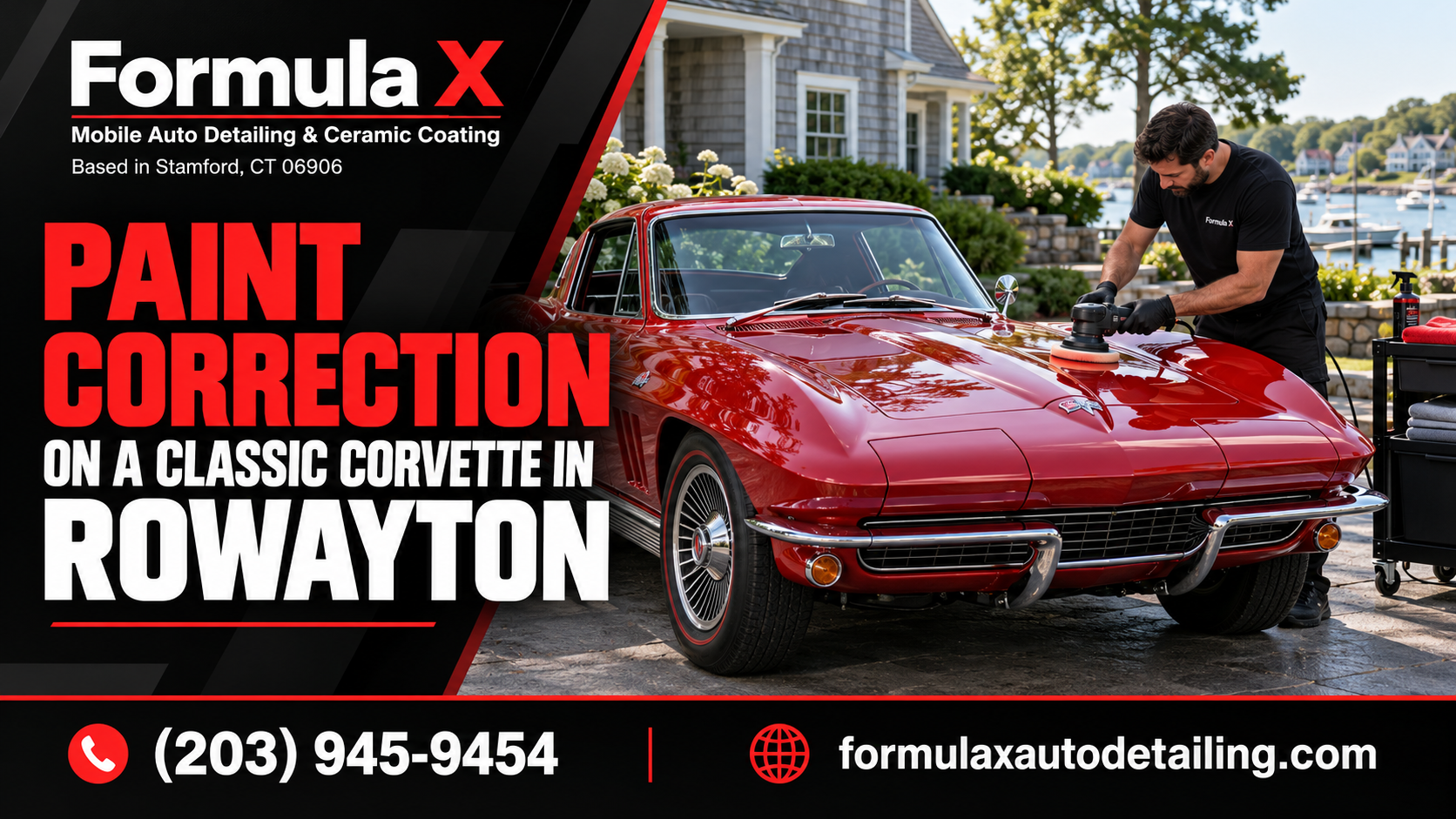
Formula X Mobile Auto Detailing & Ceramic Coating · Paint Correction Guide
Paint correction on a classic Corvette isn’t the same job as polishing a modern car. The body is fiberglass or sheet molding compound rather than steel, so the magnetic paint gauges most detailers carry can’t read it. Depending on its era and history, the paint may be original lacquer, a factory base coat and clear coat, or a repaint of any age, and original paint that’s polished away can’t be put back. If the car is judged, or might be one day, the National Corvette Restorers Society measures it against how it left the factory. This guide explains how Corvette bodies and paint changed by era, how paint thickness can actually be measured on fiberglass, where the risk of cutting through is highest, what NCRS judging means for correction decisions, and how storage near the water in Rowayton affects paint care. Formula X Mobile Auto Detailing & Ceramic Coating is based at 48 Union St, Stamford, CT 06906, and can be reached at (203) 945-9454.
Can a classic Corvette’s paint be corrected safely?
Often, yes, but only after the paint has been identified and its thickness understood, and with the least aggressive approach that gets an acceptable result. On a fiberglass Corvette, standard magnetic and eddy-current gauges don’t work; paint over fiberglass and plastic is measured with an ultrasonic gauge. Original lacquer, an old repaint, and a modern base-coat/clear-coat finish each behave differently under a polisher, and edges and body lines are where paint is thinnest and easiest to cut through. On an original-paint car, or one headed for NCRS judging, keeping original paint can matter more than removing every swirl.
This guide doesn’t describe a particular car. A classic Corvette’s year, paint, and history decide the right plan, and those are confirmed by looking at the car itself, its documentation, and its trim tag, not assumed.
Not a price list: Paint correction is quoted after an in-person look at the paint. Formula X’s paint correction page says results depend heavily on the paint’s condition and recommends a consultation first.
Why a Classic Corvette Is Different From a Modern Car
Quick answer: Four things set a classic Corvette apart: a composite body that common paint gauges can’t read, paint that may be original lacquer with no separate clear coat, a finish that may be decades old and irreplaceable, and an originality standard, set by NCRS, that values factory-correct appearance. Each one argues for measuring first and polishing less.
On a modern steel or aluminum car, a detailer can take paint readings with a handheld gauge in seconds, knows the car has a clear coat over the color, and can usually remove light defects with a known amount of margin. A classic Corvette removes most of those certainties.
Composite body
Corvette bodies have been fiberglass composites since 1953. Magnetic and eddy-current gauges need a metal substrate to work.
Paint system varies by era
St. Louis–built Corvettes were still painted in lacquer in 1981, while the new Bowling Green plant introduced a base-coat/clear-coat process.
History varies by car
A classic may wear original paint, a period repaint, or a modern refinish. Two cars of the same year can need completely different plans.
Originality has value
NCRS judges cars against how they left the factory, and its Bowtie award is reserved for unrestored cars.
Irreplaceable paint
Once original paint is polished through, the only fix is refinishing, and that panel is no longer original.
Steel underneath
The body doesn’t rust, but classic Corvettes still pair it with steel structure underneath, which matters for storage near salt air.
Fiberglass and SMC: What the Body Is Made Of
Quick answer: The first 1953 Corvettes had hand-laid fiberglass body panels over a steel chassis. According to a CompositesWorld history of the car, hand layup was replaced by liquid compression molding in 1968, and sheet molding compound (SMC) debuted on the Corvette in 1973, with later improvements in SMC carried into subsequent models. None of these materials respond to magnetic or eddy-current paint gauges.
CompositesWorld’s history of Corvette materials describes General Motors choosing hand-laid fiberglass composites for all the body panels of the original 1953 car to save tooling costs, with Molded Fiber Glass Co. making the bodywork and the first 300 cars built by hand in Flint, Michigan, over a rolling steel chassis. Production moved to St. Louis the next year and to Bowling Green, Kentucky, in 1981.
| Period | Body panel process (per CompositesWorld) | What it means for paint work |
|---|---|---|
| 1953 onward | Hand-laid fiberglass composite panels | Non-metal substrate; magnetic and eddy-current gauges can’t read paint thickness |
| 1968 onward | Liquid compression molding replaced hand layup; panels became lighter and thinner | Still a composite substrate |
| 1973 onward | Sheet molding compound (SMC) introduced, with later SMC improvements | Still a composite substrate |
Why the material matters during correction
- Measurement. A composite body needs an ultrasonic gauge to measure paint thickness, covered below.
- Heat. Composite panels and old paint both deserve care with friction heat from a machine polisher. Keeping the pad moving and the panel cool is good practice on any classic finish.
- Panel seams and bonding. Composite panels are joined and bonded rather than welded. Seams, edges, and bonding strips are places where paint can be thin or where old repairs show.
- Age-related defects. Old finishes can show cracking or other defects that come from the layers beneath the paint. Polishing doesn’t fix those, and aggressive polishing can make them worse.
Not everything is fiberglass. Bumpers, some trim, and certain parts are metal or other materials, and bumper covers on later cars are flexible. Treat each surface on its own terms.
Lacquer, Enamel, and Clear Coat: Paint by Era
Quick answer: Vette Magazine’s history of the 1981 model notes that Corvettes from the St. Louis plant were still painted in lacquer in 1981, while Bowling Green, which built its first Corvette on June 1, 1981, used a new base-coat/clear-coat process. For the exact factory finish on an earlier year, NCRS’s Technical Information Manual & Judging Guide for that year is the reference. Any given car today may also have been repainted since.
The changeover is captured in Vette Magazine’s profile of a 1981 St. Louis Corvette: 1981 was the only year the Corvette was built at two plants at once, job one at Bowling Green was built June 1, 1981, the last St. Louis car rolled out August 1, 1981, and while the St. Louis cars were still painted in lacquer, the Bowling Green cars were painted in the new base-coat/clear-coat process. The same article describes that era’s paint as deep and glossy on the fiberglass panels and a little flatter on the flexible front and rear fascias.
| Factory | Factory paint system | What polishing touches |
|---|---|---|
| St. Louis, up to its last cars in August 1981 | Lacquer at the end of production, per Vette Magazine; check NCRS’s guide for your year | On an unclear-coated lacquer finish, polishing removes colored paint itself |
| Bowling Green, from June 1981 | Base coat with clear coat | Polishing works in the clear coat; once it’s gone, the color coat is exposed |
| Any later repaint | Whatever the painter used: lacquer, single-stage urethane, or base/clear | Depends entirely on the repaint |
What single-stage paint means for correction
On a single-stage finish, color and gloss are in the same layer. When it’s polished, some color comes off on the pad, which is normal and also a reminder that each pass removes a little of the only paint layer the car has. On a base-coat/clear-coat finish, the polisher works in the clear layer, and the color underneath is untouched until the clear is gone.
Why the factory system isn’t the whole story
Many classic Corvettes have been repainted at least once, some in period-correct lacquer and some in modern urethane systems. NCRS itself gives repainting an original black Corvette with black lacquer as an example of restoration rather than counterfeiting. So the factory paint system tells you where to start; inspection tells you what’s actually on the car.
Identifying What Paint Is on Your Corvette
Quick answer: Start with the car’s documentation and history, then inspect: look for overspray, masking lines, and texture differences in jambs and under trim; do a careful test spot to see whether color transfers to the pad; and measure thickness with an ultrasonic gauge if one is available. Never assume a car is original just because it looks old.
- Gather history. Ownership records, restoration receipts, photos, and any NCRS judging sheets tell you whether the car has been repainted and with what.
- Check the trim tag and color. Whether the color matches the car’s documented original color is a first clue, not proof.
- Inspect jambs, edges, and under trim. Overspray, tape lines, and texture changes suggest a repaint.
- Compare panels. Differences in gloss, texture, or shade between panels can show partial repaints.
- Test spot. A small, gentle polishing test in an inconspicuous area shows whether color transfers, which points to single-stage paint.
- Measure. An ultrasonic gauge, used correctly, gives readings on fiberglass that a magnetic gauge can’t.
| Clue | Suggests | Caution |
|---|---|---|
| Color on the pad during a test spot | Single-stage paint (lacquer or single-stage urethane) | Every pass removes color; stay gentle |
| No color on the pad | A clear coat on top | Clear may be thin on an old or previously polished finish |
| Overspray or tape lines in jambs | Repaint | Repaint quality and thickness vary |
| Uneven gloss between panels | Partial repaint or prior heavy polishing | Measure before correcting |
| Cracking or crazing | Aged paint or problems beneath it | Polishing won’t fix it; may need refinishing |
Measuring Paint Thickness on Fiberglass
Quick answer: Paint gauge maker DeFelsko explains that magnetic gauges measure paint over steel, eddy-current gauges measure paint over aluminum and other metals, and paint over non-metal substrates such as plastic and fiberglass needs the ultrasonic technique. Its PosiTector 200 sends an ultrasonic pulse through the coating using a couplant such as water or gel and times the reflection. On a classic Corvette’s body panels, a standard magnetic or eddy-current gauge won’t give you a paint reading.
Most detailers own a magnetic or combination paint gauge, because most cars are steel and aluminum. DeFelsko’s guide to automotive paint inspection lays out the three measuring principles: magnetic gauges for paint over steel, eddy current for paint over aluminum and other non-ferrous metals, and ultrasonic for paint over non-metal substrates such as plastic and fiberglass. It notes that many magnetic instruments can’t determine paint thickness on anything other than steel.
| Gauge type | Works on | Classic Corvette body panels? |
|---|---|---|
| Magnetic (ferrous) | Paint over steel | No |
| Eddy current (non-ferrous) | Paint over aluminum and other conductive metals | No |
| Combination | Switches between steel and aluminum | No; still needs a metal substrate |
| Ultrasonic | Paint over plastic, fiberglass, and other non-metals | Yes, used correctly |
How an ultrasonic gauge works
The PosiTector 200 is DeFelsko’s ultrasonic coating thickness gauge. Its probe options include one described as ideal for polymer coatings on wood, plastic, and composites and another for thicker coatings on concrete and fiberglass. Its instruction manual explains that the probe emits a high-frequency sound pulse that travels into the coating through a couplant and reflects from any surface that differs in density; the gauge times the echo and uses the speed of sound in the coating to calculate thickness.
- Couplant is required. The manual says water works for smooth coatings, a supplied gel for rougher ones, and suggests testing couplant on a sample area first.
- Layers matter. Because the pulse reflects at density changes, primer, filler, and repaint layers affect what the gauge reports. DeFelsko says individual layers can be measured in some circumstances.
- Settings matter. The manual notes that one of the gauge’s modes is not recommended on composites and fiberglass. Readings are only as good as the operator’s setup.
- It’s a specialist tool. Ultrasonic gauges are less common than magnetic ones in detailing.
What to ask before correction
- Do you have an ultrasonic gauge that works on fiberglass?
- If not, how will you judge how much paint the car has? Without readings, the only safe plan is a very conservative one.
- Where will you take readings? Edges, body lines, and high points matter most.
- What readings would make you stop?
For the client to confirm: This guide doesn’t state whether Formula X uses an ultrasonic gauge. Ask when booking, and if not, ask how they will limit risk on a fiberglass car.
Reading the numbers sensibly
Even with a good ultrasonic gauge, numbers are a guide rather than proof of safety. Readings tell you the total thickness above the substrate at the spot measured, and sometimes individual layers; they don’t tell you how much of that is the original finish versus primer or a repaint unless the layers can be separated. The practical use is comparison: readings that are noticeably lower on one panel, edge, or crown than elsewhere are a signal to back off there, and readings that jump between panels help reveal past repaints before any polishing starts.
DeFelsko also points out that consistent thickness across a panel is normal and that significant differences between adjacent panels strongly suggest repainting, which is useful when you’re trying to learn a classic car’s history.
The Risk of Cutting Through Original Paint
Quick answer: Every polishing step removes a little paint. Edges, body lines, peaks, and areas that have been polished before have the least paint to spare. On original lacquer, there may be no clear coat to work in, and on any old finish the margin may already have been used up. Cutting through means refinishing that area, and on an original-paint Corvette, that originality is gone for good.
Paint correction works by leveling the surface around a defect until the defect disappears. That’s why it works, and why it carries risk: the paint removed doesn’t come back.
Edges and body lines
Why it’s risky. Paint tends to be thinner on sharp edges and crowns, and a machine pad concentrates pressure there.
Safer approach. Tape off edges and body lines, work them by hand or with a small pad, or leave them alone.
Previously polished panels
Why it’s risky. Decades of waxing and polishing may already have thinned the paint, invisibly.
Safer approach. Measure where possible, and start with the gentlest combination.
Single-stage lacquer
Why it’s risky. There’s no separate clear layer; you’re polishing the color.
Safer approach. Fine polishes, low aggression, frequent checks, and accepting that some defects stay.
Deep scratches
Why it’s risky. Chasing a scratch that goes deeper than the available paint thins everything around it.
Safer approach. Reduce its appearance rather than remove it, or consider touch-up. See car scratch repair.
Heat
Why it’s risky. Friction heat builds quickly when a pad stays in one place, especially on edges.
Safer approach. Keep the machine moving, use moderate speeds, and check panel temperature by hand.
Wet sanding
Why it’s risky. Sanding removes far more paint than polishing.
Safer approach. On original paint, avoid it unless the owner understands and accepts the trade-off, and only with reliable measurements.
The honest trade-off: On an original classic finish, the right result is often a big improvement in gloss and clarity with some deeper marks left in place. Chasing perfection on irreplaceable paint is how cars end up needing a respray.
What Correction Can and Can’t Fix on Old Paint
Quick answer: Polishing can reduce or remove surface defects that sit within the paint: swirls, light scratches, haze, light oxidation, and some water spot etching. It can’t fix problems that come from below the surface, such as cracking, crazing, lifting, or flaws in the body or filler, and it can’t restore paint that has already worn through. Knowing which is which before starting avoids wasting paint on defects polishing will never remove.
Old finishes collect a mix of defects over decades. Some live in the top of the paint and respond to polishing. Others are structural, and polishing either does nothing or makes them worse by thinning the paint around them.
| Defect | Where it lives | Can polishing help? |
|---|---|---|
| Swirls and wash marring | Top of the paint or clear | Usually, with a gentle approach |
| Light oxidation or haze | Top of the paint, common on old single-stage finishes | Often, though it removes some color |
| Light scratches | Within the paint | Often reduced; sometimes removed |
| Deep scratches | Through most or all of the paint | Reduced at best; may need touch-up |
| Water spot etching | Etched into the surface | Light etching often; deep etching not safely |
| Cracking or crazing | Through the paint, sometimes from beneath | No; may need refinishing |
| Stress cracks, ripples, or seam lines | In the body, filler, or bonding | No; a body issue, not a paint-polishing issue |
| Worn-through edges | Paint already gone | No; needs touch-up or refinishing |
Why this matters more on a classic
- Every pass costs paint. Spending it on a defect that can’t be fixed leaves less for the ones that can.
- Some defects are part of the car’s story. On an unrestored car, honest age may be worth more than a perfect surface.
- Body issues need the right specialist. Cracks, ripples, and seam problems in composite bodies are body and paint shop work.
- Expectations should be set up front. A good detailer will tell you before starting which defects are likely to stay.
For deeper marks, Formula X’s car scratch repair page covers options short of a respray, and scratch repair examples show the kind of results posted publicly.
NCRS Judging and Why Originality Changes the Plan
Quick answer: NCRS Flight judging scores a Corvette on originality and condition, with originality considered as the car left the factory, and NCRS says an original car in less than top condition can score as well as or better than a restored one. Its Star and Bowtie awards are only for unrestored cars, and are meant to encourage owners to keep the car in its present condition. If your Corvette has original paint, especially if it’s a Bowtie candidate, talk to experienced NCRS members before any correction.
The National Corvette Restorers Society’s judging page describes a system built around how each car left the factory. The points most relevant to paint correction:
- Flight awards are based on originality and condition. Restored and original cars both compete, and NCRS says an original car in less than top condition can score as well as or better than a restored car, depending on its originality.
- Top Flight requires 94% or more of 4,500 available points across operations, exterior, interior, mechanical, and chassis judging.
- Cleanliness is a small part. NCRS says less than 2% of the raw score relates to cleanliness and that judges expect the car to be “dealer preparation for delivery clean,” no more.
- Star and Bowtie awards are earned only at National Conventions by unrestored cars judged and voted historically and educationally significant, and are intended to encourage owners to keep the car in its present condition.
- Restoration isn’t counterfeiting. NCRS gives repainting an original black Corvette with black lacquer as an example of restoration.
- The reference manuals. NCRS publishes a Judging Reference Manual and a Corvette Technical Information Manual & Judging Guide for each year, and recommends owners use the score sheets to pre-judge their cars.
What that means for correction decisions
| Your car | What matters most | Sensible correction approach |
|---|---|---|
| Unrestored, original paint, possible Bowtie candidate | Preserving original finish | Talk to NCRS members first; cleaning and the gentlest polishing only, if any |
| Original paint, driven and enjoyed | Keeping original paint for the long term | Measured, conservative polishing; leave deeper marks |
| Restored to factory-correct standard | Factory-like appearance | Correction to suit; ask what finish the restorer intended |
| Modern repaint, not judged | Appearance and protection | Normal correction with measurement, then protection |
Not NCRS guidance: This guide doesn’t speak for NCRS or predict how judges will score any car. The judging page and NCRS’s own manuals and judges are the authority. If judging matters to you, ask before correcting.
A Careful Correction Approach for a Classic Corvette
Quick answer: Wash gently, decontaminate carefully, inspect under good light, identify the paint, measure where possible, run a test spot with the least aggressive combination, protect edges and trim, then correct panel by panel with frequent checks, stopping when the result is good enough rather than perfect. Formula X’s paint correction page describes single-stage correction for light haze and swirls and multi-stage correction for heavier defects.
- Conversation first. Is the paint original? Is the car judged? What result does the owner want, and what risk is acceptable?
- Gentle wash. Soft mitts, clean water, no aggressive chemicals on old paint and trim.
- Careful decontamination. Light clay or a gentle alternative only where needed.
- Inspection. Strong, varied lighting to separate swirls, scratches, etching, and age-related defects that polishing can’t fix.
- Identify and measure. Test spot for color transfer; ultrasonic readings if available.
- Mask. Edges, body lines, emblems, rubber, chrome, and stainless.
- Least aggressive first. Step up only if the gentler combination doesn’t work.
- Panel by panel. Check progress and heat often; wipe residue to see the true finish.
- Know when to stop. Leave deeper marks rather than thin original paint.
- Protect. A suitable wax, sealant, or coating, chosen with judging and originality in mind.
Single-stage or multi-stage?
Formula X’s paint correction page describes a single-stage correction for light haze and light swirling on paint that isn’t heavily damaged, and a multi-stage correction for heavier scratching and swirling, using a more aggressive step followed by a finer polish. On a classic Corvette, which one fits depends on what the paint is and how much of it there is; on original single-stage lacquer, a gentle single stage is often the most that’s sensible.
The G-Wagon paint correction guide explains correction stages in more depth on a modern car, which makes a useful comparison.
The Test Spot: Where Every Classic Correction Should Start
Quick answer: A test spot is a small area, ideally on a flat, inconspicuous panel away from edges, where the detailer tries the gentlest pad and polish combination first and checks the result under good light. It shows whether the paint is single-stage, how it responds, how much improvement is realistic, and whether a more aggressive step is needed at all.
On a modern car, a test spot mostly dials in the right combination. On a classic Corvette, it also answers more basic questions about what’s actually on the car and how it will behave.
- Pick the spot. A flat area away from edges and body lines, ideally somewhere less visible.
- Start gentle. A soft finishing pad and a fine polish, with light pressure.
- Watch the pad. Color on the pad points to single-stage paint.
- Wipe and inspect. Remove polish residue and look under strong, varied light.
- Decide. If the result is good, use that combination. Step up only if needed, one change at a time.
- Re-measure if possible. Compare readings before and after on an ultrasonic gauge.
- Show the owner. Agree on the result before the rest of the car is done.
A test spot also protects the owner. It turns an abstract promise into something you can see and approve before the bulk of the work begins.
Thinking About Correcting Your Corvette’s Paint?
Send Formula X Mobile Auto Detailing & Ceramic Coating what you know about your Corvette’s history, whether the paint is original or repainted, whether it’s judged or might be, where it’s kept in Rowayton, and a few photos of the paint in good light. The team can explain what an inspection would look at and what a conservative plan might involve.
Chrome, Stainless, Emblems, and Rubber
Quick answer: Classic Corvettes carry a lot of bright trim, emblems, and rubber that polish residue, pad contact, and heat can stain or damage, and some of it may be original and hard to replace. Mask it before machine work, clean residue off promptly, and treat original trim as carefully as original paint.
Depending on the year, a classic Corvette may have chrome bumpers, stainless trim, emblems, badges, and rubber seals right beside the paint. Polishing compound dries white in crevices and on rubber, and a spinning pad can catch an emblem edge.
| Part | Risk during correction | Precaution |
|---|---|---|
| Chrome bumpers and trim | Scratches from pad edges; residue in seams | Mask; clean chrome separately with a suitable product |
| Stainless trim | Residue buildup; edge contact | Mask edges; hand-work nearby paint |
| Emblems and badges | Pad catching edges; residue around lettering | Tape around; detail by hand |
| Rubber seals and weatherstrip | White staining; drying chemicals | Mask; avoid harsh solvents |
| Glass and lenses | Overspray and compound splatter | Cover nearby; clean promptly |
If your car is original, ask the detailer to treat original trim and markings with the same caution as the paint. Some originality points concern exactly these small details.
Protecting the Paint After Correction
Quick answer: After correction, the paint needs protection: a wax or sealant that can be reapplied easily, or a ceramic coating for longer-term ease of washing. On a judged or original car, choose with judging in mind and ask NCRS members first if it matters to you. Formula X offers Ceramic Pro coatings, with warranty periods printed on its package cards, quoted after inspection.
| Protection | Strengths | Trade-offs on a classic Corvette |
|---|---|---|
| Wax | Easy to apply and remove; traditional look | Needs frequent reapplication |
| Sealant | Longer-lasting than wax; still easy to strip | Still needs reapplication |
| Ceramic coating | Slick, water-shedding, easier washing | More permanent; needs careful prep; a choice to weigh on an original or judged car |
Ceramic Pro packages, if you choose a coating
Formula X’s Ceramic Pro cards list Gold, described as “perfect for new vehicles and long term ownership” with a 7-year warranty; Silver, “ideal for short term ownership” with a 5-year warranty; and Bronze, “best for leased vehicles” with a 2-year warranty. All start with a gentle hand wash, iron decontamination, and a light clay bar. Ask what the warranty covers and what it requires, and remember that “9H” is a hardness rating used in coating marketing, not a scratch-proof promise. See ceramic coatings and Ceramic Pro in Stamford.
Maintaining corrected paint
Correction only pays off if the paint isn’t re-marred at the next wash. Use clean, soft wash mitts and plenty of lubrication, rinse grit off before touching the paint, dry with soft microfiber rather than old towels or a chamois dragged across dust, and keep automated car washes out of the picture. Formula X’s paint correction page names automated washes and improper washing as leading causes of swirls, which is exactly what correction just removed.
The Porsche Cayenne ceramic coating guide and the Rivian R1S ceramic coating guide explain coating prep and aftercare in more detail.
Storage and Rowayton’s Coastal Air
Quick answer: Rowayton sits on Long Island Sound at the mouth of the Five Mile River, so moist, salty air is part of life there. Hagerty recommends a dry, temperature-stable garage, notes that dehumidifiers help keep gaskets, seals, vinyl, and rubber in better shape, and warns that stale, damp air can contribute to mildew and rot. A fiberglass body won’t rust, but the steel underneath can.
Many classic Corvettes spend more time parked than driven, so where and how they’re stored affects the paint and everything around it. Hagerty’s guide to classic car storage recommends a structure with stable temperature that stays warm in winter and cool in summer, says keeping the car dry is important, that secure garage doors help keep condensation down, that dehumidifiers help protect gaskets, seals, vinyl, and rubber, and that moving air matters because stale damp air can contribute to mildew and rot.
Why the shoreline matters
DeFelsko notes that vehicles from coastal climates that receive ocean spray are more likely to rust around the hood, trunk, and upper areas of fenders and doors, especially near molding, handles, and emblems. A classic Corvette’s composite body panels don’t rust, but, as CompositesWorld notes of the original car, the body sits on steel, and brackets, fasteners, chrome, and other metal parts can corrode in damp, salty air.
Storage habits that protect corrected paint
- Store it clean and dry. Dirt and moisture trapped under a cover sit against the paint.
- Use a breathable indoor cover, not a plastic tarp that can trap condensation.
- Control humidity in the garage where you can, and keep air moving.
- Rinse after salty or coastal drives before storing, gently.
- Check the car periodically for spots, droppings, or moisture under the cover.
A simple seasonal routine
| Season | What to watch for | Paint-friendly care |
|---|---|---|
| Spring | Pollen, condensation after storage, droppings | Gentle wash before the first drive; inspect under the cover |
| Summer | Sun, heat, sap, salt air on drives along the water | Shade when parked; prompt removal of droppings and sap |
| Fall | Leaves, damp mornings | Wash and protect before storage |
| Winter | Road salt, humidity in the garage | Keep it stored dry; wash gently after any salted-road drive |
Winter salt
A 2014 report from the Connecticut General Assembly’s Office of Legislative Research describes the state DOT pre-wetting road salt with corrosive magnesium chloride and recommending washing after storms, including the undercarriage. Many classic owners keep their cars off treated roads in winter for exactly that reason. If yours does go out, wash it, gently, before it goes back into storage.
Paint Correction at Your Home in Rowayton
Quick answer: Paint correction needs good light, shade or cover, a dry surface, steady power, and time. A home garage is ideal for a classic Corvette; a shaded driveway on a calm, dry day can also work. Formula X’s Rowayton page says the team schedules mobile appointments when driveway or lot space allows safe work. Confirm the space, light, and power plan before booking.
Formula X’s Rowayton car detailing page describes mobile service at Rowayton homes, driveways, and workplaces from its Stamford base. For a correction job on a classic, the location matters more than for a wash.
| Need | Why | What to confirm |
|---|---|---|
| Shade or cover | Products work poorly on hot panels; sun hides defects | Garage, carport, or shaded spot |
| Good light | Defects and color transfer need to be seen clearly | What lighting the detailer brings |
| Dry, calm weather | Wind blows dust and pollen into the work | A weather plan |
| Steady power | Polishers and lights | How equipment will be powered at your location |
| Time | Careful correction is slow | How long the car needs to stay put |
If the car is garaged in a condo or shared building, the same permission and power questions apply as in the Harbor Point apartment detailing guide. Rowayton is part of Norwalk; Formula X’s Norwalk mobile detailing page covers the wider city.
Formula X Services and Packages for a Classic Corvette
Quick answer: Paint correction is quoted after an in-person look at the paint. For regular care before or after correction, Formula X’s published detailing packages are Gold (interior and exterior) from $495+, Silver (interior and exterior) from $395+, Bronze Interior from $295+, and Bronze Exterior from $295+, with extra charges noted for scratches, heavy soil, tree sap, hard water spots, and pet hair.
| Service | Price basis | Classic Corvette notes |
|---|---|---|
| Paint correction | Quoted after inspection | Plan depends on paint type, thickness, originality, and goals |
| Ceramic Pro coating | Quoted after inspection | Optional; weigh originality and judging plans |
| Gold (interior + exterior) | $495+ | Card includes a clay bar and ceramic sealer; ask how products suit old paint and trim |
| Silver (interior + exterior) | $395+ | Card includes a hand wash and wax |
| Bronze Interior | $295+ | Ask how vintage interior materials will be treated |
| Bronze Exterior | $295+ | Card includes a hand wash, clay bar, and ceramic sealer |
Prices are not quotes. These are Formula X’s published starting prices, subject to change depending on the size and condition of the vehicle. Paint correction and coatings are quoted after the car has been seen.
Related services: exterior detailing, interior detailing, scratch repair examples, and scratch repair in Stamford.
Classic Corvette Owner Checklist
Quick answer: Before: gather the car’s history, decide how much originality matters, and ask about measurement. During: insist on a test spot, masking, and check-ins. After: protect the paint, store it dry, and keep notes for the car’s records.
Before booking
- Collect restoration records, repaint history, and any NCRS judging sheets.
- Decide whether the car is, or may become, a judged or Bowtie candidate.
- Photograph the paint in good light, including the defects that bother you most.
- Ask whether an ultrasonic gauge will be used, and if not, how risk will be limited.
- Agree on the goal: enhancement, moderate correction, or as much as the paint safely allows.
On the day
- Ask to see the test spot result before the full job.
- Confirm edges, body lines, emblems, rubber, and chrome are protected.
- Ask for a check-in if something unexpected appears, such as cracking, prior repairs, or thin areas.
Afterward
- Note what was done and which products were used, for the car’s records.
- Apply or maintain protection as agreed.
- Store the car clean, dry, and covered with a breathable cover.
How to Choose Who Corrects Your Classic Corvette
Quick answer: Choose someone who asks about the car’s history and your originality goals before talking about results, knows that magnetic gauges don’t read fiberglass, insists on a test spot, protects edges and trim, and is willing to stop short of perfect to preserve paint.
Questions to ask
- How will you tell whether my paint is original lacquer, base/clear, or a repaint?
- How will you measure paint thickness on a fiberglass body?
- Where will you start, and what would make you stop?
- How will you protect edges, body lines, emblems, and trim?
- Have you worked on judged or original-paint cars? Ask what you can see of that work.
- Can I see examples? Formula X posts work in its gallery.
Red flags
- Using a magnetic gauge on fiberglass panels and trusting the readings.
- Promising every scratch will disappear.
- Starting with heavy compounding or wet sanding on unknown paint.
- No questions about originality or judging.
- Skipping the test spot.
Read more about Formula X or see its service areas.
Classic Corvette Paint Myths
Quick answer: A paint gauge doesn’t work on every car, shinier isn’t always better for an original car, old lacquer isn’t the same as clear coat, and a fiberglass car still has metal to protect.
“Any paint gauge will tell you how much paint is left.”
Magnetic and eddy-current gauges need a metal substrate. On fiberglass, DeFelsko says paint thickness is measured ultrasonically.
“Perfect paint always scores better.”
NCRS judges originality as the car left the factory and says an original car in less than top condition can score as well as or better than a restored one.
“Color on the pad means the paint is being ruined.”
On single-stage paint, some color transfer is expected. It’s a reason to stay gentle, not proof of damage.
“Fiberglass cars don’t need to worry about rust.”
The body doesn’t rust, but the steel and metal parts around it can, especially in damp, salty air.
“Every classic Corvette has original paint.”
Many have been repainted. History and inspection decide, not the car’s age.
Formula X Mobile Auto Detailing & Ceramic Coating
Formula X Mobile Auto Detailing & Ceramic Coating is a mobile detailing, paint correction, scratch repair, and ceramic coating service based at 48 Union St, Stamford, CT 06906. The team works in Rowayton and across Norwalk, Stamford, Darien, Greenwich, New Canaan, Westport, and other towns in lower Fairfield County, plus Westchester County, NY.
For a classic Corvette, that means starting with the car’s history and your originality goals, identifying the paint before any polishing, planning the least aggressive correction that meets those goals, and quoting the work after the paint has been seen.
Call (203) 945-9454, email formulaxautodetail@gmail.com, send a request through the contact page, or view Formula X Mobile Auto Detailing & Ceramic Coating on Google Maps. Address: 48 Union St, Stamford, CT 06906.
Frequently Asked Questions About Classic Corvette Paint Correction
Can a classic Corvette's paint be corrected safely?
Often, yes, if the paint is identified first, its thickness is understood as well as possible, and the least aggressive approach is used. Edges and body lines carry the most risk, and on original paint it's often better to leave deeper marks than to thin the only paint the car has.
Why can't a normal paint gauge read a Corvette body?
Most detailers' gauges are magnetic or eddy-current types, which need a steel or aluminum substrate. Corvette bodies are fiberglass or sheet molding compound. DeFelsko, a gauge maker, explains that paint over plastic and fiberglass is measured with the ultrasonic technique instead.
How is paint thickness measured on fiberglass?
With an ultrasonic coating thickness gauge such as DeFelsko's PosiTector 200. A couplant such as water or gel carries a sound pulse into the paint, and the gauge times the echo from the layer beneath. Layers such as primer and repaints affect readings, so setup and interpretation matter.
Did classic Corvettes come with clear coat?
According to Vette Magazine's history of the 1981 model, St. Louis-built Corvettes were still painted in lacquer in 1981, while the new Bowling Green plant used a base-coat/clear-coat process. For an earlier year, NCRS's Technical Information Manual & Judging Guide describes the factory finish. Any car may also have been repainted since.
How can I tell if my Corvette has single-stage paint?
A careful test spot is the usual way: if color transfers to the polishing pad, the finish is single-stage, meaning color and gloss are in one layer. History, overspray in jambs, and thickness readings help confirm whether the paint is original or a repaint.
What happens if paint correction cuts through original paint?
The area has to be refinished, and on an original-paint Corvette that panel is no longer original. Edges, body lines, and previously polished areas are the most vulnerable, which is why masking, test spots, and conservative polishing matter.
Does NCRS judging care about paint originality?
NCRS Flight judging scores originality and condition, with originality considered as the car left the factory. NCRS says an original car in less than top condition can score as well as or better than a restored car. If judging matters to you, talk to experienced NCRS members before correcting original paint.
What is the NCRS Bowtie award?
NCRS Star and Bowtie awards are earned only at National Conventions by unrestored Corvettes judged and voted historically and educationally significant. NCRS says the award is intended to encourage owners to keep the car in its present condition.
Should I wet sand my classic Corvette's paint?
Wet sanding removes far more paint than polishing. On original or unknown paint, it's a decision to make only with reliable thickness measurements and a clear understanding of the trade-off, and many owners of original cars choose not to.
Should I ceramic coat a classic Corvette after correction?
It's optional. A coating makes washing easier, while wax or sealant is easier to reapply and remove. On an original or judged car, weigh originality and ask NCRS members first if judging matters. Formula X's Ceramic Pro coatings are quoted after inspection.
How should I store a classic Corvette near the water in Rowayton?
Hagerty recommends a dry, temperature-stable garage, notes that dehumidifiers help protect gaskets, seals, vinyl, and rubber, and warns that stale damp air can contribute to mildew and rot. Store the car clean and dry, and rinse it gently after salty drives.
Can paint correction be done at my home in Rowayton?
Formula X's Rowayton page describes mobile appointments at homes and driveways when there is space to work safely. Correction needs shade or cover, good light, dry weather, power, and time, so a garage is ideal. Confirm the setup with Formula X when booking.
How much does classic Corvette paint correction cost?
Paint correction is quoted after the paint has been seen, because the plan depends on paint type, thickness, condition, and your originality goals. Formula X's published detailing packages start at Gold $495+, Silver $395+, and Bronze Interior or Exterior $295+, with extra charges for scratches and other conditions.
Where is Formula X Mobile Auto Detailing & Ceramic Coating located?
Formula X Mobile Auto Detailing & Ceramic Coating is located at 48 Union St, Stamford, CT 06906. It is a mobile service that travels to customers in Rowayton, Norwalk, Stamford, lower Fairfield County, and Westchester County, NY. Call (203) 945-9454 or open the Google Maps listing for directions.
Find Formula X Mobile Auto Detailing & Ceramic Coating
Formula X Mobile Auto Detailing & Ceramic Coating is a mobile service based at 48 Union St, Stamford, CT 06906. Use the map for directions to the business address, or call (203) 945-9454 to arrange service at your location.
View Formula X Mobile Auto Detailing & Ceramic Coating on Google Maps
Talk Through a Paint Plan for Your Classic Corvette
Call Formula X Mobile Auto Detailing & Ceramic Coating at (203) 945-9454 or send a request with what you know about your Corvette’s history, whether the paint is original or repainted, whether it’s judged, where it’s kept in Rowayton, and photos of the paint. The paint is inspected before any correction is quoted, and the plan is matched to the paint and to how much originality matters to you.
48 Union St, Stamford, CT 06906 · Serving Stamford, Greenwich, lower Fairfield County, and Westchester County, NY