
Formula X Mobile Auto Detailing & Ceramic Coating · Pet Hair Removal Guide
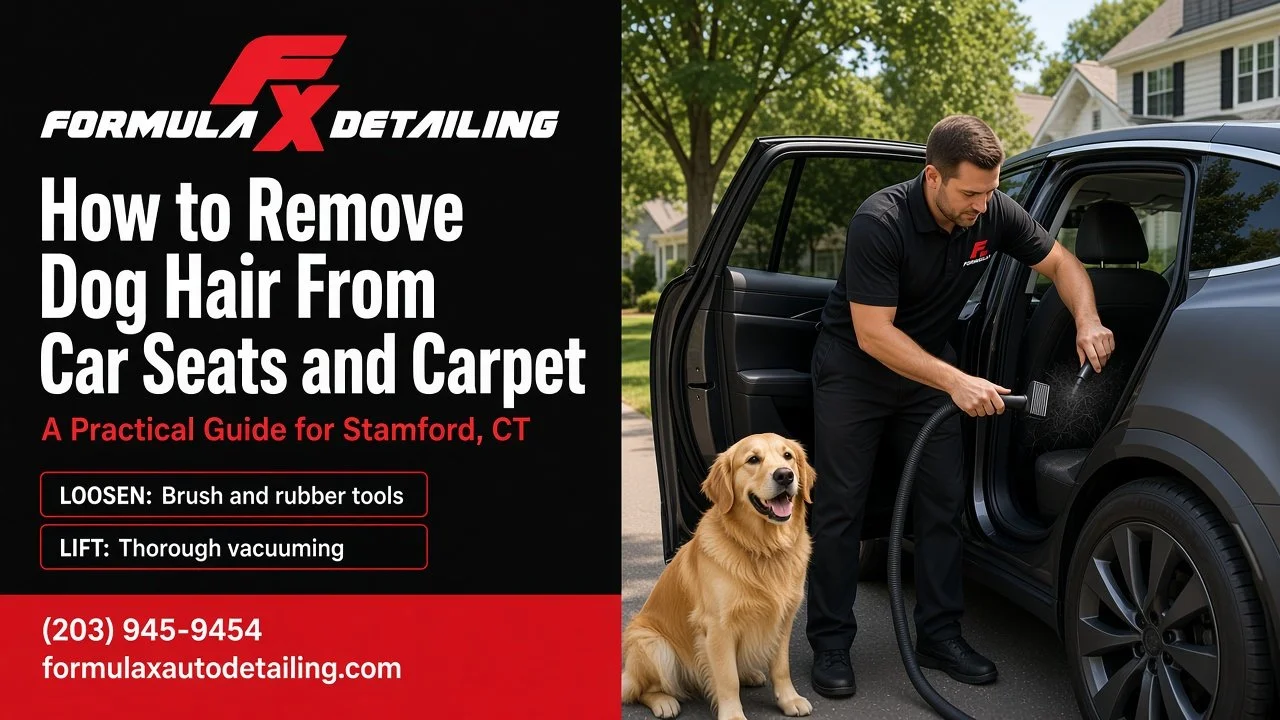
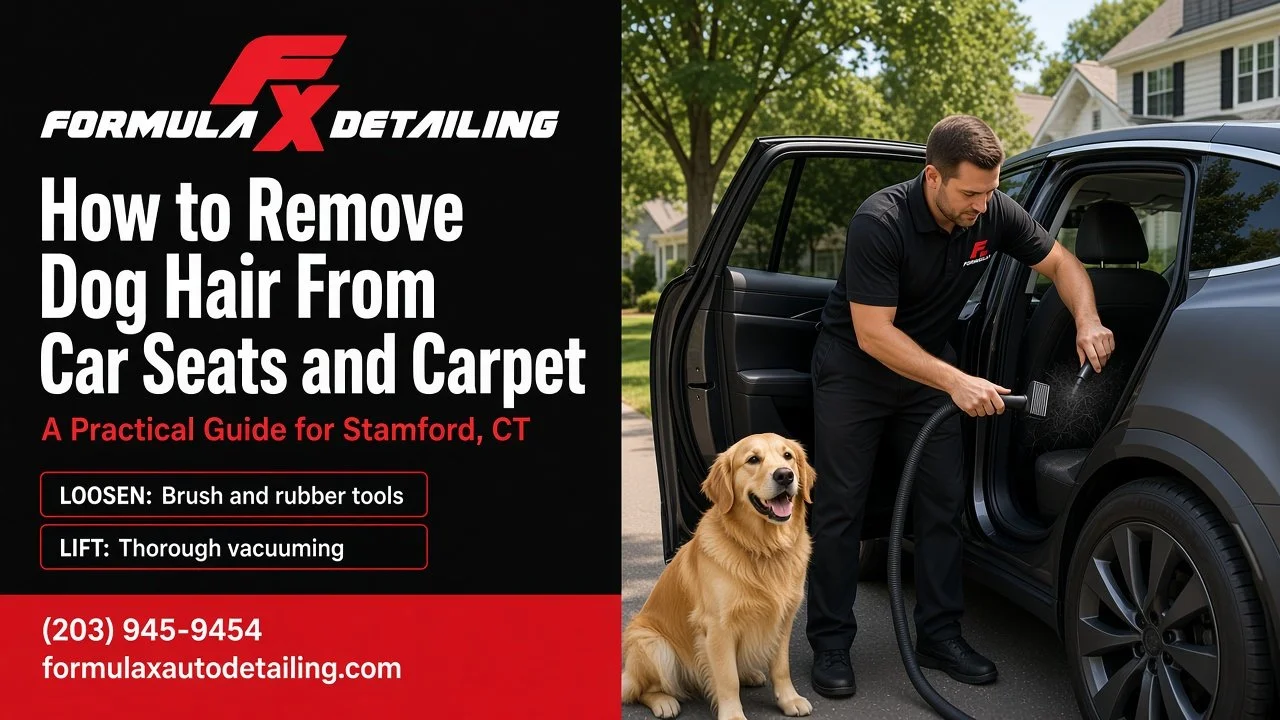
Dog hair is the reason a lot of otherwise clean cars never feel clean. You vacuum the seats, and an hour later there's still a gray haze in the carpet and a line of hair stuck in every seam. That's not bad vacuuming. Dog hair, especially the short, stiff hair of many breeds, weaves itself into carpet and fabric fibers and clings with static, so suction alone pulls only the loose layer off the top. Getting it out takes loosening first and vacuuming second, the right tool for each surface, and patience in seams and corners. This guide covers why dog hair sticks, the tools that work and the ones that don't, a step-by-step method for cloth seats, leather, carpet, and cargo areas, how to deal with odor and drool, how to keep hair from coming back, and what a professional pet hair removal involves. Formula X Mobile Auto Detailing & Ceramic Coating is based at 48 Union St, Stamford, CT 06906, and can be reached at (203) 945-9454.
How do you remove dog hair from car seats and carpet?
Loosen the hair first, then vacuum it. Take out the mats and shake them, then brush seats and carpet in one direction with a rubber pet-hair brush, rubber glove, or pumice-style pet-hair stone to pull embedded hair into clumps. Vacuum with a strong vacuum and a narrow crevice tool for seams, working in short, overlapping passes. Repeat loosen-and-vacuum until no more hair comes up. Use gentler tools on leather and delicate fabrics, finish with a lint roller on upholstery, and use seat covers or a cargo liner to keep it from coming back. Heavy, embedded hair in carpet usually needs professional tools and time.
For the service itself, see Formula X's mobile detailing page. For other interior problems, see how to get smoke smell out of a car for good and interior deep clean on a Honda Odyssey.
Where the details come from: Pet travel safety guidance comes from the American Veterinary Medical Association. Odor-treatment cautions come from the EPA. Lease wear guidance comes from Toyota Financial Services. The rest is general detailing practice. Only Formula X's published package prices appear here; the package cards note an extra charge for pet hair, which is confirmed after the car has been seen.
Why Dog Hair Sticks So Badly
Quick answer: Dog hair sticks because short, stiff hairs work their way into the weave of carpet and fabric like tiny needles, and static holds lighter undercoat hair to surfaces. A vacuum pulls air across the top, but it can't easily pull hair that's woven in. That's why loosening comes first.
Not all dog hair behaves the same. Short, coarse coats, common in many short-haired breeds, tend to be the hardest to remove, because each hair is stiff and pointed and drives into fabric. Long, fine coats tend to sit on top and clump, which makes them easier to vacuum but more visible. Double-coated breeds shed a soft undercoat that clings with static and builds up into mats in carpet.
Car carpet is especially good at trapping hair. It's a dense, looped or cut pile, and every time someone steps on it, hair gets pushed deeper. Seat fabric does the same thing on a smaller scale, and seams and stitching lines act as hair traps.
Static makes it worse in dry winter air. Hair clings to fabric, plastics, and even glass, and it jumps back onto surfaces you just cleaned.
| Coat type | How it behaves | Hardest surface |
|---|---|---|
| Short, coarse | Weaves into fibers like needles | Carpet and fabric seats |
| Long, fine | Sits on top, clumps, very visible | Seat seams and fabric |
| Double coat (undercoat) | Soft fluff that mats and clings with static | Carpet and cargo areas |
| Wiry | Moderate; catches in loops | Looped carpet |
The Tools That Actually Work
Quick answer: The most useful tools are a strong vacuum with a crevice tool and a small brush head, a rubber pet-hair brush or rubber gloves, a pet-hair stone for carpet, a stiff carpet brush, and lint rollers for finishing. Each one works on a different surface, and using them in the right order is what gets results.
| Tool | Best for | Notes |
|---|---|---|
| Strong vacuum + crevice tool | Seams, rails, edges | Suction matters; a weak vacuum just moves hair |
| Rubber pet-hair brush | Fabric seats and carpet | Pulls hair into clumps; gentle on most fabrics |
| Damp rubber glove | Seats, seams, door panels | Cheap and effective; wipe in one direction |
| Pet-hair stone (pumice-style) | Durable carpet and cargo liners | Very effective on carpet; too aggressive for seats and delicate fabric |
| Stiff carpet brush | Carpet and mats | Loosens embedded hair before vacuuming |
| Lint roller | Final pass on upholstery | Good finishing tool; slow for large areas |
| Compressed air | Vents, crevices, under seats | Blows hair out of tight spots for vacuuming |
The order is the point. Brush or rubber tools pull hair out of the fibers into piles, the vacuum removes the piles, and the lint roller catches what's left on upholstery. Vacuuming first, without loosening, wastes most of the effort.
Test aggressive tools first. Pet-hair stones and stiff brushes can fuzz, pill, or snag some fabrics and soft carpet. Test in a hidden spot, use light pressure, and keep them off seats, headliners, and delicate materials.
A Step-by-Step Method
Quick answer: Remove mats and loose items, shake and brush the mats outside, dry-vacuum the cabin to remove loose hair, loosen embedded hair with rubber or brush tools in one direction, vacuum again with a crevice tool, repeat until clear, then finish upholstery with a lint roller.
- Empty the car. Take out mats, dog beds, blankets, toys, and anything else loose.
- Mats outside. Shake and beat the mats, brush them firmly, then vacuum them on a clean surface.
- First vacuum. Vacuum seats and carpet to remove the loose top layer of hair.
- Loosen. Work seats with a rubber brush or damp rubber glove, and carpet with a rubber brush or pet-hair stone, in short strokes in one direction so hair gathers into lines and clumps.
- Vacuum the clumps. Use a crevice tool along seams and edges and a brush head on open areas.
- Repeat. Loosen and vacuum again until the tool pulls up little or nothing.
- Seams and rails. Push seams open with your fingers or a soft brush and vacuum along them; vacuum seat rails and under the seats.
- Finish. Use a lint roller on upholstery and wipe hard surfaces with a damp microfiber towel to catch clinging hair.
Work from the top down: headrests and seatbacks first, then seat cushions, then carpet. Hair falls as you work, and you only want to vacuum the floor once at the end.
Cloth Seats
Quick answer: Cloth seats respond well to rubber tools: a rubber pet-hair brush or damp rubber glove pulls embedded hair into clumps that vacuum up easily. Work seams separately with a crevice tool, and finish with a lint roller. Avoid pet-hair stones on seat fabric, which can fuzz it.
Seat fabric is usually woven, and hair works into the weave and gathers in the seams between panels. A rubber brush or a slightly damp rubber glove dragged across the fabric in one direction creates friction that pulls hair out and rolls it into lines. Vacuum the lines up, then go again in the other direction to catch what the first pass missed.
Seams need special attention. Push the seam open gently and run a crevice tool along it. Hair often collects where the seat back meets the cushion; pressing down on the cushion while vacuuming the gap helps.
After the hair is out, cloth seats can be shampooed or extracted to remove dander, oils, and odor, which hair removal alone doesn't address. That's covered in the odor section.
Leather and Vinyl Seats
Quick answer: Leather and vinyl don't trap hair in the surface, so a vacuum with a soft brush head and a damp microfiber towel usually clear it. The hair hides in seams, perforations, and stitching. Avoid stiff brushes and pet-hair stones on leather, and clean and condition it afterward to remove oils and claw marks where possible.
Leather is the easiest seat surface for hair, because hair sits on top. A soft brush attachment on the vacuum and a damp microfiber towel wiped in one direction pick it up. Seams, piping, and perforations are where it collects, so a crevice tool along the seams and a soft detailing brush on perforated sections help.
Dogs are harder on leather in other ways. Claws leave scratches, drool and nose prints leave marks, and body oils darken the surface over time. Cleaning with a proper leather cleaner removes oils and grime, and conditioning keeps it supple. Light surface scuffs sometimes improve with cleaning and conditioning; deeper scratches through the finish usually need leather repair.
Perforated leather needs a light touch. Don't push liquid into the holes, and don't press hard with brushes. If the seats are heated or ventilated, keep moisture to a minimum.
Carpet and Floor Mats
Quick answer: Carpet holds more dog hair than any other surface. Loosen it with a stiff carpet brush, a rubber brush, or a pet-hair stone, working in one direction, then vacuum in overlapping passes. Repeat several times. Mats come out and are treated the same way outside the car.
Automotive carpet is dense and tough, which is why it traps hair and also why it can take firmer tools than seats. A pet-hair stone or a stiff brush dragged across the carpet pulls embedded hair out into rolls. Vacuum them, then repeat in a different direction. On heavily matted carpet, it can take several rounds.
Edges are where hair builds up most: along the door sills, under the seat rails, around the center console, and in the footwell corners. A crevice tool and a stiff detailing brush reach them.
Floor mats should always come out. Carpet mats can be beaten, brushed hard, and vacuumed outside. Rubber or all-weather mats are easier: shake, rinse, and dry.
Hair under the carpet. In cars that have carried dogs for years, hair also works under trim edges and seat bases. Pros use compressed air to blow it out of tight gaps into the open, then vacuum it.
Cargo Areas, SUVs, and Third Rows
Quick answer: Cargo areas often carry the most dog hair because that's where many dogs ride. Remove the cargo cover and anything stored there, lift the floor panel, and work the cargo carpet with a pet-hair stone or stiff brush, then vacuum. Don't forget the side panels, seatbacks, and the spare-tire well.
In SUVs, wagons, and minivans, dogs often ride in the cargo area or third row, and the carpet there gets hair, dirt, sand, and drool. Cargo carpet is usually tough enough for firm tools, which makes it one of the more satisfying areas to clean.
The fold-down rear seatbacks are often carpeted too, and they hold hair just like the floor. Side panels and the rubber seals around the tailgate opening collect hair and dirt; a damp microfiber towel and a brush clear them.
For safety, the American Veterinary Medical Association recommends that pets ride restrained in a vehicle using an appropriate safety harness, crate, or carrier, with a crate secured so it can't move. A secured crate in the cargo area also keeps much of the hair contained in one place.
Dog Odor, Drool, and Nose Prints
Quick answer: Removing hair doesn't remove odor. Dog smell comes from oils, dander, saliva, and sometimes accidents in the fabric. Shampoo or hot-water extraction of fabric and carpet, leather cleaning, and enzyme cleaners for organic stains address it. Clean glass to remove nose prints and drool.
Once the hair is out, the remaining dog smell usually comes from oils and dander in the fabric, saliva and drool on seats and door panels, and sometimes urine or vomit. Shampooing or hot-water extraction rinses oils and dander out of fabric and carpet. Enzyme cleaners break down organic stains like urine and vomit, which ordinary cleaners don't fully remove.
Nose prints and drool on windows are a classic dog-owner problem. They need a good glass cleaner and sometimes more than one pass. Drool on door panels and plastic trim wipes off with an interior cleaner.
Be cautious with odor treatments that rely on ozone. The EPA warns that ozone generators sold as air cleaners can harm health and don't reliably remove odors, and nobody, including pets, should be in a car during any ozone treatment. Cleaning the source is the real fix.
| Problem | Approach |
|---|---|
| General dog smell | Shampoo or extract fabric and carpet; clean leather |
| Urine or vomit | Enzyme cleaner, then extraction; act quickly |
| Drool on seats and panels | Interior cleaner and microfiber |
| Nose prints on glass | Glass cleaner, multiple passes |
| Muddy paw prints | Vacuum when dry, then clean |
Vents, Plastics, Glass, and Tight Spots
Quick answer: Dog hair clings to door panels, consoles, and dashboards with static and collects in vents, seat-belt slots, and switch gaps. Wipe hard surfaces with a damp microfiber towel, use a soft brush and vacuum on vents, and use compressed air on tight gaps.
Hard surfaces are easier, but hair still clings with static. A slightly damp microfiber towel picks it up instead of pushing it around. An interior cleaner on the towel also removes the drool and smudges that often come with it.
Vents, seat-belt slots, switch gaps, and the space between the seat and the console are hair traps. A soft detailing brush loosens hair, and a vacuum held right next to it catches it. Compressed air blows hair out of gaps that a vacuum can't reach.
The cabin air filter can also collect pet hair and dander over time. Check it and replace it on the schedule in your owner's manual, or sooner if you carry dogs often.
Common Home Mistakes
Quick answer: Common mistakes are vacuuming without loosening first, using a weak vacuum, scrubbing seats with pet-hair stones, using duct tape on delicate fabric, soaking fabric to remove hair, and skipping seams and rails where most hair hides.
Vacuuming only
Suction alone leaves embedded hair behind.
A weak vacuum
Moves hair around without removing it.
Stones on seats
Can pill or fuzz seat fabric.
Tape on delicate fabric
Can leave residue or lift fibers.
Wetting first
Wet hair mats and is harder to remove.
Skipping seams
That's where most hair hides.
Keeping Dog Hair Under Control
Quick answer: Seat covers, hammock-style rear covers, cargo liners, and all-weather mats are the most effective way to keep hair out of the car's own fabric. Brushing your dog before rides, a secured crate, and a quick weekly clean keep it from building up.
The easiest dog hair to remove is the hair that never reaches the seats. A good seat cover or hammock-style cover over the rear seat, a cargo liner, and rubber mats catch most of it, and they can be shaken out or washed. Choose covers that don't interfere with seat belts and that suit the way your dog rides.
Brushing a dog before a car ride removes loose hair before it can drop in the car. A secured crate or a crash-tested harness, as the AVMA recommends, keeps the dog in one place, which limits how far hair spreads.
A quick weekly routine helps: shake out the covers and mats, run a rubber brush over the seats, and vacuum. A professional deep clean every few months handles what builds up. For a schedule, see how often should you get your car detailed?
Seat and hammock covers
Catch hair before it reaches fabric.
Cargo liners
Protect the cargo carpet.
Brush the dog first
Less loose hair in the car.
Secure the dog
Keeps hair in one area and the dog safer.
What Professional Pet Hair Removal Involves
Quick answer: Professional pet hair removal uses the same loosen-and-vacuum approach with stronger vacuums, specialized rubber and brush tools, compressed air, and much more time. Heavy, embedded hair can take a long time, which is why Formula X's package cards list pet hair as an extra charge.
A pro uses the same physics, just more of it. Strong vacuums pull harder. Rubber tools and brushes are chosen for each surface. Compressed air clears gaps and vents. And the job gets the time it needs, which for a car that's carried a heavy shedder for months can be a large part of the appointment.
After the hair is out, a professional interior detail usually continues with steam, shampoo, or extraction to remove dander, oils, and odor, leather cleaning and conditioning, and glass. That's what turns a car from hair-free into actually clean.
Formula X's Bronze Interior package includes thorough vacuuming, interior steam cleaning, leather treatment, windows and exhaust tips, and carpet and upholstery shampoo. Gold includes the same interior work plus a full exterior. The package cards list an extra charge for pet hair, because the time varies so much from car to car; it's discussed after the car has been seen.
| Package | Starting price | Interior work included |
|---|---|---|
| Bronze Interior | $295+ | Thorough vacuuming, interior steam cleaning, leather treatment, windows and exhaust tips, carpet and upholstery shampoo |
| Gold (interior + exterior) | $495+ | Thorough vacuuming, interior steam cleaning, leather treatment, carpet shampoo, plus a full exterior detail |
| Silver (interior + exterior) | $395+ | Light vacuuming and wipe-down plus exterior; a maintenance clean, not a deep pet-hair removal |
| Bronze Exterior | $295+ | Exterior only |
How Long Pet Hair Removal Takes
Quick answer: Time depends on the coat type, how long hair has built up, the surfaces, and the size of the vehicle. A lightly furred sedan takes far less time than a third-row SUV that's carried a short-haired shedder for a year. That variation is why pet hair is priced as an extra after inspection.
A car with a little hair on a seat cover and rubber mats might add very little time to a normal interior. A car where a dog has ridden directly on cloth seats and carpet for months, with hair worked into every seam and matted into the cargo carpet, can add a lot. Short, coarse hair in carpet is usually the slowest.
Telling the detailer about your dog when you book, and sending a couple of photos, helps them plan the time and explain any extra charge upfront.
Before a Lease Return or Sale
Quick answer: Pet hair, odor, stains, and claw marks can be treated as excess wear at lease return and put off buyers. Plan a thorough interior detail a few weeks before, and read your lessor's wear-and-use standard so you know what's checked.
Leasing companies publish wear-and-use standards. Toyota Financial Services, for example, publishes its wear and use guidelines for lease returns. Read yours a few months before return. Hair and odor can usually be cleaned; tears, deep claw marks, and chewed trim are damage that may need repair.
For a sale, a car that's free of hair and dog smell shows much better, especially to buyers who don't have dogs. For more on lease returns, see is ceramic coating worth it on a leased car?
Allergies and Dander
Quick answer: Dander, not hair itself, is what triggers most pet allergies. Removing hair helps, but a thorough clean that extracts fabric and carpet, cleans hard surfaces, and replaces the cabin air filter does more to reduce dander for allergic passengers.
If someone who rides in the car is allergic to dogs, hair removal is only part of the job. Dander, tiny skin flakes, and dried saliva get into fabric, carpet, and the ventilation system. Extraction of fabric and carpet, wiping all hard surfaces, cleaning vents, and replacing the cabin filter all help reduce it.
No cleaning can promise an allergen-free car, especially if the dog keeps riding in it. But a thorough clean and seat covers that can be washed regularly can make a noticeable difference for many people.
Shedding Seasons in Connecticut
Quick answer: Many double-coated dogs shed most heavily in spring and fall as they change coats, and that's when car hair builds fastest. Plan extra brushing before rides and a deeper clean of the car around those seasons.
Many dogs with double coats drop much of their undercoat as the seasons change, often in spring as days lengthen and warm up, and again in fall. In Connecticut, that lines up with pollen in spring and leaves in fall, so the car gets hit with hair, pollen, and debris at the same time.
Single-coated and short-haired dogs tend to shed more steadily through the year, but they still leave plenty of hair, and their stiff hairs are often the hardest to remove from carpet.
A practical rhythm is to brush your dog more often during heavy shedding, shake out covers and mats weekly, and book a deeper interior clean as each shedding season winds down. For a full calendar, see how often should you get your car detailed?
| Season | What happens | Car care |
|---|---|---|
| Spring | Heavy undercoat shedding plus pollen | Weekly shake-out; deeper clean as shedding slows |
| Summer | Steady shedding; sand and water from outings | Rubber mats and covers; dry wet fur before rides |
| Fall | Second heavy shed; leaves and mud | Deeper clean before winter |
| Winter | Less shedding; salt and slush on paws | Wipe paws; rubber mats; static makes hair cling |
Mud, Sand, and Wet Dogs
Quick answer: Wet, muddy, or sandy dogs make hair removal much harder, because wet hair mats into fabric and sand grinds into carpet. Dry and towel off your dog before rides, let mud dry before vacuuming, and keep a washable cover in the car for beach and trail days.
Connecticut dog owners know the routine: a beach walk, a muddy trail, or a rainy park visit, then a soaking-wet dog in the back seat. Wet hair sticks to fabric far more firmly than dry hair and dries into mats. Mud carries fine soil deep into carpet. Sand works into carpet fibers and seat seams and keeps coming out for weeks.
The best defense is preparation. Keep a towel and a washable cover in the car, dry your dog as much as possible before they get in, and wipe paws. If mud does get in, let it dry fully, then break it up and vacuum it rather than rubbing it in while wet.
Sand needs extra vacuuming with a stiff brush to lift it from deep in the carpet. Mention beach trips when booking, because sand adds time to an interior detail.
Choosing Seat Covers and Liners
Quick answer: Good covers fit your vehicle, leave seat belts and buckles accessible, don't block side airbags, stay put with straps or anchors, and are washable. Hammock-style covers protect the rear seat, footwell, and seatbacks; cargo liners protect the cargo area.
A cover is only useful if it stays in place and is easy to clean. Look for one that fits your seat shape, uses straps or seat anchors so it doesn't slide, and has openings for seat-belt buckles. Check your owner's manual and the cover maker's guidance about side airbags in the seats; some covers are designed not to interfere with them, and some aren't.
Hammock-style covers clip to the front and rear headrests and cover the rear seat cushion, the back of the front seats, and the footwell. They're popular because dogs can't slip into the footwell. Cargo liners cover the cargo floor and often the rear bumper and side panels.
Wash covers regularly. A cover full of hair and dog smell just moves the problem.
Fit
Shaped for your seats; straps or anchors keep it in place.
Access
Seat belts and buckles stay usable.
Airbags
Check that it won't interfere with side airbags.
Washable
Easy to remove and machine wash.
Tired of Fighting Dog Hair in Your Car?
Tell Formula X Mobile Auto Detailing & Ceramic Coating the vehicle, your dog's coat, how long hair has built up, whether the seats are cloth or leather, any odor or stains, and where the car is parked, with a couple of photos. You'll get a straight answer on which package fits and the pet hair extra before the work starts.
A Five-Minute Weekly Routine
Quick answer: Once a week: shake out covers and mats, run a rubber brush over seats, vacuum the obvious areas, wipe nose prints off the glass, and take out dog toys and treats. It keeps hair from building up into a job that takes hours.
- Take out the covers and mats and shake them hard outside.
- Run a rubber brush or glove over the seats to gather hair.
- Vacuum seats, footwells, and the cargo floor.
- Wipe nose prints and drool from the windows.
- Remove toys, treat wrappers, and leashes.
- Put the covers and mats back.
That routine won't replace a deep clean, but it stops hair from working deep into the carpet and seams, which is what makes removal slow later.
The Headliner, Seat Belts, and Door Panels
Quick answer: Hair floats up and clings to the headliner, collects on seat-belt webbing, and sticks to fabric door inserts. Use a lint roller or a soft rubber tool on the headliner, pull belts out fully to clean them, and treat fabric door panels like seats.
Static carries fine hair onto the headliner, especially above the rear seats. Don't use stiff brushes or pet-hair stones there, because headliner fabric is delicate and glued to foam. A lint roller or a gentle rubber tool and a soft vacuum brush work best.
Seat belts collect hair in the webbing. Pull each belt out fully, run a lint roller or a damp rubber glove along it, and let it retract slowly. If belts are cleaned with any moisture, leave them extended until they're dry.
Fabric door inserts and armrests hold hair like seats do, and they're often missed. Plastic door pockets fill with hair and dirt; vacuum them out.
Multiple Dogs, Working Dogs, and Daily Riders
Quick answer: If several dogs ride in the car or a dog rides daily, hair builds up much faster. Use full coverage, a secured crate or harnesses for each dog, rubber mats throughout, and a more frequent deep clean, often every one to two months.
Households with several dogs, dog walkers, trainers, and people who take a dog to work every day put far more hair into a car than an occasional rider. In those cases, prevention does most of the work: covers on every seat a dog uses, a cargo liner, rubber mats in every footwell, and a secured crate or harness for each dog.
The AVMA recommends that pets always ride restrained, using a crash-tested harness that works with the seat belt or a crate large enough for the pet to stand, turn, and lie down, positioned near the center of the vehicle and secured. Restraining each dog keeps them safer and keeps hair in predictable places.
Plan more frequent deep cleans for heavy use, and tell the detailer how many dogs ride and how often, so the time can be planned.
A Quick Fix When Someone Needs a Ride
Quick answer: When you need the car presentable fast, take out the covers and mats, run a damp rubber glove over the seats people will sit on, vacuum those seats and footwells, lint-roll the seats, and wipe the windows. It won't be a deep clean, but it makes the car usable in about fifteen minutes.
Sometimes you just need the front passenger seat and one rear seat clean for a colleague or a client. Focus on the seats people will touch and the footwells they'll step in. A damp rubber glove pulls hair off fabric quickly, a vacuum catches the clumps, and a lint roller handles the rest. Wipe the inside of the windows and the door handles.
Keep a lint roller and a rubber glove in the glovebox for exactly this. Then plan a proper clean when you have time.
Kids and Dogs in the Same Car
Quick answer: Family cars that carry both kids and dogs collect hair, crumbs, and spills together, and hair gets into car seats. Clean car seat areas carefully, follow the car seat's own cleaning instructions, and keep the dog's area separate where you can.
Dog hair and crumbs mix into a paste in carpet and seat seams, and hair works into child seat fabric and harness straps. Remove child seats when you deep clean if you're comfortable reinstalling them, clean the vehicle seat underneath, and clean the child seat covers following the seat's manual.
Keeping the dog in the cargo area or in one secured spot keeps hair away from the kids' seats. For more on preparing a family car for a detail, including child seats, see how to prepare for a mobile detail at your home.
Realistic Results
Quick answer: Most dog hair can be removed with enough time and the right tools, but a few stubborn hairs deep in carpet loops or under trim may remain on very heavily furred cars. Claw scratches, chewed trim, and permanent stains are damage, not dirt, and need separate repair.
A car that has carried a heavy shedder on bare cloth and carpet for a year or more can have hair driven so deep into the pile that a handful of strands keep surfacing for a while after cleaning. That's normal. A follow-up vacuum after a week or two usually catches them.
Some problems aren't hair at all. Claw scratches in leather and plastic, chewed seat-belt webbing or trim, and stains that have set into fabric for a long time may improve with cleaning but won't disappear. Chewed seat belts in particular should be checked and replaced if damaged, since they're safety equipment.
An honest detailer will look at the car, tell you what will come out, and point out anything that needs repair rather than cleaning.
Light hair
Usually removed completely in one visit.
Heavy, months of hair
Removed with time; a few strands may surface later.
Odor
Usually much improved with extraction and enzyme cleaning.
Damage
Scratches, chews, and set stains need repair, not cleaning.
Questions to Ask a Detailer
Quick answer: Ask how they remove embedded hair, which tools they use on seats versus carpet, whether shampoo or extraction is included for odor, how the pet hair extra is decided, how long it will take, and what they do about drool and nose prints.
- How do you remove hair that's woven into the carpet?
- Which tools do you use on cloth seats, leather, and the headliner?
- Is shampoo or extraction included to deal with dog odor?
- How is the pet hair extra decided, and when will I know it?
- How long will the appointment take for my car and my dog's coat?
- Do you use enzyme cleaners for accidents?
- Do you use ozone for odor, and if so, how is the car aired out?
- Will you clean the cargo area, seatbacks, and spare-tire well?
Clear answers and an upfront explanation of extras are good signs. A flat promise of a perfect result on any car, without seeing it, isn't.
Household Tricks: What Works and What Doesn't
Quick answer: Rubber gloves, squeegees, and lint rollers work well. Balloons and dryer sheets are hit or miss. Duct tape can leave residue on delicate fabric, and spraying fabric softener or water can mat hair and leave residue. Avoid anything that scratches or melts plastics.
| Trick | Verdict | Notes |
|---|---|---|
| Damp rubber glove | Works | Cheap and effective on seats |
| Window squeegee | Works | Drag across carpet and cloth seats to gather hair |
| Lint roller | Works for finishing | Slow on large areas |
| Balloon static trick | Hit or miss | Picks up some loose hair; not embedded hair |
| Dryer sheets | Hit or miss | Can leave fragrance and residue |
| Fabric softener spray | Use with caution | Can leave residue and mat hair if overdone |
| Duct tape | Use with caution | Can leave adhesive on delicate fabric |
A rubber window squeegee deserves special mention. Dragged firmly across carpet or cloth seats, its rubber edge gathers surprising amounts of hair, working the same way a rubber pet-hair brush does. Keep it clean and dry so it doesn't leave streaks.
Whatever you try, test it on a hidden area first and avoid anything that leaves residue, because residue attracts dirt and makes the next clean harder.
Choosing a Vacuum for Dog Hair
Quick answer: Strong suction and the right attachments matter more than brand. A crevice tool, a small motorized or rubber-bristle pet head, and a stiff upholstery brush cover most of a car. Cordless vacuums are convenient for weekly upkeep; a corded or shop vacuum is better for deep cleans.
For weekly upkeep, a compact cordless vacuum with a pet attachment is easy to keep in the garage and use often. For a deep clean, more suction helps. A corded canister or a shop vacuum with a narrow crevice tool pulls more hair from seams and carpet.
Motorized pet heads with rubber fins or stiff bristles combine loosening and vacuuming, which speeds up carpet work. Empty the bin or bag often, because suction drops quickly as it fills with hair, and clean the filter so the vacuum doesn't lose power halfway through.
How Formula X Handles Pet Hair
Quick answer: Formula X is a mobile service based in Stamford, so pet hair removal happens at your home or workplace. The interior work in Bronze Interior or Gold is the base, and the pet hair extra is explained after the car has been seen and before the work starts.
Formula X Mobile Auto Detailing & Ceramic Coating brings interior and exterior detailing, paint correction, scratch repair, and Ceramic Pro coatings to homes and workplaces in Stamford and nearby towns, including Darien, Norwalk, Greenwich, New Canaan, and Westport. See all service areas and the work gallery.
Same-day appointments may be available when the schedule allows; call to check. To get ready for a visit, see how to prepare for a mobile detail at your home. It helps to keep your dog inside during the appointment.
Myths About Dog Hair in Cars
Quick answer: A stronger vacuum alone won't get it all, dryer sheets and fabric softener tricks are inconsistent and can leave residue, leather isn't hair-proof in the seams, and seat covers don't need to look cheap or block seat belts.
| Myth | Reality |
|---|---|
| A powerful vacuum gets it all | Embedded hair needs loosening first. |
| Fabric softener spray solves it | Results vary, and it can leave residue on fabric. |
| Leather seats don't hold hair | Hair collects in seams, piping, and perforations. |
| Pet-hair stones are safe everywhere | Too aggressive for seats and delicate fabrics. |
| Hair-free means odor-free | Odor comes from oils, dander, and saliva, which need cleaning. |
The pattern behind all of these is the same. Dog hair comes out when it's loosened from the fibers and then removed, surface by surface, with tools suited to each material. No single gadget or spray replaces that. Covers, brushing, and a short weekly routine are what keep the job small, and a professional deep clean every few months handles what builds up anyway.
Formula X Mobile Auto Detailing & Ceramic Coating
Formula X Mobile Auto Detailing & Ceramic Coating is a mobile detailing, paint correction, scratch repair, and ceramic coating service based at 48 Union St, Stamford, CT 06906. The team works throughout Stamford, Greenwich, Darien, New Canaan, Norwalk, Rowayton, Westport, and other towns in lower Fairfield County, and Westchester County, NY.
For pet hair, that means seeing the car first, explaining the pet hair extra before the work starts, and leaving the interior free of hair and dog odor as far as the materials allow.
Call (203) 945-9454, email formulaxautodetail@gmail.com, send a request through the contact page, or view Formula X Mobile Auto Detailing & Ceramic Coating on Google Maps. Address: 48 Union St, Stamford, CT 06906.
Frequently Asked Questions About Removing Dog Hair From a Car
What is the best way to remove dog hair from car seats?
Loosen it first, then vacuum. Use a rubber pet-hair brush or damp rubber glove in one direction to pull hair into clumps, vacuum the clumps with a crevice tool along the seams, repeat until clear, and finish with a lint roller.
Why won't my vacuum pick up dog hair?
Short, stiff dog hair weaves into carpet and fabric fibers, and static holds finer hair down. Suction pulls the loose top layer but not woven-in hair. Loosen it with a rubber brush or pet-hair stone, then vacuum.
How do you get dog hair out of car carpet?
Take out the mats, brush the carpet firmly in one direction with a stiff brush, rubber brush, or pet-hair stone to pull hair into rolls, vacuum them, and repeat in a different direction. Pay extra attention to edges, sills, and under the seat rails.
Are pet-hair stones safe for car seats?
They work well on durable carpet and cargo liners but can fuzz or pill seat fabric and delicate materials. Test in a hidden spot and keep them off seats, headliners, and delicate fabrics.
How do you remove dog hair from leather seats?
Use a vacuum with a soft brush head and a damp microfiber towel wiped in one direction. Use a crevice tool on seams and a soft brush on perforations. Avoid stiff brushes and stones, and clean and condition the leather afterward.
Does removing hair get rid of dog smell?
Not completely. Dog odor comes from oils, dander, saliva, and sometimes accidents in the fabric. Shampoo or extraction of fabric and carpet, leather cleaning, and enzyme cleaners for organic stains address the smell.
Is ozone safe for removing dog odor from a car?
The EPA warns that ozone generators sold as air cleaners can harm health and don't reliably remove odors. Nobody, including pets, should be in a car during any ozone treatment, and it should be aired out thoroughly afterward. Cleaning the source comes first.
How do I keep dog hair out of my car?
Use seat or hammock covers, a cargo liner, and all-weather mats, brush your dog before rides, and keep your dog secured. The AVMA recommends an appropriate safety harness, crate, or carrier, with crates secured so they can't move.
How long does professional pet hair removal take?
It depends on the coat, how long hair has built up, the surfaces, and the vehicle size. Light hair adds little time; months of short, coarse hair in carpet can add a lot. Photos when booking help the detailer plan.
Does Formula X charge extra for pet hair?
Formula X's package cards list an extra charge for pet hair, because the time varies widely. It's explained after the car has been seen and before the work starts. Interior packages start with Bronze Interior from $295+ and Gold from $495+.
Can dog hair affect a lease return?
It can. Hair, odor, stains, and claw marks may be treated as excess wear. Read your lessor's wear-and-use standard a few months ahead and plan a thorough interior detail before return.
Does removing hair help with dog allergies?
It helps, but dander is the main allergen. Extraction of fabric and carpet, cleaning hard surfaces and vents, and replacing the cabin air filter do more to reduce it. No cleaning makes a car allergen-free if the dog keeps riding in it.
Can Formula X come the same day?
Same-day appointments may be available when the schedule allows. Call (203) 945-9454 to check. Heavy pet hair jobs may need a longer appointment.
Where is Formula X Mobile Auto Detailing & Ceramic Coating located?
Formula X Mobile Auto Detailing & Ceramic Coating is based at 48 Union St, Stamford, CT 06906. It's a mobile service working in Stamford, Greenwich, Darien, New Canaan, Norwalk, Rowayton, Westport, and other lower Fairfield County towns, and Westchester County, NY. Call (203) 945-9454.
Find Formula X Mobile Auto Detailing & Ceramic Coating
Formula X Mobile Auto Detailing & Ceramic Coating is a mobile service based at 48 Union St, Stamford, CT 06906. Use the map for directions to the business address, or call (203) 945-9454 to arrange service at your location.
View Formula X Mobile Auto Detailing & Ceramic Coating on Google Maps
Get the Dog Hair Out for Good
Call Formula X Mobile Auto Detailing & Ceramic Coating at (203) 945-9454 or send a request with your vehicle, your dog’s coat, how long hair has built up, whether the seats are cloth or leather, any odor or stains, and photos. You’ll get a straight answer on which package fits and the pet hair extra before the work starts.
48 Union St, Stamford, CT 06906 · Serving Stamford, Greenwich, lower Fairfield County, and Westchester County, NY