
Formula X Mobile Auto Detailing & Ceramic Coating · Smoke Odor Removal Guide
Smoke smell is one of the hardest odors to get out of a car, and one of the most common reasons people give up and live with it. Air fresheners cover it for a day. Opening the windows helps for an afternoon. Then the warm sun hits the dashboard, the heat comes on, and the smell is back. That's because smoke isn't really in the air of the car. It's on and in nearly every surface: the headliner, the seat foam, the carpet, the vents, the glass, and the cabin air filter. Getting rid of it for good means cleaning those surfaces, not perfuming over them. This guide explains where smoke residue hides, what you can do yourself, what a professional interior detail adds, which odor treatments are worth asking about and which carry risks, how long results last, and what to expect when the smell is very old. Formula X Mobile Auto Detailing & Ceramic Coating is based at 48 Union St, Stamford, CT 06906, and can be reached at (203) 945-9454.
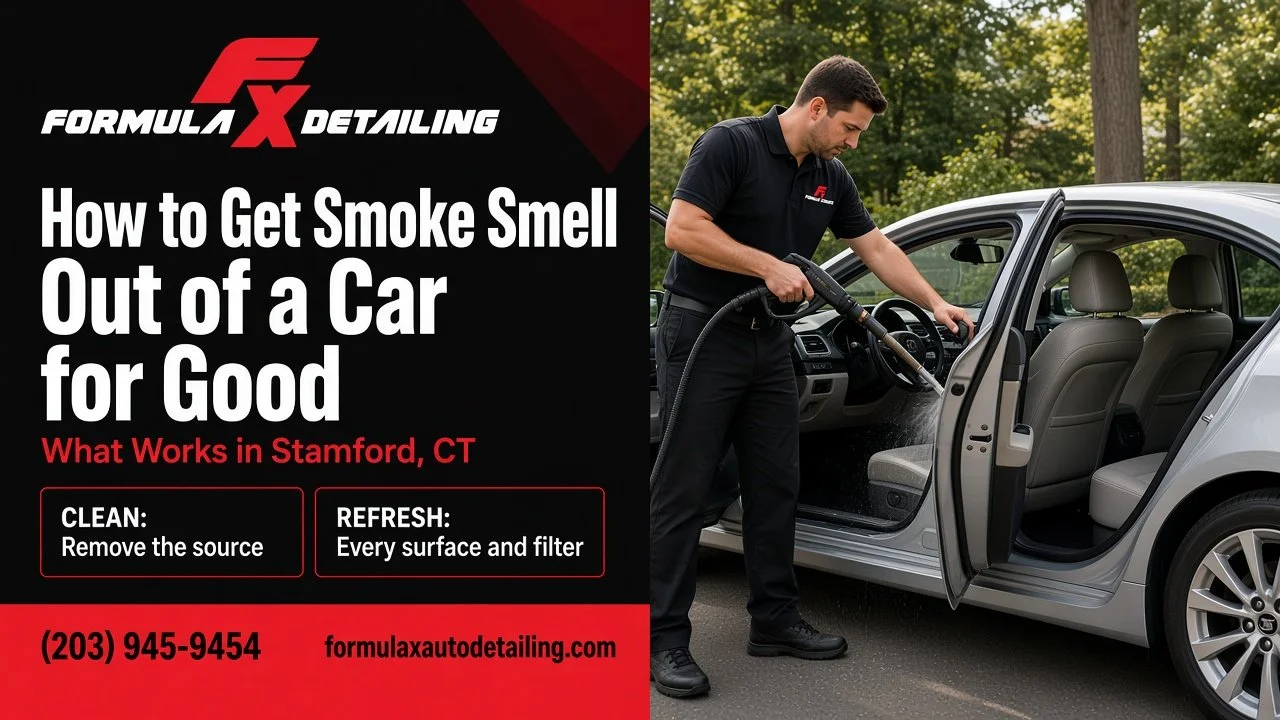
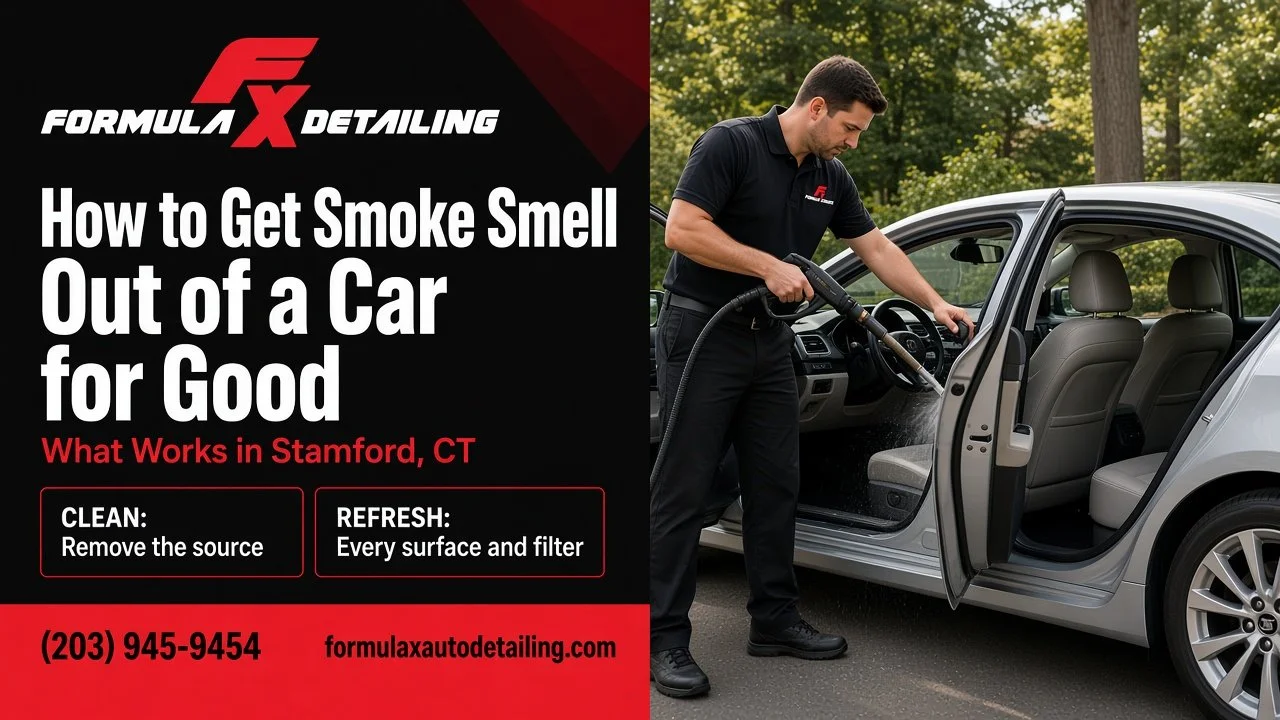
How do you get smoke smell out of a car for good?
Remove the residue, not just the smell. Stop smoking in the car, take out all ash and debris, replace the cabin air filter, and then clean every surface: vacuum and hot-water extract the carpet and fabric seats, clean and condition leather, steam and wipe hard plastics, clean the headliner gently, wash the inside of every window, and clean the vents and seat belts. Let the car dry with good airflow. Fragrances and open windows only mask smoke odor. A thorough professional interior detail gets most cars to a point where the smell is gone or faint, but very heavy, years-old smoke can soak into foam and headliner material and may only improve, not disappear completely.
For the service itself, see Formula X's mobile detailing page. For a family-car example of a deep interior clean, see interior deep clean on a Honda Odyssey, and for pet odor and hair, how to remove dog hair from car seats and carpet.
Where the details come from: What thirdhand smoke is and why airing out doesn't remove it comes from the Mayo Clinic. Ozone cautions come from the EPA. Lease wear guidance comes from Toyota Financial Services. The rest is general detailing practice. Only Formula X's published package prices appear here, and odor work beyond a package is discussed after the car has been seen.
Why Smoke Smell Lingers
Quick answer: Smoke leaves a sticky residue of tar, nicotine, and other chemicals on every surface it touches. Soft materials like carpet, seat foam, and headliner absorb it. The smell comes back because the residue is still there, and heat and humidity release it again.
The Mayo Clinic calls the residue that settles after smoking thirdhand smoke. It explains that it contains nicotine and other chemicals, that it builds up over time in soft items such as clothing, furniture, and carpets, that it settles like dust on hard surfaces including in vehicles, and that it can stay in place for many months after smoking stops. It also says more airflow doesn't clear it, and that it's hard to remove with typical household cleaning.
That matches what detailers see. A car interior is a small, closed space packed with soft, porous materials, and it heats up in the sun. Every time the cabin warms, some of the residue releases odor again. That's why a car that seemed fine on a cold morning smells strongly on a hot afternoon, and why a used car that was aired out and perfumed before sale often smells of smoke a week later.
It also explains why the fix is cleaning, not covering. Until the residue is physically removed from the surfaces, the smell will keep coming back.
| Where residue collects | Why it holds odor | How hard to clean |
|---|---|---|
| Headliner | Smoke rises; fabric and foam backing absorb it | Hard; must be cleaned gently |
| Seat fabric and foam | Deep, porous, and large | Moderate to hard |
| Carpet and mats | Ash, debris, and residue in fibers | Moderate |
| Vents and ducts | Air moves residue through them | Moderate |
| Cabin air filter | Traps smoke particles | Easy: replace it |
| Glass | Yellow-brown film on the inside | Easy to moderate |
| Hard plastics and leather | Sticky film on the surface | Easy to moderate |
| Seat belts | Fabric webbing holds residue | Moderate; clean carefully |
First Steps Before Any Cleaning
Quick answer: Stop smoking in the car, empty and clean the ashtray and cupholders, throw out butts, ash, and debris, remove everything from the cabin and trunk, and replace the cabin air filter. These steps remove the biggest sources before any deep cleaning starts.
Stop the source
No cleaning lasts if smoking continues in the car.
Empty ash and debris
Ashtrays, cupholders, door pockets, and under the seats.
Clear the cabin
Bags, papers, clothes, and anything that may hold smoke.
Replace the cabin filter
A smoke-loaded filter blows odor back in every time the fan runs.
Wash removable items
Seat covers, blankets, and mats that can be washed.
These steps sound basic, but they make a large difference. A single forgotten butt under a seat, or a filter full of smoke, can keep a cleaned car smelling. Many cars have the cabin filter behind the glovebox, and the owner's manual explains how to reach it and how often to change it.
The Cabin Air Filter and Vents
Quick answer: Replace the cabin air filter, then clean the vent openings and run the system on fresh air with the windows open. In a smoker's car, the filter and ducts carry odor every time the fan runs, so skipping them undoes much of the interior work.
The cabin air filter cleans air coming into the car through the heating and air conditioning system. In a car where people smoked, it collects smoke particles along with dust and pollen. Once it's loaded, every blast of heat or air conditioning pushes odor back into the clean cabin. Replacing it is cheap and quick on most cars, and it's one of the most effective single steps.
Vent openings and louvers collect residue too. Detailers clean them with brushes, steam, and suitable cleaners. Deeper duct cleaning varies by vehicle and is sometimes done with products designed to be run through the system; ask what's involved and whether it's suitable for your car.
After the filter is replaced and the cabin is cleaned, run the fan on fresh air, not recirculation, with the windows down for a while to clear residual odor from the ducts.
Don't spray fragrance into the vents. Scented sprays in the system mask odor briefly and can leave their own residue. Clean the source and replace the filter instead.
The Headliner: Where Smoke Hides Most
Quick answer: Smoke rises, so the headliner often holds the most odor. It also needs the gentlest cleaning, because it's usually thin fabric glued to foam, and soaking it can loosen the adhesive and cause sagging. Clean it with low moisture, light agitation, and blotting.
Most headliners are a thin fabric bonded to a foam layer on a molded board. Over years of smoking, the fabric turns yellow or brown and the foam absorbs odor. The challenge is cleaning it without wetting it too much. Too much liquid or scrubbing can dissolve or weaken the adhesive, and the headliner can sag or bubble.
A careful approach is a suitable cleaner applied lightly to a towel or soft brush rather than directly to the fabric, gentle agitation, and blotting with clean towels, working in small sections. Steam can help in skilled hands, used briefly and from a distance. Patience matters more than force.
Very heavily smoked headliners may never smell completely clean, because the odor is in the foam behind the fabric. In those cases, cleaning reduces the smell a lot, and the remaining choice is replacing the headliner, which is an upholstery job rather than a detailing job.
Seats, Carpet, and Floor Mats
Quick answer: Vacuum thoroughly, pre-treat, then hot-water extract fabric seats, carpet, and mats so the residue is rinsed out rather than spread around. Clean and condition leather rather than soaking it. Let everything dry fully with good airflow, because damp fabric can develop its own musty smell.
Seats and carpet hold the most material in a car, so they hold a lot of odor. Vacuuming removes ash and loose debris but not the residue bonded to the fibers. Hot-water extraction does: it sprays cleaning solution into the fabric and immediately pulls it back out with the dirt and residue dissolved in it. Several passes, with a rinse pass at the end, remove more than one heavy one.
Seat foam is the hard part. If smoke has gone deep into the cushion foam over years, surface extraction won't reach it all. More passes help, but it's a case where honest expectations matter.
Leather is cleaned differently. It's coated, so residue sits mostly on the surface and in the perforations and seams. A leather cleaner, a soft brush, and a conditioner afterward clean it without soaking it. Floor mats can come out and be cleaned and dried separately.
| Surface | Method | Watch for |
|---|---|---|
| Fabric seats | Vacuum, pre-treat, hot-water extraction, rinse pass | Over-wetting foam; drying time |
| Carpet | Vacuum, agitate, extract | Moisture under the carpet |
| Leather | Leather cleaner, soft brush, condition | Perforations; don't soak |
| Floor mats | Remove, clean, dry separately | Dry fully before refitting |
| Seat belts | Pull out fully, clean webbing gently, dry extended | Never retract while wet |
Hard Surfaces, Glass, and Small Parts
Quick answer: Wipe and steam dashboards, door panels, consoles, and trim with suitable cleaners, clean switches and seams with soft brushes, and wash the inside of every window, sometimes more than once, to remove the yellow film. Don't forget the rearview mirror, sun visors, and seat rails.
Smoke residue leaves a sticky, sometimes yellowish film on plastics and glass. On hard surfaces, it's mostly a cleaning problem: a suitable interior cleaner, soft brushes for textured plastics, switches, and seams, and microfiber towels changed often. Steam loosens residue from textured surfaces and tight spots.
The inside of the glass is where the film is most visible. Smokers' windshields often look hazy and cause glare at night. It may take two or three passes with glass cleaner and fresh towels to cut it completely. Tinted windows need an ammonia-free cleaner.
Small parts collect residue and are easy to forget: the sun visors, the rearview mirror, the grab handles, the seat rails and tracks, the seat-belt buckles, the inside of the glovebox and console, and the door jambs.
Odor Treatments: What to Ask About
Quick answer: After cleaning, some detailers use odor neutralizers, enzyme products, or other treatments for the last traces. Ask exactly what's used and why. Be cautious with ozone: the EPA warns ozone generators sold as air cleaners can harm health and don't reliably remove odors, so if any ozone treatment is used, the car must be aired out thoroughly before anyone gets in.
Odor products fall into a few groups. Fragrances cover smells and don't remove anything. Odor neutralizers are designed to bind with or change odor molecules. Enzyme cleaners break down organic material and are aimed more at pet, food, and body-fluid odors than smoke. Activated charcoal and similar absorbers can help with faint lingering odors over time.
Ozone is the treatment most often mentioned for smoke. The EPA warns that ozone generators sold as air cleaners can be harmful to health, that ozone at concentrations that don't exceed health standards has little effect on removing many odor-causing chemicals, and that ozone can react with chemicals indoors to form other pollutants. Ozone can also affect some rubber and plastic materials over time. If a detailer proposes ozone, ask how long it runs, that nobody, including pets, is in the car during it, and how long it's aired out afterward.
No treatment replaces cleaning. Odor products work best as a finishing step on a car whose surfaces have already been cleaned.
| Treatment | What it does | Notes |
|---|---|---|
| Air freshener | Masks odor | Temporary; can add its own smell |
| Odor neutralizer spray | Targets odor molecules | Best after cleaning |
| Enzyme cleaner | Breaks down organic material | Better for pet, food, and body-fluid odors |
| Activated charcoal | Absorbs faint odor over time | Slow; for the last traces |
| Ozone generator | Oxidizes some odors | EPA cautions; car must be unoccupied and aired out |
What You Can Do Yourself
Quick answer: You can stop smoking in the car, empty the ash and debris, replace the cabin filter, vacuum thoroughly, wipe hard surfaces, clean the glass, wash removable covers and mats, and air the car out. That often improves a lightly smoked car a lot. Extraction, headliner cleaning, and deep odor work are where professional tools help.
- Remove all trash, butts, ash, and personal items from the car.
- Replace the cabin air filter following the owner's manual.
- Vacuum every surface, including under the seats and the seat rails.
- Take out floor mats; wash rubber mats and clean carpet mats separately.
- Wipe hard surfaces with an interior cleaner and microfiber towels, changing towels often.
- Clean the inside of every window two or three times with fresh towels.
- Leave the windows open in a safe, dry place to air the car out.
- Place a box of baking soda or a charcoal bag in the car for faint lingering odor.
Home tools have limits. A household vacuum doesn't extract residue from fabric, and household cleaners can damage some interior materials. If the smell is strong or comes back on warm days, the residue is still in the soft materials, which is where extraction and professional methods make the difference.
What a Professional Interior Detail Adds
Quick answer: A professional interior detail adds hot-water extraction, steam, the right chemistry for each surface, careful headliner cleaning, attention to vents, seat belts, and seams, and the time to do multiple passes. For smoke odor, it's usually the step that turns improvement into results.
The main differences are tools and time. An extractor rinses residue out of fabric instead of moving it around. A steamer reaches textured plastics, vents, and seams. Professional cleaners are matched to leather, plastics, fabric, and glass. And a smoke job often takes more passes than a standard interior, which takes time.
Formula X's Bronze Interior package includes thorough vacuuming, interior steam cleaning, leather treatment, windows and exhaust tips, and carpet and upholstery shampoo, and the Gold package includes interior steam cleaning, leather treatment, and carpet shampoo along with a full exterior. Those are the core of a smoke-odor interior.
Heavy smoke usually takes extra time beyond a standard interior. Formula X's package cards note extra charges for heavy soil; for smoke, the honest approach is to look at the car, explain what's likely to come out and how long it will take, and agree on any extra before starting.
| Package | Starting price | Interior work included |
|---|---|---|
| Bronze Interior | $295+ | Thorough vacuuming, interior steam cleaning, leather treatment, windows and exhaust tips, carpet and upholstery shampoo |
| Gold (interior + exterior) | $495+ | Thorough vacuuming, interior steam cleaning, leather treatment, carpet shampoo, plus a full exterior detail |
| Silver (interior + exterior) | $395+ | Light vacuuming and wipe-down, plus exterior; a maintenance clean, not a smoke treatment |
Realistic Expectations
Quick answer: Most lightly to moderately smoked cars can be cleaned until the smell is gone or very faint. Cars smoked in heavily for years may keep a faint odor in seat foam and the headliner, especially on hot days. Anyone who promises total, permanent removal without seeing the car is guessing.
Results depend on how long and how heavily the car was smoked in, the materials, and how well every source is removed. A car where someone smoked occasionally for a few months usually comes clean. A car smoked in daily for a decade has residue deep in the foam, the headliner backing, and the ducts, and some of it may never fully come out.
Weather plays a role too. Odor that seems gone on a cool day can come back faintly on the first hot afternoon, because heat releases what's left. A follow-up clean of the worst areas sometimes helps.
If the car is being sold or returned off lease, it's worth knowing that lessors often treat smoke odor as excess wear. Read your lessor's standard, such as Toyota Financial Services' wear and use guidelines, a few months before return.
Light smoke
Usually cleans up fully with a thorough interior.
Moderate smoke
Usually gone or faint after a deep clean.
Heavy, long-term
Big improvement; may leave faint odor in foam or headliner.
Smoking continues
Odor returns; cleaning can't keep up.
Smoke Residue, Kids, and Passengers
Quick answer: Thirdhand smoke residue contains nicotine and other chemicals, and the Mayo Clinic notes babies and young children are at higher risk because they touch surfaces and put things in their mouths. If kids ride in a car that was smoked in, cleaning the residue is about more than smell.
The Mayo Clinic explains that people can be exposed to thirdhand smoke chemicals by touching contaminated items or breathing gases the residue releases, and that babies and young children who crawl and put objects in their mouths are at higher risk than nonsmoking adults. It also notes the long-term effects of thirdhand smoke aren't as well studied as those of secondhand smoke.
For a family buying a used car that was smoked in, that's a good reason to have the interior thoroughly cleaned before car seats go in. Clean the car seat areas, belts, and buckles, and wash any car seat covers following the seat's own instructions. Removing smoking from the car altogether is the only way to stop new residue building up.
Buying a Used Car That Was Smoked In
Quick answer: Check for smoke before you buy: smell the car after it has sat closed in the sun, look at the headliner for yellowing, check the inside of the glass for film, look for burn marks, and look for a strong air-freshener smell covering something. Factor cleaning into the price.
Closed-car test
Smell the car after it has sat closed in sun, not with the windows open.
Headliner color
Yellow or brown staining above the driver is a strong sign.
Glass film
Wipe the inside of the windshield with a white towel.
Burns and ash
Look for burn marks and ash in seams and the console.
Heavy fragrance
A strong air freshener may be covering odor.
Cabin filter
A dark, smoky-smelling filter tells the story.
A thorough interior detail can make a big difference to a smoked car, but it's worth knowing the likely cost and outcome before you agree to a price. Send photos of the headliner and seats to a detailer, or have the car looked at, before you commit.
Keeping the Smell From Coming Back
Quick answer: The only way to stop smoke odor returning is to stop smoking in the car. After that, keep the cabin filter fresh, clean the interior regularly, and deal with any remaining faint odor on warm days with airing and a charcoal absorber rather than fragrance.
Once a car has been cleaned, it stays clean only if new residue isn't added. Even smoking with the windows down leaves residue on the headliner, seats, and glass, because smoke drifts around the cabin before leaving.
Regular interior care keeps the car fresh: vacuuming, wiping touch points, cleaning glass, and periodic deep cleans. For a schedule, see how often should you get your car detailed? Replace the cabin filter on the interval in your owner's manual, or sooner if the car is used in dusty or smoky conditions.
Vape, Cannabis, and Cigar Odor
Quick answer: Vape aerosol, cannabis smoke, and cigar smoke also leave residue, though how much and how sticky varies. The cleaning approach is the same: remove the source, replace the cabin filter, and clean every surface, with extra attention to glass film.
Vape aerosol tends to leave a slick or sticky film on glass and hard surfaces rather than the deep yellowing of years of cigarettes, but heavy, long-term use can still cling to fabric and the headliner. Cannabis and cigar smoke leave strong, distinctive odors that behave much like tobacco smoke, settling into soft materials.
Tell the detailer what was smoked or vaped and for how long. It helps them plan the time and methods. As with tobacco, cleaning works far better than masking.
Preparing for a Smoke-Odor Appointment
Quick answer: Empty the car, remove ash and butts, mention how long and how heavily it was smoked in, say whether you've replaced the cabin filter, and park where doors can open fully and the car can air out. Plan for longer drying time than a normal interior.
Smoke jobs take longer than a standard interior and need good airflow afterward, so a spot with room to open all the doors, or a garage with the door up, works best. For more on getting ready, see how to prepare for a mobile detail at your home.
When you book, give the vehicle, how long it was smoked in, whether the seats are cloth or leather, the headliner condition, and any burns or stains. Photos help. You'll get a straight answer on what's likely to come out and any extra time involved before the work starts.
The Professional Process, Step by Step
Quick answer: A thorough smoke-odor interior usually runs in this order: remove debris and the cabin filter, dry vacuum, clean the headliner gently, clean hard surfaces and glass from the top down, extract seats and carpet, treat leather, clean belts and small parts, apply any finishing odor product, then dry and air the car.
- Inspection. The detailer smells and looks at the headliner, seats, carpet, vents, glass, and trunk to find the worst areas, and notes burns and stains.
- Debris and filter. Ash, butts, and trash come out; the cabin air filter is replaced or the owner is asked to supply one.
- Dry vacuum. Every surface, seam, rail, and pocket is vacuumed to remove loose ash and dust before anything gets wet.
- Top down. Headliner, visors, and pillars first, so drips fall onto surfaces that haven't been cleaned yet.
- Hard surfaces and glass. Dash, doors, console, switches, and vents are cleaned and steamed, then glass is cleaned in several passes.
- Fabric and carpet. Seats, carpet, and mats are pre-treated and extracted, with a rinse pass to remove residue and cleaner.
- Leather and belts. Leather is cleaned and conditioned; seat belts are pulled out, cleaned, and left extended to dry.
- Finishing and drying. Any odor neutralizer is applied, and the car is dried with doors or windows open.
Working from the top down matters more in smoke jobs than in most interiors, because headliner cleaning can release residue and drips that land on seats and carpet. Doing fabric last means it's only extracted once.
The Trunk, Spare-Tire Well, and Hidden Spaces
Quick answer: Smoke drifts into the trunk and cargo area too, especially in hatchbacks, wagons, and SUVs where the cabin and cargo area are open to each other. Clean the cargo carpet, side panels, the spare-tire well, and the parcel shelf or cargo cover.
In a sedan, the trunk is somewhat sealed from the cabin, but smoke still reaches the rear parcel shelf, which sits right under the rear window and absorbs a lot of residue. In an SUV or hatchback, the cargo area is part of the cabin, so its carpet, side panels, and cargo cover hold odor like the rest of the interior.
The spare-tire well is often forgotten. Ash, debris, and damp can collect there, and a musty or smoky smell from the cargo area often comes from it. Lift the floor, take out anything stored there, and have it vacuumed and cleaned.
Other hidden spaces include under-seat storage bins, the space under the rear seat cushion on some cars, seatback map pockets, and the inside of the center console and glovebox. Each should be emptied and cleaned.
Want an Honest Read on Your Car's Smoke Odor?
Tell Formula X Mobile Auto Detailing & Ceramic Coating the vehicle, how long and how heavily it was smoked in, whether the seats are cloth or leather, the headliner condition, and where it's parked, with a few photos. You'll get a straight answer on what's likely to come out, which package fits, and any extra time involved before the work starts.
Drying and Airflow After Cleaning
Quick answer: After extraction, fabric and carpet need to dry completely with good airflow. Leaving them damp can create a musty smell that's mistaken for smoke. Plan on doors or windows open, fans if needed, and avoiding closing the car up wet.
Extraction leaves some moisture in fabric and carpet, even with good technique. On a warm, dry day with the doors open, that dries fairly quickly. On a cold or humid day, or in a closed garage, it takes much longer. If the car is closed up while still damp, a musty smell can develop, and an owner might think the smoke smell has come back.
To dry well, keep the doors or windows open in a safe, dry place, run the fan on fresh air with the heat on if the car is running in an open space, and keep floor mats out until they're fully dry. Seat belts should stay extended until they're dry so moisture isn't wound into the retractor.
Smoke jobs are a case where weather and location matter. A mild, dry day or a garage with the door open is ideal. In winter, a heated garage helps.
Burn Marks and Holes
Quick answer: Cigarette burns in fabric, carpet, leather, or plastic are physical damage, not dirt, so cleaning won't remove them. Small burns in carpet and fabric can sometimes be repaired by upholstery or interior repair specialists. Mention burns when booking so expectations are clear.
A burn melts or chars the material. Cleaning can remove the soot around a burn and make it less noticeable, but the hole or melted spot remains. Small carpet burns can sometimes be repaired by cutting out the damaged fibers and replacing them, and some fabric and leather burns can be repaired by interior repair specialists. Plastic burns on consoles and door panels usually need part replacement or specialist repair.
Burns also hold odor, because the charred material is concentrated residue. Even after cleaning, a burned spot may smell faintly. If you're selling or returning the car, burns are typically treated as damage rather than wear.
The First Weeks After the Detail
Quick answer: In the first weeks after a smoke-odor detail, keep the car smoke-free, air it out on warm days, run the fan on fresh air, keep a charcoal absorber inside for faint traces, and note any area where odor returns so it can be cleaned again.
A cleaned car may smell perfectly fresh on the day and then show a faint odor on the first hot afternoon. That's usually residue in a spot that needs another pass, often the headliner, seat foam, or a hidden area like under the rear seat. Note where the smell seems strongest and mention it to the detailer.
Activated charcoal bags are a reasonable way to absorb faint lingering odor without adding fragrance. Replace or recharge them as directed. Keep the cabin filter on its regular replacement schedule, and keep the interior on a regular cleaning schedule so nothing builds up again.
Child Seats, Seat Covers, and Accessories
Quick answer: Child seats, seat covers, steering-wheel covers, floor mats, and any fabric accessories that were in the car while it was smoked in hold residue too. Clean them following their own instructions, or replace them if they still smell.
Accessories are easy to forget, and they can bring odor right back into a clean car. Fabric seat covers and steering-wheel covers often go in the washing machine; check the label. Child seat covers and harness straps usually have specific cleaning instructions in the seat's manual, and some materials shouldn't be soaked or treated with certain chemicals.
Items like phone mounts, sunshades, and organizers can be wiped down. Anything soft that still smells after cleaning may be cheaper to replace than to keep cleaning.
The Best Time of Year for a Smoke Job
Quick answer: Mild, dry weather is best, because it allows fabric to dry quickly with the doors open. Spring and fall are often ideal in Connecticut. In summer, early or late in the day avoids heat; in winter, a heated garage helps.
Because smoke jobs involve more extraction and longer drying than most interiors, the weather matters. Humid summer afternoons slow drying, and cold winter days make it hard to leave the doors open. A heated or sheltered garage solves much of that.
Heat also helps reveal what's left. Some detailers prefer to check a smoke job on a warm day, when any remaining residue releases odor and can be found and cleaned.
Questions to Ask a Detailer About Smoke Odor
Quick answer: Ask how they'll clean the headliner, whether they extract or only shampoo, whether the cabin filter is included, what odor products they use and whether ozone is involved, how long it will take, what result to expect, and how extra charges work.
- How will you clean the headliner without making it sag?
- Do you hot-water extract the seats and carpet, and how many passes for smoke?
- Will you replace the cabin air filter, or should I buy one?
- Which odor products do you use after cleaning, and do you use ozone?
- If ozone is used, how long does the car air out before I drive it?
- How long will the appointment take, and how long to dry?
- What result should I expect for a car smoked in this long?
- Will there be extra charges beyond the package, and how are they decided?
- What should I do if a faint smell returns on a hot day?
Specific answers are a good sign. Vague promises of a permanent fix without seeing the car, or a plan that relies mainly on fragrance or ozone, are reasons to keep asking.
Cloth vs. Leather Interiors
Quick answer: Cloth interiors absorb more smoke and need more extraction and drying time, but respond well to it. Leather holds less odor in the surface but traps residue in seams, perforations, and stitching. Alcantara, suede-like fabrics, and perforated leather need especially gentle methods.
Cloth seats act like a sponge for smoke. The fabric and the foam behind it absorb residue, so they hold a lot of odor, but hot-water extraction can rinse much of it out. They need longer drying afterward.
Leather is coated, so smoke residue sits mostly on the surface, where a leather cleaner and soft brush remove it. The places odor hides are seams, stitching, and perforations in ventilated seats. Perforated leather has to be cleaned with very little moisture so liquid doesn't get pushed into the foam and seat heaters or fans.
Microsuede and Alcantara-style materials are common on headliners, steering wheels, and seat inserts in many newer cars. They're delicate and can mat or discolor with harsh cleaners or scrubbing, so they need products and methods made for them.
| Material | Holds odor | Cleaning approach |
|---|---|---|
| Cloth | High | Extraction, rinse pass, thorough drying |
| Smooth leather | Low on surface; seams hold residue | Leather cleaner, soft brush, condition |
| Perforated leather | Moderate | Minimal moisture; clean holes gently |
| Microsuede / Alcantara-style | Moderate | Specialized cleaner, light touch, brush to restore nap |
| Vinyl | Low | Interior cleaner and wipe-down |
Shared, Company, and Family Cars
Quick answer: In shared cars, one smoker can undo everyone else's effort. Agree on a no-smoking rule, keep the cabin filter on schedule, and plan regular interior cleans. For company or fleet cars, a written policy and periodic deep cleans keep vehicles presentable for the next driver.
Shared cars are where smoke odor builds quietly. A family car that a teenager or relative smokes in occasionally, or a company car passed between drivers, picks up residue a little at a time until everyone notices. A clear no-smoking rule, applied to everyone, is the only lasting fix.
For businesses with several vehicles, it helps to schedule interior cleans between drivers or on a regular cycle, replace cabin filters on schedule, and inspect for burns or odor at hand-over. Mobile detailing at the workplace means the cars don't leave the lot.
If a car has to go back to a lessor or be sold, give yourself time. Smoke jobs sometimes need a second pass after the first hot day reveals what's left.
How Formula X Handles Smoke Odor
Quick answer: Formula X is a mobile service based in Stamford. Smoke-odor work starts with a look at the car, uses the interior steps in the Bronze Interior or Gold package as the base, and any extra time for heavy smoke is explained before the work starts.
Formula X Mobile Auto Detailing & Ceramic Coating brings interior and exterior detailing, paint correction, scratch repair, and Ceramic Pro coatings to homes and workplaces in Stamford and nearby towns, including Darien, Norwalk, Greenwich, New Canaan, and Westport. See all service areas and the work gallery.
Same-day appointments may be available when the schedule allows; call to check. Heavy smoke jobs may need a longer appointment and good drying weather or a garage.
Mistakes to Avoid
Quick answer: Common mistakes are covering smoke with fragrance, skipping the cabin filter, soaking the headliner, retracting wet seat belts, leaving fabric damp, running ozone in an occupied or poorly aired car, and continuing to smoke in the car after cleaning.
Fragrance only
Covers odor for a day; residue remains.
Old cabin filter
Blows smoke odor back into a clean cabin.
Soaked headliner
Can loosen adhesive and cause sagging.
Wet seat belts retracted
Can trap moisture and odor in the retractor.
Damp fabric
Can develop a musty smell of its own.
Careless ozone
EPA cautions apply; air the car out fully.
Myths About Smoke Odor in Cars
Quick answer: Opening the windows doesn't remove smoke residue, fragrance doesn't neutralize it, one product doesn't fix it overnight, and ozone isn't a safe shortcut that replaces cleaning.
| Myth | Reality |
|---|---|
| Airing it out fixes it | The Mayo Clinic notes more airflow doesn't clear thirdhand smoke. |
| A strong air freshener solves it | Fragrance masks odor; residue stays. |
| Ozone removes all smoke odor | The EPA cautions against ozone generators and notes limited odor removal. |
| Smoking with windows down leaves no smell | Smoke drifts and settles before it leaves the car. |
| One wipe-down does it | Smoke residue is in fabric, foam, the headliner, vents, and glass. |
The common thread in every myth is the idea of a shortcut. Smoke odor in a car is a residue problem, and residue only leaves when it's physically cleaned off the surfaces that hold it. Masking, airing, and gadgets can help at the edges, but cleaning the headliner, seats, carpet, vents, glass, and filter is what actually works, and keeping the car smoke-free afterward is what keeps it working.
Formula X Mobile Auto Detailing & Ceramic Coating
Formula X Mobile Auto Detailing & Ceramic Coating is a mobile detailing, paint correction, scratch repair, and ceramic coating service based at 48 Union St, Stamford, CT 06906. The team works throughout Stamford, Greenwich, Darien, New Canaan, Norwalk, Rowayton, Westport, and other towns in lower Fairfield County, and Westchester County, NY.
For smoke odor, that means looking at the car first, explaining honestly what's likely to come out, and agreeing on any extra time before the work starts.
Call (203) 945-9454, email formulaxautodetail@gmail.com, send a request through the contact page, or view Formula X Mobile Auto Detailing & Ceramic Coating on Google Maps. Address: 48 Union St, Stamford, CT 06906.
Frequently Asked Questions About Removing Smoke Smell From a Car
How do you get smoke smell out of a car permanently?
Stop smoking in the car, remove all ash and debris, replace the cabin air filter, and clean every surface: extract carpet and fabric, clean and condition leather, steam hard plastics, gently clean the headliner, and wash the inside of the glass. Then let it dry with good airflow. Fragrances only mask the smell.
Why does smoke smell come back on hot days?
Smoke residue stays on and in surfaces like the headliner, seat foam, and carpet. Heat releases odor from that residue. If the smell returns in warm weather, some residue is still there and those areas need more cleaning.
Does airing out a car remove smoke smell?
Not on its own. The Mayo Clinic notes that more airflow doesn't clear thirdhand smoke, the residue left on surfaces. Airing helps after cleaning, but the residue has to be removed.
Does replacing the cabin air filter help with smoke odor?
Yes, a lot. A filter loaded with smoke particles pushes odor back into the cabin every time the fan runs. Replace it before or during the interior clean, following your owner's manual.
Can smoke smell be removed from a headliner?
Usually it can be reduced a lot with gentle, low-moisture cleaning and blotting. Soaking or scrubbing can loosen the adhesive and cause sagging. Very heavily smoked headliners may hold odor in the foam backing, and replacement is then the remaining option.
Is ozone treatment safe for removing smoke smell?
The EPA warns that ozone generators sold as air cleaners can harm health and don't reliably remove many odors. If any ozone treatment is used, nobody, including pets, should be in the car, and it must be aired out thoroughly afterward. Cleaning the residue comes first.
Do air fresheners get rid of smoke smell?
No. They mask it briefly and can add their own residue. The smell returns when the fragrance fades because the smoke residue is still there.
How long does it take to remove smoke smell from a car?
It depends on how long and how heavily the car was smoked in. Light smoke may clear in one thorough interior detail. Heavy, long-term smoke takes longer, may need extra passes, and needs drying time afterward.
Can every car be made smoke-free?
Most lightly to moderately smoked cars can be cleaned until the smell is gone or very faint. Cars smoked in heavily for years may keep a faint odor in seat foam or the headliner. An honest detailer will tell you what's likely after seeing the car.
Is smoke residue harmful to kids?
The Mayo Clinic says thirdhand smoke contains nicotine and other chemicals and that babies and young children are at higher risk because they touch surfaces and put things in their mouths. Cleaning the interior before kids ride in a smoked car is sensible.
Does smoke smell affect a lease return?
It can. Many lessors treat odors and burns as excess wear. Read your lessor's wear-and-use standard a few months before return and have the interior cleaned in time.
How much does smoke odor removal cost at Formula X?
Smoke-odor work builds on the interior steps in Bronze Interior from $295+ or Gold from $495+. Heavy smoke usually needs extra time, which is explained and agreed after the car has been seen and before the work starts.
Can Formula X come the same day?
Same-day appointments may be available when the schedule allows. Call (203) 945-9454 to check. Heavy smoke jobs may need a longer appointment and good drying conditions.
Where is Formula X Mobile Auto Detailing & Ceramic Coating located?
Formula X Mobile Auto Detailing & Ceramic Coating is based at 48 Union St, Stamford, CT 06906. It's a mobile service working in Stamford, Greenwich, Darien, New Canaan, Norwalk, Rowayton, Westport, and other lower Fairfield County towns, and Westchester County, NY. Call (203) 945-9454.
Find Formula X Mobile Auto Detailing & Ceramic Coating
Formula X Mobile Auto Detailing & Ceramic Coating is a mobile service based at 48 Union St, Stamford, CT 06906. Use the map for directions to the business address, or call (203) 945-9454 to arrange service at your location.
View Formula X Mobile Auto Detailing & Ceramic Coating on Google Maps
Get an Honest Read on Your Car’s Smoke Odor
Call Formula X Mobile Auto Detailing & Ceramic Coating at (203) 945-9454 or send a request with your vehicle, how long and how heavily it was smoked in, whether the seats are cloth or leather, the headliner condition, and photos. You’ll hear what’s likely to come out and any extra time involved before the work starts.
48 Union St, Stamford, CT 06906 · Serving Stamford, Greenwich, lower Fairfield County, and Westchester County, NY