
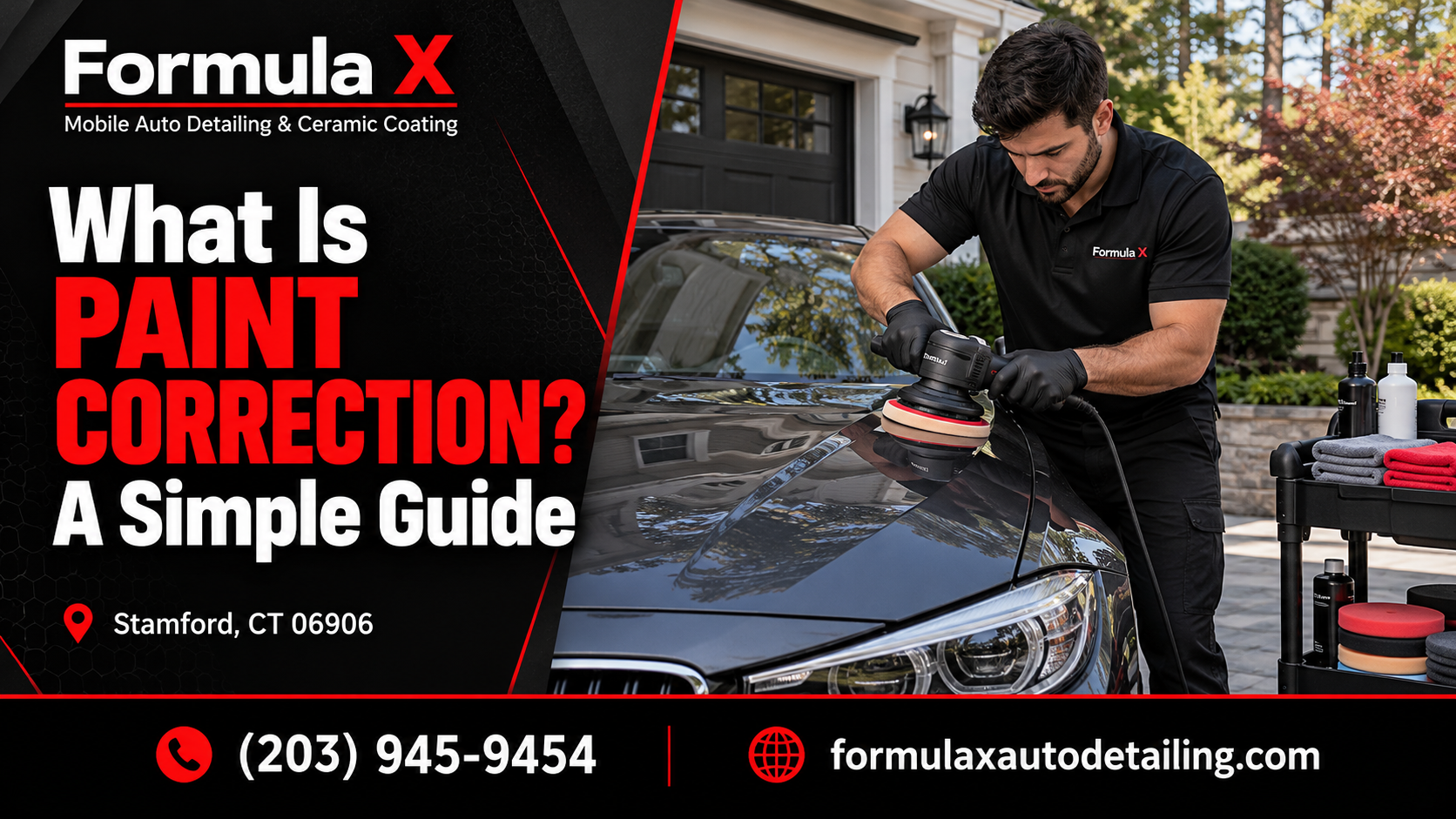
Formula X Mobile Auto Detailing & Ceramic Coating · Paint Correction Guide
Paint correction is one of the most talked-about and least understood services in car care. People hear “polish,” “compound,” “one-step,” and “multi-step,” and aren’t sure what any of it means for their own car, or whether they need it at all. In plain terms, paint correction is the careful machine polishing of a car’s clear coat to level out the fine scratches, swirls, haze, and etching that make paint look dull. It isn’t repainting, and it can’t fix everything. This guide explains what it is, how one-step and multi-step corrections differ, what swirls and holograms are, why clear coat is thin and has limits, what correction can’t fix, what drives the cost without quoting prices, why it comes before a ceramic coating, how long results last, and when DIY makes sense. Formula X Mobile Auto Detailing & Ceramic Coating is based at 48 Union St, Stamford, CT 06906, and can be reached at (203) 945-9454.
What is paint correction?
Paint correction is the process of using a machine polisher, polishing pads, and abrasive compounds or polishes to remove a very thin layer of clear coat so that fine defects, such as swirl marks, light scratches, water-spot etching, and oxidation haze, are leveled out and the surface reflects light evenly again. It is a permanent fix for the defects it removes, because they’re removed rather than hidden, but it only works on defects that sit in the clear coat. Deep scratches that go through the clear coat, rock chips, and failing paint need touch-up, repair, or refinishing instead. How much correction a car needs is decided by inspecting the paint, ideally with a paint thickness gauge, because every pass removes a little clear coat that can’t be put back.
Think of it as sanding and refining at a microscopic scale. The goal isn’t perfection at any cost; it’s the best result the paint can safely give while leaving as much protective clear coat as possible.
Where the details come from: Coating prep and warranty details come from Ceramic Pro’s published coating warranty document and aftercare page. Information on paint thickness gauges is available from gauge makers such as DeFelsko. Road salt details come from the Connecticut General Assembly’s Office of Legislative Research. This guide explains concepts and doesn’t list prices.
Paint Correction at a Glance
Quick answer: If your paint looks dull, hazy, or covered in fine circular scratches in direct sun, and the marks don’t catch a fingernail, paint correction can likely help. If scratches are deep, paint is peeling, or the clear coat is already thin, correction is limited or inadvisable and a different repair is needed.
| What you see | Is correction likely to help? | Notes |
|---|---|---|
| Fine circular swirls in sun | Yes | The classic correction target |
| Dull, hazy, oxidized paint | Often | Depends on how far oxidation has gone |
| Light scratches that don’t catch a fingernail | Often | Surface-level; may level out |
| Water-spot etching | Sometimes | Depends on depth |
| Bird-dropping etching | Sometimes | Shallow etches may polish out |
| Deep scratches that catch a fingernail | Partly or no | May need touch-up or repair |
| Rock chips | No | Need filling or repair |
| Peeling or flaking clear coat | No | Needs refinishing |
What it is
Machine polishing that levels a thin layer of clear coat to remove fine defects.
What it isn’t
A repaint, a filler, or a way to remove deep scratches.
What it costs the paint
A tiny amount of clear coat each time. It’s a finite resource, so correct only as much as needed.
What it sets up
A clean base for a ceramic coating or sealant. Ceramic Pro says any coating will amplify pre-existing damage.
How Car Paint Is Built
Quick answer: Most modern car paint has layers: primer over the metal or plastic, a color (base) coat, and a clear coat on top. The clear coat is the glossy, protective layer, and it’s the only layer paint correction is meant to touch. It’s thin, so there’s a limit to how much can be polished away.
When you look at your car, you’re mostly looking through the clear coat to the color beneath. The clear coat gives gloss and protects the color from UV, chemicals, and light abrasion. Swirls and light scratches usually live in this layer, which is why polishing it can remove them.
| Layer | Job | Relevance to correction |
|---|---|---|
| Clear coat | Gloss and protection | The layer that’s polished; thin and finite |
| Base (color) coat | Color and effect pigments | Should never be reached or removed by polishing |
| Primer | Adhesion and smoothing | Seeing it means damage through the paint |
| Substrate | Metal, aluminum, composite, or plastic | Seeing it means damage through all layers |
Not all paint is the same. Older cars, some classic cars, and some single-stage paints have no separate clear coat, so polishing removes color. Matte and satin finishes are made so the surface scatters light, and polishing them changes the finish. A professional identifies which kind of paint you have before choosing a method. The classic Corvette paint correction guide covers older paint types in more detail.
Swirls, Holograms, Haze, and Etching
Quick answer: Swirls are fine, circular scratches from washing and drying. Holograms are buffer trails that shimmer in sunlight. Haze is a general dullness from oxidation or fine marring. Etching is damage where something acidic or mineral-rich, like a bird dropping or hard water, has eaten into the clear coat. All are shallow enough that correction can often reduce or remove them.
| Defect | What it looks like | Common cause |
|---|---|---|
| Swirl marks | Spiderweb-like circles around a light source | Dirty wash mitts, brush washes, dry wiping, gritty drying towels |
| Holograms or buffer trails | Rainbow-like shimmer in direct sun | Aggressive rotary buffing without a refining step |
| Haze and oxidation | Dull, milky look | UV and weathering over time |
| Water-spot etching | Ring-shaped marks that don’t wash off | Hard water left to dry on paint |
| Bird-dropping etching | Dull or dented-looking patch where a dropping sat | Acidic droppings left on paint |
| Random isolated scratches (RIDS) | Short, random lines at different angles | Bags, belts, brushes, and careless wiping |
| Marring | Fine, hazy scratching in an area you touch a lot | Door edges, handles, trunk lids |
Why swirls show most in sun
In shade or at night, paint looks smooth. In direct sun or under a bright light, light reflects off the edges of every tiny scratch in different directions, and the eye sees a web of circles. Dark paint shows them most, because there’s little color to distract from them. Light colors hide them, but they’re still there.
What causes most of them
Most swirls come from washing and drying. A mitt that has dragged grit across a panel, a brush tunnel wash, or a dry towel on a dusty car all leave fine scratches. That’s why Ceramic Pro’s aftercare page lists no drive-thru washes, no hard brushing, and no dry towel wiping, and why how you wash matters as much as any product.
Correction without better washing is temporary. If the car goes back to brush washes and dry wiping afterward, new swirls will return, and each correction costs clear coat. Fix the cause as well as the symptom.
How Paint Correction Works
Quick answer: A machine polisher spins or oscillates a foam, microfiber, or wool pad loaded with an abrasive liquid. The abrasives are tiny and sharp at first, then break down as they work. They shave the clear coat down to the depth of the deepest defect being removed, leaving a level surface, which is then refined with finer polish until it’s glossy.
It’s helpful to picture a scratch as a valley in the clear coat. You can’t fill the valley and have it stay filled; you can only lower the surrounding ground until the valley is no longer visible. That’s what polishing does. This is also why correction is permanent for the defects it removes, and why it uses up some clear coat each time.
| Component | What it does | Notes |
|---|---|---|
| Machine polisher | Moves the pad across the paint | Dual-action machines are common and forgiving; rotary machines cut faster and need more skill |
| Pad | Carries the abrasive and controls cut | Firmer or wool pads cut more; soft foam pads refine |
| Compound | Heavier abrasive to remove deeper defects | Used first when needed |
| Polish | Finer abrasive to refine and add gloss | Removes marring from the compounding step |
| Panel wipe | Removes polishing oils | Shows the true result and prepares for coating |
| Lighting | Reveals defects | Strong, angled light is essential |
Cutting vs finishing
Correction is a balance. A more aggressive combination removes defects faster but leaves its own fine marks that need refining. A gentler combination leaves a cleaner finish but takes more passes. Professionals test on a small section to find the least aggressive combination that works, then repeat it across the car.
One-Step vs Multi-Step Paint Correction
Quick answer: A one-step correction uses a single combination of pad and product to improve gloss and remove light defects. A multi-step correction uses two or more stages, usually a cutting stage to remove deeper defects followed by one or more refining stages. One-step suits newer or lightly marred paint; multi-step suits heavier swirling or older paint, and takes more time and clear coat.
| Feature | One-step | Two-step | Three-step or more |
|---|---|---|---|
| Typical goal | Improve gloss; remove light swirls | Remove moderate swirls and scratches; refine | Maximum defect removal on difficult paint |
| Process | One pad and product combination | Cut, then refine | Cut, intermediate, refine |
| Best for | New cars, well-kept paint | Cars with visible swirls | Heavily marred, older, or hard paint |
| Clear coat removed | Least | More | Most |
| Time | Shortest | Longer | Longest |
| Risk if rushed | Low | Moderate | Higher; thin paint needs care |
Is more steps better?
Not automatically. The right number of steps is the fewest that gives the result the paint can support. Heavy correction on healthy paint that only needs a light polish wastes clear coat. Light correction on heavily swirled paint leaves visible defects. The inspection decides.
What “percent correction” means
You may hear providers promise “90 percent” or “100 percent” correction. These are marketing shorthand rather than a measurement. What matters is whether defects are reduced to an acceptable level without removing more clear coat than the paint can safely lose. Ask what result to expect on your car, not a number.
Clear Coat Thickness Limits
Quick answer: Clear coat is thin, and polishing removes some of it. A paint thickness gauge measures total paint thickness on metal panels, which helps a professional judge how much room there is. Thin readings, past repaints, and aggressive earlier polishing all reduce the safe margin. If there isn’t enough clear coat to correct safely, the right answer may be a lighter polish or none.
Gauge makers such as DeFelsko publish information on how paint meters are used for automotive paint inspection. A gauge reads the thickness of everything above the metal; it can’t, by itself, separate the clear coat from the color coat. A skilled installer combines readings with experience, the car’s history, and test spots.
| Finding | What it can mean | How a careful installer responds |
|---|---|---|
| Even readings across panels | Likely original paint with normal variation | Normal correction plan |
| Much higher readings on one panel | Possible repaint, filler, or film | Treat that panel with more caution |
| Low readings | Less margin for polishing | Lighter approach; may skip or limit cutting |
| Very different readings on edges and curves | Thin paint on edges is normal | Extra care near edges and body lines |
| Non-metal panels | Magnetic gauges may not read them | Different tools or extra caution |
Edges and body lines are where people cut through. Paint is thinner on sharp edges and creases, and a polisher concentrates pressure there. That’s where a careful installer slows down, and where inexperienced polishing often burns through to the color coat.
Why you can’t polish forever
Every correction takes some clear coat, and it doesn’t grow back. A car that is corrected several times over its life, or that has been aggressively polished before you bought it, may have little left. That’s why a good provider asks about the car’s history, explains why correction is or isn’t advisable, and focuses on prevention, such as gentle washing and a protective layer, to avoid repeat corrections.
What Paint Correction Can’t Fix
Quick answer: Correction can’t fix damage that goes through the clear coat. That includes deep scratches that catch a fingernail, rock chips, peeling or failing clear coat, dents, rust, and paint damage from collisions. These need touch-up, spot repair, panel refinishing, or bodywork.
| Problem | Why polishing can’t fix it | Typical route |
|---|---|---|
| Deep scratch through the clear coat | The defect is deeper than the clear coat can safely be leveled | Touch-up, fill and level, or refinish |
| Rock chip | Material is missing, not just scuffed | Chip repair or touch-up |
| Peeling clear coat | The layer is failing | Refinishing |
| Rust bubbles | Corrosion is under the paint | Rust repair and repaint |
| Dents and dings | The panel is deformed | Dent repair or bodywork |
| Paint transfer | Sometimes removable, sometimes not | Assessment first |
| Very deep etching | May go through the clear coat | Assessment; may need refinishing |
The fingernail test
A common rough test is to run a fingernail gently across a scratch. If the nail catches clearly, the scratch is probably deeper than a polish can level. If it doesn’t catch, correction often helps. It’s a guide, not a promise, and a professional will look closer. For a step-by-step approach to judging depth, see the BMW X5 scratch repair guide and Formula X’s scratch repair page.
Partial improvement is possible. Sometimes a deeper scratch can be reduced and made much less visible by polishing, even if it can’t be removed. A good installer will tell you the likely outcome up front and stop before taking more clear coat than is sensible.
What a Professional Paint Correction Involves
Quick answer: A professional job starts with a thorough wash and decontamination, then an inspection under strong light, usually with a paint thickness gauge. After a test spot to choose the least aggressive method, the installer works panel by panel, wipes off polishing oils to check the result, and finishes with protection, such as a sealant or ceramic coating.
- Wash. A careful hand wash removes loose dirt without adding new scratches.
- Decontaminate. Iron remover and clay remove bonded particles that would otherwise be dragged across the paint by the pad.
- Inspect. Strong, angled light shows swirls, etching, and scratches; a gauge checks thickness.
- Tape and protect. Trim, rubber, and sensitive parts are masked so compounds don’t stain or burn them.
- Test spot. A small area is tried with different pad and product combinations to find the gentlest one that works.
- Correct panel by panel. Controlled passes, with frequent pad cleaning and checks.
- Refine. A finer polish removes marks left by the cutting step.
- Wipe and inspect. A panel wipe removes oils that can hide remaining defects.
- Protect. A sealant or ceramic coating goes on the corrected paint.
The most time-consuming part is usually the correction itself, but the part that determines quality is the inspection and test spot. It’s where the installer decides how much clear coat to use.
Mobile correction. Formula X is a mobile service, so inspection and correction can often happen at your home or office, subject to space, shade, power, weather, and your building’s rules. Ask how the installer handles lighting and dust, since both matter for a good result.
What to expect on the day
- Time: correction takes longer than a wash or a normal detail. The more steps, the longer it takes, and it’s often scheduled as a full day or more.
- Access: the car needs to be clean enough to start and accessible on all sides.
- Your part: remove personal items, tell the installer about previous polishing or repaint, and mention any areas you’re worried about.
- Results: view the paint together in daylight at the end, and ask how to wash it afterward.
What Drives the Cost of Paint Correction
Quick answer: Correction is priced mostly by time and skill. The biggest drivers are the car’s size, how heavily the paint is marred, how many steps are needed, how soft or hard the paint is, and how much detail work is involved. Any honest quote comes after an inspection. This guide doesn’t list prices, because they vary too much by vehicle and paint to be useful.
| Cost driver | Why it changes the quote |
|---|---|
| Vehicle size | More surface means more time; large SUVs and trucks take far longer than small coupes |
| Paint condition | Heavily swirled or neglected paint needs more steps and passes |
| Number of steps | Each stage adds time, pads, and products |
| Paint hardness | Some paints are hard and slow to correct; others are soft and need delicate handling |
| Dark colors | Show every defect, so the standard of finish is higher |
| Body complexity | Lots of creases, vents, and trim take more hand work and masking |
| Prior work | Previous repaint, filler, or heavy polishing limits what’s safe |
| Add-ons | Wheels, glass, trim, and protection after correction |
| Location and logistics | Mobile setup, space, and access |
Why quotes can differ so much
Two providers can quote very differently for the same car, and the difference is usually in what’s included. One may be doing a quick one-step polish to boost gloss; another may be doing a careful multi-step correction with thickness readings, taping, and a full inspection. Comparing quotes means comparing the process.
- Ask how many steps are planned and why.
- Ask whether paint thickness will be measured.
- Ask what defects will remain and what result to expect.
- Ask what’s included after correction: sealant, coating, or nothing.
- Be wary of flat prices quoted without seeing the car.
Formula X quotes paint correction and scratch work after inspecting the paint, and publishes only its detailing package prices (Gold from $495+, Silver from $395+, Bronze Interior or Bronze Exterior from $295+, with scratches extra). For what drives coating quotes, see how much ceramic coating costs in Connecticut.
Why Correction Comes Before a Ceramic Coating
Quick answer: A coating locks in whatever is underneath it. Ceramic Pro’s warranty document strongly recommends a machine polish for vehicles over three months old and says any coating will amplify pre-existing damage. Correcting first means the coating protects paint that looks its best, rather than sealing in swirls.
Ceramic Pro’s warranty document also recommends addressing imperfections such as chips, scuffs, and scrapes before application. A coating adds gloss and clarity, which makes defects easier to see. That’s why prep, including correction, is often the biggest part of a coating job.
| Paint age and condition | Typical approach before coating |
|---|---|
| Brand-new, clean | Wash, decontaminate, clay; possibly no polish |
| New with delivery swirls | Decontaminate and a one-step refining polish |
| A few years old | One- or two-step correction depending on wash marring |
| Older or heavily swirled | Multi-step correction, within the paint’s limits |
| Thin or previously repainted | Lighter approach; discuss realistic goals |
For more, see should you ceramic coat a brand-new car and how much ceramic coating costs in Connecticut. If you’re comparing protection options, ceramic coating vs. wax vs. sealant explains how each fits after correction. For a car you lease, correction before turn-in is covered in is ceramic coating worth it on a leased car. EV owners can read ceramic coating for Teslas and EVs for sensor and camera cautions.
Don’t coat first and correct later. Polishing through a coating removes it. If paint needs correction, do it before the coating goes on.
How Long Paint Correction Results Last
Quick answer: Correction removes defects permanently, but new ones can be added. How long a corrected finish looks good depends almost entirely on how the car is washed, dried, parked, and protected afterward. Gentle washing and a protective layer can keep a finish looking good for years; brush washes can bring swirls back within weeks.
The scratches that were removed are gone. But a corrected surface is just as easy to scratch as it was before, unless something changes. That’s why correction is best paired with better habits and a protective layer.
| Factor | Effect on how long results last |
|---|---|
| Washing method | The biggest factor; two-bucket hand washing preserves it, brush washes destroy it |
| Drying method | Clean microfiber, used gently, preserves it; dry wiping scratches |
| Protection layer | A coating or sealant makes washing easier and resists etching |
| Parking | Garage parking reduces sap, droppings, and weather exposure |
| Road salt and grit | Winter film and abrasive grit cause marring if washed off carelessly |
| Daily handling | Belts, bags, and door edges leave random marks |
Ceramic Pro’s aftercare page recommends washing every two weeks and a two-bucket hand wash at least monthly, avoiding drive-thru washes, hard brushing, and dry wiping. Those same habits apply to any corrected paint, coated or not. In Connecticut, the Office of Legislative Research notes that road-treatment chlorides are corrosive and that DOT recommends washing cars after storms, so winter rinsing is part of keeping a corrected finish looking good. See how long ceramic coating lasts in Connecticut winters for more.
DIY vs Professional Paint Correction
Quick answer: Light polishing with a dual-action machine is a realistic DIY project for careful owners with time and the right setup. Heavy correction, rotary polishing, dark or soft paint, thin paint, and anything near a coating or film call for a professional. The main risk of DIY is burning through the clear coat, which can’t be undone.
| Factor | DIY | Professional |
|---|---|---|
| Equipment | Polisher, pads, products, lighting, towels | Provided, including thickness gauge and lighting |
| Learning curve | Steep; results improve with practice | Experienced |
| Best for | Light polishing on forgiving paint | Moderate to heavy defects, dark or soft paint, valued cars |
| Main risk | Burning through clear coat; holograms | Choosing a provider who rushes |
| Time | Many hours spread over a weekend or more | Done for you |
| Ability to measure | Usually none unless you buy a gauge | Typically included |
| After correction | You apply protection | Can be applied the same visit |
If you try it yourself
- Start small on an inconspicuous panel to learn how your paint responds.
- Use the least aggressive combination that works.
- Go slowly near edges and body lines, where paint is thinnest.
- Keep pads clean and change them when they load up.
- Use strong lighting and wipe panels to check real results.
- Stop if the paint feels hot or you see color on the pad.
- Skip polishing matte, satin, wrapped, or filmed surfaces.
Know when to stop. Many people who start with DIY end up hiring a professional for a car’s main panels. If you’re unsure, a professional inspection can tell you what your paint can safely take, even if you do the polishing yourself later.
Soft, Dark, Matte, and Classic Paint
Quick answer: Some paints need a different approach. Soft and dark paints show marring easily and need gentle, careful polishing. Matte and satin paints can’t be polished. Classic cars may have thin or single-stage paint that’s easy to cut through, and originality can matter. Always identify the paint before choosing a method.
| Paint type | What to know | Approach |
|---|---|---|
| Soft clear coat | Marrs easily, polishes quickly, shows swirls again with careless washing | Gentle polish; extra care with washing |
| Hard clear coat | Resists scratching but corrects slowly | More aggressive pads or products, within safe limits |
| Black and dark colors | Show every defect | Refining stage matters most |
| Matte and satin finishes | Polishing changes the finish | Don’t polish; use matte-safe care |
| Single-stage paint | No clear coat; polishing removes color | Very light touch; test first |
| Original classic paint | Thin and irreplaceable to some owners | Conservative approach; discuss originality |
| Repainted panels | Thickness and hardness vary | Measure; treat with caution |
For a worked example of a conservative approach, see the classic Corvette in Rowayton guide, and for a modern high-end example, the Mercedes G-Wagon in Greenwich guide. If your car has satin paint or factory film, the Range Rover Sport guide explains what to ask.
Want to Know What Your Paint Needs?
Send Formula X Mobile Auto Detailing & Ceramic Coating your vehicle’s year, make, model, and color, where it’s parked, how it’s washed, any previous polishing or repaint, and a few daylight photos of the paint, ideally in direct sun. You’ll get an honest answer on whether it needs a light polish, a multi-step correction, or a different repair, and any correction is quoted after the paint is inspected.
How to Check Your Own Paint Before Booking
Quick answer: Wash and dry the car gently, then look at it in direct sun and under a bright flashlight held at an angle. Photograph swirls, haze, and scratches, test any scratches with a fingernail, and note any panels that have been repainted or look different. Share the photos with your provider.
- Wash gently first. Dirt hides defects and adds new ones if you wipe it dry.
- Look in direct sun. Swirls and haze show most in strong light.
- Use a flashlight at an angle. Move it slowly across each panel.
- Check each panel. Hood, roof, trunk, doors, and lower bumpers differ.
- Try the fingernail test on isolated scratches.
- Look for mismatched panels. Different gloss or texture can mean repaint.
- Take daylight photos. Close-ups and wide shots both help.
Photos are only a first look; a provider will still want to see the car and measure the paint. But clear photos help them tell you quickly whether a polish is likely to be enough, or whether deeper repair is in play.
Protecting Paint After Correction
Quick answer: Corrected paint is bare and vulnerable until it’s protected. A sealant or ceramic coating after correction makes washing easier and helps keep fresh paint from marring. Wash gently, avoid brush washes, and rinse salt off in winter.
Polishing removes any wax or sealant that was on the paint, so the surface is clean and unprotected afterward. Most providers apply some form of protection straight away. Which one depends on how long you’ll keep the car and how you’ll care for it; ceramic coating vs. wax vs. sealant compares them honestly.
| Protection after correction | Fits when |
|---|---|
| Wax | You enjoy reapplying it and want a warm glow |
| Sealant | You want solid protection with low commitment |
| Ceramic coating | You’ll keep the car for years and wash it gently |
| PPF on high-impact areas | You drive a lot of highway miles and worry about chips |
Ceramic Pro says its coatings cure enough to drive within 48 hours and that the typical cure takes up to two weeks, depending on the coating, which is the period it recommends waiting before washing. Ask your provider what applies to whatever protection they use.
The Best Time of Year for Paint Correction in Connecticut
Quick answer: Late spring through early fall is easiest, because mild, dry weather helps with working, wiping, and curing protection. Fall is a popular time to correct and protect before salt season. Winter work is possible in a heated, dry space.
| Season | Pros | Cons |
|---|---|---|
| Spring | Removes winter marring; good conditions | Pollen and sap begin |
| Summer | Warm and dry; long days | Hot panels need shade; sun and heat limit working |
| Fall | Protects paint before salt season | Book early; it’s busy |
| Winter | Possible in a heated space | Cold, damp, and salt make it hard to keep the car clean and dry |
Because correction is usually followed by protection, plan so the protection has time to settle before salt. See how long ceramic coating lasts in Connecticut winters for timing advice.
Paint Correction and Paint Protection Film
Quick answer: If you plan to add paint protection film, correct the paint first, because film locks in whatever is under it. Don’t polish film itself without advice from the installer. Film edges also need care when washing.
Film is installed on prepared paint, so any swirls or haze beneath it stay there. Many owners correct the front end, then film it, then coat over the film and the rest of the car. Ceramic Pro’s film aftercare advice says to avoid high-pressure hoses along film edges and drive-thru washes. If your car already has film or a wrap, tell your provider before any polishing.
Paint Correction on New, Leased, and Older Cars
Quick answer: New cars usually need the lightest correction, often a single refining polish. Leased cars benefit from correction before turn-in only for surface wear, since lessors focus on damage through the paint. Older cars may need more steps, within the limits of the clear coat that’s left.
| Car | Typical goal | Notes |
|---|---|---|
| Brand-new | Remove delivery swirls and residue | See coating a new car |
| Leased, near turn-in | Present surface wear at its best | Doesn’t fix through-paint scratches; see coating a leased car |
| A few years old | Remove wash marring and light etching | One- or two-step is common |
| Older, neglected | Restore gloss as far as the paint allows | Measure first; expect limits |
| Electric vehicle | Same as any car, with care around sensors | See coating a Tesla or EV |
On a lease, the lessor’s guides focus on scratches that penetrate the paint, dents, and similar damage, and lessors such as Toyota Financial Services encourage repairs before return. Polishing helps with how the car looks, but it won’t change what the lessor lists as chargeable.
Realistic expectations
Before any work, agree on what “success” looks like. For a lightly marred car, that may be a clear, even gloss with only faint defects visible in strong light. For an older car, it may be a big improvement with a few deeper marks still visible. A provider who tells you that up front, and shows you the paint in daylight afterward, is giving you an honest service. One who promises perfection without seeing the car is not.
Questions worth asking any provider
A short list keeps the conversation focused, and the answers tell you a lot about how the shop works. Ask what level of correction they recommend for your car and why, rather than which package sounds best. Ask whether they measure paint thickness before polishing and what they do if a panel reads thin or looks repainted. Ask how they inspect the finish afterward, and under what light. Ask what protection goes on after the polish and what the care instructions are, in writing if possible. Finally, ask what they will not attempt, because a provider who can name the limits of polishing is one who understands the work.
It also helps to ask how long the car will be with them, what happens if the weather turns, and how they handle a defect you spot at handover. Good providers expect these questions and answer them plainly. If answers are vague, or you are pushed toward the largest option without an inspection, take that as a reason to compare another quote before you commit.
Formula X and Paint Correction
Quick answer: Formula X offers paint correction as a mobile service in Stamford, Greenwich, and nearby towns, with details on its paint correction page. Correction and scratch repair are quoted after the paint is inspected. Formula X publishes detailing package prices of Gold from $495+, Silver from $395+, and Bronze Interior or Bronze Exterior from $295+, with scratches extra.
Start with the Formula X paint correction page for the service description, then use this guide to prepare questions. If a mark looks deeper than a polish can handle, the scratch repair page explains the other options.
| Need | Where to start | Pricing |
|---|---|---|
| Swirls, haze, or dull paint | Paint correction | Quoted after inspection |
| Deeper scratches | Scratch repair | Quoted after inspection; scratches extra |
| Long-term protection after correction | Ceramic Pro in Stamford | Coatings quoted after inspection |
| Interior and exterior detail | CT mobile car detailing | Gold from $495+, Silver from $395+, Bronze from $295+ |
| Exterior only | Exterior detailing | Bronze Exterior from $295+ |
Formula X’s Ceramic Pro package cards describe Gold as “perfect for new vehicles and long term ownership,” Silver as “ideal for short term ownership,” and Bronze as “best for leased vehicles.” Paint correction isn’t listed on the cards; if your paint needs polishing before a coating, that’s part of the quote after inspection.
Check which warranty terms apply to you. If you move on to a coating, Formula X’s package cards print 7 years for Gold, 5 for Silver, and 2 for Bronze, while Ceramic Pro’s current US document lists Gold as lifetime of the vehicle with annual services, Silver as 5 years, and Bronze as 2 years. Ask which terms apply to your package and keep the paperwork.
Common Paint Correction Mistakes
Quick answer: The most common mistakes are correcting without measuring, over-polishing edges, expecting deep scratches to disappear, skipping better washing habits, and coating before correcting.
Not measuring
Without a thickness reading, there’s no way to know how much clear coat is available.
Over-polishing edges
Paint is thinnest on edges and body lines; that’s where cut-throughs happen.
Chasing deep scratches
If a fingernail catches, polishing may thin the paint without removing the scratch.
Going back to brush washes
Swirls return quickly. Ceramic Pro says no drive-thru washes.
Coating before correcting
A coating amplifies defects, per Ceramic Pro’s warranty document.
Choosing on price alone
A cheap quick polish and a careful correction are different jobs.
A Decision Guide
Quick answer: Inspect your paint in direct sun, test scratches with a fingernail, think about how you wash, and decide how long you’ll keep the car. Light swirls on a car you’ll keep, especially before a coating, point to correction. Deep damage points to repair. Heavily corrected or thin paint points to caution.
- Look at the paint in direct sun. Note swirls, haze, and spots.
- Try the fingernail test on any scratches.
- Think about history. Has it been repainted or polished heavily?
- Think about how you wash. Fix brush washes first.
- Decide on protection. Correction pairs well with a coating or sealant.
- Get an inspection. Ask for a thickness reading and a clear plan.
- Agree on expectations before work starts.
If you’re unsure whether to polish, coat, or just seal, see ceramic coating vs. wax vs. sealant.
Questions to Ask a Paint Correction Provider
Quick answer: Ask how paint thickness will be measured, how many steps are planned and why, what result to expect, how edges are handled, what protection follows, and how the car should be washed afterward.
- Will you measure paint thickness, and what will you do if readings are low?
- How many steps do you plan, and what will each one do?
- What defects will remain, and what result should I expect?
- Do you do a test spot first?
- How do you handle edges, creases, and trim?
- What protection will be applied after, and what are its warranty terms?
- What soap and washing method do you recommend afterward?
- Can I see the paint together in daylight at the end?
Clear, specific answers are a good sign. Vague promises of perfection are not.
Paint Correction Myths
Quick answer: Correction doesn’t fill scratches, remove deep damage, or make paint scratch-proof, and more steps isn’t always better. It’s a precise way to level fine defects, within the paint’s limits.
| Myth | Reality |
|---|---|
| “Polish fills in scratches.” | Correction removes clear coat to level the surface; filler-style products only hide defects temporarily. |
| “It fixes any scratch.” | Scratches through the clear coat need a different repair. |
| “You can correct as often as you like.” | Clear coat is finite. |
| “A coating hides swirls.” | A coating amplifies them; correct first. |
| “Correction is permanent against new swirls.” | Defects removed stay removed, but new ones can be added by poor washing. |
| “More steps always means a better result.” | The right number is the fewest that work safely. |
The simple version: correction levels the clear coat so light reflects evenly, which makes paint look deeper and glossier. Done carefully, it’s one of the most rewarding things you can do for a car. Done carelessly, it can thin paint that won’t come back.
Formula X Mobile Auto Detailing & Ceramic Coating
Formula X Mobile Auto Detailing & Ceramic Coating is a mobile detailing, paint correction, scratch repair, and ceramic coating service based at 48 Union St, Stamford, CT 06906. The team works throughout Stamford, Greenwich, Darien, New Canaan, Norwalk, Rowayton, Westport, and other towns in lower Fairfield County, and Westchester County, NY.
For paint correction, that means inspecting the paint under good light, explaining honestly what can and can’t be fixed, and quoting correction and scratch work after the vehicle has been seen.
Call (203) 945-9454, email formulaxautodetail@gmail.com, send a request through the contact page, or view Formula X Mobile Auto Detailing & Ceramic Coating on Google Maps. Address: 48 Union St, Stamford, CT 06906.
Frequently Asked Questions About Paint Correction
What is paint correction?
Paint correction is machine polishing that removes a very thin layer of clear coat so fine defects such as swirl marks, light scratches, haze, and some etching are leveled out and the paint reflects light evenly. It removes defects rather than hiding them, but only those that sit in the clear coat.
What is the difference between one-step and multi-step paint correction?
A one-step correction uses one pad and product combination to improve gloss and remove light defects. A multi-step correction uses a cutting stage followed by one or more refining stages to remove heavier defects. The right number of steps is the fewest that gives a good result safely, and it's decided by inspection.
What are swirl marks and holograms?
Swirls are fine circular scratches, usually from dirty mitts, brush washes, and dry wiping. Holograms are rainbow-like buffer trails left by aggressive polishing without a refining step. Both show most in direct sun and on dark paint, and both are usually shallow enough for correction to reduce.
Can paint correction remove deep scratches?
Usually not. If a scratch catches a fingernail clearly, it's probably deeper than the clear coat can safely be leveled. Polishing may reduce its visibility, but deeper scratches often need touch-up, fill and level, or refinishing.
How much clear coat can be polished away?
Clear coat is thin and finite, and every correction removes some. A paint thickness gauge helps a professional judge how much margin there is, though it measures total paint thickness rather than the clear coat alone. Thin readings, repaints, and earlier heavy polishing reduce the safe margin.
What can paint correction not fix?
It can't fix rock chips, scratches through the clear coat, peeling or failing clear coat, rust, dents, or collision damage. Those need chip repair, touch-up, refinishing, or bodywork.
How much does paint correction cost?
It depends on the car and the paint, and Formula X quotes correction after inspecting the paint rather than giving flat prices. The main drivers are vehicle size, paint condition, the number of steps, paint hardness, body complexity, and prior work. Formula X's published prices are for detailing packages only: Gold from $495+, Silver from $395+, Bronze Interior or Exterior from $295+, scratches extra.
Do I need paint correction before ceramic coating?
Usually some. A coating locks in what's underneath, and Ceramic Pro's warranty document strongly recommends a machine polish for vehicles over three months old and says any coating will amplify pre-existing damage. New cars often need only a light polish.
How long does paint correction last?
Removed defects stay removed, but new ones can be added. How long the finish looks good depends mostly on washing, drying, parking, and protection. Gentle hand washing and a coating or sealant help it last; brush car washes can bring swirls back quickly.
Can I do paint correction myself?
Light polishing with a dual-action machine is a realistic project for careful owners. Heavy correction, rotary polishing, dark or soft paint, thin paint, and matte or filmed surfaces are better left to a professional. The main risk is burning through the clear coat, which can't be undone.
Can matte or satin paint be corrected?
No. Polishing changes a matte or satin finish by making it glossier in patches. Use matte-safe care products and follow the maker's guidance.
Is it safe to polish paint more than once?
Each correction removes some clear coat, so repeated heavy correction can use up the margin. A good provider measures first, uses the least aggressive method, and focuses on prevention so repeat corrections aren't needed.
What does Formula X offer for paint correction?
Formula X offers paint correction as a mobile service, described on its paint correction page, with correction and scratch repair quoted after the paint is inspected. It also offers Ceramic Pro coatings, quoted after inspection.
Where is Formula X Mobile Auto Detailing & Ceramic Coating located?
Formula X Mobile Auto Detailing & Ceramic Coating is based at 48 Union St, Stamford, CT 06906. It's a mobile service working in Stamford, Greenwich, Darien, New Canaan, Norwalk, Rowayton, Westport, and nearby towns, plus Westchester County, NY. Call (203) 945-9454 or email formulaxautodetail@gmail.com.
Find Formula X Mobile Auto Detailing & Ceramic Coating
Formula X Mobile Auto Detailing & Ceramic Coating is a mobile service based at 48 Union St, Stamford, CT 06906. Use the map for directions to the business address, or call (203) 945-9454 to arrange service at your location.
View Formula X Mobile Auto Detailing & Ceramic Coating on Google Maps
Find Out What Your Paint Really Needs
Call Formula X Mobile Auto Detailing & Ceramic Coating at (203) 945-9454 or send a request with your vehicle’s year, make, model, and color, any previous polishing or repaint, where it’s parked, and daylight photos of the paint. The paint is inspected before any correction is quoted, and you’ll get a straight answer on what can and can’t be fixed.
48 Union St, Stamford, CT 06906 · Serving Stamford, Greenwich, lower Fairfield County, and Westchester County, NY