
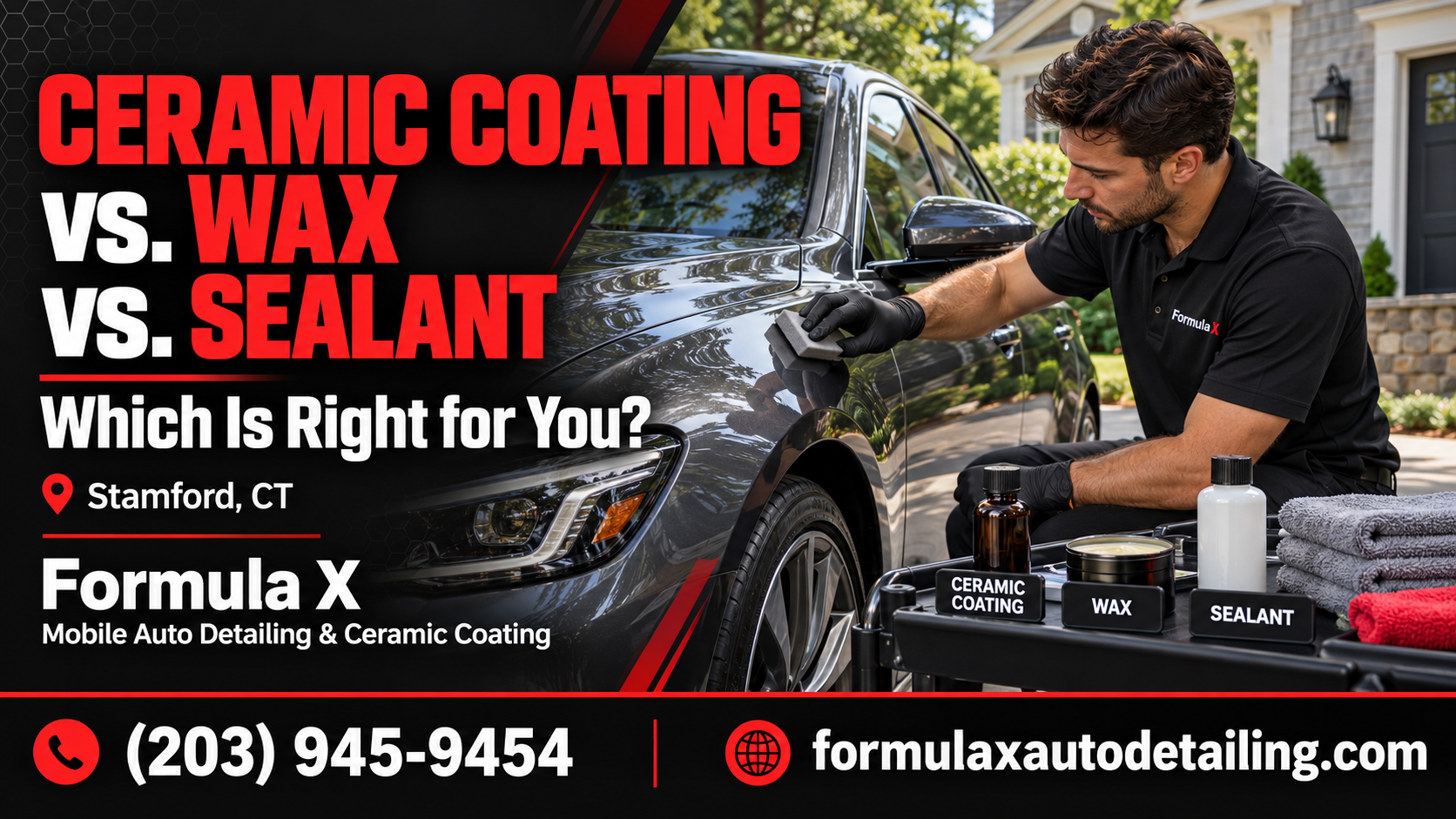
Formula X Mobile Auto Detailing & Ceramic Coating · Paint Protection Comparison Guide
Walk down the car-care aisle or ask three detailers, and you’ll hear three different answers about how to protect your paint. Wax, sealant, and ceramic coating all promise shine and water beading, but they are very different products. They’re made from different chemistry, they need different amounts of prep, they hold up differently against Connecticut road salt and summer sun, and they ask different things of you between washes. The right one depends less on which is “best” and more on your car, how long you’ll keep it, where it’s parked, and how much time you want to spend maintaining it. This guide compares all three honestly, labels manufacturer claims as claims, explains what really drives the cost of each, and shows how Fairfield County owners can combine them. Formula X Mobile Auto Detailing & Ceramic Coating is based at 48 Union St, Stamford, CT 06906, and can be reached at (203) 945-9454.
Ceramic coating vs. wax vs. sealant: which is right for you?
Wax is a natural or blended protective layer that adds warmth and gloss but wears off fastest, so it suits owners who enjoy reapplying it often. A synthetic sealant is a polymer layer that bonds better and generally lasts longer than wax, making it a practical, low-commitment choice for most daily drivers and leased cars. A ceramic coating is a hard, semi-permanent layer that cures onto the clear coat; it lasts the longest and makes washing easiest, but it needs the most prep, costs the most up front, and still needs proper maintenance. If you keep a car for years and wash it regularly, a coating usually makes the most sense. If you’re short on time or budget, or the car is leaving in a year or two, a sealant is often enough. None of the three stops rock chips, deep scratches, or dents.
All three sit on top of your paint’s clear coat and act as a sacrificial layer. They take the hit from bird droppings, sap, salt film, and UV so the clear coat doesn’t. What changes between them is how thick and hard that layer is, how strongly it bonds, and how long it lasts before it has to be renewed.
Where the details come from: Coating warranty and aftercare details come from Ceramic Pro’s published coating warranty document and aftercare page. Road salt details come from the Connecticut General Assembly’s Office of Legislative Research. Package details and prices come from Formula X’s own package cards. Durability figures in this guide are manufacturer claims and are labelled that way.
Ceramic Coating vs. Wax vs. Sealant at a Glance
Quick answer: Wax is the easiest to apply and the shortest-lived. Sealant sits in the middle on effort and lifespan. Ceramic coating takes the most prep and the highest up-front spend, and in return it lasts the longest and keeps the car easier to wash. Your choice comes down to how long you’ll keep the car, how it’s parked, and how much maintenance you’ll actually do.
The table below is a plain-language summary. It describes the general character of each product type. Individual products vary a lot, so always read the label or the installer’s paperwork for the specific product being used on your car.
| Factor | Wax | Sealant | Ceramic coating |
|---|---|---|---|
| Main ingredient | Natural waxes such as carnauba, often blended with oils and polymers | Synthetic polymers or resins | Silica-based (SiO2) or similar resin that cures into a hard layer |
| How it bonds | Sits on the surface | Bonds more strongly to the clear coat | Cures and chemically bonds to the clear coat |
| Typical lifespan | Shortest; check the product label | Longer than wax; check the product label | Longest; stated as manufacturer warranty terms with conditions |
| Prep needed | Wash; ideally decontaminate | Wash and decontaminate | Wash, decontaminate, usually polish, and panel-wipe |
| Look | Warm, deep glow | Crisp, glassy shine | Hard, glassy gloss and strong slickness |
| Chemical resistance | Low | Moderate | Highest of the three |
| Ease of washing | Good when fresh | Good | Best; dirt releases more easily |
| DIY friendly | Very | Yes | Consumer versions exist; professional coatings are installer-applied |
| Stops chips and scratches | No | No | No; it resists light marring better but isn’t armor |
None of these is paint protection film. Wax, sealant, and ceramic coating are all thin chemical layers. They don’t absorb stone impacts. If rock chips on the hood and front bumper are your main worry, ask about clear paint protection film (PPF) on those areas, which can then be coated on top.
Pick wax if…
You enjoy hand-waxing, you love a warm glow on a darker or classic car, and you’re happy to reapply it often.
Pick sealant if…
You want solid protection with little commitment, the car is leased or leaving soon, or you’d rather not invest in heavy prep.
Pick a coating if…
You’ll keep the car for years, want the easiest washing, and will follow the aftercare and annual service.
Consider PPF too if…
You drive a lot of highway miles, follow trucks on I-95 or the Merritt, or the front end already shows chips.
What Car Wax Is and What It Does
Quick answer: Car wax is a thin protective layer made mostly from natural waxes such as carnauba, usually blended with oils, solvents, and sometimes polymers. It adds depth and gloss, makes water bead, and gives the clear coat a little sacrificial protection, but it softens in heat, washes away with stronger soaps, and needs the most frequent reapplication.
Carnauba comes from the leaves of a Brazilian palm. On its own it’s too hard to spread, so wax products blend it with oils and solvents to make a paste or liquid. Some modern “waxes” are really hybrids that add synthetic polymers or even small amounts of silica to stretch their lifespan. The label on the tin matters more than the word “wax” on the front.
What wax does well
- Looks. Many enthusiasts prefer the warm, rich glow wax gives, especially on black, dark blue, and red paint, and on classic cars.
- Easy application. Wax can be applied by hand in a driveway and buffed off with a microfiber towel. Mistakes are easy to fix.
- Low commitment. If you don’t like the result, it wears off on its own.
- Fills light imperfections visually. Some waxes, especially cleaner waxes, can make very light swirls less obvious for a while. They don’t remove them.
Where wax falls short
- Short life. Wax is the least durable of the three. Heat, rain, and repeated washing wear it away.
- Weak chemical resistance. Strong soaps, degreasers, and some touch-free car-wash chemicals strip it quickly.
- Heat sensitivity. Wax softens on hot panels in a Connecticut summer, so it can attract dust and lose its protection faster.
- Not friendly to winter. Road salt film and frequent washing in winter mean a fall wax may be largely gone well before spring.
Wax and coatings don’t mix the way you might think. Ceramic Pro’s aftercare page says to avoid soaps that contain wax. Putting a traditional wax on top of a coating can mask the coating’s own slickness and water behavior. If you have a coating, use the maintenance products your installer recommends instead.
What a Paint Sealant Is and What It Does
Quick answer: A paint sealant is a fully synthetic protective layer made from polymers or resins. It bonds to the clear coat more strongly than wax, resists heat and detergents better, and generally lasts longer, while still being easy to apply and remove. It’s the practical middle ground between wax and a ceramic coating.
Sealants were developed to solve wax’s biggest weakness: durability. Instead of a natural wax that sits on top of the paint, a sealant uses engineered polymers that cross-link and grip the clear coat. The result usually looks crisper and more reflective than wax, a “glassy” shine rather than a warm glow.
What sealants do well
- Better durability than wax. Sealants typically outlast wax by a wide margin, though exact life varies by product. Check the product’s label for the manufacturer’s claim.
- Better heat and detergent resistance. A sealant holds up better on hot summer panels and against road film.
- Easy to apply. Most sealants are wipe-on, wipe-off products. Some are spray sealants used after a wash.
- Lower prep threshold. A sealant still performs best on clean, decontaminated paint, but it doesn’t demand the same level of polishing a coating does.
- Good bridge product. A sealant is a sensible choice before winter if a coating isn’t in the plan this year.
Where sealants fall short
- Still temporary. A sealant needs renewing several times over the life of a car you keep for years.
- Thinner and softer than a coating. It offers less resistance to chemical etching from bird droppings and sap.
- Look preferences. Some owners find sealant gloss a little sterile compared to wax.
| Sealant format | How it’s used | Best for |
|---|---|---|
| Paste or liquid sealant | Applied by hand or machine to clean paint, then buffed off | A seasonal protection layer, such as before winter |
| Spray sealant | Sprayed onto a clean or damp car and wiped off | Topping up protection between full applications |
| Sealant as part of a detail | Applied after a wash and decontamination by a detailer | Owners who want protection without doing it themselves |
What a Ceramic Coating Is and What It Does
Quick answer: A ceramic coating is a liquid, usually silica-based, that cures into a thin, hard, glass-like layer bonded to the clear coat. It’s far more durable and chemically resistant than wax or sealant and keeps the surface slick and easy to wash, but it can only be as good as the paint underneath, so it needs careful prep and proper maintenance.
Professional coatings are applied panel by panel to paint that has been washed, decontaminated, usually polished, and wiped clean of oils. As the solvent flashes off, the coating cures into a layer that is harder and more chemically resistant than the clear coat itself. Many systems are applied in multiple layers, and the number of layers is one reason coating packages differ so much.
What coatings do well
- Longevity. Coatings last far longer than wax or sealant. Manufacturers state that durability as warranty terms with conditions, covered in the durability section below.
- Chemical resistance. Ceramic Pro’s warranty document says its coatings protect factory paint from oxidation and from damage from bird droppings, bug splatter, tree sap, and UV, provided the coating is maintained under the warranty terms.
- Easier washing. The slick surface makes dirt, salt film, and pollen release more easily with a gentle wash.
- Gloss. A coating on well-corrected paint gives a sharp, glassy finish.
- Coverage beyond paint. Many systems include glass, wheel, and trim products.
Where coatings fall short
- Prep is mandatory. A coating locks in whatever is underneath, including swirls and scratches.
- Higher up-front spend. The product, prep, and labor make it the biggest initial investment of the three.
- Hard to remove. Unlike wax, a coating has to be polished off if it’s applied poorly or needs replacing.
- Not bulletproof. Ceramic Pro’s aftercare page says its coatings are “not bulletproof,” and its warranty excludes chips, scratches, swirl marks, and hard water spots.
- Maintenance still required. Many coating warranties, including Ceramic Pro’s, depend on proper washing and annual service.
Be wary of “permanent” or “never wash again” claims. No coating removes the need to wash the car. A coating makes washing easier and protects the clear coat; it doesn’t make the car self-cleaning or immune to scratches.
Professional vs consumer coatings
Consumer “ceramic” sprays and kits are widely sold. Many are really sealants with some silica added, and they can be very good for what they are. A professional coating is usually a more concentrated product, applied by a trained installer after correction, often in multiple layers, and backed by a manufacturer warranty registered to the vehicle. When comparing quotes or products, ask exactly which product is being applied and whether a warranty is registered.
Durability: Manufacturer Claims vs Real Life
Quick answer: Coatings last the longest, sealants come next, and wax wears off fastest. But the numbers you see printed on bottles and warranty cards are manufacturer claims with conditions attached. Real-world life on your car depends on prep, washing habits, parking, salt exposure, and maintenance far more than on the label.
Wax and sealant makers usually state durability on the product label, and those claims are normally based on ideal conditions. A coating manufacturer usually states durability as a warranty term. Here’s what Ceramic Pro’s current US coating warranty document (last updated 9/2025) lists for its main packages. These are Ceramic Pro’s claims and conditions, not a promise from Formula X.
| Ceramic Pro package | Warranty, per Ceramic Pro’s document | If an annual service is missed |
|---|---|---|
| Gold | Lifetime of the vehicle, with annual services | Becomes 5 years from the last consecutive inspection |
| Silver | 5 years, with annual services | Becomes 2 years from the last consecutive inspection |
| Bronze | 2 years, with annual services | Becomes 1 year from the last consecutive inspection |
| Sport (a spray-on maintenance product) | 6 months, no annual service required | n/a |
Check which terms apply to you. Formula X’s own Ceramic Pro package cards print 7 years for Gold, 5 years for Silver, and 2 years for Bronze, which isn’t identical to the manufacturer’s current document. If you’re considering a Formula X Ceramic Pro coating, ask which warranty terms apply to your package and keep the paperwork.
What a warranty does and doesn’t mean
A warranty describes what the manufacturer will stand behind if the product fails under its terms. Ceramic Pro’s document says the coating is warranted against unsatisfactory performance in protecting factory paint from oxidation and from damage by bird droppings, bug splatter, tree sap, and UV, among other things. It excludes hard water spots, swirl marks, marring, scratches, scuffs, scrapes, and chips, and damage from wash brushes and abrasive materials. So a warranty isn’t a promise that the car will look new for that long.
Why real life varies
Two cars with the same product can age very differently. A garaged car that’s hand washed every couple of weeks will keep its wax, sealant, or coating far longer than one that sits on a salted street and goes through a brush tunnel wash. That’s true of all three products. The difference is how much margin each one gives you before the protection is gone.
Wax
Most sensitive to heat, detergents, and frequent washing. Plan on reapplying it regularly, and expect winter to use it up quickly.
Sealant
More forgiving of detergents and heat. Often renewed seasonally, for example once before winter and once in spring.
Ceramic coating
Most durable, but it slowly clogs with grime and wears on lower panels. Decontamination and a booster often restore lost slickness.
Prep: Why It Matters Most for a Ceramic Coating
Quick answer: Wax and sealant are forgiving; you can apply them after a good wash and still see a benefit. A ceramic coating locks in whatever is underneath for years, so the paint should be washed, decontaminated, usually machine polished, and wiped free of oils first. Prep is often the biggest part of a coating job.
Ceramic Pro’s warranty document says vehicles over three months old are strongly recommended to have a machine polish by the approved installer, and that any coating will amplify pre-existing damage on the surface. It also recommends addressing imperfections such as chips, scuffs, and scrapes before application. That’s the honest reason coating quotes depend on seeing the paint.
| Prep step | Wax | Sealant | Ceramic coating |
|---|---|---|---|
| Thorough wash | Yes | Yes | Yes |
| Iron decontamination | Helpful | Recommended | Yes |
| Clay bar | Helpful | Recommended | Yes |
| Machine polish / paint correction | Optional | Optional | Usually, depending on paint condition |
| Panel wipe to remove oils | No | Sometimes | Yes |
| Cure time before washing | Minimal | Per product label | Per manufacturer; ask your installer |
What paint correction does
Paint correction uses machine polishers and abrasive compounds and polishes to level the clear coat and remove swirls, haze, and light scratches. It removes a tiny amount of clear coat, so it should be done carefully and only as much as needed. Read more on Formula X’s paint correction page, or see how it was approached on a Mercedes G-Wagon in Greenwich and a classic Corvette in Rowayton.
New cars aren’t always perfect. Vehicles can pick up wash marring, transport film residue, and minor defects before delivery. A new car may need only a light polish, but it should still be inspected before coating.
What prep can’t fix
Scratches through the clear coat, chips down to primer, and failing clear coat can’t be polished away. They need touch-up, spot repair, or refinishing. Coating over them doesn’t hide them. If your car has deeper damage, see the scratch repair page for Stamford or the BMW X5 scratch repair guide to understand the options first.
What Drives the Cost of Wax, Sealant, and Ceramic Coating
Quick answer: Wax and sealant are inexpensive products; what you pay a detailer for is mostly the wash, decontamination, and labor. A ceramic coating costs more because of the product, the number of layers, and especially the prep and paint correction it needs. Coating quotes should come after the paint is inspected, not from a flat price over the phone.
This guide doesn’t list national averages or competitor prices, because they vary so much by vehicle, paint, and product that they mislead more than they help. What we can do is explain what makes the price move.
| Cost driver | Effect on wax or sealant | Effect on a ceramic coating |
|---|---|---|
| Vehicle size | Small; more surface takes more time | Larger; more product and more panels to prep and coat |
| Paint condition | Small; wax can be applied over minor defects | Large; swirls and scratches need correction first |
| Soft or dark paint | Small | Larger; polishing takes more care and steps |
| Number of layers | n/a | Large; multi-layer packages need more product and time |
| Extra surfaces | Minor | Glass, wheels, calipers, trim, and interior add to the quote |
| Warranty registration | n/a | Manufacturer-backed systems involve certified installation and annual service |
| Ongoing maintenance | Frequent reapplication adds up over time | Annual service and boosters are part of long-term cost |
Think in cost per year of ownership
A wax is cheap once, but it has to be reapplied many times. A sealant is renewed less often. A coating is a larger single spend, with smaller ongoing maintenance costs. Which works out better depends on how long you’ll keep the car and how often you’d actually reapply wax or sealant. Many owners mean to wax every few months and end up doing it once a year, which leaves the paint unprotected most of the time.
For a deeper look at coating quotes, see how much ceramic coating costs in Connecticut.
Connecticut Road Salt and Winter: How Each Option Holds Up
Quick answer: Winter is hardest on wax, which washes off quickly under salt film and frequent washing. Sealant holds up better and is a solid pre-winter choice. A ceramic coating resists salt film best and makes it easier to rinse off, but salt still clogs it, and Ceramic Pro says road salt can greatly reduce a coating’s life if the car isn’t cleaned more often in winter.
The Connecticut General Assembly’s Office of Legislative Research describes the state DOT pre-wetting road salt with a magnesium chloride solution, notes that those chlorides are corrosive, and says DOT recommends washing cars after snowstorms, including the undercarriage. That residue sits on whatever protection is on your paint.
| Winter factor | Wax | Sealant | Ceramic coating |
|---|---|---|---|
| Salt film | Breaks down quickly | Resists better | Resists best; still clogs if left |
| Frequent washing | Wears it away fast | Moderate wear | Least wear with gentle washing |
| Touch-free wash chemicals | Can strip it | Can weaken it | Better resistance; ask about soap strength |
| Ease of rinsing salt off | Good when fresh | Good | Best |
| Re-application in winter | Difficult in the cold | Difficult in the cold | Usually not needed mid-season |
The fall decision
If you’re not ready for a coating this year, a fall wash, decontamination, and sealant before the first salt is far better than heading into winter with bare paint or an old wax. If you are considering a coating, applying it before winter means it’s working when salt season starts, though coating cure times and temperatures need to be planned with the installer. See how long ceramic coating lasts in Connecticut winters for timing and winter washing advice.
Washing in the cold. Below freezing, water can freeze in door seals and locks. Many owners wait for a mild midday, use a heated garage, or book a mobile wash on a milder day.
Garage, Driveway, or Street Parking
Quick answer: Where your car sleeps changes how fast any protection wears. Garaged cars keep wax and sealant much longer and get the most life from a coating. Cars parked outside under trees, near sprinklers, or near the shoreline lose protection faster, which tends to favor a sealant or coating over wax.
| Parking situation | Main threats | What tends to suit it |
|---|---|---|
| Attached or detached garage | Dust; salt dripping off in winter | Any of the three; a coating lasts longest here |
| Driveway under trees | Sap, pollen, leaves, bird droppings | Sealant or coating for chemical resistance |
| Near sprinklers or a well | Hard water spots | Coating for easier cleaning; move the car out of range |
| Street parking | Salt spray, traffic film, plow grit | Coating or sealant; wax won’t last long |
| Apartment or office garage | Dust, drips, limited washing access | Coating to make waterless or rinseless washing easier |
| Shoreline homes | Salt air, dew, humidity | Coating or sealant, plus more frequent rinses |
Homes in Rowayton, Shippan, Old Greenwich, Noroton, and along the Norwalk and Westport shoreline see more salt air and morning dew. In wooded parts of New Canaan, Wilton, Darien, and Greenwich, sap and leaves are the bigger problem. If you live in an apartment or park at work, guides on mobile detailing at Harbor Point and an office parking lot detail in downtown Stamford cover what to ask your building.
Maintenance for Wax, Sealant, and Ceramic Coating
Quick answer: All three need regular gentle washing with a pH-neutral soap. Wax needs frequent reapplication, sealant needs periodic renewal, and a ceramic coating needs decontamination and, for many warranties, an annual service. The biggest killer of all three is abrasive washing.
Ceramic Pro’s aftercare page recommends washing every two weeks and a two-bucket hand wash at least monthly, and says to avoid drive-thru car washes and hard brushing, and soaps with wax or petroleum distillates or with a high or low pH. Those habits also help wax and sealant last.
| Task | Wax | Sealant | Ceramic coating |
|---|---|---|---|
| Regular wash | Gentle, pH-neutral | Gentle, pH-neutral | Gentle, pH-neutral, coating-safe; no wax soaps |
| Reapplication | Frequently | Periodically, often seasonally | Not reapplied; boosted and serviced |
| Decontamination | Before re-waxing | Before renewing | Periodically, and at annual service |
| Annual service | n/a | n/a | Required by some warranties, including Ceramic Pro’s |
| Brush tunnel washes | Avoid | Avoid | Avoid; can void warranty coverage for that damage |
Ceramic Pro’s annual service
Ceramic Pro’s warranty document describes the annual service as an exterior wash, decontamination, visual inspection, and a sport coating, booster, or reapplication, carried out by a Ceramic Pro installer within 30 days before or after the anniversary date, for a fee set by the installer. Missing it reduces the warranty to the package’s minimum term, as shown in the durability table above.
Doing it yourself vs having it done
Wax and sealant are realistic DIY jobs for most owners with a shady spot, clean microfiber towels, and an afternoon. The results depend mostly on how well the car is washed and decontaminated first. A professional ceramic coating is a different kind of job: the paint is inspected, corrected as needed, wiped down, and coated panel by panel in controlled conditions, then given time to cure. If you’re torn, a practical path is to have the paint decontaminated and protected with a sealant now, then revisit a coating when you know how long you’ll keep the car.
Not Sure Which Protection Fits Your Car?
Send Formula X Mobile Auto Detailing & Ceramic Coating your vehicle’s year, make, and model, its color, how long you plan to keep it, where it’s parked, how it’s washed now, and a few photos of the paint. You’ll get a straight answer on whether a detail with a sealant makes sense, or whether paint correction and a ceramic coating are worth it, and any coating is quoted after the paint is seen.
Who Each Option Suits
Quick answer: Wax suits hands-on enthusiasts and classic-car owners who enjoy reapplying it. Sealant suits busy daily drivers, leased cars, and anyone wanting low-commitment protection. A ceramic coating suits owners keeping a car for years, those who want the easiest washing, and anyone parking outside who will follow the aftercare.
| Owner profile | Usually the best fit | Why |
|---|---|---|
| New car, keeping it five years or more | Ceramic coating | Long life, easier washing, and the paint starts in its best condition |
| Leased car, two or three years | Sealant, or a lighter coating package | Protection without a long-term investment in a car you’ll hand back |
| Weekend or classic car | Wax or coating | Wax for the look and ritual; a coating if you want less upkeep |
| Busy family hauler | Sealant or coating | Little time for frequent reapplication |
| Street-parked or shoreline car | Coating or sealant | Wax won’t last against salt and dew |
| Older car with tired paint | Correction plus sealant, or correction plus coating | The paint needs restoring before any protection makes sense |
| Selling soon | Detail and sealant | Improves appearance for sale without a long-term spend |
If you lease, the decision has its own math. See is ceramic coating worth it on a leased car for lease-end inspection rules and options.
Questions to ask before choosing
- Exactly which product will be applied, and how many layers?
- Will the paint be polished first, and how much correction is expected?
- Which surfaces are included: paint, glass, wheels, trim?
- What are the warranty terms, who registers them, and what maintenance do they require?
- How long should the car stay dry after application, and when can it be washed?
- What washing products and methods are recommended afterward?
Matte and satin paint are a special case
Traditional waxes and many sealants can add gloss or blotchiness to matte and satin finishes, and matte paint can’t be polished like gloss paint. Owners of these finishes should follow the vehicle maker’s care guidance and use matte-specific products or coatings. The Range Rover Sport ceramic coating guide covers satin paint and factory film in more detail.
Combining Wax, Sealant, and Ceramic Coating
Quick answer: You can layer some of these, but not every combination helps. A sealant can go over a fresh wax-free base, and coating-compatible “toppers” or boosters can refresh a ceramic coating. Putting traditional wax on a coating usually hides the coating’s performance rather than improving it.
| Combination | Does it make sense? | Notes |
|---|---|---|
| Sealant, then wax on top | Sometimes | Some enthusiasts do this for sealant durability with a wax look; the wax still wears first |
| Wax, then sealant on top | Usually not | Sealants generally need clean paint to bond well |
| Coating, then coating-safe spray or booster | Yes | Refreshes slickness; use what the installer recommends |
| Coating, then traditional wax | Usually not | Masks the coating; Ceramic Pro says to avoid wax soaps |
| PPF on the front, coating everywhere | Yes | Film absorbs chips; the coating makes everything easier to wash |
| Coating on paint, sealant on trim | Depends | Many coating systems include trim products; ask what’s covered |
Ask before topping a coating. Some coating manufacturers specify which maintenance products are compatible with their warranty. Using an unapproved product rarely harms paint, but it can complicate a warranty claim.
Formula X Services and Packages
Quick answer: Formula X publishes three detailing package prices: Gold from $495+, Silver from $395+, and Bronze Interior or Bronze Exterior from $295+, with scratches extra. Ceramic Pro coating packages (Gold, Silver, and Bronze) are quoted after the paint is inspected, because prep and correction vary so much.
| Service | Published price | Where it fits in this comparison |
|---|---|---|
| Gold detailing package | From $495+ | A full detail; ask what protection layer is included |
| Silver detailing package | From $395+ | A detail with short-term protection |
| Bronze Interior or Bronze Exterior | From $295+ | Focused on one side of the car |
| Ceramic Pro coating packages | Quoted after inspection | Long-term protection; prep and correction priced to your paint |
| Paint correction and scratch repair | Quoted after inspection; scratches extra | Restores the paint before wax, sealant, or coating |
Formula X’s Ceramic Pro package cards describe Gold as “perfect for new vehicles and long term ownership,” Silver as “ideal for short term ownership,” and Bronze as “best for leased vehicles.” All three start with a gentle hand wash, iron decontamination, and a light clay bar. See the Ceramic Pro page for Stamford, ceramic coatings in CT, and ceramic coatings in Connecticut for details, or the CT mobile car detailing, exterior detailing, and interior detailing pages for packages.
Warranty terms differ by source. The Formula X package cards print 7, 5, and 2 years for Gold, Silver, and Bronze. Ceramic Pro’s current US warranty document lists Gold as lifetime of the vehicle with annual service, Silver as 5 years, and Bronze as 2 years. Ask which terms apply to your package and get them in writing.
A Year of Paint Protection in Fairfield County
Quick answer: Whatever you choose, plan it around the seasons. Protect the paint before salt season, wash salt off through winter, decontaminate in spring, and keep up gentle washing through pollen, sap, and summer sun. The product changes how often you reapply; the calendar stays the same.
| Season | Wax owners | Sealant owners | Coating owners |
|---|---|---|---|
| Fall | Wash, decontaminate, and apply fresh wax or switch to a sealant | Wash, decontaminate, and renew the sealant before the first salt | Decontaminate and boost; book any annual service due |
| Winter | Rinse salt often; expect the wax to wear quickly | Rinse salt often; spray sealant on a mild day if needed | Rinse salt often; gentle hand or touch-free washes |
| Spring | Decontaminate and rewax | Decontaminate and renew | Decontaminate to remove winter film; check beading |
| Summer | Wash in shade; rewax as beading fades | Wash in shade; top up with spray sealant | Wash in shade; remove sap and droppings promptly |
Spring pollen and summer sap are sticky and acidic, and Ceramic Pro advises against parking under a shedding tree. Ceramic Pro’s aftercare page also says to wash in the shade or early or late in the day, and never on panels that are warm to the touch, which applies just as much to wax and sealant. In the fall, wet leaves trap moisture on the hood and roof, so clear them off rather than letting them sit.
The biggest difference between the three products shows up in winter. A wax applied in October may be largely gone by January. A sealant applied at the same time usually gives you more margin. A coating, kept clean, keeps working through the season and makes each salt rinse easier. That’s why many Connecticut owners who start with wax end up moving to a sealant or a coating once they’ve seen a winter of salt on their paint.
Common Mistakes With Wax, Sealant, and Coatings
Quick answer: Most protection fails because of how it’s applied or washed, not because of the product. Skipping prep, applying in the sun, using brush car washes, and expecting a coating to stop scratches are the most common mistakes.
Coating over swirled paint
A coating locks in defects for years. Ceramic Pro says any coating will amplify pre-existing damage.
Applying on hot panels
Wax, sealant, and coatings can streak or flash too fast in direct sun. Work in the shade on cool paint.
Using brush tunnel washes
Brushes abrade every type of protection. Ceramic Pro’s warranty excludes wash-brush damage.
Waxing a coated car
Traditional wax masks a coating’s slickness. Use coating-safe boosters instead.
Skipping maintenance
Forgetting to renew wax or sealant, or missing a coating’s annual service, leaves paint exposed or reduces warranty coverage.
Expecting chip protection
None of these stops stone chips. That’s what paint protection film is for.
A Simple Decision Guide
Quick answer: Answer four questions: how long you’ll keep the car, where it’s parked, how often you’ll wash it, and what condition the paint is in. Long ownership, outdoor parking, and good washing habits point to a coating. Short ownership or little time points to a sealant. Enjoying the ritual points to wax.
- How long will you keep it? Under two years usually favors sealant; several years or more favors a coating.
- Where is it parked? Outdoors, under trees, or near the shore favors sealant or a coating over wax.
- How will it be washed? If it goes through brush tunnel washes, no protection will last; fix the washing first.
- What is the paint like? Swirled or scratched paint needs correction before a coating makes sense.
- What look do you like? Warm glow points to wax; glassy gloss points to sealant or coating.
- Do you worry about chips? Add PPF on high-impact areas, whichever you choose for the rest.
Myths About Wax, Sealant, and Ceramic Coating
Quick answer: Coatings don’t make cars scratch-proof or self-cleaning, wax isn’t useless, and “ceramic” on a spray bottle doesn’t mean it’s a professional coating. Each product has a place.
| Myth | Reality |
|---|---|
| “A ceramic coating makes paint scratch-proof.” | It resists light marring better, but Ceramic Pro’s warranty excludes scratches and chips. |
| “You never need to wash a coated car.” | Ceramic Pro recommends washing every two weeks. |
| “Wax is obsolete.” | Wax still gives a look many owners love; it just needs frequent reapplication. |
| “Any ceramic spray equals a professional coating.” | Many sprays are closer to sealants; ask what product you’re getting. |
| “Coatings hide swirls.” | They make defects more visible; correction comes first. |
| “More layers always means better.” | Layers add durability only on well-prepared paint; prep matters more than layer count. |
The most useful mindset is to treat all three as sacrificial layers. Each one is there to wear out instead of your clear coat. Wax wears out quickly and is easy to replace. Sealant wears out more slowly and is still easy to replace. A coating wears out slowest, but replacing it means polishing it off and starting again. Choose the layer whose replacement cycle matches how you actually care for your car, and the paint underneath will thank you either way.
Formula X Mobile Auto Detailing & Ceramic Coating
Formula X Mobile Auto Detailing & Ceramic Coating is a mobile detailing, paint correction, scratch repair, and ceramic coating service based at 48 Union St, Stamford, CT 06906. The team works throughout Stamford, Greenwich, Darien, New Canaan, Norwalk, Rowayton, Westport, and other towns in lower Fairfield County, and Westchester County, NY.
For owners choosing between wax, sealant, and a coating, that means inspecting the paint, explaining the options honestly, and quoting coating and correction work after the vehicle has been seen.
Call (203) 945-9454, email formulaxautodetail@gmail.com, send a request through the contact page, or view Formula X Mobile Auto Detailing & Ceramic Coating on Google Maps. Address: 48 Union St, Stamford, CT 06906.
Frequently Asked Questions About Ceramic Coating, Wax, and Sealant
What is the main difference between ceramic coating, wax, and sealant?
Wax is a natural or blended layer that sits on the paint and wears off fastest. Sealant is a synthetic polymer layer that bonds better and lasts longer than wax. A ceramic coating is a silica-based liquid that cures into a hard layer bonded to the clear coat; it lasts the longest and is the most chemically resistant, but it needs the most prep.
Which lasts longest: wax, sealant, or ceramic coating?
Ceramic coating lasts longest, then sealant, then wax. Coating durability is stated by manufacturers as warranty terms with conditions. For example, Ceramic Pro's current US warranty document lists Gold as lifetime of the vehicle with annual services, Silver as 5 years, and Bronze as 2 years. Real-world life depends on prep, washing, parking, and salt exposure.
Is ceramic coating better than wax?
For durability, chemical resistance, and ease of washing, yes. Wax still has a place for owners who enjoy reapplying it and like its warm glow, especially on classic cars. A coating costs more up front and needs careful prep, so it makes most sense on a car you'll keep for years.
Is a paint sealant good enough for a daily driver?
For many daily drivers, yes. A sealant applied after a wash and decontamination gives solid protection with little commitment, and renewing it before winter and again in spring keeps the paint protected. It suits leased cars and owners who don't want the up-front investment of a coating.
Can I put wax on top of a ceramic coating?
It's usually not recommended. Traditional wax masks the coating's own slickness and water behavior, and Ceramic Pro's aftercare page says to avoid soaps containing wax. Use a coating-safe booster or the maintenance products your installer recommends instead.
Does a ceramic coating stop scratches and rock chips?
No. A coating resists light marring better than bare clear coat, but it isn't armor. Ceramic Pro's aftercare page says its coatings are not bulletproof, and its warranty excludes scratches, chips, swirl marks, and hard water spots. Paint protection film is the product designed for chip protection.
Do I need paint correction before a ceramic coating?
Usually. A coating locks in what's underneath. Ceramic Pro's warranty document strongly recommends a machine polish for vehicles over three months old and says any coating will amplify pre-existing damage. How much correction is needed depends on the paint, which is why coatings are quoted after inspection.
How much does ceramic coating cost compared with wax or sealant?
Wax and sealant products are inexpensive; with a detailer you mainly pay for the wash, decontamination, and labor. A coating costs more because of the product, layers, and prep. Formula X publishes detailing package prices (Gold from $495+, Silver from $395+, Bronze Interior or Exterior from $295+, scratches extra) and quotes coatings after inspecting the paint.
Which is best for Connecticut winters and road salt?
A ceramic coating resists salt film best and makes it easiest to rinse off, and a sealant is a strong pre-winter option. Wax breaks down quickly under salt and frequent washing. Ceramic Pro says road salt can greatly reduce a coating's life if the car isn't cleaned more often in winter, so washing still matters.
Should I coat a leased car or just use sealant?
It depends on the lease length and how much you care about the paint while you have it. A sealant is a lower-commitment option for a two- or three-year lease. Formula X's Ceramic Pro cards describe the Bronze package as best for leased vehicles. Check your lease contract and lease-end wear rules first.
Can I combine paint protection film and a ceramic coating?
Yes. A common approach is clear paint protection film on high-impact areas such as the hood and front bumper, with a ceramic coating over the film and the rest of the car. The film absorbs chips and the coating makes everything easier to wash.
How often should I wash a car with wax, sealant, or coating?
Regularly and gently. Ceramic Pro's aftercare page recommends washing every two weeks with a two-bucket hand wash at least monthly, and avoiding drive-thru brush washes and soaps that are high or low pH or contain wax. Those habits help wax and sealant last longer too.
Does a ceramic coating need an annual service?
Many coating warranties require one. Ceramic Pro's document describes an annual service of washing, decontamination, inspection, and a booster or reapplication by a Ceramic Pro installer within 30 days of the anniversary date. Missing it reduces the warranty to the package's minimum term.
Where is Formula X Mobile Auto Detailing & Ceramic Coating located?
Formula X Mobile Auto Detailing & Ceramic Coating is based at 48 Union St, Stamford, CT 06906. It's a mobile service working in Stamford, Greenwich, Darien, New Canaan, Norwalk, Rowayton, Westport, and nearby towns, plus Westchester County, NY. Call (203) 945-9454 or email formulaxautodetail@gmail.com.
Find Formula X Mobile Auto Detailing & Ceramic Coating
Formula X Mobile Auto Detailing & Ceramic Coating is a mobile service based at 48 Union St, Stamford, CT 06906. Use the map for directions to the business address, or call (203) 945-9454 to arrange service at your location.
View Formula X Mobile Auto Detailing & Ceramic Coating on Google Maps
Find the Right Paint Protection for Your Car
Call Formula X Mobile Auto Detailing & Ceramic Coating at (203) 945-9454 or send a request with your vehicle’s year, make, and model, its color, how long you plan to keep it, where it’s parked, how it’s washed now, and photos of the paint. You’ll get an honest recommendation on wax, sealant, or a ceramic coating, and any correction or coating is quoted after the paint has been seen.
48 Union St, Stamford, CT 06906 · Serving Stamford, Greenwich, lower Fairfield County, and Westchester County, NY