
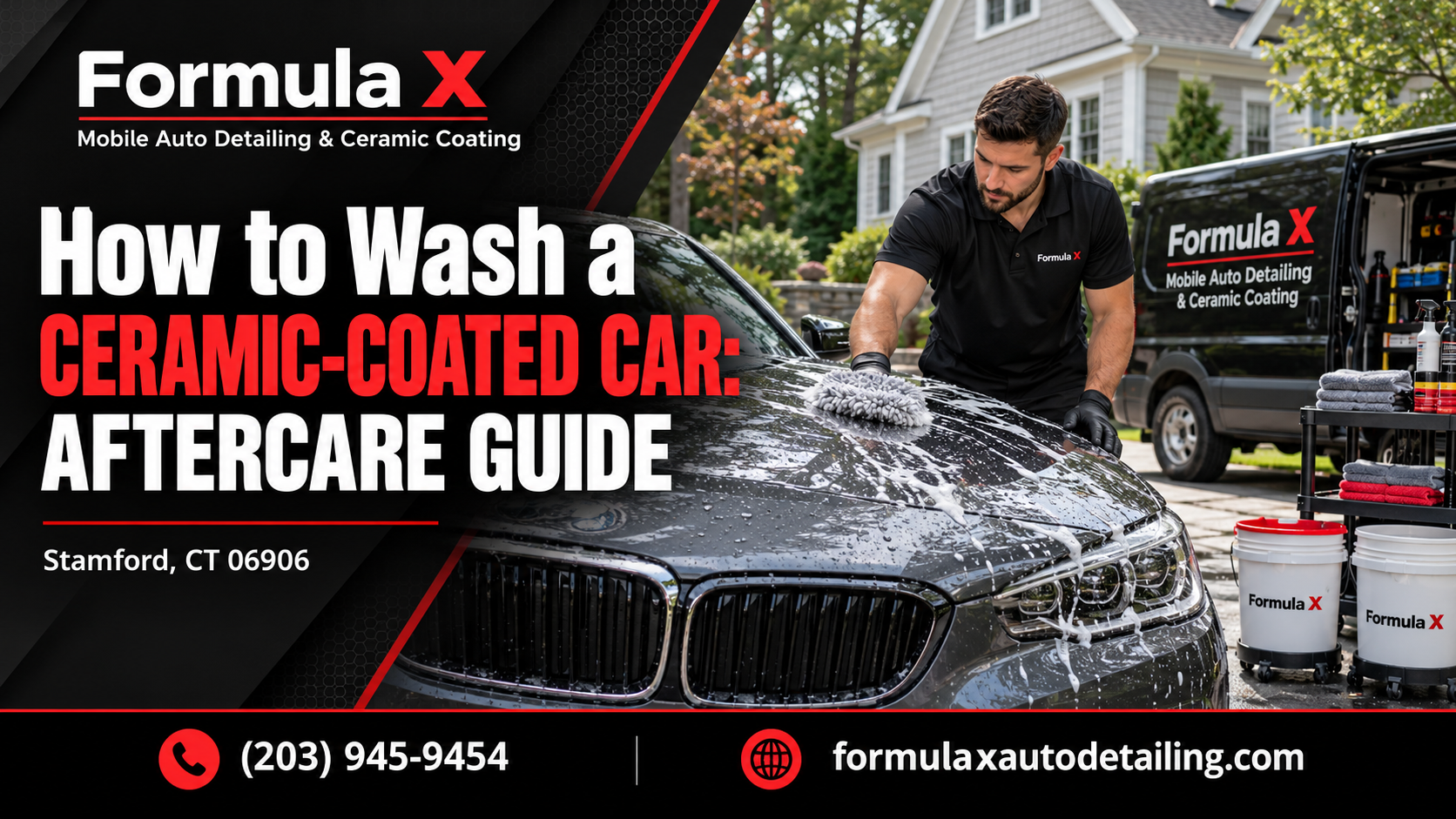
Formula X Mobile Auto Detailing & Ceramic Coating · Ceramic Coating Aftercare Guide
A ceramic coating makes a car easier to wash, but it doesn’t make washing optional, and the way you wash decides how long the coating keeps working. Most coatings that “stop working” haven’t worn away at all; they’ve been clogged with road film and minerals, or slowly abraded by brushes, dry towels, and gritty mitts. The good news is that the routine that keeps a coating healthy is simple, and the manufacturer spells it out. This guide walks through Ceramic Pro’s official aftercare advice step by step: how long to wait after application, how often to wash, which soaps to use and avoid, the two-bucket method, drying, boosters, decontamination, washing through a Connecticut winter, and the annual inspection the warranty depends on. It also covers the mistakes that shorten a coating’s life and how a mobile detailer can help. Formula X Mobile Auto Detailing & Ceramic Coating is based at 48 Union St, Stamford, CT 06906, and can be reached at (203) 945-9454.
How do you wash a ceramic-coated car?
Wait for the coating to cure first; Ceramic Pro says the typical cure takes up to two weeks depending on the coating and recommends waiting that long before washing. After that, wash every two weeks, and do a two-bucket hand wash at least once a month. Use a coating-safe car shampoo with no wax or petroleum distillates and no high or low pH, wash in the shade on panels that are cool to the touch, rinse thoroughly, and dry with a dedicated microfiber drying towel. Avoid drive-thru car washes, hard brushes, and dry wiping. In winter, rinse road salt off more often. Once a year, have a certified installer do a decontamination wash, inspection, and booster; Ceramic Pro’s warranty depends on that annual service.
That routine does two jobs. It removes contamination before it bonds to the coating and clogs its slick surface, and it avoids the friction that slowly wears the coating away. Everything else in this guide is detail on how to do those two things well.
Where the details come from: Aftercare steps come from Ceramic Pro’s official aftercare page, and warranty and annual service terms from its coating warranty document. Road salt details come from the Connecticut General Assembly’s Office of Legislative Research. If your coating is a different brand, follow that manufacturer’s instructions where they differ.
The Ceramic Coating Wash Routine at a Glance
Quick answer: Ceramic Pro’s aftercare page sets out six steps: wash every two weeks, two-bucket hand wash at least monthly, use the right soap, avoid direct sun and warm panels, dry with a dedicated microfiber towel, and follow up with annual inspections. Its list of don’ts is just as important: no hard brushing, no drive-thru car washes, no dry towel wiping.
| Ceramic Pro aftercare step | Why it matters |
|---|---|
| 1. Wash every two weeks | Removes surface debris before it bonds and clogs the coating |
| 2. Two-bucket hand wash at least monthly | Removes stubborn contaminants without dragging grit across the paint |
| 3. Use the right soap | Soaps with wax, petroleum distillates, or high or low pH can harm coating performance |
| 4. Avoid direct sun and warm panels | Soap and water dry too fast and leave spots |
| 5. Dry with a dedicated microfiber towel | Removes standing water and reduces water spotting |
| 6. Annual inspection | Decontamination, inspection, and a booster by a certified installer |
Do
Lubricate the surface with a wash solution or recommended detail spray before touching it, and always use microfiber.
Don’t
Use hard brushes, drive-thru car washes, or dry towels. Don’t leave hard water to dry on the paint.
Watch out for
Shedding trees, sprinklers, bird droppings, and road salt left sitting for weeks.
Once a year
Book the annual service within the window your warranty requires.
The First Two Weeks: Cure Time
Quick answer: Ceramic Pro’s aftercare page says its coatings cure enough to drive outside within 48 hours, that the typical curing process takes up to two weeks depending on the type of coating, and that this is the period it recommends waiting before washing the vehicle. Ask your installer for the exact guidance on your product.
A coating goes on as a liquid and hardens as its solvents evaporate and it cross-links on the surface. It feels dry to the touch quickly, but it keeps hardening for days. During that time it’s more vulnerable to water spotting, chemicals, and friction.
| Period | What to do | What to avoid |
|---|---|---|
| First 48 hours | Keep the car garaged or covered if possible | Rain, dew, sprinklers, and washing |
| Up to two weeks | Drive normally; spot-clean only if necessary | Full washes, soaps, and chemicals |
| If a dropping lands | Lubricate with the recommended detail spray and lift it gently with microfiber | Dry wiping or scrubbing |
| After the cure | Start the regular wash routine | Brush washes, forever |
What if it rains during the cure?
Rain in the first day or two is the most common worry. Light rain on a coating that has had time to flash and set usually leaves water spots rather than real damage, and those are often handled with a gentle wipe using the installer’s recommended product once the cure allows. Heavy rain or sprinklers soon after application are more of a concern. If the car gets wet early, don’t rub at it; let it dry, note any spots, and ask your installer what they want you to do. That’s also why many installers ask owners to keep the car garaged for the first night.
Bird droppings during the cure. Don’t leave them to sit, but don’t scrub them either. Ceramic Pro’s aftercare page says to lubricate the surface with the recommended detail spray or wash solution if you need to clean, and to always use microfiber towels, especially during the curing process.
How Often to Wash a Ceramic-Coated Car
Quick answer: Ceramic Pro recommends washing every two weeks, with a full two-bucket hand wash at least once a month. In salt season, along the shoreline, or under trees, you may need to rinse or wash more often. Frequent gentle washes are better for a coating than rare, heavy ones.
It can seem odd that a car with a coating that “repels dirt” still needs washing every two weeks. The coating makes dirt easier to remove, but dirt still lands on it. Left long enough, road film, pollen, and minerals bond to the surface and fill in the coating’s slick texture, so water stops beading and grime sticks. Washing on schedule keeps that from happening and keeps each wash quick and gentle.
| Situation | Suggested rhythm |
|---|---|
| Garaged, light use | Every two weeks; monthly two-bucket wash |
| Daily driver, parked outside | Every two weeks, plus rinses after rain or heavy pollen |
| Winter salt season | Rinse after storms once roads dry; wash more often |
| Shoreline or under trees | More frequent rinses; remove sap and droppings promptly |
| After a road trip | Wash soon to remove bugs and tar |
Why rare, heavy washes are worse
When a car goes a month or more without washing, the dirt doesn’t just pile up; it bonds. Removing bonded grime takes more pressure, more passes, and sometimes stronger chemicals, all of which wear on a coating. Two light washes a month cause less wear than one hard scrub, and they keep the coating doing its job in between. If two weeks isn’t realistic for you, a mobile maintenance wash on a regular schedule is a practical way to stay on track.
What You Need to Wash a Coated Car
Quick answer: Two buckets, ideally with grit guards, a coating-safe pH-neutral shampoo, soft microfiber wash mitts, a separate set of tools for wheels, a hose with a gentle nozzle or a pressure washer used at a safe distance, an optional foam cannon, and a large microfiber drying towel.
| Item | Why | Tip |
|---|---|---|
| Two buckets | One for soapy water, one for rinsing the mitt | Label them so they never swap |
| Grit guards | Keep dirt at the bottom of the bucket | One in each bucket |
| Coating-safe shampoo | Cleans without leaving wax or stripping the coating | Check the label for “pH neutral” and no wax |
| Microfiber wash mitts | Hold suds and trap grit away from the paint | Use two or more; switch for lower panels |
| Wheel tools | Brake dust is abrasive | Never use them on paint |
| Foam cannon (optional) | Loosens dirt before contact | Ceramic Pro mentions foam guns and cannons for regular home washing |
| Microfiber drying towel | Removes standing water | Keep it only for drying |
| Detail spray | Lubricates spot cleaning between washes | Use the one your installer recommends |
Wash your microfiber properly. Dirty or fabric-softened towels scratch and streak. Wash them separately, without fabric softener, and let them dry fully.
Choosing a Soap for a Ceramic Coating
Quick answer: Ceramic Pro’s aftercare page says the key is not to use car soaps with wax or petroleum distillates, or with high or low pH levels. Choose a pH-neutral shampoo labelled safe for coatings, and skip dish soap, household cleaners, and “wash and wax” products.
Ceramic Pro recommends a dedicated ceramic aftercare shampoo from its partner line, but the rule underneath is what matters: neutral pH, no wax, and no petroleum distillates. Strong alkaline or acidic cleaners can weaken the coating’s surface over time, and wax-containing soaps leave a layer that masks how the coating behaves.
| Product | Use on a coated car? | Why |
|---|---|---|
| pH-neutral, coating-safe shampoo | Yes | Cleans without harming the coating |
| Wash-and-wax soap | No | Contains wax, which Ceramic Pro says to avoid |
| Dish soap | No | Not designed for automotive finishes |
| Strong degreasers and all-purpose cleaners | Not on paint | High pH; keep to wheels or tires as directed |
| Acidic water-spot removers | Only as directed, sparingly | Low pH; ask your installer first |
| Iron remover | Periodically, as part of decontamination | Removes bonded iron particles |
Reading a shampoo label
Look for wording such as “pH neutral,” “pH balanced,” or “safe for coatings,” and check that the product doesn’t describe itself as a “wash and wax” or contain carnauba. Follow the dilution on the bottle; using far more soap than directed doesn’t clean better and can leave residue that’s harder to rinse. If the label is vague, ask your installer which shampoo they use themselves, or use the one they recommend with your coating.
Step-by-Step Two-Bucket Wash for a Coated Car
Quick answer: Work in the shade on cool panels. Clean the wheels first with separate tools, rinse the whole car, pre-foam if you can, then wash top to bottom with a soapy mitt, rinsing the mitt in a clean-water bucket after every panel. Rinse thoroughly and dry right away with a microfiber drying towel.
The two-bucket method exists for one reason: to keep the dirt you’ve just lifted off the car from going back onto it. Ceramic Pro strongly recommends a two-bucket hand wash at least once a month to remove stubborn contaminants such as bird droppings, tree sap, industrial fallout, and pollen build-up.
- Pick the time and place. Shade, early morning, or late afternoon. Touch the paint; if it’s warm, wait.
- Set up two buckets. One with shampoo and water, one with plain water, each with a grit guard.
- Wheels and tires first. Use dedicated wheel brushes and a separate mitt, then rinse them before touching the paint.
- Rinse the whole car. Start at the roof and work down to flush loose dirt and grit.
- Pre-foam (optional). Let the foam dwell briefly, without drying, then rinse.
- Wash top to bottom. Roof, glass, hood, trunk, upper sides, then lower sides and bumpers last.
- Straight, light strokes. Let the mitt and soap do the work; no scrubbing.
- Rinse the mitt after every panel. Dunk it in the clean-water bucket and rub it against the grit guard before reloading with soap.
- Switch mitts for the lower panels. They carry the most grit.
- Final rinse. Rinse from the top down; a coated car should sheet water off quickly.
- Dry immediately. Use a dedicated microfiber drying towel to remove all standing water.
If you drop the mitt, retire it for the day. A mitt that hits the ground picks up grit that will scratch paint, coating or not.
How long a proper wash takes
A careful two-bucket wash on a coated car usually goes faster than on bare paint, because dirt releases easily and water sheets off. Expect most of the time to go into wheels, rinsing, and drying rather than scrubbing. If you find yourself pressing hard to get grime off, stop: that’s a sign the coating is clogged and needs a decontamination wash, not more elbow grease. Pressing harder is how fine scratches get started.
Why top to bottom
The roof, hood, and upper panels are usually the cleanest. The lower doors, rocker panels, and bumpers carry the most road grit and, in winter, salt. Washing upper panels first means the mitt is cleanest when it touches the most visible paint, and the dirtiest work happens last.
Foam Cannons and Pressure Washers
Quick answer: Ceramic Pro’s aftercare page says you can use a foam cannon and a high-pressure hose or pressure washer for regular home washing. Keep a safe distance from the paint, avoid blasting panel edges, film edges, badges, and sensors, and follow your vehicle maker’s guidance on pressure washing.
Foam helps loosen dirt before your mitt touches the paint, which reduces the chance of dragging grit across the surface. A pressure washer used sensibly rinses faster and more thoroughly than a garden hose. Neither replaces a contact wash when the car is truly dirty, but both make that contact wash safer.
| Tool | Good for | Cautions |
|---|---|---|
| Garden hose with gentle nozzle | Rinsing, everyday washes | Low risk; may leave more grit than a pressure washer |
| Pressure washer | Thorough pre-rinse, wheel wells, salt removal | Keep distance from paint, seals, sensors, and film edges |
| Foam cannon | Pre-soaking before a contact wash | Don’t let foam dry on the paint in sun or wind |
| Foam gun on a hose | Similar to a cannon with less foam | Same as above |
Check your owner’s manual. Many vehicle makers give minimum distances and cautions for pressure washing near sensors, cameras, seals, and lights. If your car has paint protection film, Ceramic Pro’s film aftercare advice says to avoid high-pressure hoses along the edges of the film.
Drying Without Scratching or Spotting
Quick answer: Dry right away with a large, clean microfiber drying towel kept only for that job. Blot or drag it lightly across the surface rather than rubbing. Ceramic Pro recommends a dedicated microfiber drying towel to remove all standing water and reduce water spotting.
Drying is where many swirls start. A small, dirty, or rough towel rubbed hard across the paint can undo a careful wash. A coated car helps here, because water sheets off quickly and less towel contact is needed.
- Use a big towel. Fewer passes means less friction.
- Blot or glide. Lay the towel flat and pull it gently, or pat panels dry.
- Use air for gaps. A leaf blower or car dryer clears mirrors, grilles, badges, and door handles where water drips from later.
- Dry the glass and door jambs. Drips from jambs leave streaks on freshly dried paint.
- Don’t let it air-dry in sun. Mineral spots form as water evaporates, especially with hard water.
- Never dry wipe a dusty car. Ceramic Pro lists dry towel wiping among things not to do.
Drying aids
Some owners mist a coating-safe detail spray or drying aid onto the wet panel before drying. It adds lubrication under the towel and can help prevent streaks. Use a product your installer approves, apply it lightly, and keep it off the windshield if it leaves smearing. A dedicated car dryer or a clean leaf blower is another way to cut towel contact, especially on wheels, grilles, and mirror housings where towels catch. Whatever you use, finish by checking the lower edges of the doors and the trunk lid, where water tends to run out after you think you’re done.
Hard water in Fairfield County. Many homes have well water, and irrigation systems are common. Minerals in that water spot paint and glass as it dries. Ceramic Pro says not to leave hard water to dry on the paint, whether from washing or sprinklers, and its warranty excludes hard water spots.
Wheels, Glass, and Trim
Quick answer: Clean wheels first with separate tools, because brake dust is abrasive and corrosive. Coated glass needs only gentle cleaning; avoid harsh glass cleaners. Wash trim with the same gentle soap. If your installer coated wheels, glass, or trim, ask for any product-specific guidance.
| Surface | How to clean | Avoid |
|---|---|---|
| Coated wheels | Shampoo or a mild wheel cleaner; soft wheel brushes | Acid wheel cleaners unless your installer approves |
| Tires | Tire cleaner and a stiff brush, kept off the paint | Slinging tire dressing onto paint |
| Coated glass | Shampoo during the wash; gentle glass cleaner afterward | Ice scrapers more than necessary; abrasive glass polishes |
| Gloss black trim | Very light touch; plenty of lubrication | Dry wiping; it scratches easily |
| Textured plastic trim | Shampoo and a soft brush | Wax residue, which turns white |
If wheels are coated, brake dust and road grime release more easily, but the coating doesn’t stop curb rash or chips. The wheel faces and barrels collect the most salt in winter, so give them extra attention.
Washing a Coated Car Through a Connecticut Winter
Quick answer: Rinse road salt off more often in winter, especially lower panels, wheels, and the undercarriage. Ceramic Pro’s warranty document says road salt can greatly reduce the life of the product if the vehicle isn’t cleaned more often in that season. Wash on mild days or in a heated space, and never scrub salt crust off a dry car.
The Connecticut General Assembly’s Office of Legislative Research describes the state DOT pre-wetting road salt with a magnesium chloride solution, notes those chlorides are corrosive, and says DOT recommends washing cars after snowstorms, including the undercarriage. Salt film sitting on a coating clogs its surface and makes it behave like bare paint; scrubbing that film off dry is how coatings get worn.
| Winter task | How |
|---|---|
| Rinse after storms | Once roads dry; lower doors, rockers, bumpers, wheels, wheel wells |
| Soak before touching | Thorough rinse or foam to dissolve salt before any mitt contact |
| Pick mild days | Midday above freezing, or a heated garage |
| Protect seals and locks | Dry door jambs and seals so they don’t freeze shut |
| Snow removal | Soft foam snow broom on paint; scraper only on glass |
| Spring reset | Decontamination wash to remove winter film |
Pay particular attention to the areas salt hides in: behind the wheels, along the bottom edges of doors, around the rear bumper and exhaust, and inside the fuel and charge port doors. Those spots stay wet and salty longest, and they’re easy to miss on a cold day when you’re rushing to finish.
If washing at home isn’t practical in the cold, a mobile wash on a milder day or a touch-free wash between hand washes is far better than leaving salt for weeks. See how long ceramic coating lasts in Connecticut winters for more on salt and timing.
Bird Droppings, Sap, Bugs, and Water Spots
Quick answer: Remove them soon, gently, and with lubrication. Soften the spot with a detail spray or wash solution, let it dwell, then lift it with a soft microfiber towel. Don’t scrape, scrub, or dry wipe. Ceramic Pro advises not parking under a shedding tree and not letting hard water dry on the paint.
| Contaminant | Why it matters | How to remove it |
|---|---|---|
| Bird droppings | Acidic; can etch if left, especially in heat | Soak with detail spray, wait, lift gently |
| Tree sap | Sticky and hardens over time | Soften with detail spray or a safe sap remover; lift, don’t scrape |
| Bug splatter | Acidic residue on the front end and mirrors | Pre-soak, then wash; a coating makes it release faster |
| Pollen | Builds a sticky film in spring | Rinse thoroughly before any contact |
| Hard water spots | Minerals bond as water dries | Dry promptly; ask your installer about safe spot removers |
| Tar | Picked up from roads and construction | Use a tar remover your installer approves |
Ceramic Pro’s warranty describes its coatings as protecting factory paint from bird droppings, bug splatter, tree sap, and UV, provided they’re maintained under the warranty terms. That protection works best when contaminants are removed promptly rather than left to bake on.
Washing PPF, Matte, and Specialty Finishes
Quick answer: Coated paint protection film washes much like coated paint, but keep high-pressure water away from film edges. Matte and satin finishes need matte-safe soaps and no polishing or wax. Follow your vehicle maker’s care guidance for any specialty finish.
Many coated cars also have clear film on the front end, and some have matte or satin factory paint. The basic routine stays the same: gentle soap, lots of lubrication, clean microfiber, and no brushes. A few details change.
| Finish | Washing notes |
|---|---|
| Coated PPF | Ceramic Pro’s film aftercare says to avoid high-pressure hoses along film edges, no hard brushes or drive-thru washes, and not to leave hard water sitting |
| Matte or satin paint | Matte-safe shampoo; no wax, polish, or gloss-enhancing sprays; blot dry |
| Gloss black trim and pillars | Extra lubrication and a very light touch |
| Chrome and brightwork | Same shampoo; dry promptly to avoid spotting |
| Sensors and camera lenses | Gentle cleaning only; follow your owner’s manual on pressure and distance |
If you’re not sure what finish or film is on your car, ask the installer who coated it, or check the paperwork. Using a gloss product on a matte finish can leave shiny patches that are hard to undo. The Range Rover Sport guide covers satin paint and factory film in more detail.
Decontamination: Unclogging the Coating
Quick answer: Even with regular washing, iron particles, road film, and minerals slowly bond to a coating and reduce its slickness and beading. A decontamination wash, usually an iron remover and sometimes a gentle clay step, removes that bonded layer. Ceramic Pro’s annual inspection includes a detailed decontamination wash for exactly this reason.
Ceramic Pro’s aftercare page explains that the annual inspection lets a certified installer complete a detailed decontamination wash, removing debris from the surface that can “clog the coatings.” Many owners notice that a coating that seemed to have stopped working beads like new again after decontamination. The coating was there all along; it was just buried.
| Decontamination step | What it removes | Notes |
|---|---|---|
| Iron remover | Brake dust and rail dust particles | Often turns purple as it reacts; rinse thoroughly |
| Tar and adhesive remover | Road tar and residue | Use only what your installer approves |
| Mineral or water-spot remover | Hard water deposits | Low pH; use sparingly and as directed |
| Clay | Bonded contamination that chemicals don’t lift | Gentle and well lubricated; ask before claying a coating |
How often? Many owners decontaminate in spring, after salt season, and again before winter, with the annual service covering one of those. If water stops beading or the paint feels rough after a normal wash, it’s probably time.
Boosters and Toppers
Quick answer: A booster or topper is a thin maintenance product applied over a coating to restore slickness and beading. Ceramic Pro’s annual inspection includes applying a coating boost to improve the self-cleaning effect. Between services, use only coating-compatible products your installer recommends, and skip traditional wax.
| Product type | Use on a coated car? | Notes |
|---|---|---|
| Installer-recommended booster | Yes | Usually applied after a decontamination wash |
| Coating-safe detail spray | Yes | Lubricates spot cleaning; some add a little slickness |
| Spray sealant or “ceramic” spray | Ask first | Some are compatible; others can change how the coating behaves |
| Traditional wax | No | Masks the coating; Ceramic Pro says to avoid wax soaps |
| Polish or cleaner wax | No | Abrasives can remove the coating |
Applying a booster to a dirty or contaminated coating seals the contamination in, so a booster should follow a proper wash and decontamination. If you’re unsure which products are compatible with your coating and warranty, ask your installer. Using the wrong product rarely harms paint, but it can complicate a warranty claim. For a broader comparison of these products, see ceramic coating vs. wax vs. sealant.
Want Help Keeping Your Coating at Its Best?
Send Formula X Mobile Auto Detailing & Ceramic Coating your vehicle, when and by whom it was coated, which product or package if you know, how you wash it now, where it’s parked, and a few photos of the paint and how water behaves on it. You’ll hear whether it just needs a proper maintenance wash, a decontamination and booster, or its annual service.
The Annual Inspection and Your Warranty
Quick answer: Ceramic Pro says each of its coating packages requires an annual inspection by a certified installer. Its warranty document describes the service as an exterior wash, decontamination, visual inspection, and a sport coating, booster, or reapplication, due within 30 days before or after the anniversary date. Miss it, and the warranty drops to the package’s minimum term.
These are Ceramic Pro’s terms from its current US coating warranty document (last updated 9/2025), not a promise from Formula X.
| Ceramic Pro package | Warranty with annual services | If an annual service is missed |
|---|---|---|
| Gold | Lifetime of the vehicle | Becomes 5 years from the last consecutive inspection |
| Silver | 5 years | Becomes 2 years from the last consecutive inspection |
| Bronze | 2 years | Becomes 1 year from the last consecutive inspection |
Check which terms apply to you. Formula X’s own Ceramic Pro package cards print 7 years for Gold, 5 years for Silver, and 2 years for Bronze, which isn’t identical to the manufacturer’s current document. Ask Formula X which warranty terms apply to your package and keep the paperwork.
What else the warranty requires
- Fee: the annual service is carried out for a fee set by the installer.
- Claims: Ceramic Pro must be notified of a product performance claim within 30 days of the problem occurring.
- Exclusions: hard water spots, swirl marks, marring, scratches, scuffs, scrapes, chips, and damage from wash brushes and abrasive materials aren’t covered.
- Ownership: the warranty is in the vehicle owner’s name and transfers only if a new owner attends the annual service.
- Records: keep invoices for the installation and every annual service.
What happens at an annual service
Per Ceramic Pro’s description, the installer washes the exterior, carries out a decontamination wash to remove debris that clogs the coating, inspects the coating, and applies a sport coating, booster, or reapplication as needed. It’s also a good moment to point out anything you’ve noticed during the year, such as panels where beading fades early, spots that won’t wash off, or new marks, so they can be looked at while the car is being serviced. Bring your original invoice or warranty details if the service is being done by a different installer from the one who applied the coating.
Put the anniversary date in your calendar the day the coating goes on. The 30-day window on either side is generous, but it’s easy to miss in a busy year.
Automatic and Touch-Free Car Washes
Quick answer: Avoid drive-thru washes with brushes or cloth strips; Ceramic Pro’s aftercare page lists drive-thru car washes and hard brushing among things not to do, and its warranty excludes wash-brush damage. A touch-free wash is gentler and can help in winter between hand washes, but some use strong chemicals, so it isn’t a full substitute.
| Wash type | Risk to the coating | When it might make sense |
|---|---|---|
| Brush or soft-cloth tunnel | High; abrades the coating and paint | Avoid |
| Touch-free automatic | Lower friction; chemicals may be strong | Winter salt rinses between proper washes |
| Self-serve bay | Low if you bring your own mitt and skip the foam brush | Apartment dwellers without a hose |
| Hand wash service | Depends on their method | Ask whether they use two buckets and clean mitts |
| Mobile detailer | Low with proper technique | Regular maintenance at home or work |
Never use the foam brush at a self-serve bay on paint. It’s been dragged across hundreds of dirty cars and dropped on the ground. Use the bay’s rinse and your own mitt and buckets instead.
Rinseless, Waterless, and Mobile Washing
Quick answer: If you live in an apartment, park in a garage, or can’t wash at home, rinseless and waterless products used with plenty of clean microfiber can maintain a lightly dirty coated car. They’re not for heavy dirt or salt crust. A mobile detailer can do proper maintenance washes where you park.
A coating makes these methods work better, because dirt releases easily from the slick surface. The rule is lubrication: plenty of product, many clean towels, light pressure, and a fresh side of the towel for every pass. On a heavily soiled or salty car, any contact without a rinse risks scratching.
- Rinseless wash: a bucket of diluted rinseless solution and several microfiber towels; good for light dust and road film.
- Waterless wash: spray-on, wipe-off; best for very light dust between washes.
- Mobile maintenance wash: a detailer brings water, products, and technique to you, subject to your building’s rules.
If you live or work in a building, guides on mobile detailing at Harbor Point and an office lot in downtown Stamford cover what to ask. Formula X’s mobile detailing and CT mobile car detailing pages describe the service.
Mistakes That Shorten a Coating’s Life
Quick answer: Most coating problems come from washing, not from the coating. Washing too soon, brush car washes, dry wiping, the wrong soap, washing in sun, letting salt or droppings sit, and skipping the annual service are the most common.
Washing during the cure
Ceramic Pro recommends waiting up to two weeks, depending on the coating, before washing.
Brush car washes
Ceramic Pro says no drive-thru car washes or hard brushing, and its warranty excludes wash-brush damage.
Dry wiping dust
Dragging a dry towel over a dusty car scratches it. Always lubricate first.
The wrong soap
Wax, petroleum distillates, or high or low pH soaps are on Ceramic Pro’s avoid list.
Washing in sun
Soap and water dry on hot panels and leave spots. Wash in shade on cool paint.
Leaving salt for weeks
Ceramic Pro says road salt can greatly reduce coating life without more frequent winter cleaning.
Skipping the annual service
Coverage drops to the package minimum, and the coating misses its decontamination and boost.
Signs Your Coating Needs Attention
Quick answer: Fading water beading, paint that feels rough after a wash, dirt that sticks, and spots that won’t wash off usually mean the coating is clogged and needs decontamination and a booster. New swirls mean it’s being abraded, and the washing method needs to change.
| What you notice | Likely cause | What to do |
|---|---|---|
| Beading fades, especially on lower panels | Road film or salt clogging the surface | Decontamination wash, then booster |
| Paint feels gritty after washing | Bonded iron or contamination | Iron remover; gentle clay if your installer agrees |
| Dirt sticks; washing takes longer | Clogged or worn coating | Decontamination; inspection if it doesn’t improve |
| Spots that won’t wash off | Mineral etching | Professional assessment; may need polishing |
| New swirls | Abrasive washing or drying | Change wash method; correction and recoat if widespread |
A simple test helps between washes. After a rinse, watch how water behaves on the hood, the roof, and a lower door. On a healthy coating, it beads tightly or sheets off quickly. If the roof still beads well but the lower doors hold flat, clinging water, the lower panels are clogged or worn. Comparing panels like this tells you whether you need a full decontamination or just more attention where salt and road spray hit hardest.
If a decontamination wash doesn’t bring back the beading, the coating may be worn on those panels. That’s a question for an inspection; sometimes the answer is a booster, sometimes correction and a fresh coating on the most exposed areas. See paint correction and the ceramic coating cost guide for what drives a recoat quote.
A Year-Round Aftercare Schedule
Quick answer: Wash every two weeks year-round, two-bucket at least monthly, decontaminate in spring and fall, rinse salt often in winter, remove sap and droppings promptly in spring and summer, and book the annual service around the anniversary date.
| Season | Focus |
|---|---|
| Winter | Salt rinses after storms; gentle washes on mild days; soft snow broom |
| Spring | Decontamination to remove winter film; pollen rinses; check beading |
| Summer | Wash early or late; remove bugs, sap, and droppings quickly; avoid sprinklers |
| Fall | Clear wet leaves; decontaminate and boost before salt season |
| Anniversary | Annual service within 30 days either side |
If your car is new and you haven’t coated it yet, see should you ceramic coat a brand-new car. If it’s leased, see ceramic coating on a leased car.
How Formula X Helps With Coating Aftercare
Quick answer: Formula X is a mobile service, so maintenance washes, decontamination, boosters, and coating inspections can often happen at your home or office. Formula X publishes detailing package prices of Gold from $495+, Silver from $395+, and Bronze Interior or Bronze Exterior from $295+, with scratches extra; coating, correction, and recoat work is quoted after inspection.
| Need | How Formula X can help |
|---|---|
| Regular maintenance washes | Mobile washing with coating-safe products and technique |
| Clogged coating | Decontamination wash and booster |
| Annual service | Ask whether Formula X can carry out the annual service for your coating and warranty |
| Swirls or etching | Inspection, then paint correction and recoating where needed |
| Interior | Interior detailing packages |
If someone else installed your coating, bring the paperwork showing the product and date. The warranty terms that apply depend on the manufacturer and installer, so it helps to know them before any maintenance work. If your coating is Ceramic Pro from Formula X, ask which warranty terms apply to your package: the package cards and Ceramic Pro’s current document don’t list identical terms.
Ceramic Coating Aftercare Myths
Quick answer: A coated car still needs regular washing, brushes still scratch it, wax doesn’t help it, and lost beading usually means it’s clogged rather than gone.
| Myth | Reality |
|---|---|
| “A coated car doesn’t need washing.” | Ceramic Pro recommends washing every two weeks. |
| “Brush car washes are fine on a coating.” | Ceramic Pro says no drive-thru washes or hard brushing. |
| “Any soap will do.” | Avoid wax, petroleum distillates, and high or low pH. |
| “No beading means the coating is gone.” | It’s often clogged; decontamination usually brings it back. |
| “Waxing on top adds protection.” | Wax masks the coating; use a compatible booster. |
| “The warranty covers anything that happens to the paint.” | Ceramic Pro excludes scratches, swirls, chips, and water spots. |
The underlying idea is simple: the coating is a hard, thin, sacrificial layer, and almost everything that shortens its life involves friction or contamination left too long. Wash gently and often, keep it decontaminated, and let a certified installer service it once a year, and the coating can keep doing its job for as long as the manufacturer intends.
Formula X Mobile Auto Detailing & Ceramic Coating
Formula X Mobile Auto Detailing & Ceramic Coating is a mobile detailing, paint correction, scratch repair, and ceramic coating service based at 48 Union St, Stamford, CT 06906. The team works throughout Stamford, Greenwich, Darien, New Canaan, Norwalk, Rowayton, Westport, and other towns in lower Fairfield County, and Westchester County, NY.
For coated cars, that means maintenance washes done the way the coating manufacturer recommends, decontamination and boosters when a coating is clogged, and quoting correction and recoating after the vehicle has been seen. Formula X publishes detailing package prices of Gold from $495+, Silver from $395+, and Bronze Interior or Bronze Exterior from $295+, with scratches extra; coating work is quoted after inspection.
Call (203) 945-9454, email formulaxautodetail@gmail.com, send a request through the contact page, or view Formula X Mobile Auto Detailing & Ceramic Coating on Google Maps. Address: 48 Union St, Stamford, CT 06906.
Frequently Asked Questions About Washing a Ceramic-Coated Car
How long should I wait to wash my car after ceramic coating?
Ceramic Pro's aftercare page says its coatings cure enough to drive outside within 48 hours and that the typical cure takes up to two weeks depending on the coating, which is the period it recommends waiting before washing. Ask your installer for the guidance on your specific product.
How often should I wash a ceramic-coated car?
Ceramic Pro recommends washing every two weeks and a two-bucket hand wash at least once a month. In winter salt season, near the shoreline, or under trees, you may need to rinse or wash more often.
What soap is safe for a ceramic coating?
Ceramic Pro's aftercare page says not to use car soaps with wax or petroleum distillates, or with high or low pH levels. Use a pH-neutral shampoo labelled safe for coatings, and skip dish soap, household cleaners, and wash-and-wax products.
What is the two-bucket wash method?
One bucket holds soapy water and the other holds plain rinse water, ideally each with a grit guard. After washing each panel, you rinse the mitt in the clean bucket before reloading it with soap, so grit doesn't go back on the paint.
Can I take a ceramic-coated car through an automatic car wash?
Ceramic Pro's aftercare page lists drive-thru car washes and hard brushing among things not to do, and its warranty excludes wash-brush damage. A touch-free wash is gentler and can help between hand washes in winter, but some use strong chemicals.
Can I use a pressure washer on a ceramic coating?
Yes. Ceramic Pro's aftercare page mentions using a foam cannon and pressure washer for regular home washing. Keep a safe distance from paint, seals, sensors, and film edges, and follow your vehicle maker's pressure-washing guidance.
How should I dry a ceramic-coated car?
Ceramic Pro recommends a dedicated microfiber drying towel to remove all standing water and reduce spotting. Use a large, clean towel with light pressure, blow water out of gaps, and never dry wipe a dusty car.
Should I wax a ceramic-coated car?
Generally no. Traditional wax masks the coating's own slickness and water behavior, and Ceramic Pro says to avoid soaps containing wax. Use a coating-compatible booster or detail spray your installer recommends.
What is a ceramic coating booster?
A thin maintenance product applied over a coating, usually after a decontamination wash, to restore slickness and beading. Ceramic Pro's annual inspection includes a coating boost to improve the self-cleaning effect.
Why did my ceramic coating stop beading water?
Usually because road film, salt, or minerals have clogged the surface. A decontamination wash with an iron remover often restores beading. If it doesn't, the coating may be worn on those panels and should be inspected.
How do I wash a coated car in a Connecticut winter?
Rinse salt off more often, especially lower panels, wheels, and the undercarriage, once roads dry. Ceramic Pro's warranty says road salt can greatly reduce coating life if the car isn't cleaned more often in winter. Wash on mild days or in a heated space and never scrub dry salt crust.
Is the annual inspection required for the Ceramic Pro warranty?
Yes. Ceramic Pro's warranty document requires an annual service by a Ceramic Pro installer within 30 days before or after the anniversary date. If it's missed, cover drops to the package's minimum term, for example Gold to 5 years, Silver to 2, and Bronze to 1.
What warranty applies to a Formula X Ceramic Pro coating?
Formula X's package cards print 7 years for Gold, 5 for Silver, and 2 for Bronze, while Ceramic Pro's current US document lists Gold as lifetime of the vehicle with annual services, Silver as 5 years, and Bronze as 2 years. Ask which terms apply to your package and keep the paperwork.
How do I remove bird droppings from a ceramic coating?
Remove them promptly and gently. Soak the spot with the recommended detail spray or wash solution, let it soften, and lift it with a soft microfiber towel. Don't scrape, scrub, or dry wipe.
Where is Formula X Mobile Auto Detailing & Ceramic Coating located?
Formula X Mobile Auto Detailing & Ceramic Coating is based at 48 Union St, Stamford, CT 06906. It's a mobile service working in Stamford, Greenwich, Darien, New Canaan, Norwalk, Rowayton, Westport, and nearby towns, plus Westchester County, NY. Call (203) 945-9454 or email formulaxautodetail@gmail.com.
Find Formula X Mobile Auto Detailing & Ceramic Coating
Formula X Mobile Auto Detailing & Ceramic Coating is a mobile service based at 48 Union St, Stamford, CT 06906. Use the map for directions to the business address, or call (203) 945-9454 to arrange service at your location.
View Formula X Mobile Auto Detailing & Ceramic Coating on Google Maps
Keep Your Coating Working Like New
Call Formula X Mobile Auto Detailing & Ceramic Coating at (203) 945-9454 or send a request with your vehicle, when and by whom it was coated, which product or package if you know, how you wash it now, where it’s parked, and photos of the paint and how water behaves on it. Whether it needs a maintenance wash, a decontamination and booster, or its annual service, the plan starts with seeing the coating.
48 Union St, Stamford, CT 06906 · Serving Stamford, Greenwich, lower Fairfield County, and Westchester County, NY