
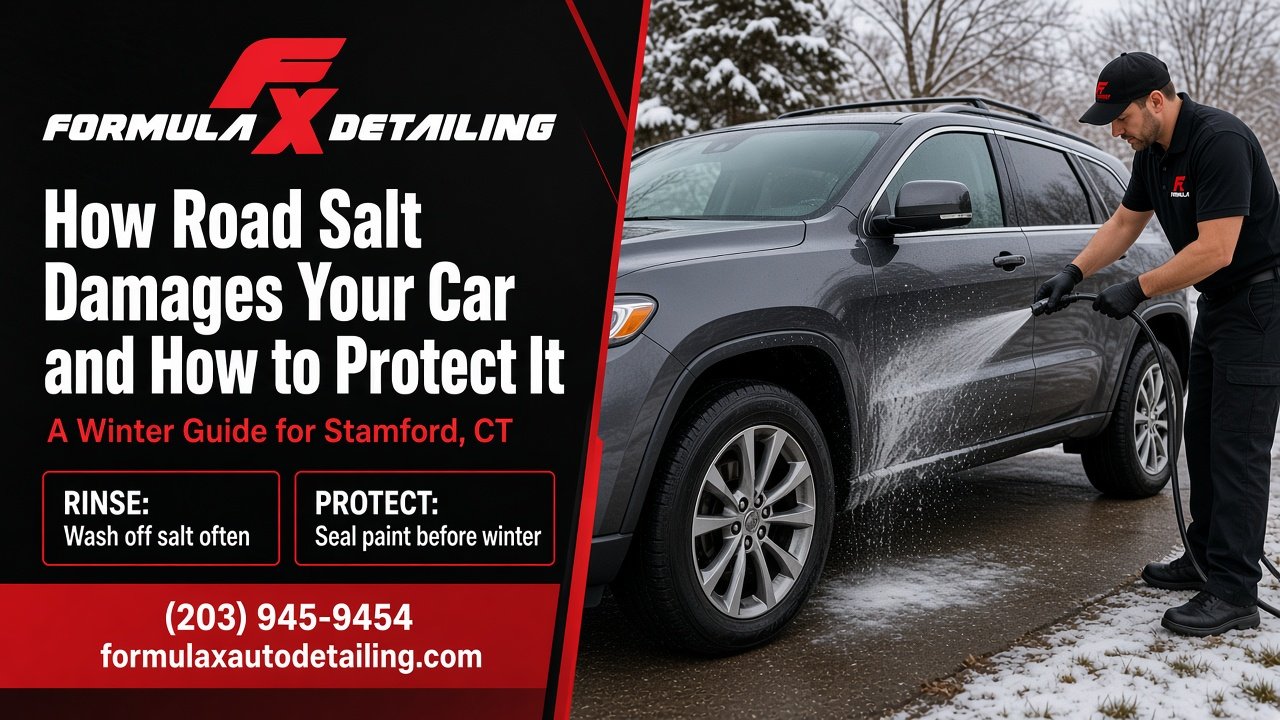
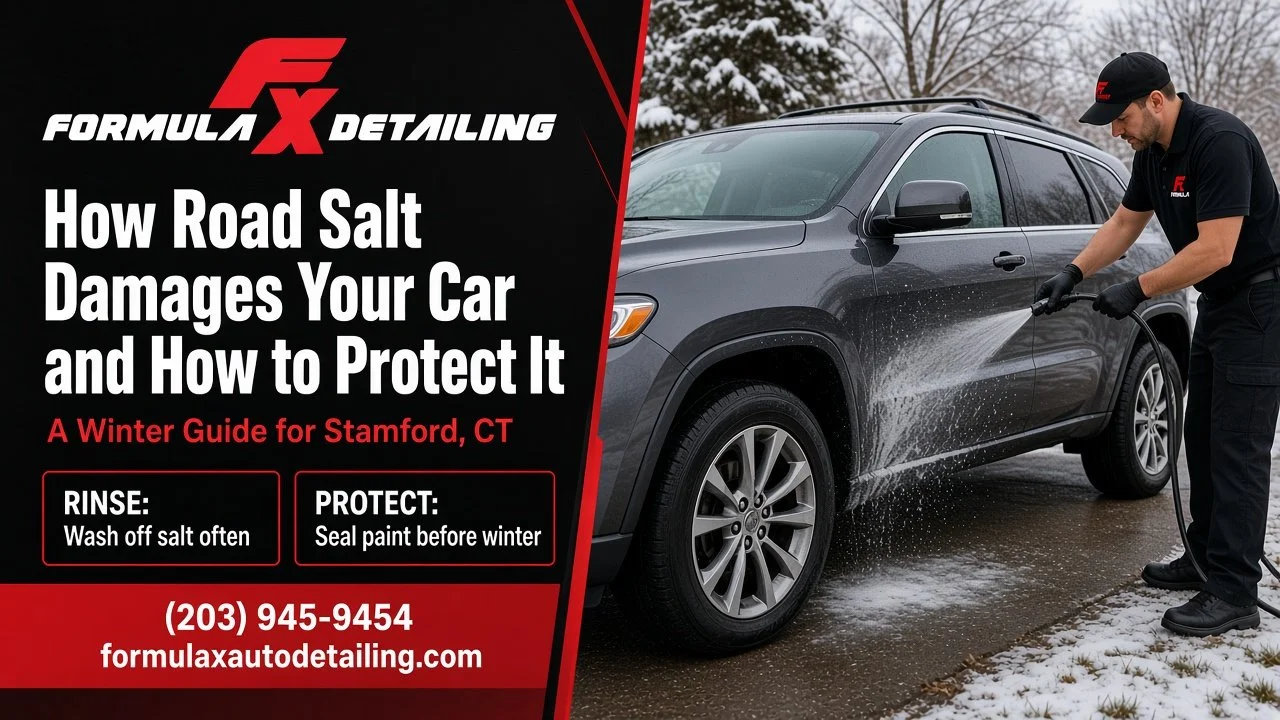
Formula X Mobile Auto Detailing & Ceramic Coating · Road Salt and Your Car
Every Connecticut winter, trucks spread salt and brine on the roads, and every Connecticut car drives through it. The salt keeps roads safer, which is why the state uses it, but it doesn't stop working once it leaves the road. It sprays onto lower panels, packs into wheel wells, coats the underbody, and gets tracked onto the carpet. Mixed with moisture, it speeds up corrosion on bare metal, brake lines, and exhaust parts, dulls and spots paint and wheels, and leaves white rings in the cabin. The good news is that most of the damage is preventable with a few habits: protecting the car before winter, washing salt off regularly once it arrives, paying attention to the parts you can't see, and cleaning up properly in spring. This guide explains what road salt is, how it damages each part of a car, and what actually protects it. Formula X Mobile Auto Detailing & Ceramic Coating is based at 48 Union St, Stamford, CT 06906, and can be reached at (203) 945-9454.
How does road salt damage a car, and how do you protect it?
Road salt and the chloride brines used with it hold moisture against metal and speed up corrosion, especially on the underbody, brake lines, exhaust, wheel wells, and any chip or scratch that exposes bare metal. They also leave a film that dulls paint, stains wheels, and leaves white rings on carpet. To protect a car, clean and seal or coat the paint and wheels before winter, use rubber floor mats, wash the car including the underbody after storms and salty stretches when temperatures allow, touch up chips before they rust, and give the car a thorough cleaning and decontamination in spring.
For the full season, see the winter car care checklist for Fairfield County drivers. For coatings in winter, see how long ceramic coating lasts in Connecticut winters, and for a washing schedule, how often should you get your car detailed?
Where the details come from: How Connecticut treats roads, why magnesium chloride is corrosive, and the DOT's washing advice come from a Connecticut Office of Legislative Research report. Coating care comes from Ceramic Pro and its warranty terms. Wash-water guidance comes from the Long Island Sound Partnership, and floor mat safety from NHTSA. The rest is general detailing practice. Only Formula X's published package prices appear here.
What's Actually on Connecticut Roads
Quick answer: Connecticut's DOT spreads rock salt pre-wetted with liquid magnesium chloride, and most towns use salt pre-treated with magnesium chloride. These chloride deicers melt ice well but are corrosive, and magnesium and calcium chloride hold moisture, which keeps them working on metal longer.
A Connecticut Office of Legislative Research report explains how the state treats roads. The DOT pre-wets rock salt with a liquid magnesium chloride solution so the salt sticks to the road instead of bouncing off, and the chemical draws moisture from the air to form brine that melts snow and ice. The report says the DOT estimated that most municipalities also use salt pre-treated with magnesium chloride.
The same report says chloride deicers are corrosive, that the DOT is aware of their effect on vehicles, and that it considers chloride salts the most effective and economical option for keeping winter roads safe. It notes that calcium and magnesium chloride are especially corrosive because they hold moisture, and that the DOT recommends motorists wash their cars, including undercarriages, after storms to remove salt.
In practical terms, what ends up on your car is a mix of salt, brine, grit, and road grime that stays damp longer than plain water would. That moisture is what makes it so hard on a car.
| Material | What it does on the road | Why it matters for your car |
|---|---|---|
| Rock salt (sodium chloride) | Melts ice and snow | Leaves crusty white residue; corrosive with moisture |
| Magnesium chloride brine | Pre-wets salt; works at lower temperatures | Holds moisture; clings and keeps corrosion active |
| Sand and grit | Adds traction in some areas | Abrasive; can mark paint and glass when wiped |
| Road film | Oils and grime mixed with salt | Dulls paint and glass; hard to rinse off |
How Salt Causes Damage
Quick answer: Salt itself doesn't eat metal. Salt dissolved in water makes a conductive solution that speeds up the chemical reaction that turns steel to rust. Brines that hold moisture keep that reaction going between storms. Anywhere salt can sit, and anywhere bare metal is exposed, is at risk.
Rust is iron reacting with oxygen and water. Salt water conducts electricity far better than plain water, which speeds up that reaction. That's why cars in salt states rust faster than cars in dry, salt-free climates, and why the parts of a car that stay wet with salty slush longest tend to rust first.
Modern cars are much better protected than older ones: many have galvanized steel panels, better paint systems, plastic wheel-well liners, and protective coatings underneath. But protection isn't complete. Stone chips expose bare metal on the hood and lower panels. Brake lines, fasteners, exhaust parts, suspension components, and seams underneath are exposed to spray. And protective coatings wear with age and road debris.
The Connecticut report notes that the DOT also pointed to other factors that make vehicles more vulnerable, including that some manufacturers stopped using a toxic chromium coating on brake lines and electrical connectors in recent years. Whatever the vehicle, the pattern is the same: the longer salt sits, the more damage it can do.
Chips are entry points. A stone chip on a hood or rocker panel that reaches bare metal can start to rust under salty conditions. Touch up chips before winter, or as soon as you find them.
The Underbody, Brake Lines, and Exhaust
Quick answer: The underbody takes the most salt and gets the least attention. Brake lines, fuel lines, suspension parts, fasteners, exhaust systems, and seams are all exposed. Rinse the underbody after salty stretches, and have it checked by a mechanic as part of normal maintenance.
Every time you drive on wet, salted roads, the tires throw brine onto the underside of the car. It collects on frame rails, crossmembers, suspension arms, brake and fuel lines, the exhaust, and in seams and pockets. Because you can't see it, it's easy to leave it there all winter.
The Connecticut report specifically says the DOT recommends washing undercarriages regularly in winter. An underbody rinse, whether from an underbody spray at a car wash, a dedicated underbody wand, or careful rinsing at home, removes much of the salt before it can sit for weeks.
Detailing focuses on cleaning, not repair. If you see heavy rust, flaking metal, or anything that looks wrong on brake lines, suspension, or the exhaust, have a mechanic look at it. Brake lines in particular are safety components.
| Underbody part | Why it's at risk | What helps |
|---|---|---|
| Brake and fuel lines | Thin metal exposed to spray | Regular rinsing; mechanic inspection |
| Frame and crossmembers | Large surfaces holding brine | Rinsing; inspection for coating damage |
| Suspension parts | Spray and grit | Rinsing; inspection |
| Exhaust | Heat cycles plus salt | Rinsing; inspection |
| Seams and pockets | Trap slush and salt | Thorough rinsing from several angles |
Paint and Clear Coat
Quick answer: Salt and road film dull paint, and the grit mixed with them scratches it when it's wiped or brushed off dry. On intact paint, salt is mostly a cleaning problem. The real risk is at chips and scratches that reach bare metal, where rust can start and spread under the paint.
A car driven through a salty week develops a gray-white film, heaviest on the lower doors, rocker panels, rear bumper, and behind the wheels. On healthy clear coat, that film is mainly cosmetic, but it's gritty, so wiping it off with a dry towel or brushing snow off with a stiff brush drags grit across the paint and leaves fine scratches. That's one reason winter swirl marks are so common.
The more serious damage happens where the paint is already broken. A chip through to bare steel on the hood edge, a scratch on a door, or a scuff on a rocker panel gives salty moisture a direct path to metal. Rust can start there and creep under the surrounding paint, showing up later as bubbling.
Protecting the paint before winter helps on both fronts: a layer of wax, sealant, or coating makes salt film easier to wash off, and touching up chips closes the entry points. For chips and scratches, see can a car scratch be buffed out? and Formula X's scratch repair page.
Wheels, Tires, and Brake Dust
Quick answer: Salt, brine, and brake dust combine into a hard, corrosive crust on wheels, especially in the barrels and around the lug nuts. It can pit and stain finishes, particularly on polished, chrome, or damaged wheels. Clean wheels at every wash and protect them before winter.
Wheels sit closest to the road and the brakes, so they get the heaviest mix of salt, brine, and metallic brake dust. Left on, that mix bonds to the finish. Painted and clear-coated wheels usually clean up if they're washed regularly. Polished, chrome, and machined finishes are more vulnerable, and any wheel with curb rash or chips can corrode where the finish is broken.
Clean wheels with a dedicated brush and a wheel cleaner suited to the finish, never the same mitt used on paint. A sealant or coating on the wheels before winter makes brake dust and salt release more easily. Some drivers switch to a separate set of winter wheels and tires, which keeps their best wheels out of the salt entirely.
Glass, Wipers, and Visibility
Quick answer: Salt spray leaves a haze on the windshield that smears when wipers run dry. Keep the washer reservoir full of winter washer fluid, replace worn blades, and clean the glass inside and out. NHTSA recommends a full reservoir of winter fluid with de-icer and working wipers and defrosters before winter.
Driving behind other cars on wet, salted roads coats the windshield with brine. When it dries, it leaves a white haze, and when the wipers run on it without enough fluid, it smears into a glare-filled film. NHTSA notes that a single snowstorm can use a lot of washer fluid, and recommends a full reservoir of winter fluid with de-icer, working defrosters and wipers, and replacing worn blades.
Clean glass also matters inside. Winter heater use and damp clothing fog windows and leave a film on the inside of the windshield. A thorough glass clean inside and out before winter, and every few weeks during it, keeps visibility clear. A glass sealant on the outside helps water and slush bead off.
Interior Salt Stains and Carpet
Quick answer: Salty slush on boots leaves white rings on carpet and mats as it dries. Left in place, the salt stiffens and wears carpet fibers and can hold moisture under the carpet. Use rubber mats, empty them often, and clean salt stains early with warm water and suitable cleaners or extraction.
The white rings on winter carpets are salt left behind as slush evaporates. They're unsightly, and the salt crystals act like grit, wearing carpet fibers each time someone steps on them. Salt also holds moisture, so a carpet that never fully dries in winter can develop a musty smell.
Deep-groove rubber or all-weather mats catch most of it. NHTSA suggests considering thicker or rubber mats for slushy conditions and stresses using mats that are the correct size, installed with retention clips, so they can't interfere with the pedals. Empty and rinse them often, and don't stack a rubber mat on top of a carpet mat.
For stains that already formed, warm water lifts much of the salt; a carpet cleaner and extraction remove the rest. Formula X's Bronze Interior and Gold packages include carpet shampoo. For more, see interior deep clean on a Honda Odyssey.
Protecting the Car Before Winter
Quick answer: Before the first storm, wash and decontaminate the paint, add wax, sealant, or a coating, protect the wheels, touch up chips, clean and treat the glass, switch to rubber mats, and lubricate door seals. A car that goes into winter clean and protected washes up much more easily all season.
Wash and decontaminate
Remove fall grime, sap, and iron particles so protection bonds.
Add protection
Wax, sealant, or coating on paint; sealant on wheels.
Touch up chips
Close bare-metal entry points before salt arrives.
Treat the glass
Clean inside and out; consider a glass sealant.
Rubber mats
Keep salty slush off the carpet.
Door seals
A rubber-safe protectant helps prevent freezing.
Timing matters. Many protection products need mild temperatures to apply and cure properly, so late fall, before temperatures drop, is the window. Formula X's Gold and Bronze Exterior packages include a ceramic sealer with about six months of durability, which is roughly a winter. For longer protection, see ceramic coatings in Connecticut.
Wax, Sealant, Ceramic Coating, or Film?
Quick answer: All of them make salt easier to wash off. Wax is the shortest-lived, sealants last longer, and ceramic coatings last the longest and resist chemicals better. Paint protection film physically blocks chips on high-impact areas. None replaces washing, and none protects the underbody.
| Protection | Typical role | Winter notes |
|---|---|---|
| Wax | Gloss and light protection | Shortest durability; may not last a full salt season |
| Sealant | Synthetic protection | Longer than wax; a good pre-winter choice |
| Ceramic coating | Durable chemical-resistant layer | Makes salt film release easily; needs correct aftercare and annual service |
| Paint protection film | Physical barrier on impact areas | Helps against stone chips on the front end |
| Underbody coatings | Barrier on the underside | A mechanic or undercoating specialist's job, not a detailer's |
For a deeper comparison, see ceramic coating vs. wax vs. sealant. Coatings are quoted after the paint is inspected. If you choose a coating, note the warranty question: Formula X's package cards list Gold at 7 years, Silver at 5, and Bronze at 2, while Ceramic Pro's U.S. warranty terms describe Gold as lifetime with annual service. Ask which terms apply and get them in writing.
How to Wash Salt Off in Winter
Quick answer: Wash after storms and salty stretches when temperatures allow, ideally on a day above freezing. Rinse thoroughly first, including the underbody and wheel wells, wash gently with clean mitts, dry door jambs and seals, and avoid leaving the car wet in freezing temperatures.
- Pick the day. A day above freezing, or a heated garage, so water doesn't freeze on paint or in locks and seals.
- Rinse first and long. Loosen and flush salt and grit before anything touches the paint, including wheel wells, lower panels, and the underbody.
- Wheels separately. Use dedicated brushes and cleaner.
- Gentle wash. Clean mitts and a two-bucket or similar method; work top down.
- Rinse again. Especially lower panels and jambs, where salt hides.
- Dry carefully. Soft towels or air; open doors and dry jambs, seals, and the fuel door.
- Treat the seals. A rubber-safe protectant on door seals helps prevent freezing.
If you wash at home, think about runoff. The Long Island Sound Partnership notes that driveway wash water carries soap, grit, and grease to storm drains that lead to Long Island Sound. Washing where water can drain to grass, using biodegradable soap, or using a car wash that recycles water helps.
Brush washes in winter. Automatic brush washes can remove salt but also drag grit across the paint, a common source of swirl marks. Touchless washes with an underbody spray are gentler for in-between rinses.
How Often to Wash Off Salt
Quick answer: Wash as often as temperatures allow after each storm or salty stretch, often weekly in a heavy winter. Even a rinse focused on the lower panels, wheel wells, and underbody helps between full washes.
| Conditions | Suggested washing |
|---|---|
| Dry, cold weeks with no treatment | Every 2 weeks |
| After a storm with salted roads | As soon as temperatures allow |
| Repeated storms or brine days | Weekly, or rinse between washes |
| Heavy commuting on I-95 or the Merritt | Weekly in salt season |
| Garaged, rarely driven | After any salty drive |
For coated cars, Ceramic Pro's aftercare guidance calls for washing about every two weeks, a two-bucket hand wash at least monthly, avoiding drive-through brush washes, and an annual inspection. In winter, salt is the reason not to stretch those intervals. For the full schedule, see how often should you get your car detailed?
Door Jambs, Seals, and Hidden Spots
Quick answer: Salt collects in places a normal wash misses: door jambs, the bottoms of doors, the trunk and hatch openings, the fuel-door area, behind the bumpers, and inside wheel wells. Open the doors and clean them every few washes in winter.
Slush thrown up by the tires and carried in on boots finds its way into door jambs and the bottom edges of doors, where drain holes can clog. The trunk or hatch opening collects drips from the roof. The fuel-door area collects spray. None of these get much attention in a quick wash.
Open each door, rinse or wipe the jambs and sills, and make sure door drain holes along the bottom edge aren't blocked. Clean the trunk opening and the area under the fuel door. Behind the bumpers and inside wheel wells, a long rinse from several angles helps.
Door jambs
Wipe or rinse every few washes.
Door bottoms
Check drain holes are clear.
Trunk opening
Wipe drips and residue.
Wheel wells
Rinse from several angles.
Spring Cleanup: Getting the Salt Out
Quick answer: In spring, give the car a thorough wash, underbody rinse, iron and clay decontamination, wheel cleaning, door-jamb cleaning, and interior salt-stain extraction, then refresh the paint protection. Spring is when you find out what winter did, so inspect for chips and rust spots.
By March, salt has worked into every seam. A normal wash removes the surface layer, but salt and iron particles stay bonded to the paint and wheels, and salt rings sit in the carpet. A spring detail clears all of that and refreshes protection for the months ahead.
It's also inspection time. With the car clean, look closely at the hood edge, the front bumper, the lower doors, and the rocker panels for chips, scratches, and any bubbling. Small spots are far easier to address now than after another year.
| Spring task | Why |
|---|---|
| Thorough wash with underbody rinse | Removes accumulated salt |
| Iron and clay decontamination | Removes bonded particles that washing leaves |
| Wheel deep clean | Removes brake dust and salt crust |
| Door jambs and seals | Clears hidden salt |
| Interior extraction | Removes salt stains from carpet and mats |
| Fresh protection | Replaces wax or sealant worn by winter |
| Chip and rust check | Catches damage early |
EVs, New Cars, and Leases
Quick answer: EVs face the same salt as any car, with extra attention needed around charge ports and the underbody, which often houses the battery pack's protective structure. New cars benefit most from protection before their first winter. Leased cars should be cleaned and inspected before turn-in.
Electric vehicles don't have exhaust systems, but they have plenty of underbody components, often including the battery enclosure, and charge ports that collect salty grime. Follow your owner's manual for washing guidance around ports and sensors. See ceramic coating for Teslas and EVs for more.
A new car going into its first Connecticut winter is the best candidate for protection, because the paint is in its best condition. See should you ceramic coat a brand-new car? For leased cars, salt stains, chips, and rust spots can count at turn-in; see is ceramic coating worth it on a leased car?
Classic and Garaged Cars
Quick answer: Many owners keep classic and collector cars off salted roads entirely. If one gets caught on salt, wash it promptly and thoroughly. For garaged daily drivers, a warm garage can actually speed corrosion if a salty car sits wet in it, so rinse before parking when possible.
Older cars often lack the galvanizing and corrosion protection of modern ones, so salt is more dangerous to them. Most classic owners store them for the winter after a full detail. See paint correction on a classic Corvette for an example of how older paint differs.
For daily drivers, a garage is a big help, but a heated garage has a catch: a salty, slushy car parked in a warm space stays wet longer, and corrosion reactions run faster in warmth. Knock off slush, rinse the car when you can, and make sure the garage floor drains or dries.
Mistakes to Avoid
Quick answer: Common mistakes are skipping winter washes, ignoring the underbody, wiping salt off dry, using stiff brushes on paint, leaving chips unrepaired, letting salt rings set in carpet, stacking floor mats, and skipping the spring cleanup.
No winter washes
Salt sits for months.
Ignoring the underbody
Where the worst corrosion happens.
Dry wiping
Drags grit across the paint.
Stiff snow brushes
Scratch paint; use a soft brush or foam tool.
Unrepaired chips
Bare metal rusts fastest.
Stacked mats
Can interfere with pedals; NHTSA warns against poorly fitted mats.
Myths About Road Salt
Quick answer: Washing in winter isn't pointless, cold doesn't stop salt damage, a coating doesn't protect the underbody, and a brand-new car isn't immune. Rain doesn't wash salt off either.
| Myth | Reality |
|---|---|
| No point washing until spring | The DOT recommends washing after storms and regularly in winter. |
| Cold weather stops corrosion | It slows it; brines stay damp and active, and warm garages speed it up. |
| A ceramic coating protects everything | It helps paint and wheels; it doesn't protect the underbody. |
| New cars don't rust | Chips and exposed metal can rust on any car. |
| Rain rinses salt away | Rain moves some salt around; it doesn't clean seams, jambs, or the underbody. |
Warning Signs of Salt Damage
Quick answer: Look for orange or brown spots at chips, bubbling paint along wheel arches, rocker panels, and door bottoms, flaking metal underneath, crusty or pitted wheels, white rings on carpet, and a soft or spongy brake pedal. Anything involving brakes goes to a mechanic right away.
Salt damage usually starts small and in places people don't look. The first sign on paint is often a tiny orange or brown dot inside a stone chip on the hood or front bumper. Later it can show up as bubbling under the paint along the wheel arches, the bottom edges of doors, the rocker panels, and the lower tailgate, where slush sits longest.
Underneath, surface rust on steel parts is common on cars of any age in salt states and isn't automatically a problem. Flaking, layered rust, holes, or rust on brake and fuel lines is different and needs a mechanic. Inside, white rings on carpet and a damp, musty smell under the mats are signs salt and moisture are sitting in the floor.
| Sign | Where to look | What to do |
|---|---|---|
| Rust dot in a chip | Hood edge, front bumper, mirrors | Clean and touch up promptly |
| Bubbling paint | Wheel arches, door bottoms, rockers, tailgate | Have it assessed by a body shop |
| Flaking or layered rust | Underbody, frame, suspension | Mechanic inspection |
| Rusty brake or fuel lines | Along the underbody | Mechanic right away |
| Crusted or pitted wheels | Barrels, spokes, lug nut area | Deep clean; protect; refinish if needed |
| White rings and damp smell | Carpet and under mats | Extract the salt and dry the carpet |
Brakes are a safety issue, not a cosmetic one. A spongy pedal, a brake warning light, or visible fluid near a wheel means stop and get the car to a mechanic. Detailing can rinse salt off, but it isn't a brake inspection.
Want Your Car Ready for Salt Season?
Tell Formula X Mobile Auto Detailing & Ceramic Coating the vehicle, how it's parked, whether there's a garage, how much you drive in winter, and any chips or existing protection, with a few photos. You'll get a straight recommendation on pre-winter protection and a washing plan, and any correction or coating is quoted after the paint has been seen.
Salt Exposure on Fairfield County Roads
Quick answer: Highway commuters on I-95, the Merritt Parkway, and Route 7 pick up a lot of brine spray from traffic, while drivers on local roads deal with slush, grit, and snowbank splash. Parking outdoors near the coast adds damp salt air. More driving on treated roads means more frequent washing.
Exposure varies a lot depending on how and where you drive. Highways are treated early and often, and the spray thrown up by other vehicles coats the whole lower half of a car with fine brine mist, including the windshield. Local roads in towns like Stamford, Greenwich, Darien, and Norwalk tend to have more slush, grit, and snowbank splash at intersections and driveways.
Where you park matters too. A car parked outdoors near the Sound sees damp, salty air on top of road salt, while a car parked in an apartment garage, like many around Harbor Point, gets shelter from snow but can sit wet in a warm space. A car that sits in a station lot all day in slush gets a different pattern of exposure than one that stays in a driveway.
None of this needs to be precise. The rule is simple: the more treated miles you drive and the longer the car stays wet, the more often it needs a rinse. For apartment and garage parking, see mobile detailing at Harbor Point, and for office lots, office parking lot detailing in downtown Stamford.
| Driving pattern | Typical exposure | Washing focus |
|---|---|---|
| Daily highway commute | Heavy brine spray, windshield film | Weekly washes; glass and lower panels |
| Local errands | Slush, grit, snowbank splash | Wheel wells, rockers, mats |
| Outdoor coastal parking | Damp salty air plus road salt | Regular washes; protection on paint |
| Heated garage parking | Salt stays wet in warmth | Rinse before parking when possible |
| Station lot commuter | Long sits in slush | Underbody and jambs |
What to Keep at Home for Salt Season
Quick answer: A useful winter kit includes a soft snow brush or foam snow tool, a plastic ice scraper, deep-groove rubber mats, winter washer fluid, a separate wheel brush, clean microfiber mitts and towels, a rubber-safe seal protectant, and a stiff mat brush for knocking off salt.
You don't need a garage full of products to keep salt under control. A few tools used often do most of the work, and the right ones avoid creating new damage while removing salt.
| Item | Why it helps | Watch out for |
|---|---|---|
| Soft snow brush or foam tool | Clears snow without dragging grit | Stiff bristles scratch paint |
| Plastic ice scraper | Clears glass | Never use it on paint |
| Deep-groove rubber mats | Contain salty slush | Correct fit and retention clips |
| Winter washer fluid | Clears brine haze | Keep the reservoir full |
| Separate wheel brush | Keeps brake dust off paint mitts | Mixing it with paint tools |
| Clean microfiber mitts and towels | Gentle on paint | Dropped mitts pick up grit |
| Rubber-safe seal protectant | Helps stop doors freezing | Products not made for rubber |
| Stiff mat brush | Knocks salt off rubber mats | Using it on carpet or upholstery |
If you want to see how the washing steps fit together on a coated car, see how to wash a ceramic-coated car. For the full list of what to check before the first storm, see the winter car care checklist.
Trim, Headlights, and Exterior Plastics
Quick answer: Salt film dries out and whitens black plastic trim, hazes headlight lenses, and sticks to rubber seals. Clean these surfaces when you wash, treat bare plastic and rubber with protectants made for them, and keep lights clear for visibility.
Unpainted black trim, bumper inserts, and mirror bases are porous and hold salt film, which leaves them chalky and gray by spring. A wash followed by a trim protectant or dressing restores the look and makes the next round of salt easier to rinse. Formula X's Silver package includes dressed trim and tires.
Headlights and taillights collect the same brine film as the windshield, and dirty lights reduce how far you can see and how well you're seen. NHTSA recommends checking headlights, brake lights, turn signals, and flashers before winter. A quick wipe with a clean, damp microfiber at fuel stops goes a long way.
Rubber door and window seals pick up salt and grit too. Wipe them clean and treat them with a rubber-safe protectant so they stay supple and don't freeze to the frame on cold mornings.
Salt, Resale Value, and Lease Returns
Quick answer: Rust spots, bubbling paint, crusted wheels, and stained carpet all make a car look older at trade-in or lease return. Regular winter washes and a spring reset protect appearance, and any chips or rust found early are cheaper to address.
Buyers and inspectors look at the same places salt attacks first: lower panels, wheel arches, wheels, and the carpet. A car that has had regular winter washes, protected paint, rubber mats, and a spring detail generally presents much better than one that went three winters without attention, even if the mileage is the same.
For leased cars, turn-in inspections typically separate normal wear from excess wear, and visible damage like rust spots or stained carpet can be judged against the lease terms. Read your lease's wear-and-use guide well before turn-in, and handle cleaning and small repairs early. See is ceramic coating worth it on a leased car? and mobile scratch repair vs. a body shop.
Clearing Snow and Ice Without Damaging the Car
Quick answer: Use a soft snow brush or foam tool, push snow off rather than dragging it, never use a scraper on paint, and let the defroster loosen ice on glass. Connecticut law requires clearing accumulated snow and ice from the hood, trunk, and roof before driving.
Snow on a car isn't just snow. After a storm it often sits on a layer of salt film and grit from the last drive, so the way it's cleared matters. A stiff bristle brush dragged across the hood moves that grit across the paint, and a plastic scraper used on paint will scratch it. A soft brush or foam snow tool, used to push snow off in sections, is far gentler.
On glass, start the car and let the defroster soften ice before scraping, and don't pour hot water on a frozen windshield, which can crack it. Clear the roof too: Connecticut's motor vehicle statutes (section 14-252a) require drivers to remove accumulated ice and snow from the hood, trunk, and roof so it doesn't threaten people or property while driving, and fines rise if dislodged snow or ice causes injury or damage.
Once the car is clear, knock slush out of the wheel wells by hand or with a soft tool if it's packed in, and keep the exhaust area clear before running the engine, which NHTSA stresses because of carbon monoxide risk.
Soft brush or foam tool
Push snow off; don't scrub.
Defrost first
Let ice soften before scraping glass.
No hot water
Temperature shock can crack glass.
Clear the roof
Required under Connecticut law.
Clear the exhaust
Carbon monoxide risk if blocked.
Quick Decision Guide: What Your Car Needs This Winter
Quick answer: If the car is new or the paint is good, protect it before winter. If the paint is swirled or chipped, address chips and consider correction before protection. If the interior already has salt rings, extract them early. Everyone benefits from rubber mats and regular underbody rinses.
| Your situation | Before winter | During winter | Spring |
|---|---|---|---|
| New car, good paint | Sealant or coating; wheels protected | Regular washes and rinses | Decontaminate; refresh |
| Older car, swirled paint | Wash, clay, protection; correction quoted after inspection | Gentle washes | Inspect chips; refresh |
| Lots of chips | Touch up chips first | Watch for rust dots | Re-check and repair |
| Already-coated car | Inspection and top-up per aftercare | Wash about every 2 weeks or more | Annual service |
| Salt-stained carpet | Rubber mats; extraction | Empty mats often | Full interior extraction |
| Garaged weekend car | Full detail and protection | Rinse after any salty drive | Spring detail |
Not sure where your car fits? Send photos through the contact page and ask for a recommendation. Correction and coatings are quoted after inspection, and you'll know what each option involves before deciding.
Storing a Car Through Winter
Quick answer: If a car will sit out the winter, detail it fully first: wash, decontaminate, protect the paint, clean the interior, and make sure it's completely dry. Store it somewhere dry and ventilated, follow the owner's manual for battery and tire care, and check on it periodically.
Some Fairfield County households keep a second car, a convertible, or a classic off the road from December to March. Storage avoids salt entirely, but how the car goes into storage matters. A car parked with salt film on the paint, road grime underneath, and damp carpet will spend months with all of that sitting on it.
Before storage, give it a thorough wash including the underbody and wheel wells, decontaminate and protect the paint, clean and dry the interior completely, and remove anything that could hold moisture or attract pests, such as food wrappers and damp floor mats. A breathable car cover, not a plastic tarp, keeps dust off without trapping moisture.
Mechanical storage steps, such as battery maintainers, fuel, and tire pressure, vary by vehicle, so follow the owner's manual or a mechanic's advice. NHTSA notes that tire pressure drops as temperatures fall and that batteries lose power in the cold, both of which matter for a car that sits.
When the car comes out in spring, give it a wash and a once-over before the first drive, check the tires and battery, and look under the cover for any moisture, droppings, or new marks. A car stored clean and dry usually needs only a light refresh before it is ready for the season, and staying off salted roads all winter keeps its paint, wheels, and underbody in far better shape.
| Storage step | Why it matters |
|---|---|
| Full wash and underbody rinse | Nothing corrosive sits for months |
| Paint protection | Guards against dust and moisture |
| Interior cleaned and fully dry | Prevents musty smells and mildew |
| Breathable cover | Keeps dust off without trapping moisture |
| Battery and tire care per manual | Cold drains batteries and lowers pressure |
| Periodic checks | Catch leaks, pests, or moisture early |
How Formula X Helps With Salt Season
Quick answer: Formula X is a mobile service based in Stamford that can prepare a car before winter, clean it during salt season when conditions allow, and reset it in spring. Detailing packages have published starting prices; correction and coatings are quoted after inspection.
| Package | Starting price | Salt-season role |
|---|---|---|
| Gold (interior + exterior) | $495+ | Pre-winter or spring reset: wash, clay, ceramic sealer (about 6 months), interior steam and carpet shampoo |
| Silver (interior + exterior) | $395+ | Lighter visit with a 6+ month wax |
| Bronze Exterior | $295+ | Hand wash, clay bar, ceramic sealer (6 months), tire shine |
| Bronze Interior | $295+ | Salt-stain cleanup with carpet and upholstery shampoo |
Formula X Mobile Auto Detailing & Ceramic Coating brings detailing, paint correction, scratch repair, and Ceramic Pro coatings to homes and workplaces in Stamford and nearby towns, including Darien, Norwalk, Greenwich, New Canaan, and Westport. See all service areas and the work gallery.
Winter exterior work depends on temperature and conditions, so a garage or a mild day is needed; interior work is more flexible. Same-day appointments may be available when the schedule allows; call to check. Underbody coatings and rust repair are mechanic or body shop work, not detailing.
Formula X Mobile Auto Detailing & Ceramic Coating
Formula X Mobile Auto Detailing & Ceramic Coating is a mobile detailing, paint correction, scratch repair, and ceramic coating service based at 48 Union St, Stamford, CT 06906. The team works throughout Stamford, Greenwich, Darien, New Canaan, Norwalk, Rowayton, Westport, and other towns in lower Fairfield County, and Westchester County, NY.
For salt season, that means protecting the car before winter, cleaning it when temperatures and conditions allow, and resetting it in spring, with correction and coatings quoted after inspection.
Call (203) 945-9454, email formulaxautodetail@gmail.com, send a request through the contact page, or view Formula X Mobile Auto Detailing & Ceramic Coating on Google Maps. Address: 48 Union St, Stamford, CT 06906.
Frequently Asked Questions About Road Salt and Your Car
How does road salt damage a car?
Salt dissolved in water speeds up corrosion of bare metal, and the magnesium chloride brine Connecticut uses holds moisture, keeping it active. It attacks the underbody, brake lines, exhaust, wheel wells, and chips that expose metal, and it dulls paint, crusts wheels, and stains carpet.
What does Connecticut put on the roads in winter?
A Connecticut Office of Legislative Research report says the state DOT spreads rock salt pre-wetted with liquid magnesium chloride, and that most towns use salt pre-treated with magnesium chloride. Both are chloride deicers, which are corrosive.
How often should I wash my car in winter?
As often as temperatures allow after storms and salty stretches, often weekly in a heavy winter. The Connecticut DOT recommends washing cars, including undercarriages, after snowstorms and regularly in winter.
Is it bad to wash a car when it's below freezing?
Water can freeze on paint, in door seals, and in locks. Wash on a day above freezing or in a heated garage, dry door jambs and seals, and don't leave the car wet in freezing temperatures.
Does an underbody wash help?
Yes. The underbody collects the most salt and is where much of the corrosion risk is. An underbody rinse after salty stretches removes salt before it sits for weeks. Have a mechanic inspect brake lines and underbody parts as part of normal maintenance.
Does ceramic coating protect against road salt?
It helps the paint and wheels by making salt film release more easily and resisting chemicals, but it doesn't protect the underbody and doesn't replace washing. Coatings need their own aftercare and annual service.
Should I wax my car before winter?
Yes, or use a sealant or coating. Protection makes salt easier to wash off. Apply it in late fall while temperatures are still mild enough for it to bond and cure.
How do I get salt stains out of car carpet?
Vacuum, then blot with warm water to dissolve the salt, and use a carpet cleaner or extraction to remove the rest. Rubber mats prevent most stains. Formula X's Bronze Interior and Gold packages include carpet shampoo.
Are automatic car washes OK in winter?
Touchless washes with an underbody spray are a reasonable way to rinse salt between hand washes. Brush washes can drag grit across the paint and cause swirl marks.
Can road salt cause rust on a new car?
Modern cars are well protected, but chips and scratches that reach bare metal can rust on any car, and underbody parts are exposed. Touch up chips and wash regularly.
What should I do in spring after salt season?
Wash thoroughly with an underbody rinse, decontaminate paint and wheels, clean door jambs, extract salt stains from the carpet, refresh protection, and inspect for chips and rust spots.
Can Formula X detail my car in winter?
Interior work is possible most of the year. Exterior work needs a garage or a day mild enough that water won't freeze. Same-day appointments may be available when the schedule allows; call (203) 945-9454 to check.
How much does a pre-winter detail cost at Formula X?
Published packages are Gold from $495+, Silver from $395+, Bronze Interior from $295+, and Bronze Exterior from $295+, with extra charges for scratches, heavy soil, sap, hard water spots, and pet hair. Correction and coatings are quoted after inspection.
Where is Formula X Mobile Auto Detailing & Ceramic Coating located?
Formula X Mobile Auto Detailing & Ceramic Coating is based at 48 Union St, Stamford, CT 06906. It's a mobile service working in Stamford, Greenwich, Darien, New Canaan, Norwalk, Rowayton, Westport, and other lower Fairfield County towns, and Westchester County, NY. Call (203) 945-9454.
Find Formula X Mobile Auto Detailing & Ceramic Coating
Formula X Mobile Auto Detailing & Ceramic Coating is a mobile service based at 48 Union St, Stamford, CT 06906. Use the map for directions to the business address, or call (203) 945-9454 to arrange service at your location.
View Formula X Mobile Auto Detailing & Ceramic Coating on Google Maps
Protect Your Car Before the Salt Trucks Roll
Call Formula X Mobile Auto Detailing & Ceramic Coating at (203) 945-9454 or send a request with your vehicle, where it’s parked, how much you drive in winter, any chips or existing protection, and photos. You’ll get a straight recommendation on pre-winter protection, and correction or coatings are quoted after inspection.
48 Union St, Stamford, CT 06906 · Serving Stamford, Greenwich, lower Fairfield County, and Westchester County, NY