
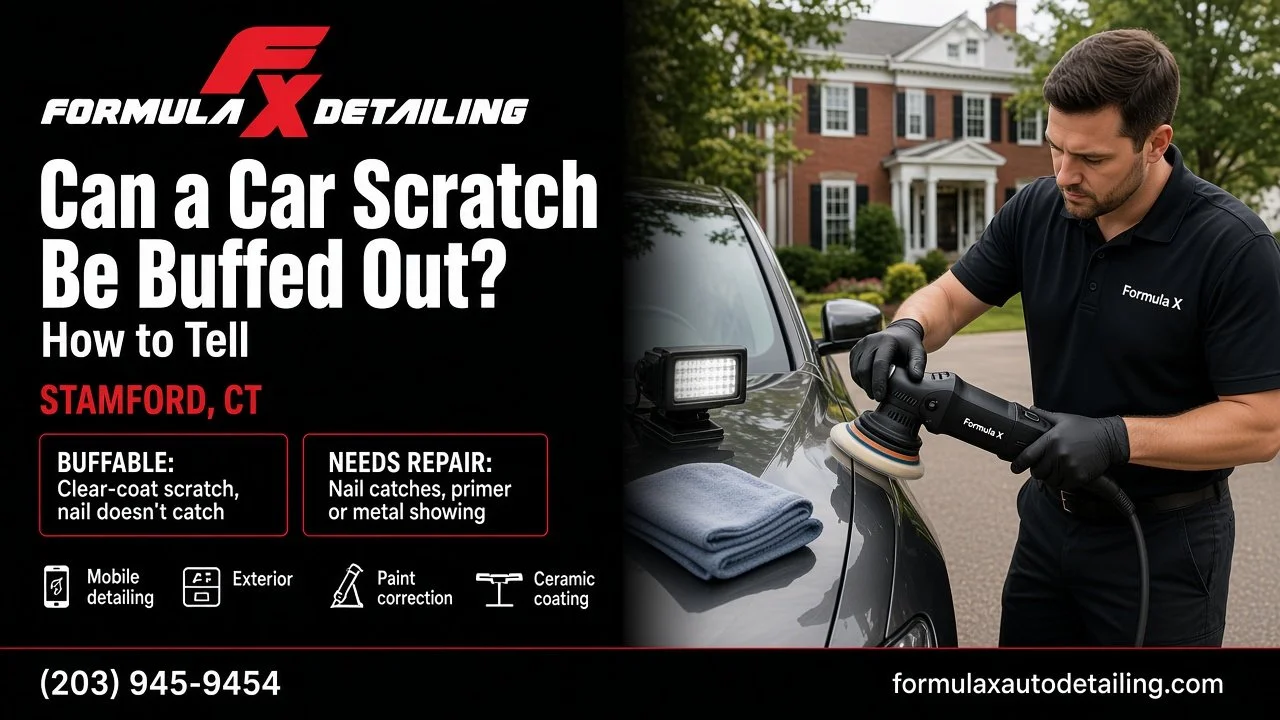
Formula X Mobile Auto Detailing & Ceramic Coating · Scratch Diagnosis Guide
Most people find a scratch the same way: a flash of white line in the sun, a run of the thumb across it, and the question of whether a detailer can make it go away. Sometimes the answer is yes in under an hour. Sometimes polishing would only thin the paint around a groove that will never level out. This guide shows how to tell the difference before anyone touches the car. It explains how thin the paint really is, how to do the fingernail test properly and where it misleads, what the color at the bottom of a scratch tells you, how wet and light tests narrow it down, which scratch types buff out and which need touch-up or refinishing, and what Connecticut winters do to a scratch you leave alone. Formula X Mobile Auto Detailing & Ceramic Coating is based at 48 Union St, Stamford, CT 06906, and can be reached at (203) 945-9454.
Can a car scratch be buffed out?
A scratch can usually be buffed out when it sits only in the clear coat, the top transparent layer of paint. The quickest home check: run a clean fingernail gently across it. If the nail glides over it and the groove looks white or silver rather than showing a different color, it is most likely a clear coat scratch that machine polishing can remove or greatly reduce. If the nail catches, or you can see the base color, gray primer, black plastic, or bare metal at the bottom, the scratch has gone deeper than polishing can fix. It then needs touch-up paint, a fill-and-level repair, or refinishing of the panel. The fingernail test is a starting point, not a verdict; a trained inspection under proper light, and ideally a paint-depth reading, decides it.
Formula X handles clear coat scratches with polishing and paint correction, and deeper chips and scratches through its mobile scratch repair service. Panels that need to be resprayed are a body shop job, and this guide explains how to recognize them. If you are deciding between those routes, read mobile scratch repair vs. body shop next.
Where the details come from: Paint layer thicknesses come from a Ford paint research presentation published by NIST and the gauge maker DeFelsko. The fingernail test wording comes from 3M’s Scratch Removal System instructions. Clear coat removal risks come from I-CAR. Connecticut road treatment comes from the Office of Legislative Research. The rest is general detailing practice. Scratch repair is quoted after inspection, so this guide gives no repair prices.
Buffable or Not: The Short Version
Quick answer: Depth decides it. Marks confined to the clear coat can usually be polished out. Marks that reach the color coat can be made less visible but not erased by polishing alone. Marks that reach primer, plastic, or metal need paint put back, and a panel with long, wide, or numerous deep scratches may need refinishing.
| Where the scratch stops | What you usually see and feel | Can it be buffed out? | Usual fix |
|---|---|---|---|
| Surface marring or residue | Haze, fine lines, or a smear that may wipe partly away | Yes, often easily | Cleaning, then a light polish |
| Clear coat, shallow | White or silver line; nail glides over it | Yes, in most cases | Machine polish or one-step correction |
| Clear coat, deeper | Sharper line; nail may just tick on it | Often reduced, sometimes removed | Compound and polish, or careful spot sanding, after a depth check |
| Into the color coat | Line shows a duller or slightly different shade; nail catches | Reduced only | Touch-up or fill-and-level, then polish |
| Through to primer | Gray, white, or tan line underneath | No | Touch-up or fill-and-level; refinish if long or wide |
| Bare metal or plastic | Silver metal or black plastic visible | No | Seal and fill soon; refinish for an invisible result |
| Peeling or failing clear coat | Flaking edges, cloudy patches, lifting film | No; polishing can make it worse | Panel refinishing |
Polish territory
Clear coat only. The groove edges are leveled until they stop catching light.
Touch-up territory
Color or primer is missing. Paint has to go back into the groove.
Refinish territory
Long, wide, or many deep scratches, or failing clear coat across a panel.
The rule
Diagnose first. Polishing a scratch that cannot level costs clear coat for nothing.
How Thin Car Paint Really Is
Quick answer: A factory paint system is a stack of very thin layers. In a Ford engineering presentation, the clear coat is about 45 microns, the base color 10 to 20, and primer about 25, over an electrocoat. DeFelsko puts typical clear coat at 35 to 50 microns (1.5 to 2.0 mils) and most total factory readings at 100 to 180 microns. A sheet of copy paper is roughly 100 microns.
Every buffing decision comes back to one number: how much clear coat sits above the color. The presentation Ford’s paint and corrosion research lead gave at a NIST workshop lays out a typical body paint system from the top down. Clear coat around 45 microns supplies gloss and protects the basecoat from ultraviolet light. Basecoat of 10 to 20 microns carries the color and any metallic flake. Primer of about 25 microns smooths the electrocoat and protects it from light. An electrocoat of about 20 microns and a phosphate layer give corrosion protection to the steel or aluminum underneath.
DeFelsko, which makes the paint gauges many detailers use, gives a similar picture from the measuring side. Clear coat usually runs 1.5 to 2.0 mils, or 35 to 50 microns. Most factory paint jobs read about 4 to 7 mils in total, or 100 to 180 microns, though DeFelsko notes some roofs measure as little as 3 mils and some SUV rocker panels as much as 17. There is no single correct number for every car. Consistency across a panel matters more.
| Layer | Typical thickness | Job | What a scratch into it looks like |
|---|---|---|---|
| Clear coat | About 35–50 microns | Gloss, depth, UV protection for the color | White or silver line; color looks intact underneath |
| Basecoat (color) | About 10–20 microns | Color and metallic or pearl effect | Duller line in the paint color, sometimes a shade off |
| Primer | About 25 microns | Smoothing, adhesion, protection of the e-coat | Gray, white, or tan line |
| Electrocoat and pretreatment | About 20 microns plus phosphate | Corrosion protection | Dark gray or black layer just above metal |
| Substrate | Steel, aluminum, plastic, or composite | The panel itself | Bright metal, or black or gray plastic |
Two practical points follow from those numbers. First, the clear coat is thin enough that a scratch you can catch with a nail has very likely used up a large share of it, and may have reached the color. Second, the color layer is thinner than the clear. Once a scratch goes through clear and into the basecoat, there is very little material left before primer, and polishing cannot replace any of it.
Not every car follows the stack. Some solid colors, older cars, and commercial vehicles use single-stage paint, where color and gloss are one layer. On single-stage paint, polishing removes pigment, which shows as color on the pad. A detailer should recognize this before treating it like clear coat.
Why a Scratch Looks White Even When Nothing White Is There
Quick answer: A scratch is a groove with sharp edges. Those edges scatter light in all directions instead of reflecting it cleanly, so the groove shows as a bright or white line. Polishing works by rounding and lowering the surrounding surface until the edges stop scattering light. It doesn’t fill the groove; it brings the surface down to meet it.
Look at a clear coat scratch from straight on in shade and it may almost disappear. Tilt your head until a light source sits in the reflection near it and it lights up. That is scattered light, and it is why scratch visibility changes so much with conditions. Under a garage LED or in low October sun, a mark that was invisible at noon can look like a crack.
This matters for diagnosis in two ways. Width and depth are different things: a wide, shallow scuff can look dramatic yet level out quickly, while a thin, sharp key line can look modest and run much deeper. And because polishing lowers the surface around the scratch rather than adding anything, a scratch can be “gone” to the eye while a trace of the groove remains, simply because its edges have been softened enough to stop throwing light. That is a legitimate result, and often the safest one. It is also why detailers talk about reducing a scratch as often as removing it.
Depth, width, and edges
Three features predict how a clear coat scratch will respond. Depth sets how much material has to come off the surrounding surface. Width affects how visible the remaining trace will be. Sharp edges, typical of key marks and grit dragged under a towel, catch light strongly but often respond well because the edges are what polishing attacks first. Rounded, wide marks, like those left by a soft object brushing past, may look worse than they are.
The Fingernail Test, Done Properly
Quick answer: Clean the area, then drag a fingernail slowly across the scratch at a right angle, with light pressure. 3M’s instructions for its scratch removal kit say: if you can feel the scratch but your nail does not catch, the kit is suitable; if your nail catches or you can see metal, follow the manufacturer’s repair procedure or see a professional. Treat “catches” as a sign of deeper damage, not proof of it.
The fingernail test survives because it is quick, free, and reasonably reliable at sorting surface marks from deep ones. It is also easy to do badly. A few rules make it far more useful.
- Wash or wipe the spot first. Grit on the panel will make your nail drag and can add new scratches as you test. A quick rinse, or a clean damp microfiber laid on and lifted off, is enough.
- Use a clean nail and almost no pressure. You are feeling for a ledge, not pressing into the paint.
- Cross the scratch, don’t follow it. Move at a right angle to the line, slowly, in both directions. A groove catches more clearly against its sharper edge.
- Test several points along the line. Many scratches are deepest where the object first hit and shallower at the tail. One section may be polish territory while another isn’t.
- Compare with a known feel. Run the nail over an undamaged area next to it, then over the scratch. The difference is what you are reading.
Where the test misleads
The test is a gauge of feel, and feel is not a measuring tool. It can mislead in both directions.
- Raised edges. Some scratches push material up at the edges. The nail can catch on that ridge even when the groove itself is shallow. These often respond better to polishing than the test suggests.
- Paint transfer. A smear of someone else’s paint or a rubber mark can feel like a ridge and look like a scratch. Much of it may come off with the right cleaner before any polishing.
- Thin, sharp cuts. A very narrow scratch can be deep enough to reach color yet too narrow for a fingernail to drop into. The color in the groove is the better clue here.
- Thin or previously polished paint. If earlier work has already thinned the clear coat, even a scratch that doesn’t catch may not be safe to chase. Only a gauge reading shows that.
- Textured or soft materials. On textured plastic trim, wrap film, and matte paint, the test tells you little, because none of those should be polished like gloss clear coat.
Don’t keep testing a scratch you already know catches. Repeated scraping with a nail, a coin, or a credit card can widen the edges and pick at a chip. Once it catches clearly and shows color or primer, the test has done its job.
What the Color in the Groove Tells You
Quick answer: Look into the scratch with a flashlight held at an angle. White or silver with the paint color intact around and beneath it points to clear coat. The paint color looking dull or slightly off inside the line points to basecoat. Gray, white, or tan points to primer. Shiny silver means bare steel or aluminum, and black or dark gray usually means plastic or e-coat.
Color is often a more honest clue than feel, because it shows which layer is exposed rather than how sharp the edge is. A phone flashlight held low to the panel and a phone camera zoomed in on the groove work well. Shade the area from direct sun, which washes everything out to white.
| What you see in the groove | Likely layer reached | What it means for buffing |
|---|---|---|
| White or silvery line, paint color clearly intact | Clear coat | Good candidate for polishing |
| Line that disappears when wet, returns when dry | Clear coat | Good candidate; see the wet test below |
| Paint color visible but dull, flat, or a shade lighter | Into the basecoat | Polishing reduces it; touch-up usually needed to hide it |
| Gray, white, tan, or light green layer | Primer | Can’t be buffed out; needs paint |
| Dark gray or black film just above metal | Electrocoat | Needs paint; protect it soon |
| Bright silver metal | Bare steel or aluminum | Needs sealing and paint promptly, especially in winter |
| Black, gray, or textured base on a bumper | Plastic substrate | Needs paint; flexible parts may need flex-additive refinishing |
| Rust-brown staining or bubbling at the edges | Corroding steel | Past cosmetic repair; the rust has to be treated |
White and silver paint colors are the exception that confuses everyone. On a white car, a primer-deep scratch can look almost the same as a clear coat scratch, and on a silver car, bare metal can blend in. On those colors, rely more on the wet test, the nail, and a professional look under magnification.
Wet, Light, and Angle Tests
Quick answer: Wet the scratch with clean water or a quick-detailer spray. If it nearly vanishes while wet and returns as it dries, the liquid is filling a shallow clear coat groove and polishing will likely work. If it stays clearly visible while wet, it is deeper. Then check it under a single strong light from several angles to judge its full length and depth.
The wet test
A liquid sitting in a groove bends light much as the clear coat does, so it temporarily hides shallow marks. That is also why water hides swirl marks in the rain and a fresh wax can make light scratches look better for a week or two. If a mark all but disappears when wet, the groove is shallow relative to the clear. If it barely changes, the edges are deep or the color is missing.
The single-light test
Overhead fluorescent light and overcast sky hide scratches. A single point of light reveals them. In the evening, hold a phone flashlight or an LED torch about a foot from the panel and move it along the scratch. Watch for the ends of the line, branching marks you didn’t notice, and any chip where the scratch started. Direct sun does the same job during the day.
The angle test
Look along the panel from low and to the side. A scratch that changes the reflection’s shape, or a nearby dent that bends a straight reflection, means more is going on than a scratch. A dent under a scratch changes the repair entirely, because polishing can’t touch the dent and paintless dent repair or bodywork may be needed first.
Location matters too
Where a scratch sits affects what can safely be done. Edges and body lines carry thinner paint and burn through easily, so detailers polish them gently or tape them off. Areas near parking sensors and radar units in bumpers carry manufacturer limits on paint work. Plastic bumpers, mirror caps, and door handles behave differently from steel panels. A scratch in the middle of a flat door is the easiest place to polish.
A Step-by-Step Diagnosis
Quick answer: Clean it, check whether it is transfer or a true scratch, run the nail test along its length, look at the color in the groove, wet it, check for a dent, then note the panel, the material, and the car’s paint history. Those answers point to polish, spot correction, touch-up, or refinish, and a test spot by the detailer confirms it.
Clean it
Wash or wipe the area so dirt and residue don’t pose as damage.
Rule out transfer
Is something sitting on the paint rather than cut into it? Raised and off-color marks often are.
Nail test
Glides, ticks, or catches, at several points along the line.
Groove color
White, color, primer, plastic, or metal under an angled light.
Wet test
Vanishes when wet, or stays sharp.
Dent and edge check
Any dent, crease, body line, or panel edge involved.
Material and history
Plastic, steel, aluminum, matte, wrapped, or repainted.
Test spot
The least aggressive pad and polish that shows progress, checked after each pass.
| Your findings | Most likely outcome |
|---|---|
| Nail glides, white line, disappears when wet, no dent | Polish or one-step correction should remove or nearly remove it |
| Nail ticks lightly, white line, fades when wet | Compounding and polishing, after a paint reading; may be reduced rather than erased |
| Nail catches, color visible in the groove | Touch-up or fill-and-level, then polish to blend |
| Primer, plastic, or metal visible, short and narrow | Touch-up or fill-and-level; seal metal soon |
| Primer or metal visible across a long or wide area | Panel refinishing at a body shop |
| Scratch over a dent or crease | Dent work first, then paint work as needed |
| Flaking, cloudy, or peeling clear coat | Refinish; don’t polish |
Common Scratches and Their Usual Verdict
Quick answer: Car-wash marring, door-handle fingernail marks, and light branch scrapes usually buff out. Shopping-cart and bag scuffs often do, once transfer is removed. Key scratches, deep branch gouges, and stone chips usually don’t, because they reach color, primer, or metal. Bumper scrapes depend on depth and whether the plastic is torn.
| Scratch type | Typical cause | Usual depth | Usual verdict |
|---|---|---|---|
| Swirls and wash marring | Brush washes, dry wiping, dirty mitts | Shallow clear coat | Buffs out with polishing |
| Door-handle cups | Fingernails and rings | Shallow to moderate clear coat | Usually buffs out; gentle work in a tight curve |
| Trunk and hatch lip | Bags, boxes, buckles | Shallow to moderate | Often buffs out; deeper marks need touch-up |
| Branch and brush scrapes | Narrow driveways, hedges, trails | Varies along the length | Light ones polish out; gouges need paint |
| Shopping cart or door ding scuff | Contact with another surface | Often transfer plus a light mark | Clean off transfer, then polish what remains |
| Key scratch | Deliberate, hard metal edge | Usually into color or primer | Rarely buffs out fully; fill-and-level or refinish |
| Stone chips | Highway debris | Often to primer or metal | Touch-up, not polishing |
| Bumper corner scrape | Garage walls, posts, curbs | Clear to plastic | Light ones polish; deep or torn ones need refinishing or repair |
| Pet claw marks | Dogs jumping at doors | Clear coat, sometimes deeper | Usually polish; deep clusters may need touch-up |
The same object can leave very different damage. A branch that brushes a car at walking speed leaves a light mark; the same branch at 30 mph leaves a gouge. That is why the verdict always comes from looking at the scratch, not from its cause. The cause still helps, because it predicts which part of a long scratch is deepest and whether transfer is involved.
Paint Transfer: The Scratch That Isn’t
Quick answer: When a car rubs against another car, a pole, a garage wall, or a cart, it often picks up a layer of that object’s paint or rubber. It looks like a scratch and can feel raised. Much of it can be removed with the right cleaner, clay, or light polish, leaving a smaller mark than you expected. Check for transfer before you assume a repair is needed.
Transfer has a few tells. It is often a different color from your paint: white or yellow from a post, black from a rubber bumper, red or blue from another car. It sits on top of the surface, so it feels raised or rough rather than grooved. And it usually covers an area rather than forming a clean line.
A detailer will normally try the gentlest removal first: a dedicated cleaner, then clay, and only then polish. The goal is to lift the foreign material without cutting into your clear coat. What remains after the transfer comes off is the true damage, and that is the part to diagnose with the nail and color tests. Plenty of “I need a body shop” scuffs turn out to be mostly transfer with light marring underneath.
Avoid harsh solvents on your own. Lacquer thinner, acetone, and similar solvents can soften clear coat and damage plastic trim. Strong household abrasives scratch. If a cleaner meant for automotive paint doesn’t lift the transfer, leave it for a professional.
Bumpers, Trim, and Other Materials
Quick answer: Painted plastic bumpers can be polished like other painted panels, carefully, because heat builds faster on plastic and edges are thin. Unpainted textured trim can’t be buffed; it is cleaned, dressed, or replaced. Matte paint, vinyl wrap, and paint protection film follow their own rules and should not be machine-polished as gloss paint.
| Surface | Can scratches be buffed? | Notes |
|---|---|---|
| Painted steel or aluminum panel | Yes, if clear coat only | The standard case; edges and body lines need care |
| Painted plastic bumper or mirror cap | Yes, if clear coat only, with care | Heat builds quickly; sensor zones carry manufacturer limits |
| Unpainted textured plastic trim | No | Clean and treat; deep gouges mean replacement or specialist repair |
| Gloss black “piano” trim | Sometimes, very gently | Soft and thin; some is plastic with a thin coating |
| Matte or satin paint | No | Polishing adds gloss and ruins the finish |
| Paint protection film | Light marks may self-heal with warmth | Deep cuts mean replacing the film section, not polishing |
| Vinyl wrap | No | Damaged sections are rewrapped |
| Headlight lenses | Yes, as lens restoration | Different process and a UV-protective finish afterward |
Sensor zones deserve their own mention. Modern bumpers house parking sensors and radar units, and some carmakers restrict paint work around them. I-CAR’s summary of BMW refinishing standards, for example, says damaged ultrasonic sensors must not be repainted by hand and must not be heated above 85°C (185°F). Light polishing is a different thing from repainting, but it is a reason to keep heat low and stay clear of the sensors themselves. Formula X’s BMW X5 scratch repair article covers that in detail.
What Buffing Actually Removes
Quick answer: Buffing, polishing, and compounding all remove a thin layer of clear coat to level the surface. DeFelsko states that most automakers recommend removing no more than about 0.3 mil (8 microns) of clear coat, because the clear also carries the UV protection for the color beneath. On a typical 35- to 50-micron clear coat, that leaves little room to chase a deep scratch.
“Buff it out” is shop shorthand that hides what happens. A machine polisher spins a pad loaded with abrasive polish. The abrasives cut the peaks of the surface down, a little at a time, until the area around a scratch is closer to the scratch’s floor. The finer the polish, the smoother the result and the less material removed. 3M’s instructions for its own scratch removal kit put it plainly: removing a defect means removing a very thin layer of the clear coat, and excessive sanding or compounding can cut through into the color, which then needs repainting.
The 8-micron figure is DeFelsko’s attribution to “most auto manufacturers,” not a number from a named carmaker document, so treat it as a working guide rather than a rule. It still makes the point. If a scratch is 15 microns deep in a 40-micron clear coat, removing it fully would take far more than that guide allows across the area around it. In practice, careful detailers level a deep scratch partway, round its edges so it stops catching light, and stop while plenty of clear coat remains.
I-CAR’s guidance on paint film thickness lists what goes wrong when too much clear coat is removed: hazing, discoloration, peeling, and failure of the finish. Those failures don’t always show on the day. They can appear after a year or two of sun, which is why thinned clear coat is a quiet problem that sellers of aggressive buffing rarely mention.
Polish, compound, and machine choice
Compounds carry coarser abrasive and cut faster; polishes carry finer abrasive and finish better. A dual-action polisher oscillates as it spins, which spreads heat and is more forgiving. A rotary polisher spins on one axis, cuts faster, and can burn an edge in seconds in the wrong hands. Formula X’s guide to one-step vs. multi-stage paint correction explains how the stages are chosen. For a single scratch, the approach is usually a spot repair: the smallest area, the gentlest combination that shows progress, and an inspection after every pass.
Paint-Depth Readings and Repaints
Quick answer: A paint thickness gauge measures the total paint above the metal, not the clear coat alone. It still tells a detailer a lot: whether a panel is unusually thin, whether it has been repainted, and whether the area around a scratch can spare any material. Low or uneven readings mean lighter work or no machine work at all.
Most handheld gauges read the whole stack on steel or aluminum panels. They can’t separate the clear from the color on a factory finish, and plain magnetic gauges don’t read plastic bumpers or composite panels at all. So a gauge doesn’t tell anyone “you have 38 microns of clear left.” What it does show is useful.
- Thin panels. A reading well below the rest of the car can mean earlier heavy polishing or a thin factory finish. That panel gets the gentlest approach.
- Repaints. Readings much higher than the rest of the car often mean a repaint. DeFelsko notes that repainted panels make buffing harder to judge, because the refinish clear may be thinner, softer, or applied differently.
- Consistency. Readings across the panel, including right beside the scratch, show whether the surrounding area is typical for the car.
DeFelsko’s own advice is that on thin coatings or paint of unknown thickness, hand polishing may be the only safe option. That is the conservative end of the spectrum, and it is a reasonable answer for a scratch on an older car with a history nobody knows.
Removed vs. Reduced: What “Buffed Out” Really Means
Quick answer: Shallow clear coat scratches can usually be removed completely. Deeper clear coat scratches are often reduced: the edges are leveled and rounded until the line stops catching light in normal viewing, while a faint trace may remain under a bright inspection light. That is often the right stopping point, because full removal would cost too much clear coat.
Ask anyone who quotes scratch work what result they expect, in plain words. Three honest answers are possible.
| Result | What you see afterward | When it is the right goal |
|---|---|---|
| Removed | No visible trace, even in direct sun | Shallow clear coat scratches on healthy paint |
| Reduced | Hard to find unless you know where it is; may show under a torch | Deeper clear coat scratches where full removal would thin the clear too much |
| Improved but visible | Less bright, softer edges, color still missing | Scratches into color, before or instead of touch-up |
A good detailer will tell you which of these to expect after a test pass, not after the whole job. If the first pass shows little change, more aggressive work may still help, but it may also be the point where touch-up or refinishing becomes the better tool.
Not Sure Whether Your Scratch Will Buff Out?
Send Formula X Mobile Auto Detailing & Ceramic Coating a few photos of the scratch, one close up with a flashlight at an angle and one from a few feet away, plus the vehicle’s year, make, model, and color and whether the panel has been repainted. You’ll get an honest read on whether it is polish, touch-up, or body shop territory, and any scratch repair is quoted after inspection.
Wet Sanding: The Step Between Polishing and Paint
Quick answer: Wet sanding uses very fine abrasive paper with water to level a small area faster than compound can. It is used for some deeper clear coat defects and for leveling touch-up paint. It removes clear coat quickly and must be followed by compounding and polishing, so it belongs in trained hands and only where readings show enough paint.
3M’s consumer scratch kit includes a sanding step for exactly this reason: compound alone is slow on a sharp, deeper groove. Professionals use the same principle with more control, often sanding only the scratch line with a small block rather than the panel around it. That keeps the material removed to a narrow strip.
The risk is in the arithmetic from earlier. With 35 to 50 microns of clear coat to work with, there is not much margin. Sanding on an edge, a body line, or a thin or repainted panel can break through in a few strokes. Done well, it can turn a “reduced” result into a “removed” one. Done badly, it turns a scratch into a refinish.
Sandpaper is not a home fix for a scratch you can catch with a nail. If a scratch is deep enough to tempt you toward sanding, it is deep enough that a mistake will cost a panel repaint.
When Touch-Up Is the Answer
Quick answer: When color or primer is missing, the fix is to put paint back. Small chips and narrow scratches are filled with color-matched touch-up paint, then often leveled and polished so the fill sits flush. It makes damage far less visible and seals the layers underneath, but it rarely makes a long or wide scratch invisible up close.
Touch-up is the honest middle ground between polishing and a respray. It starts with the factory paint code, usually printed on a label in the door jamb, and paint mixed to that code. The damage is cleaned, filled in thin layers, and allowed to cure. On a skilled repair, the excess is then leveled so the fill is flush with the surrounding clear, and the area is polished to blend.
What touch-up does well
- Stone chips on hoods, bumpers, and mirrors
- Narrow scratches that reached color or primer over a short length
- Door-edge chips, where a repaint would be out of proportion
- Sealing exposed metal or primer before winter
Where it falls short
- Long or wide scratches. The longer the line, the more any small color or texture difference shows.
- Metallic and tri-coat colors. Flake and pearl are hard to reproduce with a brush, so the fill can look flat or dark from some angles.
- Brushed clear coat. One touch-up maker explains that conventional clear coat is meant to be sprayed, and dabbing it on chips can leave a raised blob that makes the repair more visible. Kits differ, so follow the specific product’s directions.
- Peeling clear coat. No touch-up stabilizes a finish that is already lifting.
Expectations matter more here than anywhere. A well-done touch-up should make the damage hard to spot from normal viewing distance. Up close in sun, a trained eye can usually still find it. If you need a scratch to be undetectable on a long scratch across a door, a refinish is the tool for that.
When the Panel Needs Refinishing
Quick answer: Refinishing, or respraying, is the right call when scratches are long, wide, or numerous through the color; when the clear coat is peeling or failing; when there is a dent or crease under the scratch; when rust has started; or when you need an invisible result on a panel touch-up can’t match. That is body shop work, done in a booth with spray equipment and blending into adjacent panels.
A body shop repairs damage by preparing the area, priming where needed, spraying basecoat, often blending it into the neighboring panels so the color transitions without a visible edge, and then spraying clear. On many modern cars, panels near sensors and radar units have manufacturer procedures the shop must follow, and the cost reflects booth time, materials, and labor. That is why a single key scratch along two doors can become a large job.
Refinishing is not a failure of polishing or touch-up. It is the correct tool for damage that has removed too much of the paint system to rebuild in place. It has trade-offs too: a repaint is new paint that cures differently from factory paint, it may be detectable with a paint gauge, and quality varies between shops. Formula X’s companion guide, mobile scratch repair vs. body shop, walks through how to choose and what to expect from the insurance and estimate process in Connecticut.
| Option | Best for | Removes or adds paint? | Typical visibility afterward |
|---|---|---|---|
| Polishing / correction | Clear coat scratches, swirls, marring | Removes a thin layer of clear | Often invisible; deeper marks reduced |
| Wet sanding plus polish | Deeper isolated clear coat defects on healthy paint | Removes clear more quickly | Can be invisible when paint allows |
| Touch-up / fill-and-level | Chips and short, narrow scratches into color or primer | Adds paint into the damage | Much less visible; may show up close |
| Panel refinishing | Long, wide, or many deep scratches; failing clear; dents | Replaces the finish on the area | Invisible when well matched and blended |
What You Can Safely Do Yourself
Quick answer: Clean the area, diagnose it with the tests above, remove obvious transfer with a paint-safe cleaner, and try a light hand polish or a consumer scratch kit only on a mark your nail doesn’t catch. Seal any exposed metal with touch-up before winter. Leave machine compounding, sanding, deep scratches, edges, matte paint, and sensor areas to a professional.
Most of the damage detailers see from home repairs doesn’t come from the scratch. It comes from what happened next: a rubbing compound worked hard by hand into a circle of haze, a rotary polisher borrowed for the afternoon, sandpaper on a body line, or a “magic” scratch pen that left a raised glossy stripe.
| Usually safe | Risky without training |
|---|---|
| Washing and drying the area properly | Rotary polishers and aggressive compounds |
| Fingernail, color, and wet tests | Any sanding |
| Automotive transfer remover or clay on transfer | Solvents such as acetone or lacquer thinner |
| A light hand polish on a mark the nail doesn’t catch | Polishing edges, body lines, and sensor zones |
| Small dabs of correctly coded touch-up on chips | Brushing clear coat over long scratches |
| Photographing the damage for a quote | Polishing matte paint, wrap, or failing clear |
Scratch-hiding products deserve a word. Glazes, colored waxes, and filler pens can make a light scratch look better by filling it with oil or resin. That is cosmetic and temporary, and it wears off with washing. It can be useful before a sale or an event, but don’t mistake it for removal, and know that it may need to be cleaned off before a professional can judge the real depth.
Connecticut Winters and Open Scratches
Quick answer: A clear coat scratch isn’t urgent; it can wait for a convenient appointment. A scratch or chip down to bare steel is different in a state that treats its roads with salt and salt-based mixes all winter. Seal exposed metal with touch-up before the season, and get it inspected if you see brown staining or bubbling at the edges.
Connecticut’s Office of Legislative Research has documented the state’s use of road salt and liquid treatments on highways through the winter. On the shoreline, from Greenwich through Stamford and Darien to Norwalk, cars also live with salty air and brine kicked up on I-95 and the Merritt. Salt and moisture are what turn a cosmetic chip into corrosion.
| Damage | Urgency before winter | Why |
|---|---|---|
| Clear coat scratch | Low | Color and primer still protect the metal |
| Into the color coat | Moderate | Thin color has little protective margin left |
| Through to primer | Moderate to high | Primer alone is not a long-term exterior finish |
| Bare steel | High | Salt and moisture can start corrosion at the edges |
| Bare aluminum or plastic | Moderate | No red rust, but the area still needs sealing |
Late fall is also a good time to have light scratches polished, because a car corrected and protected before December goes into the season with a fresh layer of protection. Formula X’s article on how ceramic coatings hold up in Connecticut winters explains what that protection does and doesn’t do.
Scratches and Ceramic Coatings
Quick answer: A ceramic coating doesn’t fill or hide scratches; it bonds to the surface as it is and can make defects look sharper by adding gloss. Scratches should be polished out or repaired before coating. Afterward, the coating can make washing easier and reduce light wash marring, but it doesn’t make paint scratch-proof.
Ceramic Pro’s coating warranty document says any coating will amplify pre-existing damage and strongly recommends a machine polish for vehicles more than three months old. That is the reason scratch work comes first. A scratch that is coated over is locked in, and removing it later means removing the coating from that area too.
If you are planning a coating, the scratch diagnosis is part of the prep. Clear coat scratches are polished during correction. Chips and deeper scratches are touched up and given time to cure before coating. Panels that need refinishing go to the body shop first, and the coating goes on once the new paint has cured as the shop and coating maker advise. Formula X’s guides to ceramic coating vs. wax vs. sealant and coating a brand-new car cover that planning.
How Formula X Handles Scratches
Quick answer: Formula X inspects the scratch at your home or workplace, explains whether it is polish, touch-up, or body shop territory, and quotes scratch repair or correction after that inspection. Its published detailing packages are Gold from $495+, Silver from $395+, and Bronze Interior or Bronze Exterior from $295+, with scratches extra.
Formula X is a mobile service. It does detailing, paint correction, scratch repair, and ceramic coating at the customer’s location across Stamford, Greenwich, Darien, New Canaan, Norwalk, and nearby towns, and in Westchester County, NY. It isn’t a collision center or paint booth, so panel refinishing and dent and structural work belong at a body shop. Part of an honest inspection is saying so.
- Clear coat scratches and marring: polishing or correction, starting with a test spot.
- Chips and short scratches into color or primer: mobile scratch repair, with the result explained before work starts.
- A whole car of swirls with a few scratches: correction as part of a detail, often before a coating.
- Long, wide, or rusting damage, or a dent: a recommendation to see a body shop.
Scratches are priced separately from the detailing packages because depth, length, and paint vary so much. You can see the detailing packages on the Stamford mobile detailing page.
Photos That Help a Quote
Quick answer: Send one close-up with a flashlight angled across the scratch, one from about three feet away showing the whole panel, and one in daylight showing the reflection. Add the year, make, model, color, paint code if you have it, and any repaint or previous repair. Photos narrow things down; the inspection decides.
- Wash the area so dirt doesn’t look like damage.
- Close-up at an angle with a flashlight across the groove, so the layer color shows.
- Panel view from a few feet away, so the length and position are clear.
- Reflection view in daylight, showing any dent or ripple.
- A coin or ruler beside it for scale.
- Your notes: nail test result, whether it fades when wet, and anything you have already tried on it.
Scratch Mistakes to Avoid
Quick answer: The costly mistakes are chasing a deep scratch with compound until the clear coat is gone, sanding at home, using solvents on transfer, polishing matte paint or wrap, coating over scratches, and leaving bare steel open through a Connecticut winter.
Chasing depth
Repeated compounding on a scratch that reaches color thins everything around it.
Skipping the diagnosis
The nail, color, and wet tests take two minutes and save the wrong repair.
Solvents on transfer
Harsh solvents can soften clear coat and stain trim.
Polishing the wrong finish
Matte paint, wrap, and failing clear coat don’t polish.
Coating first
A coating seals scratches in and makes them more visible.
Waiting on bare metal
Salt season turns an open chip into corrosion.
Scratch Myths
Quick answer: Toothpaste doesn’t repair scratches, “scratch-proof” coatings don’t exist, every scratch can’t be buffed out, and a scratch that disappears after waxing hasn’t gone anywhere.
| Myth | Reality |
|---|---|
| Toothpaste fixes scratches | It is a crude, uncontrolled abrasive. It can dull clear coat and hazes more than it fixes. |
| Any scratch can be buffed out | Only clear coat scratches can be. Missing color needs paint. |
| Wax removed the scratch | Wax and glaze fill it temporarily. It returns as the product washes off. |
| A ceramic coating makes paint scratch-proof | It adds a thin, hard layer that helps with light marring, not keys, branches, or stones. |
| If it catches a nail, it needs a body shop | Many short, deep scratches are handled with touch-up or fill-and-level. |
| More polishing always means a better result | Past a point, it means less clear coat and a shorter-lived finish. |
Formula X Mobile Auto Detailing & Ceramic Coating
Formula X Mobile Auto Detailing & Ceramic Coating is a mobile detailing, paint correction, scratch repair, and ceramic coating service based at 48 Union St, Stamford, CT 06906. The team works throughout Stamford, Greenwich, Darien, New Canaan, Norwalk, Rowayton, Westport, and other towns in lower Fairfield County, and Westchester County, NY.
For scratches, that means looking at the damage in person, telling you whether it will buff out, need touch-up, or belong at a body shop, and quoting the work after the inspection.
Call (203) 945-9454, email formulaxautodetail@gmail.com, send a request through the contact page, or view Formula X Mobile Auto Detailing & Ceramic Coating on Google Maps. Address: 48 Union St, Stamford, CT 06906.
Frequently Asked Questions About Buffing Out Scratches
Can a car scratch be buffed out?
Yes, if it sits only in the clear coat. Polishing levels the surface around the scratch until it stops catching light. If the scratch has reached the color coat, primer, plastic, or metal, buffing can soften it but can't remove it, and paint has to be put back with touch-up or refinishing.
How does the fingernail test work?
Clean the area, then drag a fingernail gently across the scratch at a right angle in several places. If you can feel it but your nail doesn't catch, it is likely a clear coat scratch. If the nail catches, or you see metal, it is probably deeper. 3M uses the same rule in its scratch kit instructions.
Is the fingernail test always accurate?
No. Raised edges and paint transfer can make a shallow mark catch, and very narrow scratches can reach the color without catching. Use it with the color and wet tests, and treat it as a starting point for an inspection rather than a final answer.
How thick is a car's clear coat?
Thin. A Ford paint presentation published by NIST lists clear coat at about 45 microns, and the gauge maker DeFelsko gives a typical range of 35 to 50 microns, or 1.5 to 2.0 mils. Total factory paint usually measures about 100 to 180 microns, roughly the thickness of a sheet of copy paper.
What does the color inside a scratch tell me?
A white or silver line with intact color around it usually means clear coat. Dull paint color inside the line means it reached the basecoat. Gray, white, or tan means primer. Shiny silver means bare metal, and black or gray texture on a bumper usually means plastic.
Why does a scratch disappear when it's wet?
Water or a detail spray fills a shallow groove and bends light much like the clear coat does, so the scratch hides until it dries. A scratch that nearly vanishes when wet is usually shallow enough to polish. One that stays sharp when wet is deeper.
How much clear coat does buffing remove?
Each pass removes a thin layer, and the amount depends on the pad, product, machine, and paint. DeFelsko says most automakers recommend removing no more than about 8 microns of clear coat. That is why deep scratches are often reduced rather than chased all the way out.
Can a deep scratch be buffed out?
Usually not completely. A deep clear coat scratch can often be reduced until it is hard to see, and careful sanding can sometimes remove more where readings allow. A scratch through the color needs touch-up or a fill-and-level repair, and long or wide ones may need refinishing.
Can key scratches be buffed out?
Rarely in full. Keys are hard, sharp, and pressed in, so the scratch usually reaches the color or primer. Polishing can soften the edges, but the missing paint needs filling, and a long key scratch across several panels is often a refinishing job.
Is it a scratch or paint transfer?
Transfer sits on top of the paint and is often a different color, like white from a post or black from a bumper. It can feel raised. Much of it can be removed with a paint-safe cleaner, clay, or light polish, and only the damage left underneath needs repair.
Will touch-up paint make a scratch invisible?
It makes chips and narrow scratches much less visible and seals the layers underneath. On long or wide scratches, metallic colors, and pearl colors, a careful eye can usually still find it up close. For an invisible result on a large area, a panel is refinished.
Should I fix scratches before a ceramic coating?
Yes. A coating doesn't fill scratches and can make them more noticeable by adding gloss. Ceramic Pro's warranty document says any coating will amplify pre-existing damage. Polish clear coat scratches and touch up chips before the coating goes on.
Is a scratch urgent in a Connecticut winter?
A clear coat scratch isn't. A chip or scratch down to bare steel is more urgent, because road salt and moisture can start corrosion at the edges. Seal exposed metal with touch-up before the season or have it looked at.
How much does scratch repair cost at Formula X?
Scratch repair and correction are quoted after Formula X inspects the damage, because depth, length, and paint vary so much. The published detailing packages are Gold from $495+, Silver from $395+, and Bronze Interior or Bronze Exterior from $295+, with scratches extra.
Where is Formula X Mobile Auto Detailing & Ceramic Coating located?
Formula X Mobile Auto Detailing & Ceramic Coating is based at 48 Union St, Stamford, CT 06906. It's a mobile service working in Stamford, Greenwich, Darien, New Canaan, Norwalk, Rowayton, Westport, and nearby towns, plus Westchester County, NY. Call (203) 945-9454 or email formulaxautodetail@gmail.com.
Find Formula X Mobile Auto Detailing & Ceramic Coating
Formula X Mobile Auto Detailing & Ceramic Coating is a mobile service based at 48 Union St, Stamford, CT 06906. Use the map for directions to the business address, or call (203) 945-9454 to arrange service at your location.
View Formula X Mobile Auto Detailing & Ceramic Coating on Google Maps
Find Out If Your Scratch Will Buff Out
Call Formula X Mobile Auto Detailing & Ceramic Coating at (203) 945-9454 or send a request with your vehicle’s year, make, model, and color, the nail-test result, and two photos: one close-up with a flashlight angled across the scratch and one of the whole panel. The scratch is inspected before any polishing or repair is quoted, and you’ll hear plainly whether it is polish, touch-up, or body shop work.
48 Union St, Stamford, CT 06906 · Serving Stamford, Greenwich, lower Fairfield County, and Westchester County, NY