
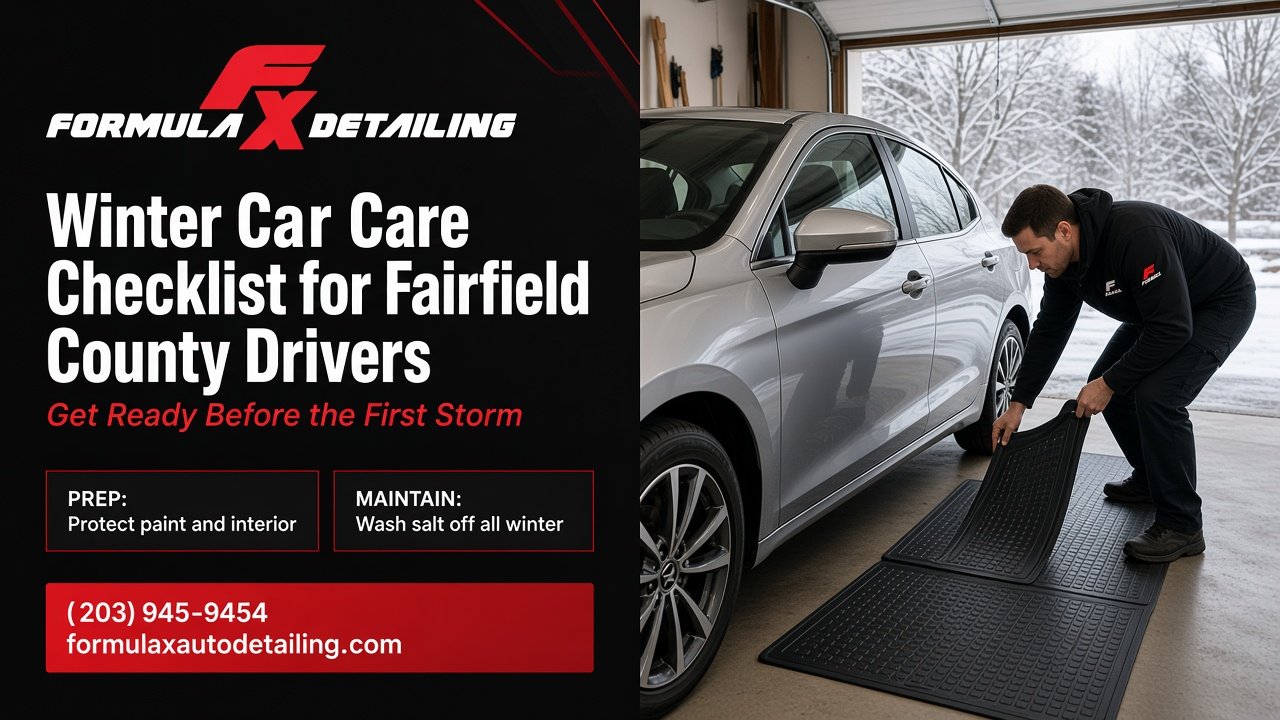
Formula X Mobile Auto Detailing & Ceramic Coating · Winter Car Care
Winter in Fairfield County is hard on cars in a particular way. Storms come off the Sound with wet, heavy snow, temperatures swing around freezing, and the roads from I-95 to the back lanes of New Canaan get salted and brined again and again. That combination means slush, salt film, frozen door seals, hazy windshields, dead batteries, and white rings on the carpet, often all in the same week. The cars that come through winter looking good aren't lucky; their owners did a handful of things before the first storm and kept up a few habits until spring. This checklist covers all of it in order: what to do in the fall, what to keep in the car, how to clear snow safely and legally, how to handle salt through the season, and how to reset the car in spring. Use it as a list to work through, not a lecture. Formula X Mobile Auto Detailing & Ceramic Coating is based at 48 Union St, Stamford, CT 06906, and can be reached at (203) 945-9454.
What should a winter car care checklist include?
Before winter: wash, decontaminate, and protect the paint and wheels; touch up chips; clean and treat the glass; switch to well-fitted rubber floor mats; have tires, battery, wipers, lights, and coolant checked; fill up with winter washer fluid; and pack an emergency kit. During winter: clear all snow and ice, including the roof, before driving; wash salt off, including the underbody, whenever temperatures allow; and keep the exhaust clear. In spring: deep clean, decontaminate, extract salt stains from the carpet, refresh protection, and inspect for chips and rust.
For the science of salt damage, see how road salt damages your car and how to protect it. For coatings in cold weather, see how long ceramic coating lasts in Connecticut winters.
Where the details come from: Vehicle prep and emergency kit items follow NHTSA winter driving guidance. The snow-removal rule is Connecticut General Statutes section 14-252a in the motor vehicle statutes. Road treatment and the DOT's washing advice come from a Connecticut Office of Legislative Research report. Coating care comes from Ceramic Pro, and runoff guidance from the Long Island Sound Partnership. Only Formula X's published package prices appear here.
The Winter Car Care Timeline at a Glance
Quick answer: Think in three phases: prepare in October and November while it's still mild, maintain from December through March, and reset in late March or April once the salt trucks stop. Most of the work that protects a car happens in the first phase.
| Phase | When (typical) | Main jobs |
|---|---|---|
| Prepare | October to late November | Detail and protect, mechanical checks, mats, kit |
| Maintain | December to March | Clear snow, wash salt off, keep glass and mats clean |
| Reset | Late March to April | Deep clean, decontaminate, extract salt, re-protect, inspect |
The dates shift every year. Some Fairfield County winters bring an early storm before Thanksgiving; others stay mild into January. The useful trigger isn't the calendar but the weather: protection products need mild temperatures to bond and cure, so the prep work should be done before nights stay below freezing.
If you only do one thing from this list, make it the fall prep. A car that goes into winter clean, protected, and on rubber mats is dramatically easier to keep up for the next four months. For how this fits a year-round schedule, see how often should you get your car detailed?
Fall Checklist: Exterior Protection
Quick answer: Wash thoroughly, decontaminate with clay and iron removal, address any swirls or chips you want fixed, then apply wax, sealant, or a ceramic coating to paint and wheels. Treat the glass and trim. Do it while temperatures are mild enough for products to cure.
| Task | Why it matters in winter | Done? |
|---|---|---|
| Thorough hand wash | Removes fall grime, sap, and leaf stains | ☐ |
| Clay and iron decontamination | Lets protection bond to clean paint | ☐ |
| Touch up stone chips | Bare metal rusts fastest in salt | ☐ |
| Paint protection (wax, sealant, or coating) | Salt film washes off more easily | ☐ |
| Wheel sealant | Brake dust and salt release more easily | ☐ |
| Glass cleaned and sealed | Better visibility; slush sheds faster | ☐ |
| Trim and rubber treated | Less chalking; fewer frozen seals | ☐ |
Formula X's Bronze Exterior package covers a hand wash, clay bar, windows, a protective ceramic sealer with about six months of durability, and tire shine, starting at $295+. The Gold package adds the full interior, starting at $495+. If the paint has swirls you want removed before protecting it, paint correction is quoted after inspection. See what causes swirl marks.
Fall leaves and sap. Wet leaves left on paint can stain, and tree sap bonds harder as it ages. Remove both before applying protection; sap removal may carry an extra charge.
Should You Coat the Car Before Winter?
Quick answer: A ceramic coating applied in fall gives the most durable protection for salt season, but it needs proper prep, cure time, and aftercare. A sealant is a lighter, shorter-lived option. Coatings are quoted after the paint is inspected.
A coating is the most durable way to make salt film, slush, and brake dust release easily. The catch is timing and care. Ceramic Pro's aftercare guidance says to wait 48 hours before driving and up to two weeks before washing, to wash about every two weeks, to do a two-bucket hand wash at least monthly, and to have an annual inspection. In winter that means applying it early enough to cure in mild weather, then keeping up with washes.
On warranties, there's a conflict to know about: Formula X's package cards list Gold at 7 years, Silver at 5, and Bronze at 2, while Ceramic Pro's U.S. warranty terms describe Gold as lifetime with annual service. Ask which terms apply to your car and get them in writing. For a comparison of options, see ceramic coating vs. wax vs. sealant and ceramic coatings in Connecticut.
| Option | Best for | Winter consideration |
|---|---|---|
| Wax | Short-term gloss | May not last a full salt season |
| Ceramic sealer (as in Gold and Bronze Exterior) | One season of protection | About 6 months durability |
| Ceramic coating | Long-term protection | Cure time and annual service; quoted after inspection |
Fall Checklist: Interior
Quick answer: Deep clean the interior before winter, condition leather, switch to deep-groove rubber mats that fit properly, clean the inside of the glass, and empty out clutter. A clean interior dries faster and resists salt stains and musty smells.
| Task | Why | Done? |
|---|---|---|
| Vacuum and steam clean | Removes fall dirt before salt arrives | ☐ |
| Shampoo carpet and mats | Start the season clean | ☐ |
| Condition leather | Dry heater air is hard on leather | ☐ |
| Install rubber mats | Contains salty slush | ☐ |
| Clean inside of glass | Reduces fogging and glare | ☐ |
| Remove clutter | Easier to clean all winter | ☐ |
NHTSA suggests considering thicker or rubber mats for slushy conditions, and warns that improperly installed mats can interfere with the accelerator or brake pedal. Use mats made for your vehicle, secure them with the retention clips, and never stack a rubber mat on top of a carpet mat.
Formula X's Bronze Interior package, starting at $295+, includes thorough vacuuming, interior steam cleaning, leather treatment, windows, and carpet and upholstery shampoo. Heavy soil and pet hair can carry extra charges. See interior deep clean on a Honda Odyssey.
Tires: Pressure, Tread, and Snow Tires
Quick answer: Check pressure monthly when tires are cold and set it to the figure on the driver's door label, not the number on the tire. Check tread and look for damage. Consider dedicated winter tires. NHTSA notes tire pressure drops as temperatures fall.
NHTSA explains that tire pressure drops with the temperature, and that the correct pressure is the vehicle manufacturer's figure in the owner's manual and on the driver's door frame label, not the maximum printed on the tire. It recommends inspecting tires at least monthly, checking them cold, looking for cuts, bulges, and cracks, checking tread depth, and not forgetting the spare. It also suggests considering snow tires.
From a detailing point of view, winter is also a good time to think about wheels. Some owners mount winter tires on a separate set of wheels, which keeps their best wheels away from salt and brake dust all season. Whatever you run, clean the wheels regularly and protect them before winter.
| Tire check | How often | Done? |
|---|---|---|
| Pressure to door-label spec | Monthly, cold | ☐ |
| Tread depth | Before winter | ☐ |
| Cuts, bulges, cracks | Monthly | ☐ |
| Spare tire | Before winter | ☐ |
| Snow tires considered | Before the first storm | ☐ |
Battery, Wipers, Lights, and Fluids
Quick answer: Have a mechanic check the battery, charging system, belts, coolant, and hoses. Replace worn wiper blades, fill the reservoir with winter washer fluid with de-icer, and confirm every light and the defroster work. These are NHTSA's core winter prep items.
| Item | What to check | Done? |
|---|---|---|
| Battery and charging system | Mechanic test; cold reduces battery power | ☐ |
| Coolant | Level and spec per owner's manual | ☐ |
| Belts and hoses | Wear and leaks | ☐ |
| Wiper blades | Replace if streaking or worn | ☐ |
| Washer fluid | Full reservoir of winter fluid with de-icer | ☐ |
| Lights | Headlights, brake lights, signals, flashers, interior | ☐ |
| Defroster and heater | Working front and rear | ☐ |
| Recalls | Check your VIN on NHTSA's lookup tool | ☐ |
All of these come from NHTSA's winter vehicle prep guidance, which also notes that a single storm can use a lot of washer fluid and that cold weather can reduce an EV's driving range. Mechanical checks are a mechanic's job. Detailing complements them by keeping glass, lights, and lenses clean, which matters as much as the fluid in the reservoir.
The Winter Emergency Kit
Quick answer: NHTSA recommends carrying a snow shovel, broom, ice scraper, sand or kitty litter, jumper cables, flashlight, warning devices, a first aid kit, blankets, a phone and charger, water, food, and any medicine. Keep the tank near full or an EV charged.
| Item | Why | Packed? |
|---|---|---|
| Snow shovel and broom | Dig out and clear the car | ☐ |
| Ice scraper | Clear glass | ☐ |
| Sand or kitty litter | Traction if stuck | ☐ |
| Jumper cables | Cold-weather battery failures | ☐ |
| Flashlight and warning devices | Visibility if stopped | ☐ |
| First aid kit | Emergencies | ☐ |
| Blankets | Warmth if stranded | ☐ |
| Phone and charger | Communication | ☐ |
| Water, food, medicine | If delayed for hours | ☐ |
The list is from NHTSA, which also advises keeping the gas tank close to full and, for EVs, keeping the battery charged and plugging in overnight in cold weather where possible.
A detailing tip to go with it: keep the kit in a bin or bag, not loose in the cargo area. Wet shovels, salty brooms, and kitty litter leave stains and grit in carpet, and a lidded bin keeps it all contained.
If you're stuck. NHTSA advises staying with the car, making it visible, keeping the exhaust pipe clear of snow, and running the engine only sporadically to stay warm, because of carbon monoxide risk.
Clearing Snow and Ice: Safely and Legally
Quick answer: Connecticut law requires clearing accumulated ice and snow from the hood, trunk, and roof so it doesn't threaten people or property. Use a soft brush or foam tool on paint, a plastic scraper only on glass, and let the defroster loosen ice first.
Connecticut General Statutes section 14-252a, part of the state's motor vehicle statutes, requires drivers to remove accumulated ice and snow from the vehicle, including the hood, trunk, and roof, so it doesn't pose a threat to persons or property. The statute sets a fine of seventy-five dollars for failing to do so, and a higher fine range if dislodged snow or ice causes injury or property damage. It doesn't apply to snow that begins falling while you're driving, or while the car is parked.
How you clear the car matters for the paint. Snow often sits on top of a layer of salt film and grit. A stiff-bristled brush dragged across it scratches the clear coat, and a plastic scraper used on paint will mark it. A soft brush or foam snow tool, used to push snow off in sections, is much gentler.
Start with the defroster
Let ice soften before scraping glass.
Push, don't scrub
Move snow off in sections with a soft tool.
Scraper on glass only
Never on paint or trim.
Clear the roof
Required under Connecticut law.
Clear lights and sensors
Headlights, taillights, cameras, and radar sensors.
Check the exhaust
Keep it clear of snow before running the engine.
Never warm a car in a closed garage. Carbon monoxide builds up quickly. Open the garage door fully or move the car out before letting it idle, and keep the tailpipe clear of snow.
During Winter: Washing Off Salt
Quick answer: Wash after storms and salty stretches whenever temperatures allow, rinsing the underbody, wheel wells, and lower panels thoroughly. The Connecticut DOT recommends washing cars, including undercarriages, after storms and regularly in winter. Dry door jambs and seals afterward.
The Connecticut Office of Legislative Research report explains that the state DOT spreads rock salt pre-wetted with magnesium chloride, that chloride deicers are corrosive, and that the DOT recommends washing cars, including the undercarriage, after storms and regularly during winter. Magnesium and calcium chloride hold moisture, so they keep working on metal long after the storm.
In practice, that means washing as often as conditions allow, which is weekly in a heavy winter for many commuters. Pick a day above freezing or use a heated space, rinse long before touching the paint, wash gently, rinse again, and dry door jambs and seals so they don't freeze. For the full explanation, see how road salt damages your car.
| Situation | Suggested washing | Done? |
|---|---|---|
| After a storm with salted roads | As soon as temperatures allow | ☐ |
| Repeated brine days | Weekly, or rinse between washes | ☐ |
| Heavy highway commuting | Weekly in salt season | ☐ |
| Coated car | About every 2 weeks minimum, per aftercare | ☐ |
| Garaged weekend car | After any salty drive | ☐ |
If you wash at home, the Long Island Sound Partnership notes that driveway wash water carries soap and grime to storm drains that lead to the Sound. Washing on grass or gravel, using biodegradable soap, or using a car wash that treats or recycles water helps.
During Winter: Glass, Lights, and Visibility
Quick answer: Brine haze builds up on the windshield, headlights, and camera lenses fast. Keep the washer reservoir full, wipe lights and sensors at fuel stops, clean the inside of the windshield every few weeks, and use the defroster and fresh air to fight fogging.
Highway driving in Fairfield County in a wet week coats everything in front of you with a fine brine mist. On the windshield it smears; on headlights it dims the beam; on cameras and radar sensors it can trigger warnings or reduce how well driver-assistance features work. A clean microfiber in the door pocket and a wipe at every fuel stop make a real difference.
Inside, damp boots, wet coats, and heater use leave a film on the inside of the glass that fogs easily and glares at night. A proper glass clean inside every few weeks helps, and running the defroster with fresh air rather than recirculation clears fog faster.
During Winter: Mats, Carpet, and Smells
Quick answer: Empty and rinse rubber mats regularly, knock salt off boots, blot salt rings early with warm water, and let the cabin dry out when you can. Damp carpet that never dries leads to musty smells.
The cabin collects salt the same way the outside does. Slush melts off boots, runs to the low points of the mats, and dries into white rings. If it gets past the mats, the salt and moisture soak into the carpet, where they stiffen fibers and can hold moisture underneath for weeks.
Empty and rinse rubber mats every week or two in a salty stretch and let them dry before putting them back. Blot any salt rings on carpet with warm water while they're fresh; older stains need a carpet cleaner and extraction. On a dry, mild day, running the heater with the windows cracked helps dry the cabin. If a musty smell appears, see how to get odor out of a car for how deep odors are treated.
| Interior task | How often | Done? |
|---|---|---|
| Empty and rinse rubber mats | Every 1 to 2 weeks | ☐ |
| Blot fresh salt rings | As soon as they appear | ☐ |
| Vacuum | Every 2 weeks | ☐ |
| Clean inside of glass | Every few weeks | ☐ |
| Dry the cabin | Mild days | ☐ |
Families, Car Seats, and Dogs
Quick answer: NHTSA advises against bulky winter coats under car seat harnesses; use thin layers and put blankets over the buckled harness. Car seats, booster seats, and dog areas collect salt, crumbs, and hair, so protect them and clean them more often in winter.
NHTSA notes that heavy winter coats can interfere with proper car seat harness fit, and recommends thin, warm layers with blankets or coats placed over the child after the harness is snug. See NHTSA's car seat guidance for the right seat for each age and size.
From a cleaning standpoint, family cars take a beating in winter: wet boots kicking seat backs, salt on the floor, snacks in the seat bases. Kick mats on the seat backs and a washable liner under car seats help. For dog owners, slushy paws add salt, mud, and hair; a washable cargo liner or seat cover and a towel by the door go a long way. See how to remove dog hair from car seats and carpet. Pet hair can carry an extra charge on Formula X packages.
Winter Checklist for EVs and Hybrids
Quick answer: Keep the battery charged and plug in overnight in cold weather where possible, since NHTSA notes cold can reduce range. Keep charge ports clean and clear of ice, follow the owner's manual for washing around ports and sensors, and rinse the underbody like any car.
NHTSA explains that batteries lose energy storage and delivery capability in the cold, that EVs use battery power to heat the battery, and that plugging in overnight helps keep the battery in its optimal range. Preconditioning the cabin while plugged in is a common way to save range.
For detailing, the differences are small but real. Charge ports and their covers collect salty grime and can freeze shut, so wipe them clean and keep the area clear. Many EVs have extensive underbody panels and battery enclosures, which still benefit from salt rinsing. Follow the owner's manual on washing near ports and sensors. See ceramic coating for Teslas and EVs.
Where You Park Changes the Checklist
Quick answer: Driveway, street, apartment garage, and office lot parking each create different winter problems: plowed-in snowbanks, salt spray from passing plows, wet cars sitting in warm garages, and long days in slushy lots. Adjust washing and protection to match.
| Parking | Winter issue | Adjustment |
|---|---|---|
| Open driveway | Snow load; refreezing | Soft snow tool; protect paint and glass |
| Street parking | Plow spray and snowbanks | More frequent washes; watch for scrapes |
| Heated or apartment garage | Salty car stays wet in warmth | Rinse when possible; keep floor dry |
| Office or station lot | Long days in slush | Underbody and jamb rinses |
| Coastal parking | Damp salt air | Keep protection fresh |
Garage parking is a big advantage, but a heated garage can let a salty, slushy car stay wet for hours at temperatures where corrosion runs faster. For apartment garages, see mobile detailing at Harbor Point; for workplace lots, office parking lot detailing in downtown Stamford.
The Storm-Week Routine: Before, During, After
Quick answer: Before a storm, fill the tank or charge, top up washer fluid, and park where plows won't bury the car. During it, stay off the roads if you can. After it, clear the car fully, keep the exhaust clear, and wash salt off at the first mild day.
Fairfield County storms usually come with a day or two of warning. That window is the time to handle the small things that turn into big problems once the snow is down, and to set the car up for an easy cleanup afterward.
| When | Task | Done? |
|---|---|---|
| Day before | Fill the tank or fully charge the EV | ☐ |
| Day before | Top up winter washer fluid | ☐ |
| Day before | Lift wipers or cover the windshield if parked outside | ☐ |
| Day before | Park clear of the plow path if you can | ☐ |
| During | Postpone non-essential trips, as NHTSA suggests | ☐ |
| After | Clear hood, roof, trunk, lights, and sensors | ☐ |
| After | Check the exhaust is clear before idling | ☐ |
| After | Knock packed slush out of wheel wells | ☐ |
| First mild day | Wash with an underbody rinse | ☐ |
NHTSA recommends checking weather and traffic before heading out, postponing non-essential travel until roads are cleared, slowing down, increasing following distance, and giving snowplows plenty of room. Plows also throw salt and slush, so staying well back protects your paint and windshield as well as your safety.
Extra Steps for Highway Commuters
Quick answer: Daily commuters on I-95, the Merritt Parkway, and Route 7 drive through more brine spray than anyone. Weekly washes in salt season, extra washer fluid, clean lights and sensors, and good paint protection on the front end make the biggest difference.
Highway commuting adds up. Treated lanes, heavy traffic, and trucks throwing spray mean the front and lower half of the car are coated in brine almost every day there's moisture on the road. The windshield takes a beating too, and washer fluid goes fast.
For commuters, the checklist leans on frequency: weekly washes when temperatures allow, an underbody rinse at least every other wash, a spare jug of winter washer fluid in the trunk, and a quick wipe of headlights and sensors at fuel stops. Front-end chips are common, so check the hood edge and bumper for chips before winter and touch them up. For work-lot detailing, see office parking lot detailing in downtown Stamford.
| Commuter add-on | Why | Done? |
|---|---|---|
| Weekly washes in salt season | Daily brine exposure | ☐ |
| Spare washer fluid | Brine haze uses it fast | ☐ |
| Front-end chip touch-up | Highway chips rust in salt | ☐ |
| Wipe lights and sensors | Visibility and driver assists | ☐ |
Winter Tools to Keep at Home
Quick answer: A soft snow brush or foam tool, a plastic ice scraper, a spare set of rubber mats, winter washer fluid, a rubber-safe seal protectant, microfiber towels, and a dedicated wheel brush cover most winter care between professional details.
| Tool | Use | Avoid |
|---|---|---|
| Soft snow brush or foam tool | Clearing paint | Stiff bristles |
| Plastic ice scraper | Glass only | Using it on paint |
| Rubber-safe seal protectant | Prevents frozen doors | Products not made for rubber |
| Microfiber towels | Glass, lights, quick wipes | Dropped or gritty towels on paint |
| Wheel brush | Brake dust and salt | Sharing it with paint tools |
| Lock de-icer | Frozen locks | Hot water |
| Spare washer fluid | Top-ups | Summer-only fluid |
With these, most mid-winter care is a 15-minute job. For the full wash method on a coated car, see how to wash a ceramic-coated car.
New Cars and Leases in Winter
Quick answer: A new car's first winter is the best time to protect it, because the paint is at its best. Leased cars benefit from protection and regular cleaning too, since salt stains, chips, and rust spots can count against you at turn-in.
New paint is at its cleanest and smoothest when the car is delivered, which makes it the ideal base for protection before its first salt season. Getting a sealant or coating on before the first storm means less salt bonding from day one. See should you ceramic coat a brand-new car?
For leases, the concern is turn-in condition. Inspectors look at the same areas winter damages: wheels, lower panels, chips, and carpet. Regular washes and a spring cleanup keep these in good shape, and small chips are easier to address early. See is ceramic coating worth it on a leased car? and mobile scratch repair vs. a body shop.
Want the Fall Prep Done for You?
Tell Formula X Mobile Auto Detailing & Ceramic Coating the vehicle, where it's parked, whether there's a garage, how you drive in winter, and any chips or existing protection, with a few photos. You'll get a recommendation on which package fits the season, and any correction or coating is quoted after the paint has been seen.
If the Car Is Being Stored for Winter
Quick answer: Before storing a car for winter, detail it fully, make sure it is completely dry inside and out, protect the paint, use a breathable cover, and follow the owner's manual or a mechanic's advice on battery, fuel, and tires.
Convertibles, classics, and second cars often sit out the winter. Storage avoids salt, but a car stored dirty spends months with grime and moisture sitting on it. Wash and protect it, clean and dry the interior, remove anything that holds moisture or attracts pests, and use a breathable cover rather than plastic. Mechanical storage steps vary by vehicle, so follow the manual. For classic paint, see paint correction on a classic Corvette.
| Storage step | Done? |
|---|---|
| Full wash with underbody rinse | ☐ |
| Paint protection applied | ☐ |
| Interior cleaned and fully dry | ☐ |
| Breathable cover | ☐ |
| Battery, fuel, and tires per manual | ☐ |
Frozen Doors, Locks, and Seals
Quick answer: Frozen doors usually come from water on the rubber seals. Dry the jambs and seals after washing, treat seals with a rubber-safe protectant before winter, and never pour hot water on locks, handles, or glass.
After a wash, a thaw, or freezing rain, water settles on door seals and in the jambs, and an overnight freeze glues the door shut. Pulling hard can tear the seal or break a handle. A few minutes of prevention avoids it: dry the jambs and seals with a towel after washing, and wipe a rubber-safe protectant onto the seals in the fall and again mid-winter.
If a door does freeze, push firmly against it to crack the ice before pulling, or let the car warm up with the heater running. Hot water may seem quick but can refreeze worse and can crack cold glass. A lock de-icer handles frozen keyholes on older cars. On vehicles with flush or pop-out door handles, follow the owner's manual for icy conditions.
| Problem | Prevention | If it happens |
|---|---|---|
| Frozen door | Dry and treat seals | Push to crack ice; let the car warm up |
| Frozen lock | Keep lock covered or treated | Lock de-icer |
| Frozen wipers | Lift wipers or cover the glass before a storm | Defroster; don't pull them free |
| Frozen fuel door | Dry it after washing | Gentle pressure; warm the car |
The One-Page Master Checklist
Quick answer: Here's the whole season in one list: protect and detail in fall, check mechanicals and tires, set up mats and a kit, clear snow fully, wash salt off regularly, keep glass and mats clean, and reset in spring.
| Phase | Checklist item | Done? |
|---|---|---|
| Fall | Wash, decontaminate, and protect paint and wheels | ☐ |
| Fall | Touch up chips | ☐ |
| Fall | Interior deep clean and leather conditioning | ☐ |
| Fall | Rubber mats installed with clips | ☐ |
| Fall | Tires, battery, coolant, wipers, lights checked | ☐ |
| Fall | Winter washer fluid; emergency kit packed | ☐ |
| Winter | Clear roof, hood, trunk, lights, sensors | ☐ |
| Winter | Wash salt off, including underbody, when mild | ☐ |
| Winter | Empty mats; blot salt rings | ☐ |
| Winter | Check tire pressure monthly | ☐ |
| Spring | Full detail and decontamination | ☐ |
| Spring | Interior extraction | ☐ |
| Spring | Refresh protection; inspect for chips and rust | ☐ |
Save or print this table and work through it as the season goes. If you'd rather hand off the detailing parts, see Formula X's exterior detailing and mobile detailing pages, or send photos through the contact page.
Why Fairfield County Winters Are Hard on Cars
Quick answer: Coastal Connecticut winters swing around freezing, with wet snow, freezing rain, and frequent thaws. That means more slush, more salt and brine applications, and more freeze-thaw cycles on seals and glass than a steadily cold climate.
Inland and northern climates often stay cold and dry for weeks, with powdery snow that brushes off. Lower Fairfield County, sitting on Long Island Sound, tends to see wet, heavy snow, rain that turns to ice, and thaws a day or two later. Each swing brings another round of road treatment, and each thaw turns old snowbanks into salty slush.
For cars, that pattern means the salt never really dries out, door seals and wipers freeze and thaw repeatedly, and the windshield is hazed with brine more often. It's also why mild days matter so much: they're the windows for washing salt off, and it's worth planning around them. When the forecast shows a day or two above freezing after a storm, that's wash day.
| Weather pattern | Effect on the car | Checklist response |
|---|---|---|
| Wet, heavy snow | Heavy roof load; slush everywhere | Soft tool; clear roof; empty mats |
| Freezing rain | Iced glass, seals, and wipers | Defroster first; treated seals |
| Quick thaws | Salty slush spray | Wash on the mild day |
| Repeated treatment | Brine on lower panels and underbody | Underbody rinses |
What to Do Yourself and What to Hand Off
Quick answer: Most of the winter routine is DIY: clearing snow, rinsing salt, emptying mats, checking tire pressure, and topping up fluid. Fall protection, decontamination, interior extraction, correction, and coatings are where professional work saves time and gets better results. Mechanical checks go to a mechanic.
| Task | DIY | Detailer | Mechanic |
|---|---|---|---|
| Snow clearing and quick rinses | Yes | ||
| Emptying mats; blotting salt rings | Yes | ||
| Tire pressure checks | Yes | Tread and damage if unsure | |
| Fall decontamination and protection | Possible | Yes | |
| Interior steam and carpet extraction | Limited | Yes | |
| Paint correction and coatings | Yes, quoted after inspection | ||
| Battery, coolant, brakes, underbody inspection | Yes |
If you do the fall prep yourself, give it a full day in mild weather so protection can cure. If you'd rather hand it off, Formula X brings the work to your driveway or garage; see mobile detailing vs. a detail shop for how that compares to dropping the car off.
Common Winter Car Care Mistakes
Quick answer: Common mistakes include skipping fall protection, leaving the roof covered in snow, using a stiff brush or scraper on paint, driving all winter without a wash, ignoring the underbody, stacking floor mats, and warming the car in a closed garage.
No fall protection
Salt bonds to bare paint and wheels.
Snow left on the roof
Unsafe and against Connecticut law.
Stiff brush on paint
Leaves fine scratches.
No winter washes
Salt sits for months.
Ignoring the underbody
Where the worst corrosion risk is.
Stacked mats
Can interfere with the pedals.
Idling in a closed garage
Carbon monoxide danger.
Spring Checklist: The Reset
Quick answer: Once the salt season ends, give the car a full wash with an underbody rinse, iron and clay decontamination, wheel deep clean, door-jamb cleaning, interior extraction of salt stains, and fresh protection, then inspect for chips and rust spots.
| Spring task | Why | Done? |
|---|---|---|
| Wash with underbody rinse | Removes accumulated salt | ☐ |
| Iron and clay decontamination | Removes bonded particles | ☐ |
| Wheel deep clean | Removes brake dust and salt crust | ☐ |
| Door jambs and seals | Clears hidden salt | ☐ |
| Carpet and mat extraction | Removes salt stains | ☐ |
| Refresh protection | Replaces wax or sealant worn by winter | ☐ |
| Chip and rust inspection | Catches damage early | ☐ |
| Coating annual service (if coated) | Per aftercare and warranty terms | ☐ |
| Swap back from winter tires | Per tire shop advice | ☐ |
A Gold package covers both sides of the reset, starting at $495+, with extra charges for heavy soil and similar conditions. If spring inspection turns up scratches or chips worth fixing, see scratch repair and can a car scratch be buffed out?; these are quoted after inspection.
Wheels, Trim, and Headlights Through Winter
Quick answer: Wheels collect the heaviest mix of salt and brake dust, black trim turns chalky from salt film, and headlights haze over. Clean wheels at every wash with a dedicated brush, treat trim with a protectant made for plastic, and wipe lights often.
Wheels sit right next to the brakes and the road, so they get a crust of salt, brine, and metallic brake dust that bonds to the finish if it's left on. Painted wheels usually clean up with regular washing; polished, chrome, and machined finishes are more sensitive, and wheels with curb rash can corrode where the finish is broken. A sealant applied in the fall makes the crust release far more easily.
Unpainted black trim, bumper inserts, and mirror bases are porous and hold salt film, which leaves them gray and chalky by March. Washing them along with the paint and applying a trim protectant restores the color and helps them shed the next round of salt. Formula X's Silver package includes dressed trim and tires.
Headlights and taillights get the same brine haze as the windshield, which shortens how far you can see and how visible you are to others. NHTSA lists checking all lights as part of winter prep; keeping the lenses clean is the detailing side of that.
None of these jobs takes long once they are part of the routine. A wheel brush and a bottle of trim protectant kept with the wash supplies, plus a clean microfiber in the door pocket for lights and sensors, cover most of it. The payoff shows in spring, when wheels, trim, and lenses that were looked after all winter need only a normal clean instead of a restoration.
| Surface | Winter problem | Checklist fix | Done? |
|---|---|---|---|
| Wheels | Salt and brake dust crust | Dedicated brush each wash; fall sealant | ☐ |
| Black trim | Chalky, gray film | Wash and trim protectant | ☐ |
| Headlights | Brine haze | Wipe at fuel stops | ☐ |
| Sensors and cameras | Spray coats lenses | Wipe with clean microfiber | ☐ |
How Formula X Fits Into the Checklist
Quick answer: Formula X is a mobile detailing service based in Stamford that can handle the fall prep, interior cleanups during winter, and the spring reset at your home or workplace. Packages have published starting prices; correction and coatings are quoted after inspection.
| Package | Starting price | Where it fits |
|---|---|---|
| Gold (interior + exterior) | $495+ | Fall prep or spring reset: wash, clay, ceramic sealer (about 6 months), steam, leather, carpet shampoo |
| Silver (interior + exterior) | $395+ | Lighter refresh with a 6+ month wax and dressed trim |
| Bronze Exterior | $295+ | Pre-winter exterior protection with ceramic sealer |
| Bronze Interior | $295+ | Mid-winter or spring salt-stain cleanup |
Formula X Mobile Auto Detailing & Ceramic Coating works across Stamford and nearby towns, including Darien, Norwalk, Greenwich, New Canaan, Westport, and Rowayton. See all service areas, the work gallery, and mobile detailing. For what a mobile visit needs, see how to prepare for a mobile detail.
Exterior work in winter depends on temperature and conditions, so a garage or a mild day is needed; interior work is more flexible. Same-day appointments may be available when the schedule allows; call to check. Mechanical checks, tires, and rust repair belong with a mechanic or body shop.
Formula X Mobile Auto Detailing & Ceramic Coating
Formula X Mobile Auto Detailing & Ceramic Coating is a mobile detailing, paint correction, scratch repair, and ceramic coating service based at 48 Union St, Stamford, CT 06906. The team works throughout Stamford, Greenwich, Darien, New Canaan, Norwalk, Rowayton, Westport, and other towns in lower Fairfield County, and Westchester County, NY.
For winter, that means fall prep before the first storm, interior cleanups when salt builds up, and a spring reset, with correction and coatings quoted after inspection.
Call (203) 945-9454, email formulaxautodetail@gmail.com, send a request through the contact page, or view Formula X Mobile Auto Detailing & Ceramic Coating on Google Maps. Address: 48 Union St, Stamford, CT 06906.
Frequently Asked Questions About Winter Car Care
What should be on a winter car care checklist?
Fall: wash, decontaminate, and protect paint and wheels, touch up chips, deep clean the interior, install rubber mats, check tires, battery, coolant, wipers, and lights, fill up with winter washer fluid, and pack an emergency kit. Winter: clear all snow, wash salt off regularly, and keep mats and glass clean. Spring: full detail, extraction, re-protection, and inspection.
When should I prepare my car for winter in Connecticut?
October to late November, before nights stay below freezing. Protection products need mild temperatures to bond and cure, so the fall window matters.
Is it illegal to drive with snow on your car in Connecticut?
Connecticut General Statutes section 14-252a requires drivers to remove accumulated ice and snow, including from the hood, trunk, and roof, so it doesn't threaten people or property. Fines apply, and they rise if dislodged snow or ice causes injury or damage.
What should I keep in my car in winter?
NHTSA recommends a snow shovel, broom, ice scraper, sand or kitty litter, jumper cables, a flashlight and warning devices, a first aid kit, blankets, a phone and charger, water, food, and any medicine.
How often should I wash my car in winter?
Whenever temperatures allow after storms and salty stretches, often weekly for commuters. The Connecticut DOT recommends washing cars, including undercarriages, after storms and regularly in winter.
Should I get a ceramic coating before winter?
It's the most durable option for salt season if it's applied early enough to cure in mild weather and maintained with regular washes and annual service. Coatings are quoted after inspection. Ask which warranty terms apply and get them in writing.
Do I need rubber floor mats in winter?
They're the best way to keep salty slush off the carpet. NHTSA suggests thicker or rubber mats for slushy conditions and stresses correct fit and retention clips so mats can't interfere with the pedals.
How do I stop my car doors from freezing shut?
Dry the door jambs and rubber seals after washing and treat the seals with a rubber-safe protectant before and during winter. If a door freezes, push to crack the ice or let the car warm up; don't use hot water.
Why does tire pressure drop in winter?
Air pressure falls with temperature. NHTSA recommends checking pressure at least monthly, with tires cold, and setting it to the figure on the driver's door label rather than the maximum on the tire.
What's different about winter care for an EV?
Cold can reduce range, so keep the battery charged and plug in overnight where possible. Keep charge ports clean and free of ice, follow the manual for washing near ports and sensors, and rinse the underbody like any car.
What should I do to my car in spring?
Wash with an underbody rinse, decontaminate paint and wheels, clean door jambs, extract salt stains from the carpet, refresh protection, inspect for chips and rust, and book annual coating service if the car is coated.
Can Formula X detail my car in winter?
Interior work is possible most of the year. Exterior work needs a garage or a day mild enough that water won't freeze. Same-day appointments may be available when the schedule allows; call (203) 945-9454 to check.
How much does a pre-winter detail cost at Formula X?
Published packages are Gold from $495+, Silver from $395+, Bronze Interior from $295+, and Bronze Exterior from $295+, with extra charges for scratches, heavy soil, sap, hard water spots, and pet hair. Correction and coatings are quoted after inspection.
Where is Formula X Mobile Auto Detailing & Ceramic Coating located?
Formula X Mobile Auto Detailing & Ceramic Coating is based at 48 Union St, Stamford, CT 06906. It's a mobile service working in Stamford, Greenwich, Darien, New Canaan, Norwalk, Rowayton, Westport, and other lower Fairfield County towns, and Westchester County, NY. Call (203) 945-9454.
Find Formula X Mobile Auto Detailing & Ceramic Coating
Formula X Mobile Auto Detailing & Ceramic Coating is a mobile service based at 48 Union St, Stamford, CT 06906. Use the map for directions to the business address, or call (203) 945-9454 to arrange service at your location.
View Formula X Mobile Auto Detailing & Ceramic Coating on Google Maps
Get Your Car Ready for a Fairfield County Winter
Call Formula X Mobile Auto Detailing & Ceramic Coating at (203) 945-9454 or send a request with your vehicle, where it’s parked, whether there’s a garage, how you drive in winter, and photos. You’ll hear which pre-winter service fits, and correction or coatings are quoted after inspection.
48 Union St, Stamford, CT 06906 · Serving Stamford, Greenwich, lower Fairfield County, and Westchester County, NY