
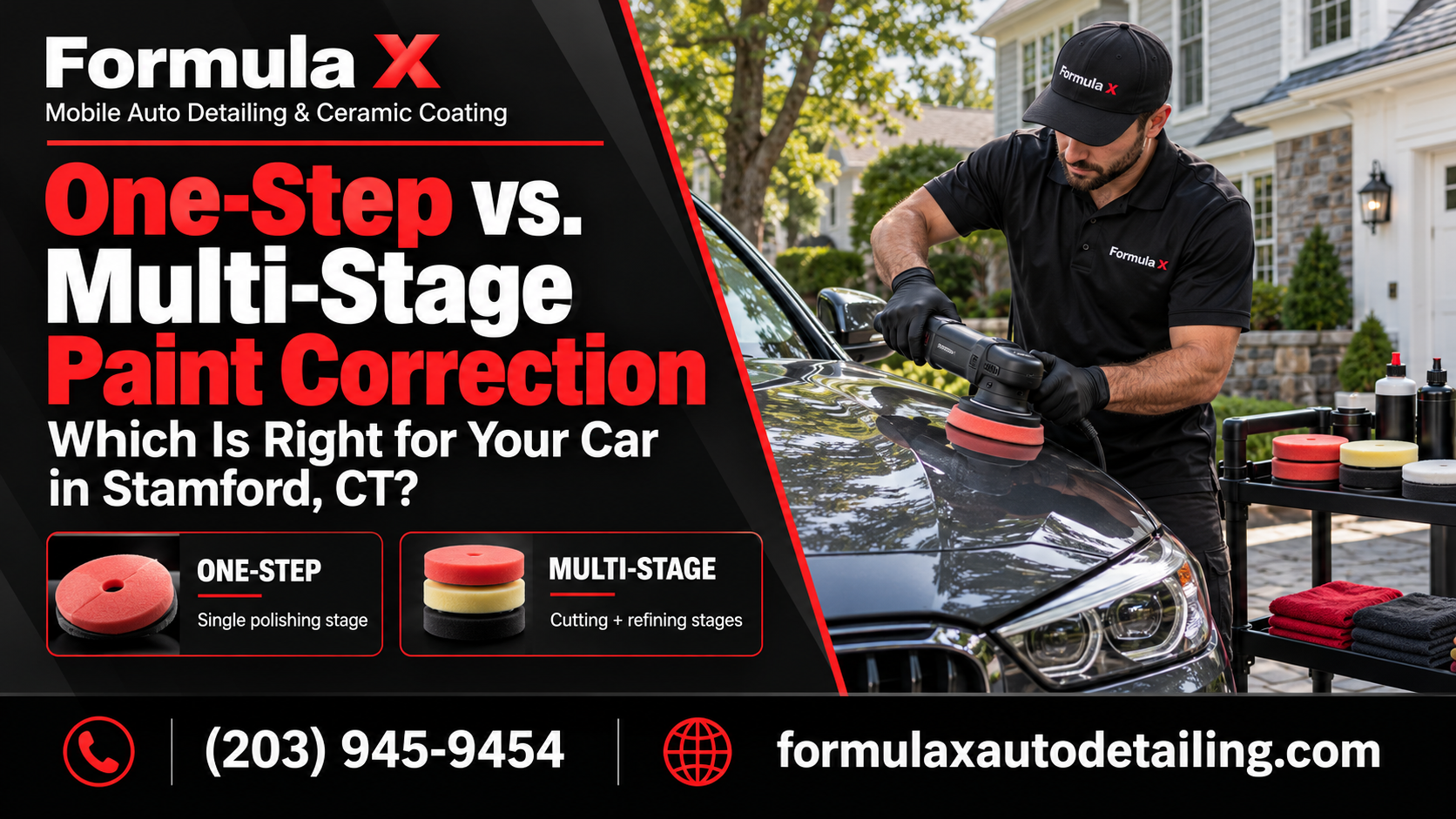
Formula X Mobile Auto Detailing & Ceramic Coating · Paint Correction Comparison
Once you know your paint needs correcting, the next question is how much. Detailers talk about one-step polishes and two- or three-stage corrections, and the difference matters for the finish you get, the time the job takes, and how much clear coat is left afterward. This guide goes deeper than an overview. It breaks down what compounding, polishing, and refining each do, why defect removal and clear coat removal are two sides of the same trade, how paint-depth readings shape the plan, why soft and hard paints behave so differently, which conditions suit each approach, what drives the time on the car, and which makes sense before a ceramic coating, plus a simple way to choose. If you’re new to the topic, read what is paint correction first. Formula X Mobile Auto Detailing & Ceramic Coating is based at 48 Union St, Stamford, CT 06906, and can be reached at (203) 945-9454.
Should you choose one-step or multi-stage paint correction?
Choose a one-step correction when the paint is fairly healthy: light swirls, mild haze, a newer car, or a car you won’t keep long. It uses a single pad and product to remove some defects and raise gloss in one pass, taking the least clear coat and time. Choose a multi-stage correction when defects are moderate to heavy and you want them mostly gone: it compounds first to remove deeper marring, then polishes and sometimes refines to restore clarity, which takes more time and more clear coat. The right choice is the fewest stages that reach a result you’re happy with, decided by a test spot and, ideally, paint-depth readings, not by a package name.
Before a ceramic coating, newer paint often needs only a one-step, while heavily swirled paint on a car you’ll keep usually justifies more. Formula X’s paint correction page describes the service, and the paint correction guide covers the basics.
Where the details come from: Paint-gauge information comes from gauge makers such as DeFelsko. Coating prep, cure, and warranty details come from Ceramic Pro’s coating warranty document and aftercare page. Connecticut road-treatment details come from the Office of Legislative Research. The rest is general detailing practice. This guide doesn’t give prices for correction, which is quoted after inspection.
One-Step vs. Multi-Stage at a Glance
Quick answer: A one-step is a compromise between cutting and finishing in a single pass. A multi-stage correction separates those jobs: cut hard enough to remove defects, then finish fine enough to remove the haze that cutting leaves. The more stages, the more defects removed, the more time spent, and the more clear coat used.
| Factor | One-step | Two-stage | Three-stage |
|---|---|---|---|
| Stages | One combined cut-and-finish pass | Compound, then polish | Compound, polish, then refine |
| Defect removal | Light defects removed; moderate ones reduced | Most moderate defects removed | Most removable defects removed, with the highest clarity |
| Finish quality | Good; may show faint haze on dark paint | Very good | Highest, especially on dark or soft paint |
| Clear coat used | Least | More | Similar to two-stage plus a little more |
| Time on the car | Shortest | Longer | Longest |
| Typical use | New or well-kept paint, lighter budgets, leases | Visible swirling on a car you’ll keep | Heavily marred or show-level dark paint |
One-step
One pad and product chosen to cut a little and finish well. Efficient and conservative.
Two-stage
Cut to remove defects, then polish out the haze the cut left.
Three-stage
Adds a final refining step for maximum clarity on demanding paint.
The rule
The fewest stages that reach the result you want, on the paint you have.
The Vocabulary: Compounding, Polishing, and Refining
Quick answer: Compounding is the heavy cutting stage that removes deeper defects. Polishing is a medium stage that removes the haze and fine marks from compounding and adds gloss. Refining, also called finishing or jeweling, uses the finest pad and product to remove any last micro-marring and maximize clarity. The words overlap in marketing, so ask what each stage actually does.
Every pass of a polisher does two things at once: it removes material (cut) and it leaves a surface of a certain smoothness (finish). Aggressive combinations cut fast but leave a finish that looks hazy, especially on dark paint. Gentle combinations leave a crisp finish but cut slowly. Stages exist because no single combination does both perfectly on every paint.
| Term | Purpose | Typical pad | Typical product |
|---|---|---|---|
| Compounding (cutting) | Remove deeper swirls, scratches, and etching | Firm foam, microfiber, or wool | Compound with larger or more aggressive abrasives |
| Polishing | Remove compounding haze and light defects; build gloss | Medium foam | Polish with finer abrasives |
| Refining (finishing, jeweling) | Remove final micro-marring; maximize depth and clarity | Soft finishing foam | Ultra-fine finishing polish |
| One-step | Moderate cut and good finish in one pass | Medium foam or light microfiber | One-step polish or a medium polish |
| All-in-one | Light cut plus a protective layer | Medium or soft foam | Cleaner polish with sealant or wax |
“Stage” and “step” mean the same thing. Some shops say two-step, others two-stage. What matters is how many distinct cut-and-finish passes are planned, and why.
Stage One: Compounding
Quick answer: Compounding is where most defect removal and most clear coat removal happen. A firmer pad and a more aggressive compound level the clear coat down toward the bottom of the swirls and light scratches. It’s used only where defects are deep enough to need it, and it almost always leaves some haze that must be polished afterward.
Compounding is the stage that changes the most, so it’s also the one that needs the most judgment. The installer chooses pad firmness, compound, machine speed, pressure, and the number of passes. Each of those controls how much material comes off per pass. The aim is to cut just enough to remove, or acceptably reduce, the target defects, and no more.
- Removes: heavy swirling, wash marring, light scratches, shallow etching, some oxidation.
- Leaves behind: fine haze or micro-marring from the compound itself, often called compounding haze.
- Uses: the most clear coat of any stage.
- Risks: heat build-up, cutting through on edges and body lines, and rotary holograms if not followed by polishing.
- Not needed when: a polish alone removes the defects well enough in a test spot.
Spot compounding
Compounding doesn’t have to be all or nothing. Many careful corrections compound only where it’s needed, such as a hood, a trunk lid, or a cluster of deeper scratches, and use a lighter stage elsewhere. That keeps clear coat removal targeted. Ask whether your provider plans to compound the whole car or only problem areas.
Compounding is not for chasing deep scratches. If a scratch catches a fingernail, repeated compounding may thin the paint around it without removing it. That’s a scratch repair question. Formula X’s scratch repair page explains the options.
Stage Two: Polishing
Quick answer: The polishing stage removes the haze and fine marks that compounding leaves, and on its own removes light swirls. It uses a softer pad and a finer polish, removes much less clear coat than compounding, and is where most of the visible gloss comes back.
On a two-stage correction, polishing is the finishing step. On a three-stage, it’s the middle step that bridges the heavy cut and the final refine. Either way, its job is to replace the dull, hazy surface left by compounding with a smoother one that reflects light cleanly. On lighter colors, a good polishing stage often looks as good as anyone will notice. On black or very dark paint, a trained eye in strong sun may still see faint marring, which is what the refining stage is for.
| After polishing… | What it usually means |
|---|---|
| Clear, sharp reflections on light paint | Finished; refining may add little |
| Faint haze visible on dark paint in sun | A refining stage would help |
| Remaining swirls in some areas | Those areas may need spot compounding, or are at the paint’s limit |
| Holograms visible | Pad, product, or technique needs adjusting before moving on |
Stage Three: Refining and Finishing
Quick answer: Refining is the gentlest stage. A soft finishing pad and ultra-fine polish remove the last micro-marring and bring out the most depth and clarity. It removes very little clear coat. It matters most on black and dark colors, soft clear coats that haze easily, and cars where the owner wants the closest thing to a flawless finish.
Refining is where diminishing returns kick in. The visual gain from a second to a third stage is usually smaller than from the first to the second. On a white daily driver, most people won’t see it. On a black car parked in direct sun, they might. That’s why three-stage corrections are usually reserved for specific paints and goals, rather than being the default.
- Worth considering: black or very dark colors, soft clear coats, show or photography goals, cars you’ll keep long term.
- Often unnecessary: light colors, hard clear coats that finish well from a polish, daily drivers where a two-stage already looks clear.
- Before a coating: a coating adds gloss and clarity, which makes any remaining haze easier to see, so dark cars headed for a coating sometimes justify a refine.
What a One-Step Correction Really Is
Quick answer: A one-step uses a single pad and product combination chosen to cut enough to improve defects while still finishing cleanly. It doesn’t remove everything a multi-stage would; it’s designed to give the biggest visible improvement for the least clear coat and time. On light swirling, it can look close to a multi-stage. On heavy swirling, expect a clear improvement rather than perfection.
Modern polishes are designed to break down as they work, cutting at first and finishing as the abrasives get smaller. That’s what makes a one-step possible. With the right pad and machine settings, a single product can remove light defects and finish well enough that no second pass is needed. The installer decides on a test spot whether that’s true for your paint.
| Situation | How a one-step usually performs |
|---|---|
| New car with delivery marring | Often removes most or all of it |
| Well-kept car, light wash marks | Removes most; strong gloss |
| Moderate swirling | Significant reduction; some remain in strong light |
| Heavy swirling or etching | Visible improvement but leaves many defects |
| Thin or repainted panels | Often the safest option available |
One-step vs. an all-in-one
An all-in-one product combines a light polish with a sealant or wax. It’s faster still and leaves a protected finish, but the protection can also fill fine marks, so the result may not last as long visually. It’s a reasonable maintenance option. It isn’t ideal before a ceramic coating, which needs bare, oil-free paint to bond to. If you’re planning a coating, ask for a one-step polish followed by a panel wipe instead.
Pads, Machines, and Products by Stage
Quick answer: The pad usually changes more between stages than the machine does. Firm foam, microfiber, or wool pads cut; medium foam polishes; soft foam refines. Dual-action machines are the common, forgiving choice for most stages, while rotary machines cut faster but need more skill and a careful finishing step to avoid holograms.
| Choice | Cutting stage | Polishing stage | Refining stage |
|---|---|---|---|
| Pad | Firm foam, microfiber, or wool | Medium foam | Soft finishing foam |
| Product | Compound | Polish | Ultra-fine finishing polish |
| Machine | Dual-action or rotary | Dual-action, or rotary with care | Usually dual-action |
| Pressure and speed | Higher, within safe limits | Moderate | Light |
| Main risk | Heat, cut-through on edges | Leaving haze if rushed | Little, if surfaces are clean |
Small pads and machines matter too. Pillars, mirror caps, bumpers with tight curves, and areas around sensors need smaller backing plates, and sometimes hand work. That detail work is part of why multi-stage correction on a complex body takes longer than the panel count suggests.
Pad condition matters as much as pad type. A pad loaded with spent product and removed clear coat cuts unpredictably and runs hotter, so careful installers clean pads frequently during a panel and swap to fresh ones often. On a multi-stage job, that means a stack of pads for each stage, which is one reason those jobs need more setup and time. Microfiber cutting pads in particular load up quickly and are usually cleaned with compressed air or a brush after every section.
Why the image shows stacked pads. A one-step uses one pad type. A multi-stage moves through two or three pad types, from firm to soft, with a matching product for each, which is the simplest way to picture the difference.
Dark Colors, Metallics, and Why Finishing Matters
Quick answer: Dark solid colors show the finishing haze left by compounding much more than light colors do, which is why black and very dark cars are the most common case for an extra refining stage. Metallics and pearls partly disguise haze with sparkle, but marring still dulls the flake. Light colors are the most forgiving, so a one-step or two-stage often looks complete.
| Color | How much finishing shows | Usual stage count to look complete |
|---|---|---|
| Black and very dark solids | Every trace of haze | Two-stage with a refine, or three-stage |
| Dark metallic or pearl | Haze dulls the flake | Two-stage, sometimes a refine |
| Mid-tone colors | Moderate | One-step or two-stage |
| White, silver, light metallics | Little | One-step is often enough |
| Matte or satin | Not applicable | No polishing; matte-safe care only |
There’s a practical side to this. If you own a white car, a multi-stage correction may give you a result that only a detailer’s inspection light can tell apart from a one-step. If you own a black car that sits in the sun, the same comparison can be obvious from across the street. Choose stages for the color you have.
One Heavy Correction or Lighter Polishes Over Time?
Quick answer: For most owners, one proper correction followed by careful washing and protection uses less clear coat over the car’s life than repeated quick polishes to chase returning swirls. But if the paint is thin or the car won’t be kept long, a single light one-step and better washing may be all that makes sense.
Some owners fall into a cycle: a quick polish every year or so, swirls back within months, another polish. Each round spends a little clear coat without fixing the cause. Breaking the cycle usually means correcting properly once, protecting the finish with a sealant or coating, and changing how the car is washed. After that, a light refining polish every few years, only if needed, keeps the paint looking good while preserving most of what’s left.
- Long-term car, swirled now: correct properly once, then protect and wash gently.
- Short-term car: a one-step for presentation, and better washing.
- Thin or repainted paint: the lightest polish that helps, with protection.
- Well-kept, coated car: maintenance washing and the annual service rather than repeat correction.
Defect Removal vs. Clear Coat Removal
Quick answer: Every defect removed costs some clear coat, because polishing levels the surface down to the bottom of the defect. More stages remove more defects, and use more of the clear coat that protects the color beneath. The goal isn’t maximum removal; it’s the best balance between how the paint looks now and how much protection is left for its future.
It helps to think of clear coat as a budget. The factory gives each panel a finite amount. Every correction over the car’s life spends a little, and none of it comes back. A one-step spends a small amount for a good improvement. A multi-stage spends more for a better one. Whether the extra spending is worth it depends on how much is available and how long the car needs to last.
| Approach | Defects removed | Clear coat spent | Future margin |
|---|---|---|---|
| Glaze or filler only | None (hidden) | None | Unchanged |
| One-step | Light ones; moderate reduced | Small | Most of it kept |
| Two-stage | Most moderate defects | Moderate | Reduced |
| Three-stage | Most removable defects, best clarity | Moderate plus a little more | Reduced |
| Chasing every last defect | Close to all, sometimes | Highest | Potentially very little left |
Why “close enough” is often the right answer
The last few deeper defects on a panel usually cost far more clear coat to remove than the first many shallow ones. A careful installer often stops at the point where the paint looks excellent in normal light, rather than removing every isolated mark that only shows under an inspection lamp. If a provider talks only about how many defects they can remove, and not about what will be left, ask the second question too.
A coating does not restore clear coat. Ceramic coatings add a thin protective layer, but they aren’t a replacement for the clear coat removed by polishing. Correct conservatively, then protect.
Paint-Depth Readings and How They Change the Plan
Quick answer: A paint thickness gauge measures the total thickness of the paint above a metal panel. Readings don’t show the clear coat on its own, but they show which panels are thinner, which may have been repainted, and how readings vary across the car. Low or uneven readings push the plan toward fewer, gentler stages; healthy, even readings leave room for more.
Gauge makers such as DeFelsko publish guidance on using paint meters for automotive inspection. For correction, the useful thing about readings is comparison: the same car, panel against panel, and the same panel at several points. A reading that stands out tells the installer to slow down and ask why.
| What the readings show | How it changes the plan |
|---|---|
| Consistent readings across panels | Normal plan; stages chosen by defects and test spot |
| One panel much thicker | Possible repaint; test separately, since hardness and finish may differ |
| One panel noticeably thinner | Possible earlier heavy polishing; lighter approach or one-step only |
| Low readings overall | Conservative plan; avoid heavy compounding |
| Thinner on edges and body lines | Normal; tape or avoid edges and work carefully nearby |
| Plastic or composite panels | Magnetic gauges may not read them; extra caution |
Before-and-after readings
Some installers take readings before and after correction on the same spots. That shows the owner the plan was conservative and records where the paint stands for any future work. If paint history matters to you, for a car you’ll keep long term or a collectible, ask whether readings can be noted for your records.
Readings on edges, curves, and trim areas
Paint is usually thinner on sharp edges, panel creases, and the curved tops of fenders than on flat areas, because paint flows away from edges as it’s sprayed and cured. Those are also the spots where a polisher concentrates pressure. That’s why many installers tape off sharp edges, take extra readings near body lines, and use a smaller pad or simply stay away from the edge on the cutting stage. On a multi-stage plan, the edges often get only the final polish. If you see a provider taping body lines and trim before starting, that’s a sign the clear coat budget is being taken seriously.
Gauges are a guide, not a verdict. Because a gauge reads total paint, two panels with the same reading can have different amounts of clear coat. Experienced installers combine readings with test spots, the car’s history, and what they see on the pad.
Soft vs. Hard Paint
Quick answer: Clear coats vary in hardness by manufacturer, model, and era. Soft paint corrects quickly but hazes and marrs easily, so it often needs an extra refining stage and gentle aftercare. Hard paint resists light marring but corrects slowly, so it may need a more aggressive cut to remove defects, and can finish well from a polish. A test spot is how a detailer finds out.
Two cars with similar-looking swirls can need different plans, because the paint underneath behaves differently. Soft clear coats respond to almost any polish, but they also show the marks left by that polish, and they pick up new swirls quickly from washing. Hard clear coats are stubborn; a light polish may barely touch the defects, but once corrected, they tend to finish crisply and resist fresh marring.
| Trait | Soft clear coat | Hard clear coat |
|---|---|---|
| How it marrs | Easily, from washing and drying | Less easily |
| How it corrects | Quickly; defects come out with less cut | Slowly; may need a firmer pad or compound |
| How it finishes | Prone to haze; may need a refining stage | Often finishes well from a polish |
| One-step suitability | Good for light defects, with a gentle finishing combination | Good if defects are light; limited on heavy ones |
| Multi-stage need | Driven by finish quality on dark colors | Driven by defect depth |
| Aftercare | Very gentle washing; protection helps | Still gentle washing; marrs less |
Hardness isn’t printed on a spec sheet, and it can vary between panels on the same car if any have been repainted. That’s one more reason the plan comes from a test spot, not a chart. For examples of very different paints, see the classic Corvette in Rowayton guide, which covers older paint systems, and the Mercedes G-Wagon in Greenwich guide.
Which Cars and Conditions Suit Each Approach
Quick answer: One-steps suit new and nearly new cars, well-kept paint, leases, light colors, and thin or repainted panels. Two-stage corrections suit visibly swirled paint on cars you’ll keep, especially darker colors. Three-stage corrections suit heavily marred dark paint, soft clear coats, and owners who want the highest clarity. These are general patterns, not rules for any particular make.
| Condition or goal | Usual starting point | Why |
|---|---|---|
| Brand-new or nearly new | One-step | Delivery marring is usually shallow; see coating a new car |
| Leased, a year or two left | One-step or none | Keep clear coat and cost down; see coating a leased car |
| Daily driver with brush-wash haze | Two-stage | Haze usually needs a cut to clear |
| Light color, moderate swirls | One-step or two-stage | Light colors hide residual marring |
| Dark color, moderate to heavy swirls | Two- or three-stage | Dark paint shows finishing haze |
| Soft clear coat, dark color | Two-stage with a refine, or three-stage | Hazes easily; finishing matters |
| Repainted or thin panels | One-step on those panels | Preserve what’s left |
| Older original paint you’re keeping | Conservative; decided by readings | Originality and margin matter |
| EV or car with many sensors | Any, with care around sensors and cameras | See coating a Tesla or EV |
Mixing approaches panel by panel
Correction doesn’t have to be the same everywhere. A common plan is a two-stage on the hood, roof, and trunk, where swirling is usually worst, and a one-step on the sides and lower panels. Repainted or thin panels can get the lightest treatment. Ask your provider whether a mixed plan makes sense for your car; it often gives a better balance of result, time, and clear coat than one approach applied everywhere.
What Drives the Time on the Car
Quick answer: Time grows with the number of stages, the size and shape of the vehicle, how hard the paint is, how heavy the defects are, how much masking is needed, and conditions like heat, shade, and light. A one-step is typically the quickest correction; multi-stage work can take considerably longer and is often scheduled over a longer day or more than one day.
| Time driver | Effect |
|---|---|
| Number of stages | Each stage is another pass over every corrected panel |
| Vehicle size | Large SUVs, vans, and trucks have far more surface than a coupe |
| Body shape | Vents, creases, and small panels need smaller pads and hand work |
| Paint hardness | Hard paint needs more passes to remove the same defects |
| Defect severity | Heavier marring needs more cutting |
| Prep | Washing, decontamination, and masking come before any polishing |
| Inspection and wiping | Checking under good light between stages takes time but prevents surprises |
| Working conditions | Heat, direct sun, wind, and dust slow mobile work |
| Protection afterward | A coating adds prep, application, and initial cure time |
Time is the main reason quotes differ, and why a correction can’t honestly be priced without seeing the paint. Formula X quotes correction after inspection; for coating quote drivers, see how much ceramic coating costs in Connecticut.
Mobile correction and the weather. Because Formula X works on location, correction usually takes place in your driveway or at your workplace, depending on shade, power, space, and any building rules. Polishing in direct sun or wind isn’t ideal, so mobile correction days are planned around conditions, and in Connecticut winters, around a dry, sheltered space.
Not Sure How Many Stages Your Paint Needs?
Send Formula X Mobile Auto Detailing & Ceramic Coating your vehicle’s year, make, model, and color, any repaint or previous polishing, whether a ceramic coating is planned, and daylight photos taken in direct sun. You’ll get an honest recommendation on a one-step, a multi-stage correction, or a mixed plan, and any correction is quoted after the paint is inspected and tested.
Which to Choose Before a Ceramic Coating
Quick answer: Choose based on the paint, not the coating package. Newer or lightly marred paint usually needs only a one-step before coating. Visibly swirled paint on a car you’ll keep for years usually justifies a two-stage, and dark, soft paint may justify a refine. Ceramic Pro’s warranty document strongly recommends a machine polish for vehicles over three months old and says any coating will amplify pre-existing damage.
A coating locks in the finish underneath it and adds gloss, which makes the remaining defects more obvious, not less. That doesn’t mean every coated car needs a three-stage correction. It means the correction should match how long you’ll keep the car, how it will be washed, and how demanding you are about the finish in strong sun.
| Your situation | Typical correction before coating | Reasoning |
|---|---|---|
| New car, short ownership or lease | One-step or a light polish | Little marring; keep clear coat and cost down |
| New car, long-term ownership | One-step, sometimes with spot work | Start the coating on clean paint |
| A few years old, moderate swirls, keeping it | Two-stage | The coating will last years; correct properly once |
| Dark, soft paint, keeping it | Two-stage plus refine, or three-stage | Coatings magnify finishing haze on dark paint |
| Thin or repainted panels | One-step on those panels | Protect what’s left |
| Planning to sell soon | One-step, possibly with a sealant instead of a coating | Presentation over longevity |
Once the coating is on, Ceramic Pro says it cures enough to drive within 48 hours, with a typical cure of up to two weeks depending on the coating, the period it recommends before washing. Correction after coating removes the coating, so any polishing should happen first.
Why a panel wipe matters before coating
Polishes contain oils that can make a finish look better than it is. Before a coating goes on, the paint is wiped with a panel-prep solution to remove those oils, both so the coating can bond to bare paint and so the real result of the correction is visible. A one-step that looked flawless before the wipe may show some remaining haze afterward, which is the moment to decide whether one more stage is worth it. It’s much better to find that out before the coating than after.
Check which warranty terms apply. Formula X’s Ceramic Pro package cards print 7 years for Gold, 5 for Silver, and 2 for Bronze. Ceramic Pro’s current US warranty document lists Gold as lifetime of the vehicle with annual services, Silver as 5 years, and Bronze as 2 years. Ask which terms apply to your package and keep your paperwork.
For more on choosing protection after correction, see ceramic coating vs. wax vs. sealant, how long ceramic coating lasts in Connecticut winters, and how to wash a ceramic-coated car.
The Test Spot: How the Decision Is Really Made
Quick answer: A test spot is a small section, often on the hood or trunk, where the installer tries the gentlest pad and product combination first and steps up only if needed. It shows how your paint actually responds, whether a one-step gets close enough, and whether a cutting stage is worth the clear coat. It’s the most important part of choosing between one-step and multi-stage.
- Clean and decontaminate the area so the result isn’t affected by bonded grime.
- Inspect and, ideally, measure the spot and the panel.
- Try the gentlest combination first, usually a polish on a medium pad.
- Wipe and inspect under strong light. Are defects acceptably reduced? Is the finish clean?
- Step up only if needed: firmer pad, then compound, one change at a time.
- If cutting was needed, test the follow-up polish to make sure the haze comes out.
- Show the owner the spot in good light and agree on the plan.
Owners are often surprised at how much a single test spot reveals. Sometimes a one-step gets most of the way to what they want, and they choose it over a full multi-stage. Sometimes the test shows the paint is hard and the swirls barely move with a polish, which makes the case for compounding. Either way, the decision is based on evidence from your car.
Percentages are estimates. Terms like “80 percent correction” are a way of describing what you see, not a measurement. Ask the installer to show you the result rather than quote a figure.
How to Choose: A Step-by-Step Guide
Quick answer: Look at the paint in direct sun, decide how long you’ll keep the car, decide how perfect it needs to look, and think about whether a coating is coming. Then let a test spot and readings decide between one-step, multi-stage, or a mixed plan.
- Inspect in direct sun. Note how heavy the swirling is and where it’s worst.
- Test any scratches with a fingernail. Deep ones are a repair question, not a stage question.
- Think about ownership. Lease or short ownership leans one-step; long ownership leans multi-stage.
- Think about color. Dark colors reward more finishing.
- Think about history. Repaints and prior polishing lean conservative.
- Decide on protection. A long-term coating justifies correcting properly first.
- Ask for a test spot and readings.
- Agree on the plan and expected result before work starts.
| If you answer… | Lean toward |
|---|---|
| “Light swirls, lease, light color” | One-step |
| “Moderate swirls, keeping it, coating planned” | Two-stage |
| “Heavy swirls, black, keeping it, coating planned” | Two-stage plus refine or three-stage |
| “Swirls, but a panel was repainted” | Mixed plan; lightest work on that panel |
| “I just want it to look better for a sale” | One-step, maybe with a sealant |
What Each Approach Leaves Behind
Quick answer: After a one-step, expect strong gloss and most light defects gone, with some deeper swirls still visible in direct sun. After a two-stage, expect most visible swirling gone and very clear reflections. After a three-stage, expect the clearest finish the paint can safely give. In every case, deep scratches and chips remain, and new swirls return if washing doesn’t change.
| After… | In shade | In direct sun | What remains |
|---|---|---|---|
| One-step | Looks excellent | Some swirls visible on dark paint | Deeper swirls and scratches |
| Two-stage | Looks excellent | Very clear; faint marring possible on soft, dark paint | Isolated deeper marks |
| Three-stage | Looks excellent | Highest clarity | Defects beyond the safe limit |
How long that finish lasts has little to do with the number of stages and everything to do with washing. Ceramic Pro’s aftercare page recommends washing every two weeks, a two-bucket hand wash at least monthly, no drive-thru washes, no hard brushing, and no dry towel wiping. If you want to know where swirls come from and how to avoid them, read what causes swirl marks and how to remove them. In winter, Connecticut DOT recommends washing after storms to remove salt, as the Office of Legislative Research notes, so plan a gentle rinse routine.
Questions to Ask Before Booking
Quick answer: Ask how many stages are planned and why, whether a test spot and readings come first, whether the plan varies by panel, what will remain afterward, how dark-paint finishing is handled, and what protection and washing advice follow.
- How many stages do you recommend for my car, and what will each one do?
- Will you do a test spot first and show me the result?
- Will you measure paint thickness, and what happens if a panel reads thin or repainted?
- Will every panel get the same treatment, or will you vary it?
- What defects will likely remain after the plan you’re suggesting?
- How do you handle edges, body lines, trim, and sensors?
- Will you wipe panels to check the true result before any coating?
- What protection follows, and how should I wash the car afterward?
Specific, honest answers are a good sign. A provider who recommends the fewest stages your paint needs, and explains why, is usually one who’s thinking about your clear coat as well as today’s result. Be cautious with anyone who recommends the largest package before seeing the car.
Formula X Options for One-Step and Multi-Stage Correction
Quick answer: Formula X offers paint correction as a mobile service, described on its paint correction page. The number of stages is decided after the paint is inspected and tested, and correction is quoted after inspection. Published detailing packages are Gold from $495+, Silver from $395+, and Bronze Interior or Bronze Exterior from $295+, with scratches extra.
Start with the Formula X paint correction page, and if you want the basics first, the guide to what paint correction is. Then send photos in direct sun so the plan can start from what your paint looks like.
| Need | Where to start | Pricing |
|---|---|---|
| One-step or multi-stage correction | Paint correction | Quoted after inspection |
| Deeper scratches | Scratch repair | Quoted after inspection; scratches extra |
| Coating after correction | Ceramic Pro in Stamford · Ceramic coatings | Coatings quoted after inspection |
| Exterior detail | Exterior detailing | Bronze Exterior from $295+ |
| Inside and out | CT mobile car detailing | Gold from $495+, Silver from $395+ |
Formula X’s package cards describe Gold as “perfect for new vehicles and long term ownership,” Silver as “ideal for short term ownership,” and Bronze as “best for leased vehicles.” Paint correction isn’t listed on the cards; the stages needed before a coating are part of the quote after inspection.
One-Step and Multi-Stage Mistakes to Avoid
Quick answer: Common mistakes include picking stages by package name instead of the paint, compounding the whole car when only some panels need it, skipping readings, stopping after a cut on dark paint, using an all-in-one before a coating, and expecting stages to fix deep scratches.
Choosing by package name
“Three-stage” sounds better, but the paint decides what it needs.
Compounding everywhere
Spot compounding keeps clear coat removal where it’s needed.
Skipping readings
Repaints and thin panels need a lighter plan.
Stopping after the cut
Compounding haze shows on dark paint and under a coating.
All-in-one before a coating
Coatings need bare, oil-free paint. Polish and wipe instead.
Expecting stages to fix deep scratches
If a nail catches, it’s a repair question.
One-Step vs. Multi-Stage Myths
Quick answer: More stages aren’t automatically better, a one-step isn’t a shortcut, and no number of stages fixes damage through the clear coat. The best correction is the one that fits the paint, the goal, and the clear coat that’s left.
| Myth | Reality |
|---|---|
| “Multi-stage is always better.” | Only when the paint needs it; otherwise it spends clear coat for little gain. |
| “A one-step is just a quick wax.” | A true one-step is machine polishing that removes defects. |
| “Three stages means three times the result.” | Each extra stage usually adds less than the one before. |
| “Stages are the same on every car.” | Soft and hard paints need different pads, products, and stages. |
| “A coating will hide what the polish missed.” | Ceramic Pro says any coating will amplify pre-existing damage. |
| “You can always correct again later.” | Clear coat is finite; plan corrections conservatively. |
Formula X Mobile Auto Detailing & Ceramic Coating
Formula X Mobile Auto Detailing & Ceramic Coating is a mobile detailing, paint correction, scratch repair, and ceramic coating service based at 48 Union St, Stamford, CT 06906. The team works throughout Stamford, Greenwich, Darien, New Canaan, Norwalk, Rowayton, Westport, and other towns in lower Fairfield County, and Westchester County, NY.
For paint correction, that means inspecting and testing the paint before choosing the number of stages, explaining what each will and won’t achieve, and quoting the work after the vehicle has been seen.
Call (203) 945-9454, email formulaxautodetail@gmail.com, send a request through the contact page, or view Formula X Mobile Auto Detailing & Ceramic Coating on Google Maps. Address: 48 Union St, Stamford, CT 06906.
Frequently Asked Questions About One-Step and Multi-Stage Correction
What is the difference between one-step and multi-stage paint correction?
A one-step uses a single pad and product combination to cut a little and finish well in one pass, removing light defects and raising gloss. A multi-stage correction separates the jobs: a compounding stage removes deeper defects, then a polishing stage, and sometimes a refining stage, removes the haze the cut leaves and restores clarity.
What does compounding do?
Compounding is the heavy cutting stage. A firmer pad and a more aggressive compound level the clear coat toward the bottom of deeper swirls, light scratches, and etching. It removes the most defects and the most clear coat, and it usually leaves haze that must be polished out.
What is the refining stage in paint correction?
Refining, also called finishing or jeweling, is the gentlest stage. A soft pad and ultra-fine polish remove final micro-marring for maximum depth and clarity. It matters most on black and dark colors and soft clear coats, and adds little on light colors.
Is multi-stage paint correction always better?
No. More stages remove more defects, but they also take more time and more clear coat, and each extra stage usually adds less than the one before. The right choice is the fewest stages that reach the result you want on the paint you have.
How much clear coat does each approach remove?
A one-step removes the least, a two-stage removes more, and a three-stage adds a little more on top of that. Exact amounts depend on the paint, pads, products, and technique. Because clear coat doesn't come back, careful installers correct conservatively and measure where they can.
Why do paint-depth readings matter?
A paint thickness gauge reads the total paint above a metal panel. It doesn't isolate the clear coat, but it shows thin panels, possible repaints, and variation across the car. Low or uneven readings push the plan toward fewer, gentler stages.
What is the difference between soft and hard paint?
Soft clear coats correct quickly but haze and marr easily, so they often need a refining stage and gentle washing. Hard clear coats resist marring but correct slowly, so they may need a firmer cut, and they often finish well from a polish. A test spot shows which you have.
Which cars suit a one-step correction?
One-steps commonly suit new and nearly new cars, well-kept paint, leased cars, light colors, and thin or repainted panels where preserving clear coat matters. On heavy swirling, a one-step gives a clear improvement but not full removal.
Which cars suit multi-stage correction?
Multi-stage correction commonly suits visibly swirled paint on cars you'll keep, darker colors, soft clear coats that haze easily, and owners who want the highest clarity, especially before a long-term ceramic coating. These are general patterns, not rules for any make.
Should I get one-step or multi-stage correction before a ceramic coating?
It depends on the paint and how long you'll keep the car. New or lightly marred paint usually needs only a one-step; moderately swirled paint on a long-term car often justifies a two-stage. Ceramic Pro's warranty document strongly recommends a machine polish for vehicles over three months old and says any coating will amplify pre-existing damage.
Can I mix one-step and multi-stage on the same car?
Yes, and it's common. Horizontal panels like the hood, roof, and trunk often get a two-stage, while sides and lower panels get a one-step, and thin or repainted panels get the lightest treatment. It balances result, time, and clear coat.
How long does one-step vs. multi-stage correction take?
A one-step is usually the quicker job. Multi-stage work takes considerably longer and is often scheduled over a longer day or more than one day. Vehicle size, body shape, paint hardness, defect severity, prep, and working conditions all affect the time.
How much does paint correction cost at Formula X?
Formula X quotes paint correction after inspecting and testing the paint, because the number of stages and the time vary so much. Its published detailing packages are Gold from $495+, Silver from $395+, and Bronze Interior or Bronze Exterior from $295+, with scratches extra; ceramic coatings are quoted after inspection.
Where is Formula X Mobile Auto Detailing & Ceramic Coating located?
Formula X Mobile Auto Detailing & Ceramic Coating is based at 48 Union St, Stamford, CT 06906. It's a mobile service working in Stamford, Greenwich, Darien, New Canaan, Norwalk, Rowayton, Westport, and nearby towns, plus Westchester County, NY. Call (203) 945-9454 or email formulaxautodetail@gmail.com.
Find Formula X Mobile Auto Detailing & Ceramic Coating
Formula X Mobile Auto Detailing & Ceramic Coating is a mobile service based at 48 Union St, Stamford, CT 06906. Use the map for directions to the business address, or call (203) 945-9454 to arrange service at your location.
View Formula X Mobile Auto Detailing & Ceramic Coating on Google Maps
Find Out Which Correction Your Paint Needs
Call Formula X Mobile Auto Detailing & Ceramic Coating at (203) 945-9454 or send a request with your vehicle’s year, make, model, and color, any previous polishing or repaint, whether you plan a ceramic coating, where it’s parked, and daylight photos of the paint. The paint is inspected and tested before any correction is quoted, and the plan uses the fewest stages your paint needs.
48 Union St, Stamford, CT 06906 · Serving Stamford, Greenwich, lower Fairfield County, and Westchester County, NY