
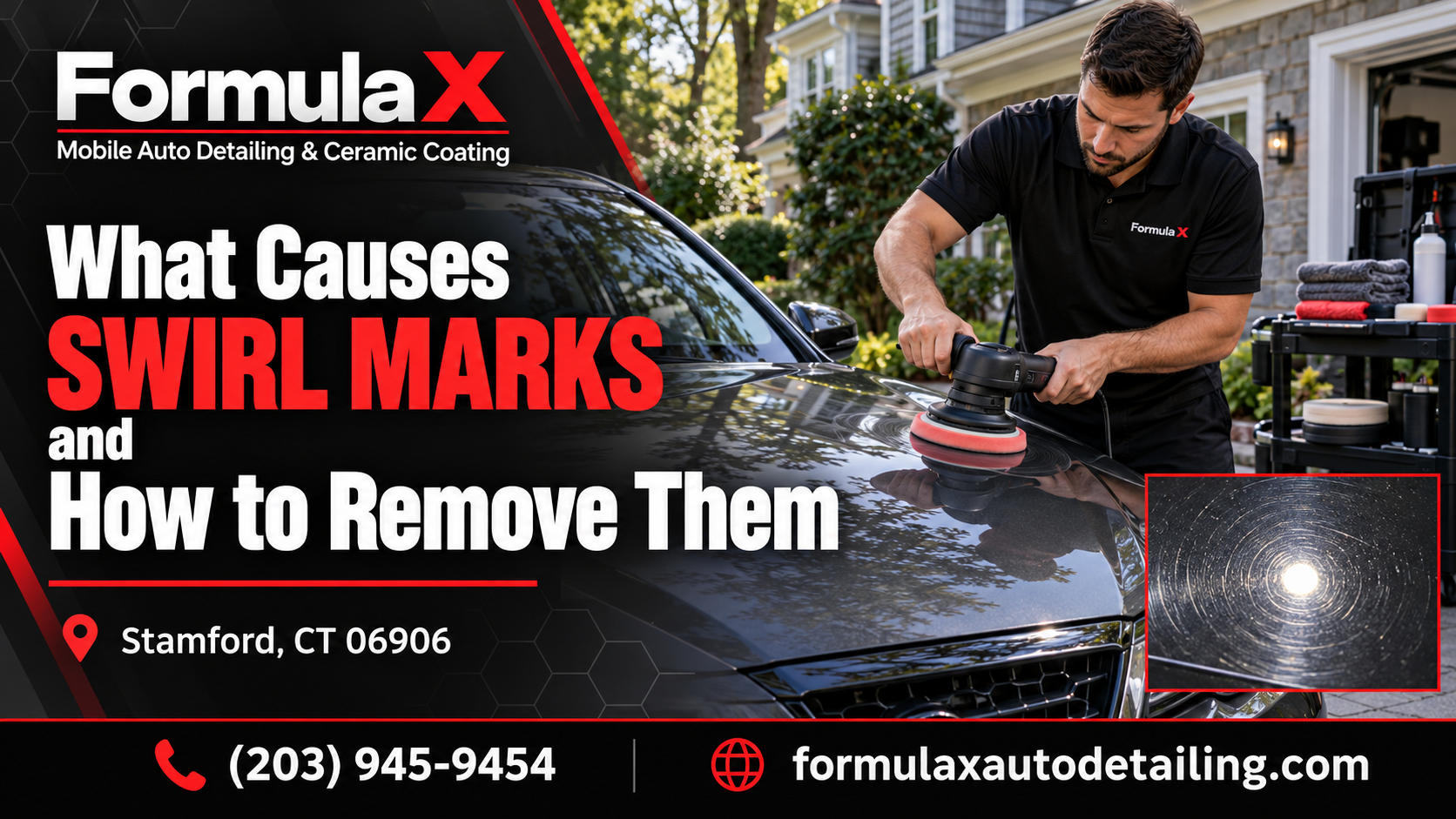
Formula X Mobile Auto Detailing & Ceramic Coating · Swirl Marks Guide
Swirl marks are the fine, spiderweb-like scratches that appear around the sun’s reflection on a car’s paint. Nearly every car has some, and dark paint shows them the most. The good news is that most swirls are shallow and come from a short list of habits: automatic brush washes, wiping a dry or dusty car, dirty mitts and towels, rushed dealer prep, and Connecticut winter grit that gets dragged across the paint. This guide explains each cause, how to spot swirls with sunlight and an LED light, how to stop adding new ones, and the real removal options, from fillers and glazes that hide swirls for a few washes to polishing and multi-stage correction that remove them. It also covers coating afterward. For the basics of correction, start with what is paint correction. Formula X Mobile Auto Detailing & Ceramic Coating is based at 48 Union St, Stamford, CT 06906, and can be reached at (203) 945-9454.
What causes swirl marks, and how do you remove them?
Swirl marks are caused by grit being rubbed across the paint, most often during washing and drying. The usual sources are automatic brush or soft-cloth washes, wiping a dry or dusty car, dirty wash mitts and sponges, worn or dirty drying towels, rushed machine work during dealer prep, and winter road grit and salt film being scrubbed off carelessly. Because they sit in the clear coat, most swirls can be removed by machine polishing, which levels the surface around them. A light one-step polish handles mild swirls; heavier swirling may need multi-stage paint correction. Glazes, fillers, and some waxes only hide swirls until they wash off. After removal, gentle washing and a sealant or ceramic coating keep new swirls from coming straight back.
In short: find the cause, change the habit, then remove what’s there with the gentlest method that works. Formula X’s paint correction page describes the service, and the paint correction guide explains how polishing works.
Where the details come from: Washing, drying, and cure guidance comes from Ceramic Pro’s aftercare page and its coating warranty document. Connecticut road-treatment details come from the Connecticut General Assembly’s Office of Legislative Research. Paint-gauge information is available from makers such as DeFelsko. The rest is general detailing practice, and no prices are given beyond Formula X’s published packages.
Swirl Marks at a Glance
Quick answer: Almost every swirl traces back to friction plus grit. Change the habit that’s causing them first, then choose how to deal with the ones already there: hide them for a while with a glaze, remove light ones with a one-step polish, or remove heavier ones with multi-stage correction.
| Cause | Why it scratches | What to change |
|---|---|---|
| Automatic brush or cloth wash | Brushes and cloths carry grit from car to car | Hand wash or a careful mobile wash |
| Dry wiping a dusty car | Dust becomes sandpaper under a towel | Lubricate with detail spray or rinse first |
| Dirty mitt or sponge | Grit trapped in the mitt is dragged across panels | Two buckets, clean mitts, rinse often |
| Worn or dirty drying towels | Old fibers and trapped grit scratch | Clean, dedicated microfiber; blot or drag gently |
| Rushed dealer prep | Quick washes and fast machine work | Inspect at delivery; ask what was done |
| Winter grit and salt film | Abrasive particles scrubbed off in a hurry | Pre-rinse heavily before any contact |
| Snow brushes and covers | Stiff bristles and dusty fabric rub the paint | Soft foam snow tools; clean covers on clean cars |
Where they live
In the clear coat, almost always. That’s why polishing can remove them.
Why they look circular
Light catches scratches running across its reflection, so they seem to orbit the bright spot.
Hide vs. remove
Glazes and fillers mask swirls for a few washes. Polishing levels them for good.
The real fix
Removal plus better washing. Without the second part, swirls return.
What Swirl Marks Actually Are
Quick answer: Swirl marks are thousands of very fine, shallow scratches in the clear coat, most of them running in the direction a mitt, brush, or towel moved. They’re not usually circles at all. They look circular because, under a single bright light, only the scratches lying across the path of the reflection light up, so they appear to ring the light source.
Run a clean finger across swirled paint and it usually feels perfectly smooth. Each scratch is tiny, much shallower than a scratch you can feel. What makes them visible is light. A smooth, level clear coat reflects light like a mirror, in one direction. Every tiny scratch has edges that send light off at other angles, and when there are enough of them, the paint looks hazy, grey, or webbed in bright sun.
That’s also why swirls seem to move. Walk around the car and the “circles” follow the sun’s reflection, because the scratches that line up across your line of sight change as you move. The scratches themselves stay put; you’re just seeing a different set of them light up.
| Trait | What it tells you |
|---|---|
| Visible in sun, invisible in shade | Shallow surface marring, typical swirls |
| Concentric pattern around the light | Random wash scratches lit up by a point source |
| Straight, parallel lines | Wiping or washing in one direction; same cause, different motion |
| Worse on hood, roof, and trunk | Horizontal panels get the most dust and the most wiping |
| Worse on dark colors | Dark paint hides nothing; light colors still have swirls but disguise them |
| Worse around handles and the trunk lid | Fingernails, rings, keys, and bags |
“Swirl” is used loosely. Detailers use the word for general wash marring, and some people use it for buffer trails (holograms) as well. For the distinctions, see the look-alike table later in this guide, and for a broader explanation of clear coat and how it’s leveled, see what is paint correction.
Automatic Brush and Soft-Cloth Washes
Quick answer: Friction washes are one of the fastest ways to swirl paint. The brushes or cloth strips touch every car that goes through, and the grit from one car can be pushed across the next. Ceramic Pro’s aftercare page says no drive-thru car washes and no hard brushing on coated cars, and the same logic applies to any paint you want to keep swirl-free.
A tunnel wash is designed for speed. Cars go in dirty, sometimes very dirty, and the brushes, mops, or soft-cloth curtains rotate across one car after another. Even with plenty of soap and water, some grit stays in the material and is dragged across paint at high speed. Over months of weekly visits, that adds up to the classic grey haze you see on many daily drivers.
There’s a second issue in winter. The Connecticut Office of Legislative Research notes that car washes may recycle the water they use, so salt washed off one vehicle may be sprayed onto others. That doesn’t make every car wash a bad idea for salt removal, but it’s worth knowing what you’re paying for.
| Wash type | Swirl risk | Notes |
|---|---|---|
| Brush tunnel | High | Rotating brushes touch the paint hard |
| Soft-cloth tunnel | Moderate to high | Softer material, but still contact and shared grit |
| Hand wash at a busy station | Varies | Depends on how often mitts and towels are cleaned |
| Touchless automatic | Lower for scratching | Relies on stronger chemicals and may not remove all film |
| Careful two-bucket hand wash | Lowest | Clean mitts, plenty of lubrication, rinsing first |
What about touchless washes?
Touchless washes avoid brushes, so they don’t drag grit across the paint the same way. To clean without touching, they usually rely on stronger detergents and high-pressure water, which can leave a film behind and may be harder on waxes and sealants. For many owners, an occasional touchless rinse in winter is a reasonable trade-off between leaving salt on the car and risking brush marks. If your car is coated, follow your installer’s guidance and Ceramic Pro’s advice to avoid drive-thru washes and soaps with high or low pH.
Fresh correction and brush washes don’t mix. Paying to have swirls removed and then going back through a brush tunnel is the quickest way to waste the work. If convenience matters, look at a mobile maintenance wash instead.
Dry Wiping, Dusters, and Quick Detailers
Quick answer: Wiping a dry, dusty car with a towel, a sleeve, or a feather duster grinds dust into the clear coat. Ceramic Pro lists no dry towel wiping and says to lubricate the surface with a detail spray or wash solution if you need to clean. If a car is more than lightly dusty, rinse it instead.
Dust looks harmless, but much of it is mineral grit. Push it across the paint with no lubrication and every particle acts like a tiny cutting tool. This is one of the most common causes of swirls on cars that never see a brush wash, because careful owners often wipe off pollen or dust between washes without realizing what it does.
- Pollen season: spring pollen in Fairfield County coats cars quickly. Rinse it off rather than wiping it.
- Dusty garages: fine dust settles on stored cars. A quick detail spray with a plush towel is fine on light dust; a rinse is better for heavy dust.
- Bird droppings: soften with water or detail spray and lift off, rather than scrubbing.
- Car covers: a cover on a dirty car rubs grit in every time it moves in the wind.
- Feather dusters and sleeves: fine on very light, fresh dust with care; risky on anything more.
How to use a quick detailer safely
A quick detailer or detail spray is meant for very light dust and fingerprints on an otherwise clean car. Spray generously, wipe gently in straight lines with a clean, folded microfiber towel, turn to a fresh side often, and buff off with a second towel. If the towel feels gritty or you can hear the dust, stop and rinse instead.
Dirty Mitts, Sponges, and One-Bucket Washing
Quick answer: A single bucket turns into a bucket of dirty water within a couple of panels, and the mitt picks that grit back up. Sponges trap grit on their flat faces. The two-bucket method, with one bucket of soapy water and one for rinsing the mitt, plus a clean microfiber or wool mitt, is the standard answer, and Ceramic Pro recommends a two-bucket hand wash at least once a month.
Home washing causes plenty of swirls even when owners avoid car washes. The pattern is usually the same: one bucket, an old sponge or mitt, washing the dirtiest parts of the car first or in the same water as the paint, and a mitt that gets dropped on the driveway and keeps going.
| Habit | Why it causes swirls | Better approach |
|---|---|---|
| One bucket | Grit goes back onto the mitt | Separate wash and rinse buckets, ideally with grit guards |
| Sponges | Grit sits on the surface and is pressed into the paint | Microfiber or wool wash mitts with deep pile |
| Wheels first with the same mitt | Brake dust and road grit are very abrasive | Separate tools and bucket for wheels |
| Dropped mitt | Picks up sand and gravel | Swap to a clean mitt; never reuse a dropped one |
| Scrubbing in circles | Leaves circular scratches that show easily | Light pressure in straight lines |
| Skipping the pre-rinse | Loose dirt is still on the car when the mitt arrives | Rinse thoroughly; pre-foam if you can |
| Washing lower panels first | The dirtiest grit contaminates the mitt early | Top to bottom; lower panels last |
The full routine, with soap choice, shade, and drying, is set out in Formula X’s guide to how to wash a ceramic-coated car. It applies just as well to uncoated paint.
Drying Towels and Drying Technique
Quick answer: Drying is the second scratch point after washing. Old bath towels, chamois that have dried stiff, and microfiber towels washed with fabric softener or dropped on the ground all add swirls. Ceramic Pro recommends a dedicated microfiber drying towel to remove all standing water, which also helps prevent water spots.
- Use a dedicated drying towel that only touches clean paint.
- Lay and pat, or drag gently with no pressure, instead of rubbing.
- Keep towels off the ground. A dropped towel goes in the laundry.
- Wash microfiber separately, without fabric softener, and let it air dry or tumble on low heat.
- Use an air blower for mirrors, grilles, and badges, so you don’t have to reach into tight spots with a towel.
- Retire old towels to wheels and door jambs once they feel stiff or matted.
Water spots are a separate problem. Letting hard water dry on the paint doesn’t cause swirls, but it can leave mineral rings and, over time, etching. Ceramic Pro advises against leaving hard water to dry on the paint, including from sprinklers. Dry promptly, in the shade.
Dealer Prep and Transport
Quick answer: Many new cars arrive with light swirls or buffer trails. Cars are washed, sometimes machine-polished, and handled several times between the factory and your driveway, often quickly. That’s why new paint should still be inspected before any coating. It’s a common pattern, not a claim against any particular dealer.
Between the plant and delivery, a car can be wrapped, unwrapped, washed at a port or lot, moved repeatedly, and given a final prep wash before you pick it up. Some dealerships also run a polisher over the car to brighten it for delivery. Done quickly, any of these steps can leave fine marring or rainbow-like holograms that show up the first time you see the car in strong sun.
| Stage | What can happen |
|---|---|
| Transport | Dust, film residue, handling marks |
| Lot storage | Dust, pollen, droppings, quick dry wipes |
| Prep wash | Fast washing and drying, sometimes with shared towels |
| Delivery polish | Holograms if a machine polish isn’t refined |
| Dealer-applied products | Glazes or sealants that hide marks until they wash off |
What to do at delivery
- Look at the car outside in daylight if you can, not only in the showroom.
- Use your phone flashlight on the hood and doors.
- Ask what was applied during prep, such as a polish, glaze, or sealant.
- Consider asking for no extra machine polishing if you plan to have the car professionally prepared and coated.
- Take daylight photos for your records.
Formula X’s guide on whether to ceramic coat a brand-new car covers why new paint often needs only a light polish before coating, and Ceramic Pro’s warranty document notes that any coating will amplify pre-existing damage.
Connecticut Winter: Salt, Sand, and Grit
Quick answer: Winter adds swirls in two ways. Road film full of salt, brine, and fine grit dries onto lower panels, and it’s abrasive if you scrub it off without soaking it first. Cold weather also pushes owners toward quick brush washes and snow brushes on paint. Rinse heavily before touching the paint, and save contact washing for milder days.
According to the Office of Legislative Research, the state Department of Transportation switched in 2006 from a sand-and-salt program to one using salt pre-wetted with liquid chemicals, now magnesium chloride. DOT recommends that motorists wash their cars after snowstorms to remove salt, including the undercarriage. Towns run their own programs, so the mix on local roads can vary, and plows, tires, and slush still throw grit onto cars.
| Winter source | Swirl risk | How to handle it |
|---|---|---|
| Dried salt and brine film | Crusty film scratches under a mitt | Soak and rinse first; pre-foam if possible |
| Grit and fine stones from roads | Very abrasive on lower doors and bumpers | Rinse lower panels last and longest; use separate mitts |
| Snow brushes | Stiff bristles drag frozen grit | Soft foam snow broom on paint; scrapers on glass only |
| Quick brush washes | Shared brushes full of winter grit | Touchless rinse in a pinch; hand wash on mild days |
| Wiping slush off by hand | Grit under a glove or sleeve | Leave it and rinse later |
| Washing in the cold | Rushed technique, frozen towels | Wait for a milder, dry day when you can |
The trade-off in winter is real. Leaving salt on a car isn’t good for it, and DOT recommends washing after storms. But how you remove the salt determines whether you add swirls doing it. A thorough rinse, especially of the lower panels and wheel wells, removes much of the loose material without touching the paint. A contact wash can wait for a day when you can do it properly.
Plan correction around winter. If your car is swirled now, the common approach is to correct and protect in the fall, before salt season, or in spring once roads are clean. A coating or sealant makes winter rinsing more effective, because grime releases more easily. See how long ceramic coating lasts in Connecticut winters for timing.
Other Everyday Causes of Swirls and Marring
Quick answer: Beyond washing, swirls and fine marring come from bags and backpacks set on the trunk, leaning on the car, jacket zippers, pets, kids’ toys, rings near door handles, dusty car covers, and amateur machine polishing that wasn’t refined. Most are small habits that are easy to change once you know about them.
| Cause | Where it shows | Easy change |
|---|---|---|
| Bags, groceries, boxes | Trunk lid and rear bumper | Use a bumper protector mat or set items down first |
| Rings and keys | Behind door handles | Door-cup film or more care when opening |
| Leaning and zippers | Doors and fenders | Keep clothing off the paint when loading |
| Pets | Doors, rear bumper, tailgate | Ramps, seat covers, and care around paint |
| Dusty car covers | Roof, hood, fenders | Only cover a clean car; wash the cover |
| Amateur machine polishing | Anywhere, as holograms or haze | Learn on a test panel and finish with a refining polish |
| Rubbing compounds by hand | Around a single scratch | A patch of haze around a spot repair; get it refined |
None of these are a reason to treat a car like a museum piece. They’re just the reason that even well-washed cars pick up some marring over time, and why a light polish every so often, rather than heavy correction, is often all a carefully kept car needs.
How to Spot Swirls: Sunlight and LED Light
Quick answer: Swirls show best under a single, strong, point-like light source. That means direct sun on a clear day, or a bright LED flashlight held at an angle in a darker garage. Diffuse light, like an overcast sky or long overhead garage tubes, hides them. Look at the reflection of the light, not straight at the panel.
Many owners are surprised the first time they see their car in strong sun after a wash. The paint looked perfect in the garage, and suddenly the hood is covered in fine webs. Nothing changed except the light. Learning how to look is the most useful thing you can do before booking any polishing, because it lets you judge both the problem and the result.
- Start with clean, dry paint. Dust and water drops hide marring and confuse what you see.
- Use direct sun. Stand so you can see the sun’s reflection in the paint and look around it.
- Or use an LED flashlight. In a garage, hold a bright LED light close to the panel at an angle and move it slowly.
- Look into the reflection. Swirls appear as rings or webs around the bright spot.
- Move around the car. Different scratches light up from different angles.
- Check horizontal panels first. The hood, roof, and trunk usually show the most.
- Photograph what you find, with the light in the shot, so the swirls are visible in the photo.
| Light source | How well it shows swirls | Notes |
|---|---|---|
| Direct sun | Very well | The most honest test of a finish |
| Bright LED flashlight | Very well, up close | Good for garages and evenings; move it slowly |
| Phone flashlight | Reasonably well | A handy first check at delivery or in a lot |
| Overcast daylight | Poorly | Shows overall gloss and color, hides fine marring |
| Long overhead tubes or panels | Poorly to moderately | Shows larger scratches and haze more than swirls |
| Gas station canopy lights | Moderately | Point-like LEDs can reveal swirls at night |
Why detailers use several lights. A professional inspection usually combines a bright handheld light for fine swirls with broader lighting for haze and overall gloss. Ask your provider how they’ll inspect the paint before and after work, and look at it together in daylight at the end.
Swirls vs. Look-Alike Defects
Quick answer: Not every mark that looks like a swirl is one. Holograms are machine trails, water spots are mineral rings, etching is chemical damage, and a deep scratch is a single line that catches a fingernail. Telling them apart matters, because each needs a different fix, and some can’t be polished out.
| Defect | How to tell it apart | Usual fix |
|---|---|---|
| Wash swirls | Fine webs around the light, all over the car | Polish or correction |
| Holograms (buffer trails) | Wavy, rainbow-like trails that shift as you move; follow the path of a machine | Refining polish with a finer pad and product |
| Random isolated scratches | Single, longer lines at odd angles | Polishing may reduce or remove; deeper ones need repair |
| Water spots | Rings or dots that sit on top or slightly etched in | Washing or a mineral remover first; polish if etched |
| Bird or bug etching | Dull, sometimes wrinkled patch where something sat | Polishing if shallow; repair if deep |
| Deep scratch | Catches a fingernail; may show a different color at the bottom | Touch-up, fill and level, or refinish |
| Oxidation | Chalky, faded look over a whole panel | Polishing if the clear coat is intact |
If you see wavy, rainbow-like trails rather than fine webs, the paint has probably been machine-polished before without a final refining step. That’s good news in one sense, because holograms are usually shallow, but it also tells you some clear coat has already been used. For deeper single scratches, Formula X’s scratch repair page and the BMW X5 scratch repair guide explain how depth is judged.
Swirls on Different Colors and Finishes
Quick answer: Black and other dark colors show swirls most clearly; white, silver, and light metallics hide them better, though the scratches are still there and dull the gloss. Matte and satin finishes don’t swirl in the same way and must not be polished, and wrapped or filmed panels need the film installer’s advice.
| Finish | How swirls show | What to keep in mind |
|---|---|---|
| Black and dark solid colors | Very clearly, even in moderate light | The refining step matters most |
| Dark metallics | Clearly, with sparkle partly disguising them | Swirls dull the metallic flake |
| White and silver | Faintly; often noticed only as reduced gloss | Check with a flashlight before deciding |
| Matte and satin paint | As shiny patches or marks rather than swirls | Don’t polish; use matte-safe care |
| Wraps and paint protection film | Fine marks in the film’s surface | Ask the installer before any polishing |
Owners of light-colored cars are often told they don’t need swirl removal. They may not need much, but a light polish can still bring back noticeable clarity. For satin finishes, see the Range Rover Sport guide for what to ask.
How Bad Are Your Swirls? A Simple Scale
Quick answer: Light swirls are visible only in direct sun or under a flashlight; moderate swirls are visible in normal daylight; heavy swirls make the paint look grey or hazy even in shade. Light swirling usually needs only a one-step polish. Moderate to heavy swirling often needs multi-stage correction, within the limits of the clear coat.
| Level | What you see | Typical approach |
|---|---|---|
| Light | Faint webs only in direct sun or close LED light | One-step polish, or a glaze if you only want it hidden for an event |
| Moderate | Swirls visible in ordinary daylight; gloss looks a bit flat | One-step for improvement, or two-stage for fuller removal |
| Heavy | Paint looks grey or hazy even in shade; dark colors look milky | Multi-stage correction after paint-depth readings |
| Heavy plus deeper scratches | Haze plus lines that catch a nail | Correction for swirls; separate repair for deep marks |
This scale is only a starting point. Two cars that look similar can respond very differently to polishing, depending on how hard the clear coat is and how much of it is left. That’s why a test spot and, ideally, paint-depth readings come before any decision. Formula X’s guide to one-step vs. multi-stage paint correction goes into how that choice is made.
Not Sure How Swirled Your Paint Is?
Send Formula X Mobile Auto Detailing & Ceramic Coating your vehicle’s year, make, model, and color, how it’s usually washed, where it’s parked, and a few photos taken in direct sun with the reflection in the shot. You’ll get an honest read on whether a light polish, a fuller correction, or simply a better wash routine makes sense, and any correction is quoted after the paint is inspected.
Removal Options: Hide, Polish, or Correct
Quick answer: There are three broad routes. Hiding uses glazes, fillers, or filler-rich waxes to mask swirls temporarily. Polishing, often called a one-step, removes light swirls and improves the rest. Multi-stage correction cuts and then refines to remove heavier swirling. Only polishing and correction actually remove swirls; hiding wears off.
| Option | What it does to swirls | How long the look lasts | Clear coat used |
|---|---|---|---|
| Glaze or filler | Fills and masks them | Until it washes off, often a few washes | None |
| Cleaner wax or all-in-one | Lightly polishes and fills, then protects | Weeks to a few months, depending on product and care | Very little |
| One-step machine polish | Removes light swirls, reduces moderate ones | Removed swirls stay removed | A little |
| Multi-stage correction | Removes most swirling, then refines | Removed swirls stay removed | More |
| Wet sanding plus correction | For deeper defects, not normal swirls | Permanent where safe | Most; specialist work |
Which route makes sense depends on what you want and how long you’ll keep the car. A glaze before a weekend event is a perfectly reasonable choice if you understand it’s temporary. A one-step polish is often the sweet spot for daily drivers and newer cars. Multi-stage correction is worth it when swirling is heavy, the car is a keeper, or you’re about to apply a long-term coating. The paint correction guide explains how polishing levels clear coat, and one-step vs. multi-stage paint correction compares the two removal routes stage by stage.
Fillers and Glazes: Why Swirls Come Back After a Wash
Quick answer: Glazes and filler-heavy products contain oils, resins, or fine fillers that settle into scratches and smooth out how light reflects. The paint looks swirl-free, but the scratches are still there. As the product washes away, often within a few washes, the swirls reappear. That’s the most common reason owners think swirls “came back” after a cheap polish.
There’s nothing wrong with fillers in themselves. Show cars, cars being photographed, and cars going to an event often get a glaze for exactly this effect. The problem is when a filler is sold, or understood, as correction. If a quick “polish” left the car looking perfect and the swirls were back in a month, there’s a good chance much of the effect came from fillers rather than abrasives.
| Sign | What it suggests |
|---|---|
| Perfect finish right after, swirls back within weeks | Fillers did most of the work |
| Swirls reappear after a panel wipe or strong soap | The oils that were hiding them have been removed |
| Very quick “correction” on a heavily swirled car | Probably masking rather than leveling |
| Finish stays clear through many gentle washes | The swirls were actually removed |
Why professionals wipe panels during correction
Polishes themselves contain oils that can hide fine marks. That’s why careful installers wipe panels with a panel-prep solution during and after correction, to see the real result. It’s also a necessary step before a ceramic coating, which needs a clean, oil-free surface to bond. Ask whether your provider does this, and if you want to judge the result yourself, look at the paint after it has been washed a couple of times.
Fillers and coatings don’t go together. A coating should be applied to bare, corrected paint, not over a glaze. If a filler is hiding swirls under a coating, they’ll show again once the filler breaks down, and the coating is now in the way of fixing them.
Polish vs. Full Correction for Swirls
Quick answer: A one-step polish uses a single pad and product to remove light swirls and noticeably improve moderate ones, using little clear coat. Full, multi-stage correction cuts first to remove deeper swirling, then refines to restore clarity. Choose the polish for light swirling or limited budgets and time; choose correction for heavy swirling or before a long-term coating.
| Question | One-step polish | Multi-stage correction |
|---|---|---|
| Typical result on light swirls | Most or all removed | All or nearly all removed |
| Typical result on heavy swirls | Clear improvement; some remain | Most removed, within safe limits |
| Clear coat used | Less | More |
| Time on the car | Shorter | Longer |
| Best before a coating when | Paint is new or lightly marred | Paint is heavily swirled and you’ll keep the car |
The deciding factors are how deep the swirls go, how hard the clear coat is, and how much is left. A test spot on one panel tells an installer whether a one-step will get close enough or whether a cutting stage is needed. If you want the detail on stages, pads, and paint-depth readings, read one-step vs. multi-stage paint correction.
A Swirl-Free Wash Routine
Quick answer: Rinse thoroughly, use two buckets and clean mitts, wash in the shade from top to bottom with light pressure, keep wheels separate, dry with a dedicated microfiber towel, and never wipe a dusty car dry. Ceramic Pro recommends washing every two weeks, a two-bucket hand wash at least monthly, and avoiding drive-thru washes and dry towel wiping.
- Work in the shade on cool paint. Ceramic Pro advises against washing in direct sun or on surfaces that are warm to the touch.
- Rinse first, thoroughly. Remove as much loose grit as possible before touching the car.
- Pre-foam if you can. A foam cannon helps loosen dirt.
- Use two buckets. One for soapy water, one to rinse the mitt.
- Use a pH-balanced car soap. Ceramic Pro says to avoid soaps with wax or petroleum distillates, or with high or low pH, on coated cars.
- Wash top to bottom, in straight lines, with light pressure. Rinse the mitt often.
- Save the lowest panels for last, or use a separate mitt.
- Clean wheels with their own tools.
- Rinse again, then dry with a dedicated microfiber drying towel.
- Wash your microfiber properly so it’s clean for next time.
For coated cars, Formula X’s washing guide covers boosters, decontamination, and the annual service. For EVs, the ceramic coating for Teslas and EVs guide adds camera, sensor, and charge-port cautions from the owner’s manual.
Coating After Swirl Removal
Quick answer: A ceramic coating after swirl removal makes the paint easier to wash and helps it resist some light marring, but it doesn’t make paint scratch-proof. Ceramic Pro’s aftercare page describes its coatings as protecting the factory clear coat while noting they are not bulletproof and need routine aftercare. Correct first, coat second, then wash gently.
Ceramic Pro’s warranty document strongly recommends a machine polish for vehicles over three months old and notes that any coating will amplify pre-existing damage. That’s why swirl removal and coating usually go together. Once the coating is on, Ceramic Pro says it cures enough to drive within 48 hours, with a typical cure of up to two weeks depending on the coating, which is the period it recommends waiting before washing.
| Protection after removal | What it helps with | What it won’t do |
|---|---|---|
| Wax | Gloss and short-term water beading | Last long or resist marring much |
| Sealant | Longer protection, easier washing | Stop wash scratches if technique is poor |
| Ceramic coating | Easier cleaning, gloss, chemical resistance | Make paint scratch-proof or prevent swirls from brush washes |
| Paint protection film | Chips and physical impacts on high-risk areas | Replace good washing habits |
To compare these honestly, see ceramic coating vs. wax vs. sealant. For what drives coating quotes, see how much ceramic coating costs in Connecticut, and for leased cars, is ceramic coating worth it on a leased car.
Ask which warranty terms apply. Formula X’s Ceramic Pro package cards print 7 years for Gold, 5 for Silver, and 2 for Bronze. Ceramic Pro’s current US warranty document lists Gold as lifetime of the vehicle with annual services, Silver as 5 years, and Bronze as 2 years. Ask which terms apply to your package, and keep your invoice and service records.
Formula X Options for Swirl Marks
Quick answer: Formula X offers swirl removal through its paint correction service, quoted after the paint is inspected, and Ceramic Pro coatings to protect the result. Published detailing packages are Gold from $495+, Silver from $395+, and Bronze Interior or Bronze Exterior from $295+, with scratches extra.
If swirls are your main concern, start with Formula X’s paint correction page and the guide to what paint correction is. Send photos taken in direct sun, and the paint will be inspected before anything is quoted.
| Need | Where to start | Pricing |
|---|---|---|
| Swirls and haze | Paint correction | Quoted after inspection |
| A deeper scratch among the swirls | Scratch repair | Quoted after inspection; scratches extra |
| Protection after removal | Ceramic Pro in Stamford · Ceramic coatings | Coatings quoted after inspection |
| Exterior detail | Exterior detailing | Bronze Exterior from $295+ |
| Inside and out | CT mobile car detailing | Gold from $495+, Silver from $395+ |
Formula X’s package cards describe Gold as “perfect for new vehicles and long term ownership,” Silver as “ideal for short term ownership,” and Bronze as “best for leased vehicles.” Paint correction isn’t listed on the cards; if the paint needs polishing before a coating, that’s part of the quote after inspection.
Swirl Mark Mistakes to Avoid
Quick answer: The biggest mistakes are removing swirls without changing how the car is washed, mistaking a glaze for correction, polishing by hand or machine without refining, coating over swirls, and scrubbing winter grime off without a heavy rinse.
Not changing the wash
Correction followed by brush washes brings swirls back quickly.
Paying for a glaze as correction
Fillers hide swirls for a few washes. Ask what the product does.
Skipping the refining step
Aggressive machine work without refining leaves holograms.
Coating over swirls
Ceramic Pro says any coating will amplify pre-existing damage.
Scrubbing winter film dry
Salt crust and grit scratch. Soak and rinse first.
Dry wiping pollen and dust
Ceramic Pro says no dry towel wiping. Lubricate or rinse.
Swirl Mark Myths
Quick answer: Swirls aren’t a sign of bad paint, they aren’t only a dark-car problem, a coating won’t stop them on its own, and a wax that hides them hasn’t removed them. They’re fine scratches, and they’re removed by leveling the clear coat.
| Myth | Reality |
|---|---|
| “Only black cars get swirls.” | All colors get them; dark colors show them more. |
| “Soft-cloth washes are swirl-free.” | Softer material, but still contact and shared grit. |
| “A coating makes my car swirl-proof.” | Ceramic Pro says its coatings are not bulletproof and need routine aftercare. |
| “The wax got rid of the swirls.” | If they come back after washing, they were filled, not removed. |
| “New cars don’t have swirls.” | Many arrive with light marring from transport and prep. |
| “Polishing more often keeps swirls away.” | Each polish uses clear coat; gentle washing is the real prevention. |
The practical version: swirls come from how a car is touched. Touch it less, touch it more gently, and when it’s time to remove what’s there, use the lightest method that does the job.
Formula X Mobile Auto Detailing & Ceramic Coating
Formula X Mobile Auto Detailing & Ceramic Coating is a mobile detailing, paint correction, scratch repair, and ceramic coating service based at 48 Union St, Stamford, CT 06906. The team works throughout Stamford, Greenwich, Darien, New Canaan, Norwalk, Rowayton, Westport, and other towns in lower Fairfield County, and Westchester County, NY.
For swirl marks, that means looking at the paint in strong light, explaining whether a polish or a fuller correction makes sense, and quoting the work after the vehicle has been seen.
Call (203) 945-9454, email formulaxautodetail@gmail.com, send a request through the contact page, or view Formula X Mobile Auto Detailing & Ceramic Coating on Google Maps. Address: 48 Union St, Stamford, CT 06906.
Frequently Asked Questions About Swirl Marks
What causes swirl marks on car paint?
Swirl marks are fine scratches caused by grit being rubbed across the clear coat. The most common sources are automatic brush or soft-cloth washes, wiping a dry or dusty car, dirty mitts and sponges, one-bucket washing, worn or dirty drying towels, rushed dealer prep, and winter grit scrubbed off without a proper rinse.
Why do swirl marks look like circles?
Most swirls are random fine scratches, not true circles. Under a single bright light, such as the sun, only the scratches lying across the path of the reflection light up, so they appear to ring the light source. As you move, a different set lights up and the pattern seems to follow you.
How can I see swirl marks on my car?
Look at clean, dry paint in direct sun, or use a bright LED flashlight held at an angle in a darker garage. Look into the reflection of the light rather than straight at the panel. Overcast daylight and long overhead garage lights tend to hide swirls.
Do automatic car washes cause swirl marks?
Brush and soft-cloth washes are a common cause, because the material touches every car and can carry grit from one to the next. Ceramic Pro's aftercare guidance says no drive-thru washes and no hard brushing on coated cars. Touchless washes avoid brush contact but rely on stronger chemicals.
Can a new car have swirl marks?
Yes. Many new cars arrive with light swirls or buffer trails from transport, lot storage, prep washes, and quick machine polishing before delivery. That's why new paint should be inspected before any coating, and why it often needs only a light polish.
Does Connecticut winter cause swirl marks?
Winter adds risk. Salt, brine film, and road grit dry onto lower panels and are abrasive if scrubbed off without soaking and rinsing first, and cold weather pushes owners toward brush washes and stiff snow brushes. Connecticut DOT recommends washing after storms, so rinse thoroughly and save contact washing for milder days.
Can swirl marks be removed?
Usually, yes. Because most swirls sit in the clear coat, machine polishing can level the surface around them. Light swirls often come out with a one-step polish; heavier swirling may need multi-stage correction. Deep scratches that catch a fingernail are a separate problem and may need repair.
What is the difference between hiding and removing swirls?
Glazes, fillers, and filler-rich waxes settle into the scratches and hide them until they wash away, often within a few washes. Polishing and correction remove a very thin layer of clear coat so the scratches are leveled and stay gone, as long as new ones aren't added.
Why did my swirls come back after a polish?
Either the effect came mostly from fillers that washed off, or new swirls were added by washing and drying habits. If the finish looked perfect and then faded within weeks, fillers are the likely reason. If it stayed clear for a while and then slowly hazed, look at how the car is being washed.
Should I get a one-step polish or full correction for swirls?
A one-step polish suits light swirling and newer cars and uses less clear coat. Multi-stage correction suits heavy swirling, especially on a car you'll keep or before a long-term coating. A test spot and paint-depth readings help decide.
Will a ceramic coating prevent swirl marks?
It helps, but it doesn't make paint scratch-proof. A coating makes washing easier and can resist some light marring, but Ceramic Pro describes its coatings as not bulletproof and requiring routine aftercare. Gentle washing is still the main prevention.
Can I remove swirl marks myself?
Light swirls on forgiving paint can be improved by a careful owner with a dual-action polisher, the right pads, and good lighting. The risks are holograms from skipping the refining step and cutting through thin paint near edges. Heavy swirling, dark or soft paint, and anything under a coating or film are better left to a professional.
How much does swirl removal cost at Formula X?
Swirl removal is part of paint correction, which Formula X quotes after inspecting the paint. Formula X's published detailing packages are Gold from $495+, Silver from $395+, and Bronze Interior or Bronze Exterior from $295+, with scratches extra; ceramic coatings are quoted after inspection.
Where is Formula X Mobile Auto Detailing & Ceramic Coating located?
Formula X Mobile Auto Detailing & Ceramic Coating is based at 48 Union St, Stamford, CT 06906. It's a mobile service working in Stamford, Greenwich, Darien, New Canaan, Norwalk, Rowayton, Westport, and nearby towns, plus Westchester County, NY. Call (203) 945-9454 or email formulaxautodetail@gmail.com.
Find Formula X Mobile Auto Detailing & Ceramic Coating
Formula X Mobile Auto Detailing & Ceramic Coating is a mobile service based at 48 Union St, Stamford, CT 06906. Use the map for directions to the business address, or call (203) 945-9454 to arrange service at your location.
View Formula X Mobile Auto Detailing & Ceramic Coating on Google Maps
Get Your Swirl Marks Assessed
Call Formula X Mobile Auto Detailing & Ceramic Coating at (203) 945-9454 or send a request with your vehicle’s year, make, model, and color, how it’s washed now, where it’s parked, and photos taken in direct sun with the reflection in the shot. The paint is inspected before any polish or correction is quoted, and you’ll get a straight answer on whether the swirls can be polished out and how to keep them from coming back.
48 Union St, Stamford, CT 06906 · Serving Stamford, Greenwich, lower Fairfield County, and Westchester County, NY