
Formula X Mobile Auto Detailing & Ceramic Coating · Mobile Interior Detailing
The inside of a car takes more abuse than most people notice until they look closely: crumbs in the seat rails, salt rings on the carpet, a sticky cupholder, a film on the inside of the windshield, and a smell nobody can quite place. An interior detail is a deep clean of all of it, done by hand, surface by surface. A mobile interior detail brings the vacuums, extractor, steamer, and products to your driveway or office lot. This guide walks through each step in the order a detailer usually works, what Formula X's published interior packages include, which stains and odors usually come out and which don't, what costs extra, and what belongs with an upholstery shop, glass shop, or mechanic. It also covers kids' car seats, pets, drying time, and how to check the work. Formula X Mobile Auto Detailing & Ceramic Coating is based at 48 Union St, Stamford, CT 06906, and can be reached at (203) 945-9454.
What's included in a mobile interior detailing service?
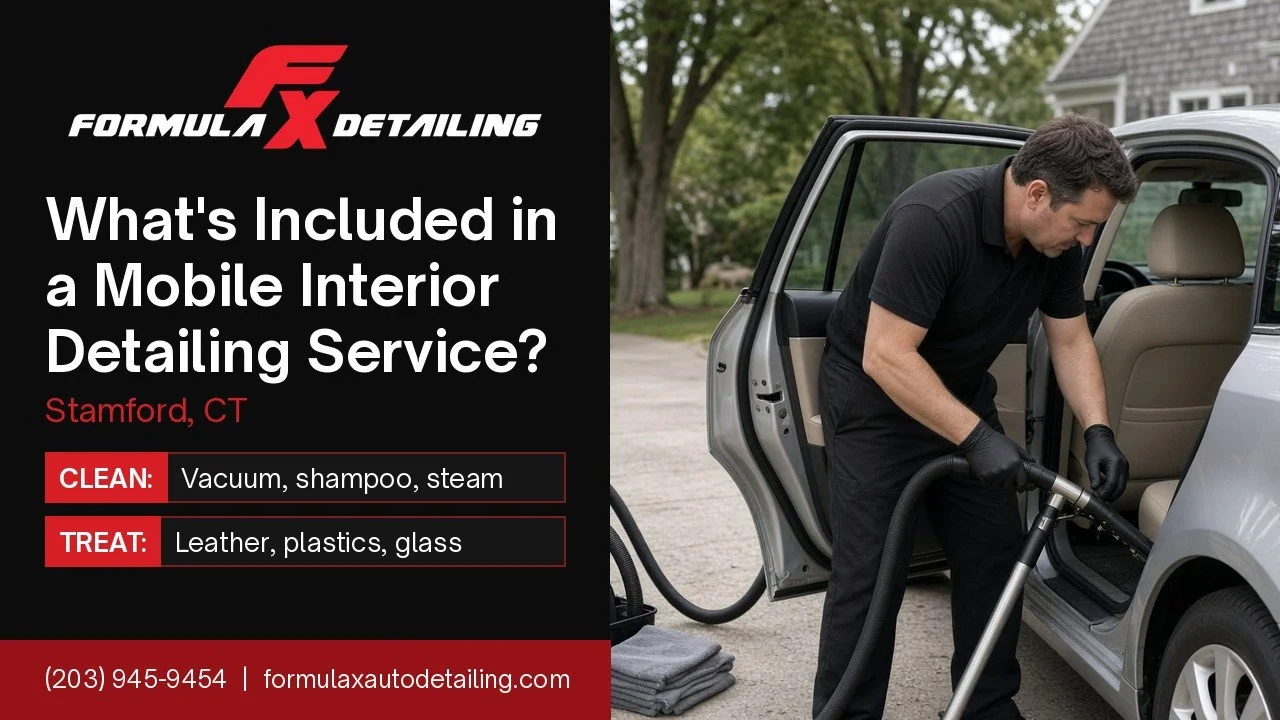
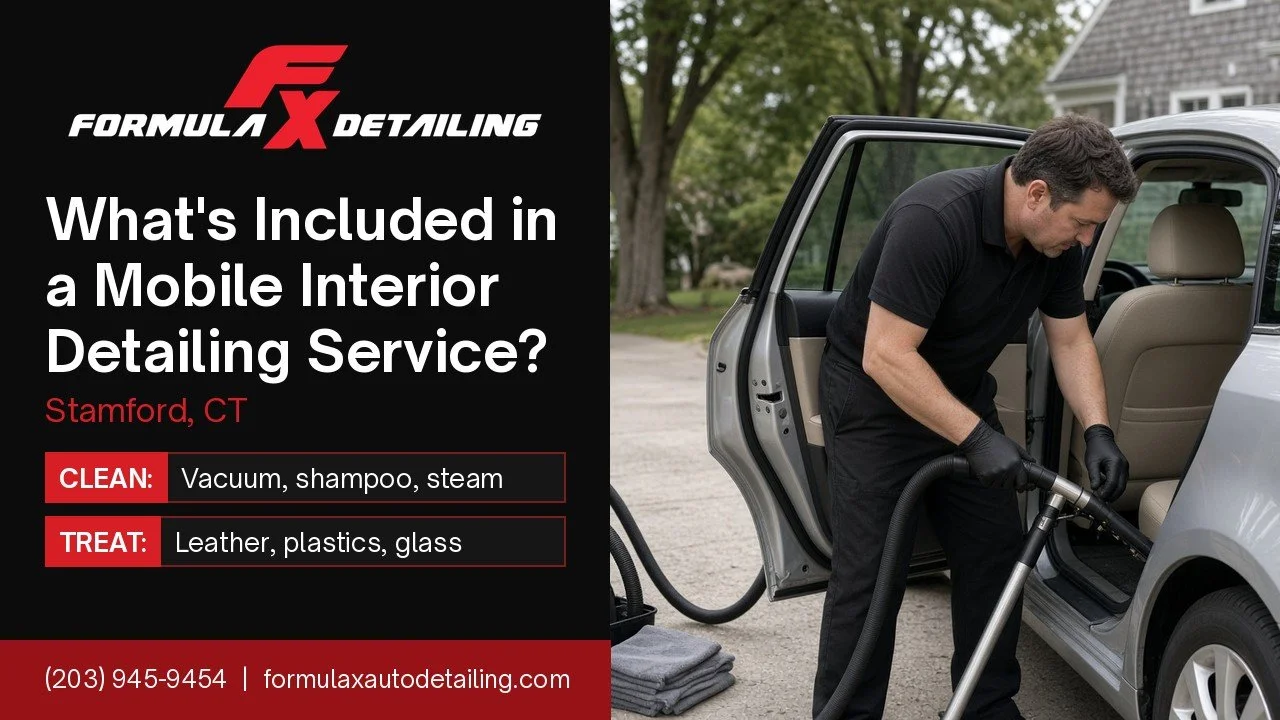
A mobile interior detail usually includes removing trash, a thorough vacuum of seats, carpets, mats, and the trunk, shampooing or extracting carpets and cloth upholstery, steam cleaning hard surfaces, vents, and cupholders, cleaning and treating leather, wiping down the dashboard, console, and door panels, and cleaning the inside of the windows, all done where the car is parked. Formula X's Bronze Interior package ($295+) lists thorough vacuuming, interior steam cleaning, leather treatment, windows and exhaust tips, and carpet and upholstery shampoo. Tears, burns, and leaks go to an upholstery shop or body shop.
For the outside of the car, read the companion guide, what’s included in a mobile exterior detailing service. For the service itself, see interior detailing in Stamford, CT and mobile detailing, and to get ready for the visit, read how to prepare for a mobile detail.
Where the details come from: Package contents and prices come from Formula X's published packages. Odor-treatment cautions come from the EPA, car seat guidance from NHTSA, floor mat safety from NHTSA winter driving tips, pet travel guidance from the American Veterinary Medical Association, and thirdhand smoke background from the Mayo Clinic. The step-by-step process is general professional detailing practice. Ask any detailer, including Formula X, exactly which steps your package covers.
What a Mobile Interior Detail Actually Is
Quick answer: An interior detail is a hand deep clean of everything inside the car: seats, carpets, mats, headliner, dashboard, console, door panels, vents, glass, and the trunk. A mobile detail brings the equipment to your home or office, so the car never leaves.
A quick vacuum at a gas station picks up what's on top. An interior detail goes after what's underneath and in between: sand ground into carpet fibers, crumbs in seat tracks, spills soaked into cloth seats, dust in the vents, and the greasy film that builds up on screens and the inside of the glass. It's slow, careful work, and most of the time goes into areas you don't see at a glance.
Like exterior detailing, the word gets used loosely. One shop's interior detail is a vacuum and a wipe. Another's includes hot-water extraction, steam, and leather care. The most useful question when you book is “what steps are in this package?” A clear answer will say whether carpets and seats are shampooed or only vacuumed, whether steam is used, how leather is treated, and whether the trunk and glass are included.
Mobile simply means the detailer comes to you. Interior work has one big advantage here: it doesn't need water running off the car, so it's often possible in places where washing isn't allowed, such as many condo garages and office lots. It does need power for vacuums and extractors, and room to open all the doors.
| Service | What it usually covers | What it usually skips |
|---|---|---|
| Quick vacuum | Loose dirt on carpets and seats | Stains, crevices, plastics, glass, odor |
| Wipe-down clean | Vacuum plus a wipe of hard surfaces | Shampoo, extraction, leather care |
| Interior detail | Deep vacuum, shampoo or extraction, steam, leather care, plastics, glass | Repairs, tears, burns, leaks |
| Upholstery repair | Fixing tears, burns, worn bolsters, sagging headliners | Cleaning; this is a trim shop job |
How a Mobile Interior Detail Works at Your Home or Office
Quick answer: The detailer sets up beside the car with vacuums, an extractor or steamer, brushes, and towels, opens the doors, and works through the cabin section by section. You need room to open every door fully and an answer on power before the day.
A typical visit starts with a look inside. The detailer checks the seats, carpets, headliner, and plastics, notes stains, wear, and any damage, and confirms what you've booked. This is when to point out the juice spill under the car seat, the pen mark on the leather, or the smell you've been trying to track down.
Then comes setup. Interior work needs power for vacuums, extractors, and steamers. Many mobile vans carry their own power, and some use a customer's outlet, so ask which applies. Any generator belongs outside, away from doors and windows. Cords should stay out of walkways.
Space matters more than people expect. Every door needs to open fully, and the detailer needs room to kneel at each one. In a tight garage, it helps to pull the car out or clear the walls around it. Shade helps too, because a car sitting in the sun gets hot inside, and products dry too quickly on hot surfaces.
| Ask before the visit | Why it matters |
|---|---|
| Do you bring power? | Decides whether you need an outlet nearby |
| Can it be done in my garage? | Many interior details can, with light and ventilation |
| Are carpets and seats shampooed or just vacuumed? | The biggest difference between packages |
| How long will carpets take to dry? | Affects when you can drive and whether to leave windows open |
| Are pet hair and heavy stains extra? | Formula X lists extra charges for pet hair and heavy soil |
Step 1: Clearing Out Trash and Personal Items
Quick answer: Before cleaning starts, the cabin needs to be emptied: trash, loose items, car seats if they'll be cleaned under, and anything in the door pockets, console, glovebox, and trunk that you want kept safe. Doing it yourself first saves time and keeps valuables with you.
Detailers work around what's in the car, and every bag, toy, charging cable, and stack of paperwork slows them down. Clearing the car beforehand means the time goes into cleaning. Take out anything valuable or personal, including garage door openers, parking passes, and documents, or put them in one bag for the detailer to set aside.
If a child seat is installed, decide before the day whether it should come out. Underneath a car seat is usually where the worst crumbs and spills hide. Removing it lets the seat be cleaned properly, but it then needs to be reinstalled correctly. More on that below.
Mention anything fragile or unusual: a dash camera, aftermarket screen, seat covers, or a custom mat set. For the full prep list, read how to prepare for a mobile detail.
- Trash, wrappers, bottles, and cups
- Valuables, documents, and parking passes
- Charging cables and phone mounts if loose
- Child seats, if they'll be removed
- Sports gear, strollers, and cargo in the trunk
- Anything in door pockets, the console, and seat-back pockets
Step 2: A Thorough Vacuum, Top to Bottom
Quick answer: Vacuuming comes first and takes longer than most people expect. Seats, seat tracks, crevices, carpets, mats, and the trunk are vacuumed with crevice tools and brushes to loosen ground-in sand and debris. Formula X's Bronze Interior and Gold packages list thorough vacuuming.
A detail vacuum works from the top down and from the back to the front, so debris falls onto areas that haven't been done yet. Seats are moved fully forward and back to reach the tracks. A stiff brush or air tool loosens dirt from carpet fibers and seams so the vacuum can pull it out.
The crevices are where the time goes: between the seats and the console, inside seat seams, along door sills, in the cupholders, and around the pedals. A car that's been through a few Connecticut winters often has sand and salt deep in the carpet that a quick vacuum leaves behind.
The trunk or cargo area gets the same treatment, including under the floor panel if it lifts. In SUVs and minivans with third rows, the area behind and under the back seats often holds the most surprises.
| Area | Why it takes time |
|---|---|
| Seat tracks and rails | Seats must be moved to reach debris |
| Between seats and console | Narrow gaps that trap crumbs and coins |
| Carpet fibers | Ground-in sand and salt need agitation |
| Third row and cargo area | Large areas, often heavily used by kids and pets |
Step 3: Floor Mats Cleaned Outside the Car
Quick answer: Floor mats are taken out and cleaned separately. Rubber and all-weather mats are scrubbed and rinsed, and carpet mats are vacuumed and shampooed. They go back in dry and correctly secured with their retention clips.
Mats take the worst of the dirt, especially in winter. Rubber and all-weather mats hold slush, salt, and sand in their channels, and they're cleaned with a scrub brush and a rinse. Carpet mats are vacuumed, treated for stains, and shampooed or extracted like the main carpet.
Putting mats back correctly matters for safety. NHTSA stresses using floor mats that are the correct size for the vehicle, installed with their retention clips, so they can't slide forward and interfere with the pedals. Never stack a second mat on top of the original. Check the driver's mat yourself before driving off.
Rubber mats should be fully dry and free of any slippery dressing before they go back in. A shiny, slippery mat under the pedals is a hazard, and a careful detailer won't dress them.
Mat safety: A loose or stacked floor mat can slide under the pedals. After any interior cleaning, check that the driver's mat is the right one for the car, lies flat, and is hooked onto its retention clips.
Step 4: Carpet Shampoo and Hot-Water Extraction
Quick answer: Carpets are pre-treated for stains, agitated with a brush, and then shampooed or extracted, which rinses dirt out of the fibers and pulls the water back out. Formula X's Bronze Interior package lists carpet and upholstery shampoo, and Gold lists carpet shampoo.
Vacuuming removes dry dirt. Shampoo and extraction remove what's stuck to the fibers: spilled drinks, mud, salt residue, and the general grime that turns light carpet gray. The usual process is to spray a cleaner, agitate it with a brush to loosen soil, then use an extractor, which sprays clean water into the carpet and immediately vacuums it back out with the dirt.
Winter salt rings, the white tide lines that appear on carpet after slushy boots dry, usually come out well with the right cleaner and extraction. Coffee, soda, juice, and mud usually come out or fade a lot. Some stains, such as ink, dye, and old heat-set spills, may be permanent.
Carpets need time to dry afterward. More on that below. For a real example of a family vehicle deep clean, read this Honda Odyssey interior deep clean in Norwalk.
| Stain | Usual outcome with shampoo and extraction |
|---|---|
| Winter salt rings | Usually comes out well |
| Coffee, soda, juice | Usually comes out or fades a lot, depending on age |
| Mud and general grime | Usually comes out |
| Ink, dye, makeup | May lighten but can be permanent |
| Old heat-set or bleach marks | Often permanent; bleach removes color |
Step 5: Cloth Upholstery Shampoo
Quick answer: Cloth seats are vacuumed, spot-treated, gently agitated, and shampooed or extracted, much like carpet but with more care, because seat foam holds water. Formula X's Bronze Interior package lists upholstery shampoo.
Cloth seats collect body oils, food, drinks, and dust. Over time they look darker and dull, and spills leave rings. Cleaning them follows the same idea as carpet, with a lighter touch: a mild cleaner, a soft brush, and extraction that pulls out as much water as possible so the foam underneath doesn't stay damp.
Rings can form if a seat is cleaned in spots and dries unevenly. That's why a seat is usually cleaned edge to edge, or panel by panel, instead of just at the stain. Seats with heating elements or sensors in them are cleaned with care to avoid soaking.
Fabric that's torn, burned, or worn through can't be cleaned back to new. A cigarette burn or a split seam is a repair, and repairs belong with an automotive upholstery or trim shop.
Step 6: Steam Cleaning Hard-to-Reach Areas
Quick answer: Steam loosens grime in places a towel can't reach well: vents, cupholders, seat rails, console seams, door handles, and textured plastics. Formula X's Bronze Interior and Gold packages list interior steam cleaning.
Steam is hot water vapor delivered through a narrow nozzle. It softens sticky residue, such as dried soda in a cupholder or the grime in a door handle's texture, so it can be wiped away. It's useful on textured plastics, vent slats, and seams, where dirt collects and a towel just slides over it.
Steam is used with care. Too much heat on certain materials, glued trim, screens, or electronics can cause damage, so a careful detailer keeps it away from screens and sensitive surfaces and uses short passes on delicate materials.
Steam can help with odor, too, because many odors come from residue in the carpet and seats. It isn't a cure-all, and heavy smoke or pet odor may need more. See how to get smoke smell out of a car.
Step 7: Leather Cleaning and Treatment
Quick answer: Leather seats are cleaned with a leather-safe cleaner and a soft brush to lift dirt from the grain, then wiped and treated. Formula X's Bronze Interior and Gold packages list leather treatment. Cleaning first matters, because conditioner over dirt just seals it in.
Leather looks shiny and dark when it's dirty, not when it's clean. Body oils and grime build up in the grain, especially on the driver's bolster, the steering wheel, and the armrests. A leather cleaner and a soft brush lift that grime, and a towel wipes it away. Clean leather usually has a softer, more matte look.
After cleaning, a treatment helps the leather feel soft and protects it from future dirt and dye transfer. Perforated and ventilated seats are cleaned with care, so product and water don't clog the holes.
Cracked, torn, or worn-through leather is a repair, not a cleaning job. Color loss on bolsters can sometimes be re-dyed by a leather repair specialist. For an example of a luxury interior, read this Range Rover interior detail in Cos Cob.
| Seat material | General care note |
|---|---|
| Smooth leather | Gentle leather cleaner, soft brush, then treatment |
| Perforated or ventilated leather | Light product use to avoid clogging holes |
| Synthetic leather | Similar cleaning; follow the maker's guidance |
| Alcantara or suede-like | Special gentle cleaners; avoid soaking and heavy scrubbing |
| Cloth | Shampoo or extraction |
Step 8: Dashboard, Console, Door Panels, and Plastics
Quick answer: Hard surfaces are dusted, cleaned with a gentle interior cleaner, brushed in the seams and textures, and wiped dry. The goal is a clean, natural finish, not a greasy shine that reflects in the windshield.
The dashboard, center console, door panels, and pillar trim collect dust, fingerprints, and skin oils. A soft brush pulls dust out of seams and vents, and a gentle interior cleaner removes film. Door panels, including the pockets and armrests, often need extra attention because they're touched constantly.
Dressing is a matter of taste, but a heavy, shiny dressing on the dashboard can cause glare on the windshield and attract dust. Many detailers use a matte or satin protectant that leaves plastics looking clean and natural.
Pedals, the steering wheel, and the shifter are cleaned with care. A steering wheel should never be left slippery, and pedals should never be dressed.
Step 9: Screens, Buttons, and Electronics
Quick answer: Touchscreens, instrument displays, and piano-black trim scratch easily, so they're cleaned with a soft, clean microfiber and a screen-safe product, never sprayed directly. Buttons and switches are wiped, not soaked.
Modern interiors have a lot of glossy black plastic and large screens, and both scratch if wiped with a dirty towel or a harsh cleaner. Many screens have anti-glare coatings that some household cleaners can damage. The safe approach is a clean, soft microfiber, lightly dampened with a screen-safe cleaner, never spraying product straight onto the screen or into switches.
Check your owner's manual for any specific screen-care instructions. Some manufacturers advise against certain chemicals. If a screen already has scratches, cleaning won't remove them.
Cupholders, wireless charging pads, and console bins often hold sticky residue and crumbs. Steam and soft brushes help, with care around electronics.
Step 10: Cleaning the Inside of the Windows
Quick answer: The inside of the windshield, side windows, rear glass, mirrors, and any glass roof are cleaned streak-free. Formula X's Bronze Interior and Gold packages list windows. Interior glass film causes glare at night and fogs faster.
The inside of the windshield collects a hazy film from plastics outgassing, from breath, and from smoke if anyone smokes in the car. It shows up as glare when headlights hit it at night, and it makes the glass fog faster. A good glass clean removes the film with a glass cleaner and clean, dedicated towels, wiping in two directions to catch streaks.
The lower corners of the windshield, where it meets the dashboard, are the hardest place to reach. Detailers often use a reach tool or a towel wrapped around the hand. Rear glass with defroster lines is cleaned gently along the lines so they aren't damaged. Aftermarket window tint is cleaned with a tint-safe product.
Chips and cracks are a separate matter and go to a glass shop.
Step 11: Headliner, Visors, and Seat Belts
Quick answer: The headliner is cleaned gently by hand, never soaked, because too much moisture can loosen the adhesive and cause sagging. Visors and seat belts get attention too. A headliner that's already sagging is a repair for a trim shop.
The headliner, the fabric ceiling of the car, collects fingerprints, smoke residue, and the occasional spill. It's held up with adhesive, and if it gets too wet, the adhesive can let go. That's why it's cleaned with a light mist of cleaner on a towel or soft brush, not sprayed directly or extracted.
Visors, grab handles, and the area around dome lights are cleaned the same gentle way. Seat belts can be pulled out, cleaned with a mild cleaner, and left extended to dry before they retract.
If a headliner is already sagging or stained from a leak, cleaning won't fix it. Sagging needs a trim shop, and a water stain points to a leak that should be found first, often by a body shop or glass shop.
Step 12: Trunk and Cargo Area
Quick answer: The trunk or cargo area is vacuumed, spot-treated, and wiped down, including the floor carpet, side panels, and, where it lifts, the space under the floor panel. Third-row and cargo areas in SUVs and minivans often need the most work.
Trunks hold the things nobody thinks about: sand from beach gear, mulch from garden runs, salt from winter boots, and spills from groceries. The carpet, side panels, and cargo cover are vacuumed and cleaned, and stains are treated.
Lifting the floor panel often reveals sand and moisture around the spare tire or inflator kit. A detailer can vacuum and dry that area. Standing water or rust there points to a leak, which is a job for a body shop.
In minivans and three-row SUVs, the cargo area and third row get heavy use from kids and pets. For a real example, see this Honda Odyssey deep clean.
Which Stains Come Out, and Which Usually Don't
Quick answer: Most everyday stains, such as salt rings, coffee, soda, juice, and mud, come out or fade a lot with the right cleaner and extraction. Ink, dye, makeup, bleach, and old heat-set stains can be permanent. Tell the detailer what the stain is and how old it is.
The best predictor of whether a stain comes out is what caused it and how long it's been there. A fresh coffee spill is far easier than a five-year-old one that's been baked by summer heat. Knowing the cause helps the detailer pick the right cleaner, because protein stains, oily stains, and dye stains each respond to different products.
Some stains lighten without disappearing. A detailer should tell you that honestly, rather than promising a stain will be gone. Bleach and some chemical spills remove the color itself, and no cleaning brings it back.
If you're cleaning a car for a lease return or sale, a stain that won't come out can matter. Read lease return detailing and detailing before selling your car.
Salt rings
Usually come out well with the right cleaner and extraction.
Coffee, soda, juice
Usually come out or fade a lot; older stains are harder.
Food, grease, makeup
Often lighten; oily stains may need repeat treatment.
Ink and dye
Can be permanent, especially on light fabric.
Bleach and burns
Permanent damage to color or fabric; repair, not cleaning.
Odors: What a Detail Can and Can't Do
Quick answer: Most odors come from residue in carpets, seats, vents, and the headliner, so a deep clean often reduces them a lot. Heavy smoke and pet odors may need more work and may not disappear fully. Be cautious with ozone treatments; the EPA warns about ozone generators.
A car that smells bad usually has something in it causing the smell: spilled milk under a seat, a damp carpet, pet dander, or smoke residue on every surface. Cleaning those surfaces is the first and most effective step. Fragrances only cover the smell for a while.
Smoke is the hardest. The Mayo Clinic describes thirdhand smoke as the residue that clings to surfaces and dust after smoking, and in a car that means the headliner, seats, carpets, vents, and the inside of the glass. A thorough interior detail can reduce smoke odor a lot, but heavy, long-term smoking may leave some odor behind.
Some odor treatments use ozone. The EPA warns that ozone generators sold as air cleaners can harm health and that ozone at levels that don't exceed health standards does little to remove many odor-causing chemicals. If ozone is ever proposed, ask how it will be used and how long the car will be aired out before anyone, including pets, gets in. For more, read how to get smoke smell out of a car.
Musty smells and leaks: A musty or mildew smell often means water is getting in, from a door seal, sunroof drain, or windshield seal, or that the cabin air filter needs attention. Cleaning can treat the result, but the cause needs a body shop, glass shop, or mechanic. Ask a mechanic to check the cabin air filter and A/C system if the smell comes from the vents.
Pet Hair: Why It Takes Time and Costs Extra
Quick answer: Pet hair weaves into carpet and fabric and doesn't vacuum out easily. Removing it takes rubber tools, brushes, and repeated vacuuming. Formula X lists an extra charge for pet hair, and the price depends on how much there is.
Dog hair, especially short, coarse hair, works its way into carpet fibers and cloth seats like tiny needles. A vacuum alone leaves most of it behind. Detailers use rubber brushes, pumice-style stones, and specialized tools to pull it loose, then vacuum again. A car with a lot of hair can take much longer than one without.
The American Veterinary Medical Association recommends that pets ride restrained, in a crash-tested harness or a secured crate. It's mainly a safety recommendation, but keeping a dog in one place also limits how far hair spreads. A washable seat cover or cargo liner helps too.
For more on getting hair out and keeping it out, read how to remove dog hair from your car.
| Amount of pet hair | What to expect |
|---|---|
| Light, on one seat or the cargo area | Removed during the normal vacuum, with some extra time |
| Moderate, on several seats and carpet | Extra tools and time; extra charge applies |
| Heavy, woven into everything | Significant extra time; ask for a price with photos |
Want the Inside of Your Car Deep Cleaned Where It's Parked?
Tell Formula X Mobile Auto Detailing & Ceramic Coating the vehicle, where it's parked, and what's bothering you, such as stains, salt rings, pet hair, or a smell, with a few photos. You'll hear which package fits, what's likely to come out, and what needs an upholstery shop, body shop, or mechanic instead.
Kids' Car Seats and Family Vehicles
Quick answer: Family cars usually need the most interior work, especially under and around child seats. If a car seat is removed for cleaning, it needs to be reinstalled correctly. NHTSA offers guidance and help finding a car seat inspection.
Under a child seat is often the dirtiest spot in the car: crumbs, spilled milk, juice, and the occasional crayon. Cleaning it properly means taking the seat out. That raises a safety question, because a car seat that's reinstalled wrong may not protect a child in a crash.
NHTSA provides guidance on choosing and installing car seats, including how to find a car seat inspection to check the installation. The simplest approach is to remove the seats yourself before the detail and reinstall them yourself afterward, following the car seat and vehicle manuals. If you'd like a check, use NHTSA's resources to find an inspection station.
Cleaning the car seat itself is a separate question. Many car seat makers limit what can be used on the harness straps, because harsh cleaners can weaken them. Follow the car seat manual, and ask before having a detailer clean the seat itself.
Car seat safety: If car seats are removed for the detail, reinstall them following the car seat and vehicle manuals, or have the installation checked through NHTSA's car seat inspection resources. Don't use harsh cleaners on harness straps.
Drying Time, Ventilation, and When You Can Drive
Quick answer: Shampooed carpets and seats need time to dry. Extraction removes most of the water, but a car can stay slightly damp for several hours. Good airflow, windows cracked open, and warm, dry weather speed it up. Avoid shutting a damp car up for days.
Drying time depends on how much water was used, how thick the carpet is, the weather, and airflow. A warm, dry day with the doors open dries a car far faster than a cold, humid one in a closed garage. Fans and running the heater or A/C with fresh air also help.
You can usually drive the car once the seats are dry to the touch. Carpets may still feel slightly damp underneath for a while. If the car will sit in a garage overnight, leaving a window cracked and keeping the garage ventilated helps. A car that stays wet for days can start to smell musty.
Ask the detailer for an estimate based on what was cleaned and the weather that day, and plan around it.
| Factor | Effect on drying |
|---|---|
| Warm, dry weather | Faster |
| Cold or humid weather | Slower |
| Thick carpet or heavy soiling | Slower; more water used |
| Good airflow, windows cracked | Faster |
| Closed garage, no ventilation | Slower; risk of musty smell |
What Formula X's Interior and Combined Packages Include
Quick answer: Formula X's published packages are Bronze Interior from $295+, Silver (interior and exterior) from $395+, and Gold (interior and exterior) from $495+. Prices vary with the vehicle's size and condition, with extra charges for scratches, heavy soil, sap, hard water spots, and pet hair.
If you only want the inside done, Bronze Interior is the interior-only package. Gold covers a deep interior clean plus the exterior. Silver is a lighter clean on both sides, with light vacuuming and a wipe-down inside. The table below lists what each published package includes, with nothing added.
The “+” in each price matters. A two-seat coupe and a minivan that's carried three kids and a dog through winter aren't the same job, and the final price reflects that. Sending the vehicle, its condition, and a few photos when you book gives you a clearer picture.
| Package | From | What it includes |
|---|---|---|
| Bronze Interior | $295+ | Thorough vacuuming, interior steam cleaning, leather treatment, windows and exhaust tips, carpet and upholstery shampoo |
| Gold (interior + exterior) | $495+ | Safe hand wash, clay bar decontamination, thorough vacuuming, ceramic sealer (about 6-month durability), interior steam cleaning, leather treatment, carpet shampoo, windows and exhaust tips, tire shine |
| Silver (interior + exterior) | $395+ | Safe hand wash, light vacuuming and wipe-down, 6+ month wax, dressed trim and tires, tire shine |
| Bronze Exterior | $295+ | Hand wash, clay bar, windows and exhaust tips, protective ceramic sealer (6 months), tire shine |
For the exterior side, read the companion guide on what’s included in a mobile exterior detail. For an overview of the interior service, see interior detailing in Stamford.
Which Interior Package Fits Your Car?
Quick answer: Pick Bronze Interior when the inside needs a deep clean with shampoo, steam, and leather care, and the outside is fine. Pick Gold when the whole car needs a reset. Pick Silver when both sides need a lighter refresh rather than a deep clean.
Start with the carpets and seats. If there are stains, salt rings, spills, or a smell, you need shampoo and steam, which Bronze Interior includes, and Gold includes carpet shampoo and steam along with the exterior. If the interior is mostly tidy and just needs a vacuum and wipe, Silver's light interior clean may be enough.
Then think about pets and kids. Heavy pet hair adds time and cost in any package. A family vehicle with car seats usually needs a deep clean rather than a light one.
Finally, think about timing. Before a lease return, a sale, or after a long winter, a deep interior clean makes the biggest visible difference.
| Your situation | Package to ask about |
|---|---|
| Stains, spills, or odor; exterior is fine | Bronze Interior ($295+) |
| Whole car needs a reset | Gold ($495+) |
| Tidy car, light refresh inside and out | Silver ($395+) |
| Heavy pet hair | Any package, with the pet hair extra charge |
| Tears, burns, sagging headliner | Upholstery or trim shop |
What an Interior Detail Doesn't Fix
Quick answer: Formula X doesn't repair upholstery, leather, headliners, electronics, leaks, or mechanical problems. Tears, burns, cracked leather, sagging headliners, water leaks, and A/C or electrical issues belong with a trim shop, body or glass shop, or mechanic.
A detail can make an interior look and smell far better, but it can't sew a seam, patch a burn, or stop water getting in. Being clear about that up front saves disappointment. If the walk-around turns up damage, the honest answer is a referral.
Here's the general line. Torn, burned, or cracked seats and worn bolsters go to an automotive upholstery or leather repair specialist. Sagging headliners go to a trim shop. Water on the floor, wet carpets after rain, or a musty smell that keeps coming back point to a leak, which a body shop or glass shop should find. Vent odors and A/C problems go to a mechanic, who can also check the cabin air filter. Broken switches, screens, and electrical problems go to the dealer or an auto electrician.
Tears, burns, cracked leather
Automotive upholstery or leather repair specialist.
Sagging headliner
Trim shop.
Water leaks and wet carpets
Body shop or glass shop to find the leak.
Vent odor, A/C problems, cabin filter
A mechanic.
Broken screens, switches, electrical faults
Dealer or auto electrician.
When Extra Charges Apply
Quick answer: Prices start at the published rate and go up with vehicle size and condition. Formula X lists extra charges for pet hair, heavy soil, scratches, sap, and hard water spots. For interiors, pet hair and heavy soil are the usual reasons.
Heavy soil means more than a normal amount of dirt: a car full of sand after a summer at the beach, mud-caked carpets, large spills, or a car that hasn't been cleaned in years. Each adds time to vacuuming, shampooing, and drying.
Size matters for the same reason. A three-row SUV or minivan has much more carpet, more seats, and a bigger cargo area than a sedan.
The way to avoid surprises is to describe the car honestly and send a few photos: the worst seat, the carpet, the cargo area, and any stains. Then ask what the price is likely to be for that car in that condition.
| Condition | Why it adds time |
|---|---|
| Pet hair | Needs special tools and repeated vacuuming |
| Heavy soil, sand, or mud | Longer vacuum, more shampoo and extraction |
| Large or old spills | Repeat treatments and longer drying |
| Large vehicle | More seats, carpet, and cargo area |
How to Prepare for a Mobile Interior Detail
Quick answer: Empty the car of personal items and trash, decide about car seats, confirm power and location, point out stains and odors with what caused them, and leave time for carpets to dry afterward.
For the full checklist, read how to prepare for a mobile detail. For examples of mobile work at offices and apartments, see this office parking lot detail in downtown Stamford and this mobile detail at Harbor Point. The short version is below.
- Remove valuables, documents, and personal items.
- Throw out trash and empty door pockets, the console, and the trunk.
- Decide whether car seats will come out, and plan to reinstall them correctly.
- Confirm where the car will be and whether the detailer needs your power.
- Point out stains, odors, and what caused them, with photos.
- Mention pet hair so it can be priced.
- Plan for carpets to dry before the car is closed up.
- Have keys available so the doors and windows can be opened.
How Often to Book an Interior Detail
Quick answer: For many drivers, a deep interior detail once or twice a year, often in spring after winter salt and in fall, works well. Families with kids, pet owners, rideshare drivers, and anyone who eats in the car may need it more often.
Winter is hard on interiors in Connecticut. Salt, sand, and slush get tracked in for months, and a spring deep clean removes it before it wears into the carpet. A fall clean gets the car ready for winter with fresh mats and clean glass.
Between details, a quick weekly vacuum, wiping spills right away, and using all-weather mats in winter keep the interior from getting too far gone. For a deeper look, read how often should you get your car detailed?, the winter car care checklist, and spring detailing for salt and pollen.
| Driving pattern | A reasonable plan |
|---|---|
| Commuter, no kids or pets | Deep interior clean once or twice a year |
| Family with kids | Twice a year, plus quick cleans as needed |
| Dog owner | Two to four times a year, depending on hair |
| Heavy winter driving | A spring deep clean for salt and sand |
How to Check the Work When It's Done
Quick answer: Sit in every seat and look closely. Check the seat tracks, between the seats, the carpets under the mats, cupholders, vents, door pockets, the inside of the glass, and the trunk. Make sure the driver's mat is secured, and ask about anything that doesn't look right before the detailer leaves.
Look at the glass from the driver's seat with the light behind it, which shows streaks and haze. Run a hand over the carpet to feel for leftover sand. Check the leather for an even, clean look rather than a greasy shine. Lift the trunk floor if it was cleaned.
Remember what cleaning doesn't change. Permanent stains may be lighter but still visible, and some odors fade over the next day or two as the car dries and airs out. Tears and burns will still be there.
For the outside of the car, read what’s included in a mobile exterior detail. For a full reset that includes paint protection, see ceramic coatings in Connecticut and paint correction, both quoted after inspection.
| Check | What good looks like |
|---|---|
| Carpets and mats | No sand or crumbs, stains treated, driver's mat clipped in |
| Seats | Clean seams and tracks, no rings, leather even and not greasy |
| Hard surfaces | Dust-free vents and seams, no greasy shine |
| Glass | No streaks or haze, including lower windshield corners |
| Trunk | Vacuumed and wiped, under-floor area clean |
Formula X Mobile Auto Detailing & Ceramic Coating
Formula X Mobile Auto Detailing & Ceramic Coating is a mobile detailing, paint correction, scratch repair, and ceramic coating service based at 48 Union St, Stamford, CT 06906. The team works throughout Stamford, Greenwich, Darien, New Canaan, Norwalk, Rowayton, Westport, and other towns in lower Fairfield County, and Westchester County, NY.
For an interior detail, that means a thorough vacuum, shampoo, steam, and leather care where your car is parked, a straight answer on which stains and odors are likely to come out, and a referral to the right shop for repairs.
Call (203) 945-9454, email formulaxautodetail@gmail.com, send a request through the contact page, or view Formula X Mobile Auto Detailing & Ceramic Coating on Google Maps. Address: 48 Union St, Stamford, CT 06906.
Frequently Asked Questions About Mobile Interior Detailing
What's included in a mobile interior detail?
Usually trash removal, a thorough vacuum of seats, carpets, mats, and the trunk, carpet and cloth upholstery shampoo or extraction, steam cleaning of vents, cupholders, and seams, leather cleaning and treatment, a wipe-down of the dashboard, console, and door panels, and clean interior glass. Formula X's Bronze Interior package lists thorough vacuuming, interior steam cleaning, leather treatment, windows and exhaust tips, and carpet and upholstery shampoo.
How much does a mobile interior detail cost at Formula X?
Bronze Interior starts at $295+. Gold (interior and exterior) starts at $495+, and Silver (interior and exterior) starts at $395+. Prices vary with the vehicle's size and condition, with extra charges for pet hair, heavy soil, scratches, sap, and hard water spots.
Is an interior detail the same as a vacuum and wipe-down?
No. A vacuum and wipe-down cleans what's on top. An interior detail adds deep vacuuming of seat tracks and crevices, shampoo or extraction of carpets and cloth seats, steam on hard-to-reach areas, leather cleaning and treatment, and clean interior glass.
Can a mobile interior detail be done in a garage or office lot?
Often, yes. Interior work doesn't send water off the car, so it's usually possible where washing isn't allowed. It needs power, light, room to open every door, and ventilation while carpets dry. Check the property's rules and confirm power when you book.
Will all the stains come out of my seats and carpet?
Most everyday stains, such as salt rings, coffee, soda, juice, and mud, come out or fade a lot. Ink, dye, makeup, bleach, and old heat-set stains can be permanent. Tell the detailer what caused a stain and how old it is.
Can an interior detail remove smoke smell?
A thorough interior detail can reduce smoke odor a lot by cleaning the residue from the headliner, seats, carpets, vents, and glass. Heavy, long-term smoking may leave some odor behind. The EPA cautions about ozone generators, so ask how any ozone treatment would be used.
How long does it take carpets to dry after shampooing?
It depends on the weather, airflow, carpet thickness, and how much cleaning was needed. Extraction removes most of the water, but carpets can stay slightly damp for several hours. Crack the windows and keep the car ventilated, and ask the detailer for an estimate on the day.
Does pet hair cost extra?
Yes. Formula X lists an extra charge for pet hair, because removing it takes special tools and repeated vacuuming. The amount depends on how much hair there is, so send photos when you book.
Should I remove my kids' car seats before the detail?
It helps, because the worst crumbs and spills are usually underneath. Remove and reinstall the seats yourself following the car seat and vehicle manuals, or use NHTSA's resources to find a car seat inspection. Don't use harsh cleaners on harness straps.
Does Formula X repair torn seats or sagging headliners?
No. Tears, burns, cracked leather, and sagging headliners belong with an automotive upholstery, leather repair, or trim shop. Leaks go to a body or glass shop, and vent odors or A/C problems go to a mechanic.
How often should I get an interior detail?
For many drivers, a deep interior detail once or twice a year works well, often in spring after winter salt. Families with kids, dog owners, and anyone who eats in the car may need it more often.
Can I get same-day mobile interior detailing?
Same-day appointments may be available when the schedule allows; call (203) 945-9454 to check.
What's included in a mobile exterior detail?
Formula X's Bronze Exterior package lists a hand wash, clay bar, windows and exhaust tips, a protective ceramic sealer rated at about six months, and tire shine. The companion guide on what's included in a mobile exterior detailing service covers each step.
Where is Formula X Mobile Auto Detailing & Ceramic Coating located?
Formula X Mobile Auto Detailing & Ceramic Coating is based at 48 Union St, Stamford, CT 06906. It's a mobile service working in Stamford, Greenwich, Darien, New Canaan, Norwalk, Rowayton, Westport, and other lower Fairfield County towns, and Westchester County, NY. Call (203) 945-9454.
Find Formula X Mobile Auto Detailing & Ceramic Coating
Formula X Mobile Auto Detailing & Ceramic Coating is a mobile service based at 48 Union St, Stamford, CT 06906. Use the map for directions to the business address, or call (203) 945-9454 to arrange service at your location.
View Formula X Mobile Auto Detailing & Ceramic Coating on Google Maps
Book a Mobile Interior Detail
Call Formula X Mobile Auto Detailing & Ceramic Coating at (203) 945-9454 or send a request with your vehicle, where it’s parked, the stains, odors, or pet hair you’re dealing with, and a few photos. You’ll hear which package fits and what’s likely to come out, and anything that needs an upholstery shop, body shop, or mechanic will be said plainly.
48 Union St, Stamford, CT 06906 · Serving Stamford, Greenwich, lower Fairfield County, and Westchester County, NY