
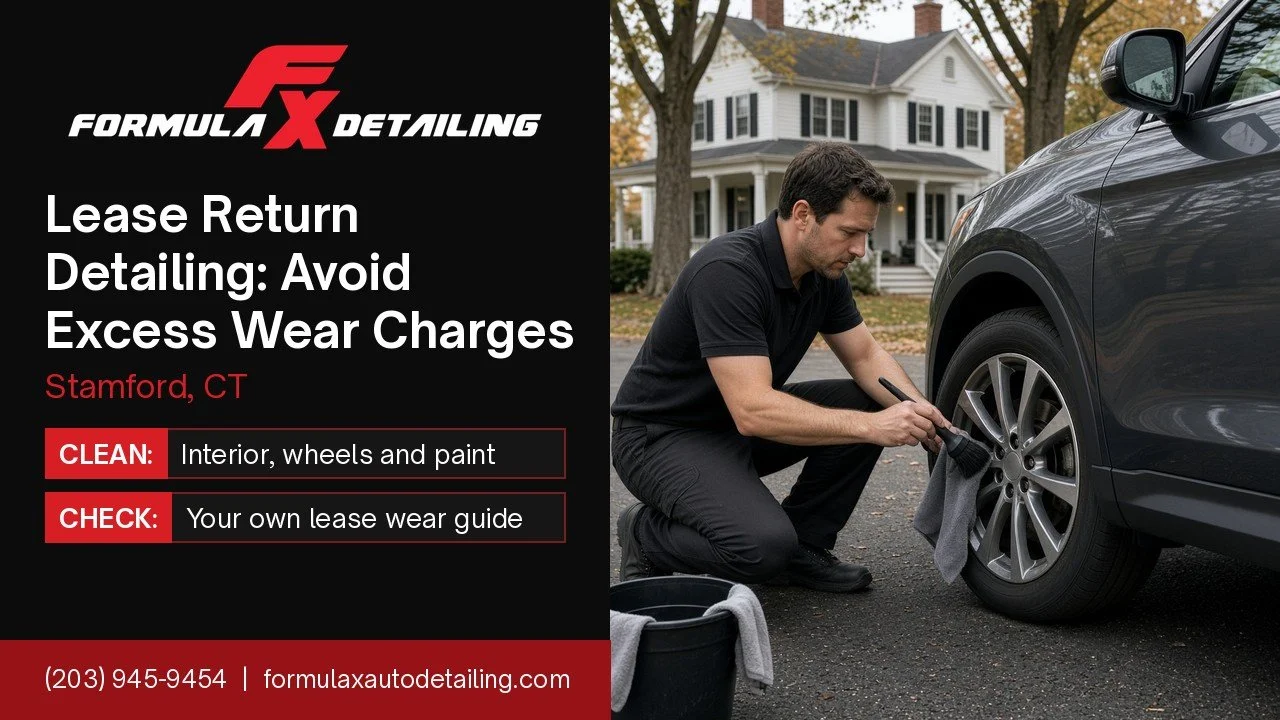
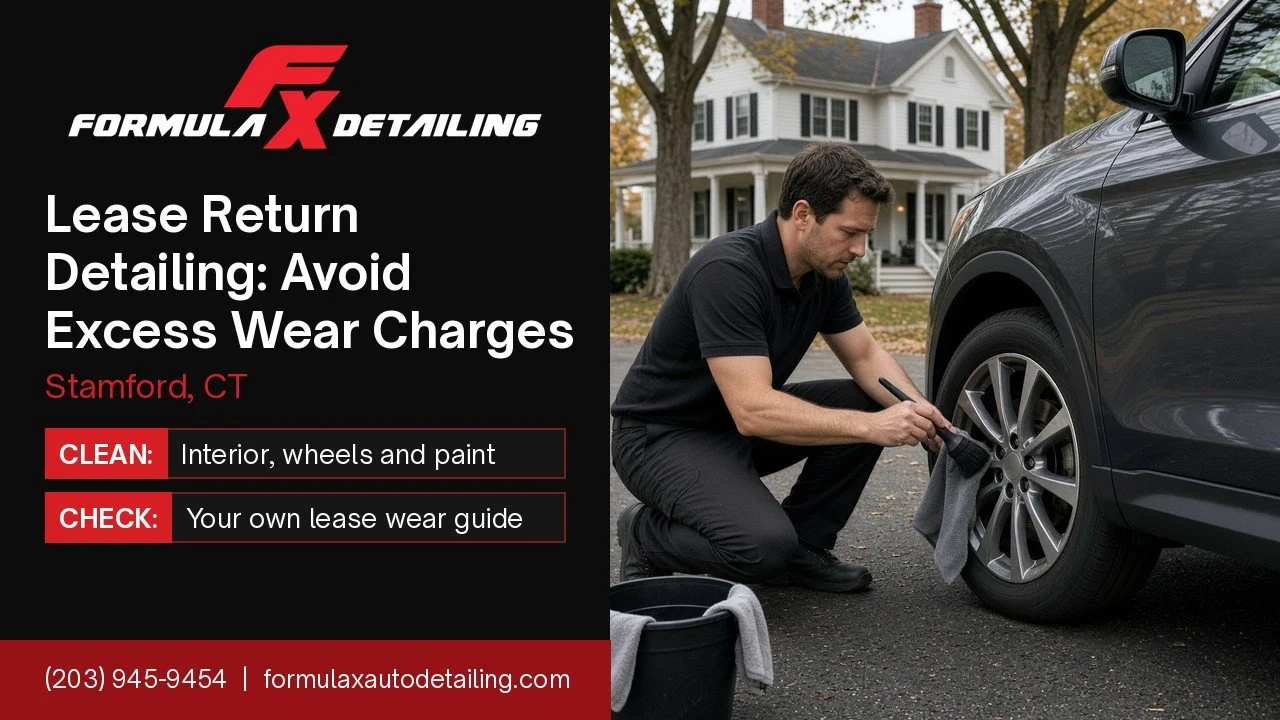
Formula X Mobile Auto Detailing & Ceramic Coating · Lease Turn-In Preparation
Three years go by fast, and the lease turn-in date tends to arrive with a letter about a pre-inspection and a car that still has two winters of Connecticut road salt in the carpet. Most leases charge for wear beyond a stated standard, and the inspector's first look is at a car's condition, not its history. A careful detail before the inspection doesn't change the lease terms, and it can't hide real damage. What it can do is remove grime, stains, and light marks that might otherwise be noted, and make the real damage easy to see so you can decide what's worth repairing. This guide walks through how lease wear is judged, which items detailing can help with, which need a body shop, glass shop, or tire shop, and how to plan the weeks before turn-in. Formula X Mobile Auto Detailing & Ceramic Coating is based at 48 Union St, Stamford, CT 06906, and can be reached at (203) 945-9454.
Can detailing help you avoid excess wear charges on a lease return?
It can help with some of them, but it can't promise anything. Leasing companies charge for wear beyond the standards in your lease, such as larger dents, scratches through the paint, interior tears or burns, cracked glass, and worn tires. A good detail removes dirt, stains, odors, light scuffs, and surface marks that can make a car look worse than it is, and it shows clearly what's left. Read your own lease wear guide, book the pre-inspection your leasing company offers, and use the report to decide what to clean, what to repair, and what to leave.
If you're still early in the lease, see is ceramic coating worth it on a leased car? For keeping a car in shape through the term, read how often should you get your car detailed? and the winter car care checklist.
Where the details come from: The general rules on excess wear come from the Federal Reserve consumer guide to vehicle leasing and its page on lease-end vehicle return. Examples of specific standards come from Toyota Financial Services, its repair FAQ, and Mercedes-Benz Financial Services. Those are examples only; your lease and your leasing company's guide are what count. The rest is general detailing practice, and only Formula X's published package prices appear here.
What “Excess Wear and Use” Actually Means
Quick answer: Excess wear is damage or wear beyond the standards written into your lease. The Federal Reserve's leasing guide says those standards must be reasonable, and that the lease's residual value assumes the car comes back in a certain condition. Normal wear, like light marks from everyday use, usually isn't charged.
Every closed-end lease is built around a guess: what the car will be worth when you hand it back. That number, the residual value, assumes a certain mileage and a certain condition. The Federal Reserve leasing guide explains that excessive wear is wear that exceeds the standards stated in your lease, that many leases describe those standards in specific terms, and that any standards set by the lessor must be reasonable.
Normal wear and use is the gentle aging every car shows: a few light swirls, small stone chips on the hood, a slightly shiny steering wheel, light scuffs on a door sill. Excess wear is damage that lowers the car's value beyond that, such as a dented door, a scratch down to bare metal, a burn in the seat, or a cracked windshield.
The line between the two isn't the same at every company. One leasing company may use a credit-card-sized template for dents and scratches. Another may count the number of small scratches on a single panel. That's why the first step for anyone with a turn-in date is to find the wear guide that came with the lease, or download it from the leasing company's website.
| Usually normal wear | Often counted as excess wear |
|---|---|
| Light swirl marks and fine wash marks | Scratches through the paint past the size limit |
| Small stone chips on the front end | Dents and dings past the size limit |
| Light wear on seat bolsters and the steering wheel | Tears, cuts, holes, or burns in upholstery |
| Removable dirt and light stains | Permanent stains in fabric or carpet |
| Minor wheel scuffs within the limit | Gouged, cracked, or bent wheels |
| Tires with tread above the minimum | Tires below the lease's tread minimum or mismatched |
Why the Car's Condition Matters at Turn-In
Quick answer: If you return a leased car, you're usually responsible for excess wear and excess mileage charges, any disposition fee in the lease, and other amounts owed. Condition is the part of that list you can still influence in the last few months.
The Federal Reserve page on lease-end return lists what a closed-end lessee is generally responsible for at turn-in: excess mileage, excess wear and tear, any disposition fee disclosed in the lease, and other amounts due under the lease. Mileage is fixed by then, and the disposition fee is in the contract. Condition is the one item you still have some control over in the final months.
That control has limits. A detail can't fix a bent wheel or a cracked windshield, and it shouldn't try to hide either one. What it can do is clean the car thoroughly enough that the inspector sees the car's real condition, not road film, salt rings, pet hair, and coffee stains that make a car look rougher than it is.
There's also a practical benefit. A clean car is much easier to inspect yourself. Small scratches, curb rash, and interior marks are hard to see under dirt, so a proper clean before your own walk-around helps you find the things that actually need a decision.
Start With Your Own Lease Wear Guide
Quick answer: Wear standards vary by leasing company and sometimes by contract date. Find the wear-and-use guide that came with your lease, or download it from your leasing company's site, and use it as the checklist. Nothing in a blog post, including this one, replaces it.
Most captive finance companies, the lending arms of carmakers, publish a wear-and-use guide or a lease-end page. Bank and credit-union leases have their own terms. The guide usually explains how dents, scratches, glass, tires, wheels, interior damage, missing items, and maintenance records are judged, and where the car should be returned.
The specifics differ. Toyota Financial Services uses a credit-card-sized measure for several items, such as scratches through the paint and dents. Mercedes-Benz Financial Services lists, among other things, dents and through-paint scratches larger than a credit card, the sixth and each later small through-paint scratch on a panel, and interior tears, cuts, holes, or burns of any size. Those are two companies' published examples. Yours may be stricter, looser, or simply measured differently.
Look for the date on your guide, too. Some companies update their standards or programs for leases signed after a certain date, so an older guide found online may not match your contract. When in doubt, call the leasing company and ask which version applies to your account.
Your lease is the rulebook. The Toyota and Mercedes-Benz standards quoted here are examples of how two companies describe wear. They don't apply to other leases, and they may change. Read your own contract and wear guide, and ask your leasing company if anything is unclear.
Book the Pre-Inspection, Then Plan
Quick answer: Many leasing companies offer a courtesy pre-inspection before turn-in. Toyota Financial Services, for example, recommends one within 60 days of return. The report tells you what the inspector sees, so you can decide what to clean, repair, or leave before the final inspection.
A pre-inspection is a walk-around by an inspector, often at your home or office, that records the car's condition against the lease standards. Toyota Financial Services describes a courtesy pre-inspection and recommends scheduling it within 60 days before the vehicle is returned. Other companies offer similar inspections on their own timelines; check yours.
Timing matters for two reasons. If the car is dirty, small marks may be missed or noted inaccurately, so clean the car before the pre-inspection, not only before the final turn-in. And once you have the report, you need enough time to book any body, glass, or tire work before the return date.
Treat the report as a to-do list. Items the inspector flags as chargeable are the ones to price out with the right shop. Toyota Financial Services notes that you may use a dealer or another trusted repair facility, and should keep receipts. Items that aren't flagged may still be worth cleaning, but they don't need a repair bill.
- Find and read your lease wear guide
- Detail the car before the pre-inspection
- Book the pre-inspection with your leasing company
- Read the report line by line
- Get quotes from the right shops for chargeable items
- Decide: repair, leave, or ask the leasing company
- Detail again close to turn-in if needed
- Gather keys, accessories, and service records
A 90-Day Lease Return Timeline
Quick answer: Start about three months out: read the guide and book a detail. Around two months out, have the pre-inspection. Use the next few weeks for any repairs. In the final week, do a light refresh, gather everything, and take photos.
There's no single right schedule, but working backward from the return date keeps you from rushing. Body shop and glass appointments can take a while to get, especially after winter, so leave room.
If you're buying out the lease instead of returning it, the wear charges usually don't apply in the same way, but a detail still makes sense if you're keeping or selling the car. See the guide to detailing before selling for that path.
| When | What to do | Why |
|---|---|---|
| About 90 days out | Read your wear guide; book a detail | Gives time for everything after |
| About 60-75 days out | Full detail, then your own walk-around | Shows the real condition |
| About 60 days out | Pre-inspection, if your company offers one | Toyota, for example, recommends within 60 days |
| 30-55 days out | Repairs at body, glass, or tire shops | Time for parts and appointments |
| 1-2 weeks out | Light refresh detail or wash | Clean car for the final inspection |
| Final week | Keys, accessories, records, photos | Missing items and records can be charged |
Exterior Paint: What Detailing Can and Can't Change
Quick answer: A wash, clay treatment, and polish can remove road film, bonded grime, water spots, transfer marks, and light scratches that sit in the clear coat. Scratches through the paint, dents, and chipped or cracked paint need body or paint work, which Formula X doesn't do.
A lot of what looks like damage on a lease car is surface material: road film, salt haze, tree sap, bird droppings, bumper paint transfer from a parking garage, and water spots. Those can usually be removed with the right wash, a clay treatment, and sometimes a light polish.
Light scratches that sit only in the clear coat can often be reduced or removed with polishing. That's paint correction, and it's quoted after inspection because the result depends on how deep the marks are and how much clear coat the panel has. See can a car scratch be buffed out? and what is paint correction?
A scratch that catches a fingernail firmly, shows primer or bare metal, or has cracked the paint won't polish out. Dents, creases, and chipped or peeling paint need a body shop or paintless dent repair specialist. Formula X doesn't do dent, paint, or body repair. For how these options compare, see mobile scratch repair vs. a body shop.
| Exterior issue | Detailing can help? | Who handles it |
|---|---|---|
| Road film, salt haze, sap, droppings | Yes, usually | Detailer |
| Paint transfer from a garage pillar | Often | Detailer; body shop if paint is broken |
| Water spots | Often; etched spots may need polish | Detailer, quoted after inspection |
| Light clear-coat scratches and swirls | Often reduced or removed | Paint correction, quoted after inspection |
| Scratch to primer or metal | No | Body shop |
| Dents and creases | No | Body shop or paintless dent repair |
| Chipped, cracked, or peeling paint | No | Body shop |
How to Judge a Scratch Before You Pay to Fix It
Quick answer: Clean the panel first, then look at the scratch in good light and run a fingernail across it gently. If it barely catches and you see no primer or metal, it may be in the clear coat. If it catches firmly or shows a different color, it's deeper. Compare it with your lease guide's size limits.
Scratches look worse on a dirty car, and dirt can hide them too. Wash and dry the panel before judging anything. Look at it in shade and in direct light, or with a flashlight held at an angle.
A fine scratch that you can see but barely feel is usually in the clear coat. A scratch that catches your nail, shows white, gray, or a different color in the groove, or runs through to metal has gone through the paint. Many wear guides treat through-paint scratches differently from surface marks, and some measure them against a size template.
If you aren't sure, ask during the pre-inspection or send clear photos to a detailer and a body shop. Formula X can tell you whether a mark is likely to polish out, and will say so plainly when it's body shop work. For background, see what causes swirl marks and one-step vs. multi-stage correction.
Clean it first
Dirt hides scratches and makes others look worse.
Use angled light
Shade plus a flashlight shows depth.
Fingernail test
A light catch may be clear coat; a firm catch is deeper.
Look for color
Primer or metal in the groove means through the paint.
Check the size
Compare with your lease guide's template or limit.
Wheels, Tires, and Curb Rash
Quick answer: Wheels can be deep cleaned to remove brake dust and staining, but curb rash, gouges, cracks, and bends are repair work for a wheel shop. Tires are judged on tread depth and matching; the Federal Reserve guide mentions tires worn to about 1/8 inch as a common example of excess wear. Check your own lease's minimum.
Wheels on a three-year-old lease car usually carry a layer of baked-on brake dust, especially on the inner barrels. A proper wheel cleaning with an iron remover and separate brushes often makes them look far better and shows what actual damage is there.
Curb rash is the most common wheel issue on cars that park on Stamford and Greenwich streets or in tight garages. Many guides allow small scuffs but charge for gouges, cracks, or bends past a size limit; Mercedes-Benz Financial Services lists cracked and bent wheels as chargeable. Wheel refinishing is a job for a wheel repair specialist, not a detailer.
Tires are a separate category. The Federal Reserve leasing guide gives excessively worn tires, often 1/8 inch of tread at the shallowest point, as an example of excess wear. Mercedes-Benz lists tires below 4/32 inch and mismatched tires. Check your own guide, measure the tread with a gauge, and ask a tire shop if replacements are needed. Tire dressing makes tires look clean, but it doesn't change tread depth.
| Wheel or tire issue | Detailing role | Who repairs it |
|---|---|---|
| Brake dust and staining | Deep clean and protect | Detailer |
| Light scuffs | Clean so the size is clear | Wheel shop if past the limit |
| Gouges, cracks, bends | None | Wheel repair specialist |
| Low tread | None | Tire shop |
| Mismatched tires | None | Tire shop; check the lease rules |
Glass, Headlights, and Mirrors
Quick answer: Detailing cleans glass inside and out and can remove films and water spots. Cracks, stars, and chips are glass work; several leasing guides count them as chargeable. Get chips looked at by a glass shop early, before they spread.
Clean glass makes a car look cared for, and it also makes chips and cracks easier to see. A detail cleans the windshield, side windows, mirrors, and the inside of the glass, where a film builds up from heating, cooling, and vinyl off-gassing.
Cracks, stars, and bull's-eyes in the windshield are glass damage, and both Toyota Financial Services and Mercedes-Benz Financial Services list them. Mercedes-Benz also lists three or more windshield chips. A glass shop can tell you whether a chip can be repaired or the glass needs replacing. Small chips that are repaired early are less likely to spread into cracks during a cold snap.
Hazy or yellowed headlights are a separate matter. Some leasing companies treat them as normal aging. If yours are badly clouded, ask about restoration, and check your guide before paying for it.
Interior Stains, Spills, and Odors
Quick answer: Most stains in a lease car are removable with hot-water extraction and the right cleaner: coffee, juice, mud, salt rings, and light grease. Some stains are permanent, and leasing guides often count permanent stains. Tears, burns, and holes are upholstery repair, not detailing.
Interior condition is where a detail usually makes the biggest visible difference. Three winters of boots leave white salt rings in the carpet. Kids leave juice and snacks in the seat seams. Commuters leave coffee in the cup holders and on the console. Most of that comes out with vacuuming, steam, and carpet and upholstery shampooing with extraction.
Some stains don't come out completely, especially dye-based spills, ink, and stains that have been cooked in by summer heat. The Federal Reserve leasing guide lists permanent stains in fabric or carpet as an example of excess wear, so it's worth having a detailer try before the inspection. Formula X will tell you plainly if a stain is likely to stay.
Odors matter too. Smoke and pet smells can be treated, and the results depend on how long and how heavily the car was exposed. See how to get smoke smell out of a car and how to remove dog hair from a car. Tears, cuts, holes, and burns are upholstery repair; Mercedes-Benz counts them at any size.
| Interior issue | Typical detailing result | Notes |
|---|---|---|
| Salt rings in carpet | Usually removed | Hot-water extraction |
| Coffee, juice, mud | Usually removed or greatly reduced | Older stains take more work |
| Pet hair | Removed with time and tools | Extra charge for pet hair |
| Smoke and pet odor | Reduced; depends on exposure | May need more than one treatment |
| Ink and dye stains | Sometimes reduced | May be permanent |
| Tears, burns, holes | Not a detailing fix | Upholstery repair |
Leather Seats, Touchscreens, and Interior Trim
Quick answer: Leather and synthetic leather can be cleaned and conditioned to remove body oils and dye transfer from jeans. Screens, piano-black trim, and soft-touch plastics need gentle products. Cracks, tears, and peeling are repair work.
Leather seats on a lease car often show a shiny, darker driver's bolster and blue dye transfer from jeans on light colors. Gentle leather cleaning removes body oils and much of the transfer, and a conditioner or protectant leaves the surface looking more even. Synthetic leathers clean up the same way with products made for them.
Infotainment screens, gloss-black trim, and digital gauge covers scratch easily. They should be cleaned with a soft microfiber and a screen-safe cleaner, not paper towels or glass cleaner with ammonia. Fine scratches on gloss-black trim can sometimes be reduced, but deep marks stay.
Steering wheels, shift knobs, and door pulls collect grime that makes them look worn. A careful clean often brings back the original finish. Peeling, cracked, or torn surfaces are a repair question for an upholstery or interior trim shop.
The Cargo Area, Trunk, and Third Row
Quick answer: Inspectors look in the cargo area and trunk. Clean the carpet and liner, remove stains, and check that the cargo cover, floor panels, spare, and tool kit are present if your car came with them. Missing items are often charged.
SUVs and minivans carry a lot over a three-year lease: sports gear, strollers, dogs, groceries, and home-improvement runs. The cargo carpet and plastic sill plates show it. A deep vacuum, extraction, and a clean of the sill and plastic trim make a real difference.
This is also where many missing items live. Mercedes-Benz Financial Services lists missing items such as the cargo cover, tool kit, and spare among chargeable conditions. Lift the floor and check that the spare tire or inflator kit, the jack, and any tools are there, and that the cargo cover and floor panels went back in after you removed them.
Third-row seats and fold-down mechanisms collect crumbs and lost items. Fold them down during the clean. For a family-car example, see the Honda Odyssey interior deep clean in Norwalk.
Keys, Accessories, and Missing Items
Quick answer: Missing keys and factory items are a common and avoidable charge. Find both keys, the owner's manual, floor mats, headrests, cargo cover, tool kit, spare, and any charging cables that came with the car. Check your guide's list.
Wear guides usually list items that must come back with the car. Mercedes-Benz Financial Services names the second key, headrests, the cargo cover, the tool kit, the spare, and, for electric vehicles, the charging cables. Other companies have similar lists. A detail doesn't fix a missing item, but the detailing visit is a good reminder to gather everything.
Look through the garage, the house, and the other car. Floor mats are often swapped for all-weather liners in winter and forgotten. If you added aftermarket accessories, such as a hitch, tinted windows, or a wrap, check what your lease says about them before turn-in.
- Both keys or key cards
- Owner's manual and any key-code cards
- Factory floor mats
- Headrests, if removed
- Cargo cover and floor panels
- Spare or inflator kit, jack, and tool kit
- EV charging cables, if supplied
- Parcel shelf or tonneau, if equipped
Maintenance Records and Why They Count
Quick answer: Most leases require maintenance on the manufacturer's schedule. The Federal Reserve guide says you don't have to use a franchise dealer, but you should be able to document the service. Gather receipts and records before turn-in.
Detailing and maintenance are different jobs, but both show up at lease end. The Federal Reserve leasing guide says most lessors require the vehicle to be maintained according to the manufacturer's recommendations, that this doesn't mean you have to use a franchise dealer, and that you should be prepared to document the service. If you can't, you may be charged for wear caused by poor maintenance or for overdue service.
Put oil change, tire rotation, and inspection receipts in one folder or one digital file. Mercedes-Benz Financial Services lists undocumented maintenance among its chargeable items. Formula X doesn't do mechanical work, so oil, brakes, and scheduled service belong with a dealer or independent mechanic.
What Connecticut Winters Do to a Lease Car
Quick answer: Road salt and brine leave white rings in carpet, film on paint and glass, and residue in jambs and wheel wells. Before a spring turn-in, flush salt out inside and out. Rust or underbody damage is for a mechanic or body shop.
A lease car in Fairfield County usually lives through two or three winters. Each one leaves salt in the carpet, on the lower doors and rocker panels, in the wheel wells, and in the door jambs. If the turn-in date is in March or April, the car may go to inspection with the whole winter still on it. See how road salt damages your car.
A thorough exterior wash with an underbody rinse, jambs opened and cleaned, and hot-water extraction for the carpets gets most of it out. Salt rings that have sat for months may take more than one pass. For a full spring reset, see spring detailing: removing salt and pollen damage.
If the car was parked near the water in Shippan, Old Greenwich, Rowayton, or Noroton, salt air adds to the film on glass and trim. See protecting your car from salt air on the CT coast. Any rust or underbody corrosion is a mechanic or body shop question.
Pets, Kids, and Smoke: The Hardest Interiors
Quick answer: Pet hair, kid spills, and smoke are the three things most likely to make a lease interior look and smell worse than normal wear. All three can be improved a lot with time and the right tools, and extra charges apply for pet hair and heavy soil.
Dog hair weaves itself into carpet and cloth seats and takes rubber tools, brushes, and patience to remove. Car seats leave dents and crushed snacks in the seat bases. Smoke settles into the headliner, the vents, and every soft surface. See removing dog hair and getting smoke smell out.
Formula X's published prices are starting prices. Extra charges apply for pet hair and heavy soil, because those jobs take longer. Send photos ahead of time so the price and time are clear before the visit.
Pet hair
Woven into carpet; needs dedicated tools and time.
Car-seat marks
Crumbs and dents in seat bases; clean and lift the pile.
Spills
Juice and milk can sour; extraction is the fix.
Smoke
Reaches the headliner and vents; may need repeat treatment.
Muddy gear
Sports and beach gear grind dirt into cargo carpet.
What a Lease-Return Detail Should Cover
Quick answer: A lease-return detail is a full interior and exterior detail with extra attention to the areas inspectors check: paint, wheels, glass, seats, carpet, cargo area, and jambs. It's about showing the car's real condition clearly, not hiding damage.
There's no official lease-return package. In practice, it means a full interior and exterior detail, with a few areas given more time: the paint, so marks can be judged; the wheels; the glass; the seats and carpet; the cargo area; and the door jambs and sills, which every inspector sees when they open a door.
It doesn't mean filling scratches with glaze, covering stains with dye, or masking odors with fragrance. Those tricks can wear off before inspection and may look worse when they do. A straightforward deep clean and, where it makes sense, a light polish are the honest version.
| Area | What the detail does | What it doesn't do |
|---|---|---|
| Paint | Wash, clay, protect; polish quoted separately | Fix dents or through-paint scratches |
| Wheels and tires | Deep clean, dress tires | Repair curb rash or add tread |
| Glass | Clean inside and out | Repair chips or cracks |
| Seats and carpet | Vacuum, steam, shampoo, extract | Repair tears or burns |
| Cargo area | Vacuum, extract, clean trim | Replace missing items |
| Jambs and sills | Clean and dry | Repair rust |
Turning In a Lease Soon? Get the Car Inspection-Ready
Tell Formula X Mobile Auto Detailing & Ceramic Coating the vehicle, your turn-in or pre-inspection date, and what you're worried about, such as salt stains, pet hair, scuffs, or swirls, with a few photos. You'll hear which package fits, what's likely to clean up, and what needs a body, glass, or tire shop instead.
Is Paint Correction Worth It Before a Lease Return?
Quick answer: Sometimes. If the pre-inspection or your own walk-around shows clear-coat scratches or heavy swirls that may be noted, a light polish on the affected panels may be worth pricing. A full multi-stage correction on a car you're returning usually isn't. Correction is quoted after inspection.
Paint correction makes the most sense on a car you're keeping. On a car you're returning, the question is narrower: will polishing a specific mark cost less than whatever the leasing company might charge for it, if it's charged at all? That depends on your guide, the mark, and the quote.
A light, targeted polish on a bumper corner, a door edge, or a trunk lid with scratches from bags and keys can be a reasonable middle ground. A full multi-stage correction on the whole car is usually more than a lease return needs. See paint correction in Connecticut and scratch repair in Stamford.
Formula X quotes correction after seeing the paint, and will tell you if a mark is too deep to polish or if it's normal wear that probably isn't worth touching.
Should You Coat a Car You're About to Return?
Quick answer: Not usually. A ceramic coating is a multi-year product and makes the most sense early in a lease or on a car you're keeping. Near turn-in, a sealant applied during the detail is enough to leave the paint clean and protected.
A ceramic coating's value comes from years of easier washing and protection. If the car is going back in a few weeks, you won't get much of that. A ceramic sealer, like the one in Formula X's Gold and Bronze Exterior packages, is rated for about six months and is plenty for the final stretch. For the full discussion, see is ceramic coating worth it on a leased car?
If you're planning to buy out the lease and keep the car, the picture changes. A turn-in detail can become the prep step for a coating. See ceramic coatings in Connecticut and ceramic coating vs. wax vs. sealant.
Repairs That Belong With Other Shops
Quick answer: Dents, body damage, through-paint scratches, cracked glass, wheel damage, worn tires, upholstery tears, and mechanical issues all belong with specialists. Some leasing companies say you may use a dealer or another trusted shop and should keep receipts. Check your lease's repair-quality rules.
Detailing is cleaning and paint care. It isn't dent repair, body or paint repair, glass replacement, wheel repair, tire replacement, upholstery repair, or mechanical work. Formula X refers those out. Toyota Financial Services notes that its customers may use the dealer or another trusted repair facility and should keep receipts.
Repair quality matters. The Federal Reserve leasing guide lists poor-quality repairs, or repairs that don't meet the lessor's standards, as an example of excess wear. A cheap fix that leaves a mismatched panel or a wavy dent can be charged anyway. Ask your leasing company what standard repairs need to meet.
| Problem | Right specialist |
|---|---|
| Dents and creases | Paintless dent repair or body shop |
| Through-paint scratches, cracked paint | Body shop |
| Windshield chips and cracks | Auto glass shop |
| Curb rash, bent or cracked wheels | Wheel repair shop |
| Low or mismatched tires | Tire shop |
| Seat tears and burns | Upholstery shop |
| Warning lights, brakes, scheduled service | Dealer or mechanic |
Should You Repair Damage or Pay the Charge?
Quick answer: Compare the repair quote with what your leasing company says it may charge, and think about repair quality. The Federal Reserve guide says state law may limit charges to actual repair costs or reasonable estimates. Some leases include a waiver or protection product; check yours.
For each chargeable item, you have a choice: fix it before turn-in or let the leasing company assess it. The Federal Reserve guide notes that charges for returning the car to the condition stated in the lease may be limited by state law to actual repair costs or reasonable estimates. Your leasing company can tell you how it calculates charges.
Some leases include a wear-and-use waiver or come with a separately purchased protection product that covers some damage up to a limit. Toyota Financial Services, for example, describes a waiver for some newer leases. Read the terms carefully before deciding to repair anything; you may not need to.
Detailing fits into this decision differently. It's the low-cost step that removes things that aren't damage at all, so the remaining list is shorter and clearer.
Photograph and Document the Car at Turn-In
Quick answer: After the final detail, take dated photos and a short video of every panel, the wheels, glass, interior, cargo area, odometer, and keys. Keep them with your inspection report, repair receipts, and maintenance records.
A set of clear photos taken right after the final clean is a simple record of the car's condition on the day you returned it. Shoot each side of the car, the front and rear, each wheel, the roof if you can, the windshield, each seat, the carpet, the cargo area, the odometer, and the keys.
Take them in good daylight, not under a dim parking garage light. Keep them with the pre-inspection report, any repair receipts, and maintenance records until the lease account is closed and any final bill is settled.
- Four corners and each side
- Each wheel up close
- Windshield and roof
- Front and rear seats
- Carpet and floor mats
- Cargo area and spare well
- Odometer and dashboard
- Both keys and accessories
EVs, Luxury SUVs, and High-Value Leases
Quick answer: EV and luxury leases often have the same wear categories plus extra items, like charging cables. Matte paint, film-wrapped panels, and delicate leather need specific products. Ask before polishing matte or film.
Electric vehicles return with the same wear categories as other cars, plus charging equipment. For cleaning tips around sensors and charge ports, see ceramic coating on Teslas and EVs.
Luxury SUVs leased in Greenwich, Darien, and New Canaan often have larger wheels that pick up curb rash, light leather that shows dye transfer, and paint that shows every swirl. Matte paint and paint protection film need products made for them and shouldn't be polished or waxed unless the maker allows it. For examples of the kind of work involved, see the Range Rover interior in Cos Cob, the Porsche Cayenne coating in Old Greenwich, the G-Wagon paint correction in Greenwich, and the BMW X5 scratch repair in Greenwich.
Getting the Detail Done at Home or Work
Quick answer: A mobile detail can happen in your driveway, condo lot, or office parking where the property allows it, which saves a trip during a busy turn-in month. Clear out personal items first and have both keys handy.
The last month of a lease is often busy, with a new car to pick up and paperwork to finish. A mobile detail at your home or workplace saves a drop-off. Formula X works in Stamford and nearby towns, at homes, apartment and condo lots, and offices, where the property allows it. See mobile detailing at a Harbor Point apartment and office lot detailing in downtown Stamford.
Before the visit, empty the glovebox, door pockets, console, and trunk, and take out child seats if you can. That's also a good time to find the second key and the accessories you'll need to return. See how to prepare for a mobile detail and mobile detailing vs. a detail shop. Same-day appointments may be available when the schedule allows; call to check.
Lease Return Mistakes to Avoid
Quick answer: Common mistakes: waiting until the last week, skipping the pre-inspection, using glaze or dye to hide damage, doing cheap repairs, forgetting keys and accessories, losing service records, and assuming an online guide matches your lease.
| Mistake | Why it hurts | Better habit |
|---|---|---|
| Waiting until the final week | No time for repairs | Start about 90 days out |
| Skipping the pre-inspection | You don't know what will be charged | Book it if offered |
| Inspecting a dirty car | Marks are hidden or exaggerated | Detail first, then look |
| Hiding damage with fillers or dye | Wears off; may look worse | Clean honestly; repair properly |
| Cheap, poor repairs | Can be charged anyway | Use a shop that meets the lease standard |
| Forgetting the second key | Often charged | Find it early |
| No service records | Possible maintenance charges | Gather receipts |
| Trusting a generic guide | Standards vary by company | Read your own lease |
Lease Turn-In Notes for Stamford and Fairfield County
Quick answer: Lease cars around Stamford see parking-garage scrapes, tight street parking, highway chips from I-95 and the Merritt Parkway, and winter salt. Plan the detail around the weather, and leave extra time after winter for body and glass appointments.
Driving patterns shape what a lease car looks like at the end. Commuters on I-95 and the Merritt Parkway pick up stone chips on the hood and bumper. Cars parked in downtown Stamford garages collect scuffs on bumper corners and mirrors from tight pillars. Street parking in Greenwich and Norwalk brings door dings and curb rash. Cars near the shore collect salt film.
Weather matters for scheduling. Exterior work goes best on a dry day above freezing, so a turn-in in January or February may need a flexible date. After a long winter, body shops and glass shops can be busy, which is another reason to start early. For more on local service, see car detailing in Darien, mobile detailing in Norwalk, and all service areas.
How Formula X Helps With a Lease Return
Quick answer: Formula X brings a full detail to your home or workplace before your pre-inspection or turn-in, tells you honestly what's cleanable and what isn't, and refers dent, paint, body, glass, wheel, tire, and mechanical work out. Packages have published starting prices; correction is quoted after inspection.
| Package | Starting price | Lease-return role |
|---|---|---|
| Gold (interior + exterior) | $495+ | Full reset: wash, clay, ceramic sealer (about 6 months), interior steam and carpet shampoo |
| Silver (interior + exterior) | $395+ | Refresh with a 6+ month wax and dressed trim and tires |
| Bronze Exterior | $295+ | Hand wash, clay bar, ceramic sealer (6 months), tire shine |
| Bronze Interior | $295+ | Carpet and upholstery shampoo for salt, spills, and stains |
Formula X Mobile Auto Detailing & Ceramic Coating offers mobile detailing, paint correction, scratch repair, and Ceramic Pro coatings in Stamford and nearby towns. See mobile detailing, exterior detailing in Stamford, and the work gallery.
Extra charges apply for scratches, heavy soil, sap, hard water spots, and pet hair. Same-day appointments may be available when the schedule allows; call to check. A detail can't promise that a leasing company won't charge for anything; that decision is the leasing company's, based on your lease.
Formula X Mobile Auto Detailing & Ceramic Coating
Formula X Mobile Auto Detailing & Ceramic Coating is a mobile detailing, paint correction, scratch repair, and ceramic coating service based at 48 Union St, Stamford, CT 06906. The team works throughout Stamford, Greenwich, Darien, New Canaan, Norwalk, Rowayton, Westport, and other towns in lower Fairfield County, and Westchester County, NY.
For a lease return, that means a thorough detail before the pre-inspection, a straight answer on what's cleanable, and a referral to the right shop for anything that isn't.
Call (203) 945-9454, email formulaxautodetail@gmail.com, send a request through the contact page, or view Formula X Mobile Auto Detailing & Ceramic Coating on Google Maps. Address: 48 Union St, Stamford, CT 06906.
Frequently Asked Questions About Lease Return Detailing
Does detailing a leased car help avoid excess wear charges?
It can help with some items, but it can't promise anything. A detail removes dirt, stains, odors, and light surface marks that might otherwise be noted, and shows the car's real condition. Dents, through-paint scratches, cracked glass, worn tires, and tears are judged on their own, and the leasing company decides what's charged under your lease.
What counts as excess wear on a lease?
Wear beyond the standards in your lease. Common examples include dents and scratches past a size limit, scratches through the paint, interior tears, cuts, or burns, permanent stains, cracked glass, damaged wheels, worn or mismatched tires, missing items, and poor repairs. Standards vary by leasing company, so read your own wear guide.
When should I detail my car before turning in a lease?
Ideally before the pre-inspection, so the inspector and you see the car's real condition, and again lightly close to turn-in if it's gotten dirty. Starting about 90 days out leaves time for any repairs the inspection points to.
What is a lease pre-inspection?
A courtesy inspection that many leasing companies offer before turn-in. An inspector records the car's condition against the lease standards so you know what may be charged. Toyota Financial Services, for example, recommends one within 60 days of return. Check what your leasing company offers.
Can scratches be buffed out before a lease return?
Light scratches in the clear coat can often be reduced or removed with polishing, which is quoted after inspection. Scratches that catch a fingernail firmly or show primer or metal have gone through the paint and need a body shop. Compare marks with your lease guide's limits before paying for any work.
Does Formula X repair dents or body damage?
No. Formula X does detailing, paint correction, scratch repair within the clear coat, and Ceramic Pro coatings. Dents, body and paint repair, glass, wheel repair, tires, upholstery repair, and mechanical work belong with the right specialist shop.
Can stains in my lease car's carpet be removed?
Most common stains, such as salt rings, coffee, juice, and mud, come out or fade a lot with steam and hot-water extraction. Some dye, ink, and old heat-set stains are permanent. Leasing guides often count permanent stains, so it's worth trying a proper clean before the inspection.
Will a lease inspector notice smoke or pet odor?
Odors and pet hair are often noticed, and some leases treat them as excess wear. Pet hair can be removed with time and the right tools, and smoke and pet odors can be reduced, depending on how heavy the exposure was. Extra charges apply for pet hair and heavy soil.
Should I put a ceramic coating on a car I'm about to return?
Usually not. A coating's value comes over years. Near turn-in, a ceramic sealer applied during a detail is enough. If you plan to buy out the lease and keep the car, a coating can make sense.
Is it cheaper to repair damage or pay the lease charge?
It depends on the repair quote, how your leasing company calculates charges, and whether your lease includes a waiver or protection product. Get quotes from the right shops, ask the leasing company how it charges, and make sure any repair meets the lease's quality standard.
Do I need dealer service records to return a lease?
Most leases require maintenance on the manufacturer's schedule. The Federal Reserve leasing guide says you don't have to use a franchise dealer, but you should be able to document the service. Keep all receipts together.
What items do I need to return with a leased car?
Check your lease guide. Common items include both keys, the owner's manual, floor mats, headrests, the cargo cover, the spare or inflator kit and tools, and any EV charging cables that came with the car.
Can Formula X detail my lease car at home or at work?
Yes, where the property allows it. Formula X is a mobile service working in Stamford and nearby towns. Published packages are Gold from $495+, Silver from $395+, Bronze Interior from $295+, and Bronze Exterior from $295+, with extra charges for scratches, heavy soil, sap, hard water spots, and pet hair. Same-day appointments may be available when the schedule allows; call to check.
Where is Formula X Mobile Auto Detailing & Ceramic Coating located?
Formula X Mobile Auto Detailing & Ceramic Coating is based at 48 Union St, Stamford, CT 06906. It's a mobile service working in Stamford, Greenwich, Darien, New Canaan, Norwalk, Rowayton, Westport, and other lower Fairfield County towns, and Westchester County, NY. Call (203) 945-9454.
Find Formula X Mobile Auto Detailing & Ceramic Coating
Formula X Mobile Auto Detailing & Ceramic Coating is a mobile service based at 48 Union St, Stamford, CT 06906. Use the map for directions to the business address, or call (203) 945-9454 to arrange service at your location.
View Formula X Mobile Auto Detailing & Ceramic Coating on Google Maps
Get Your Lease Car Ready for Turn-In
Call Formula X Mobile Auto Detailing & Ceramic Coating at (203) 945-9454 or send a request with your vehicle, your pre-inspection or turn-in date, what you’re worried about, and photos. You’ll hear which package fits and what’s likely to clean up, and anything that needs a body, glass, or tire shop will be said plainly.
48 Union St, Stamford, CT 06906 · Serving Stamford, Greenwich, lower Fairfield County, and Westchester County, NY