
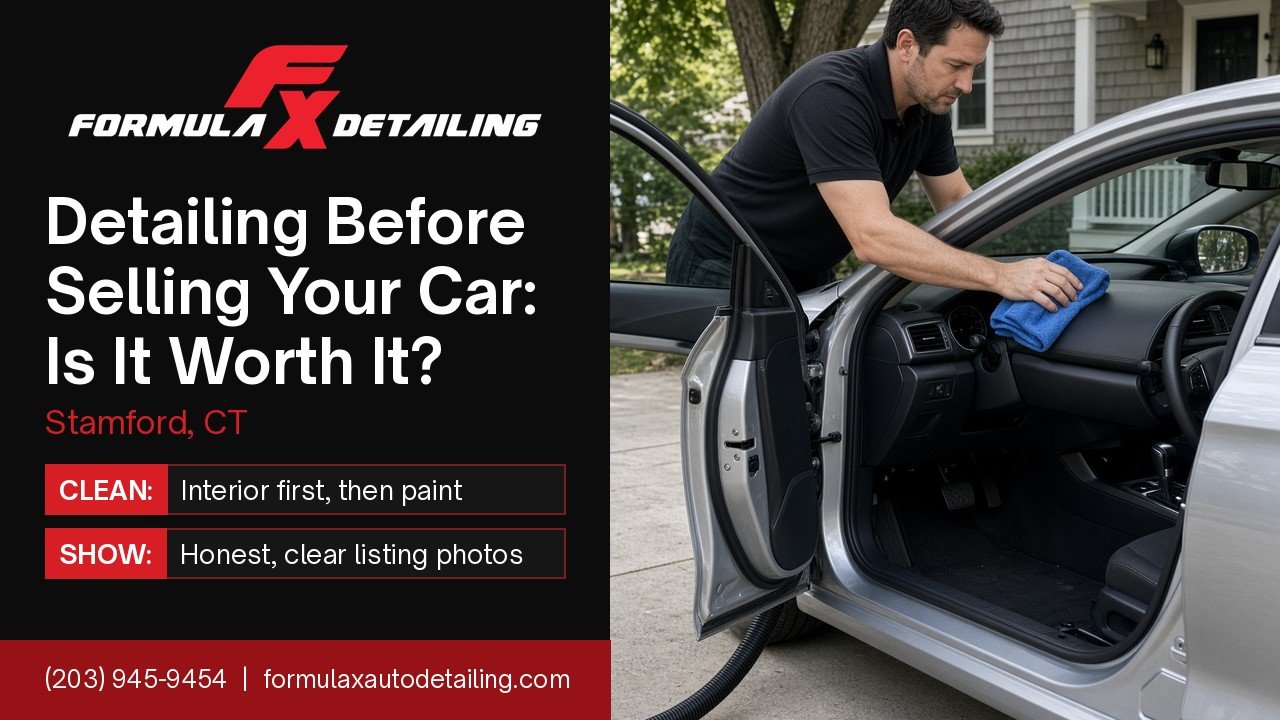
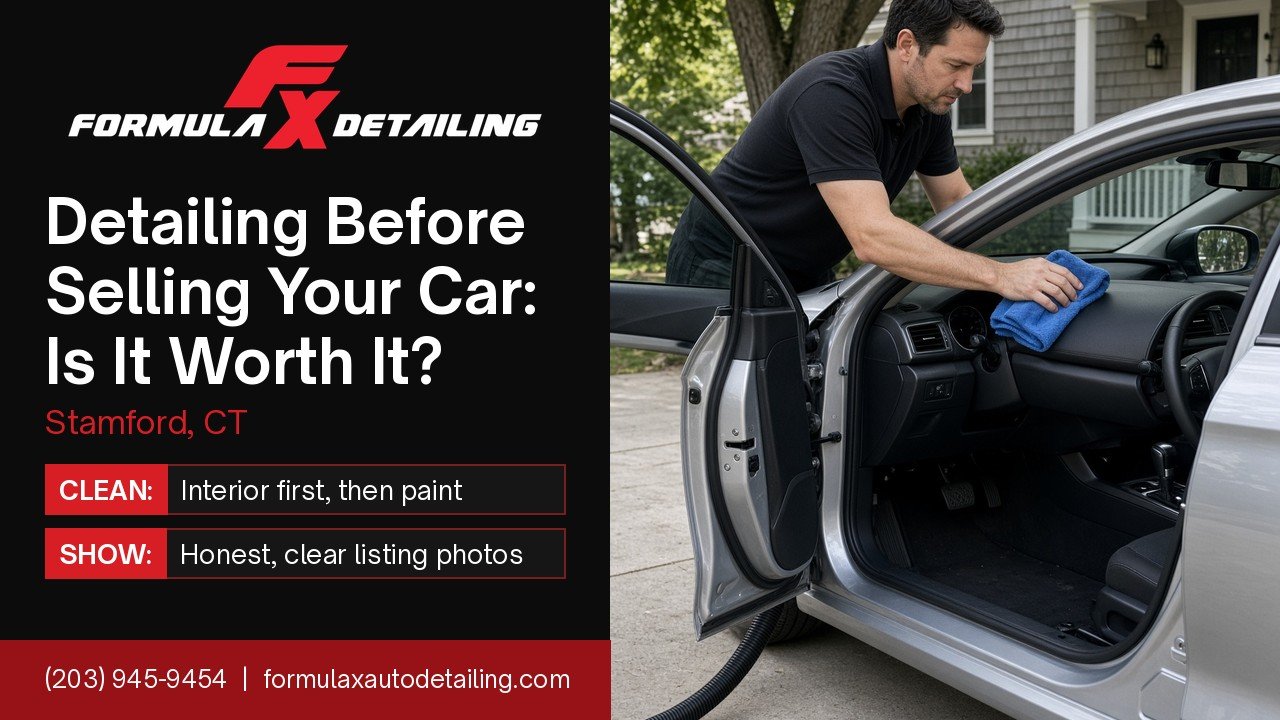
Formula X Mobile Auto Detailing & Ceramic Coating · Getting a Car Ready to Sell
Buyers decide a lot in the first minute. They walk up to a used car, open the driver's door, and form an opinion before they've looked at the service records or started the engine. A car with salt-stained carpet, a hazy windshield, dog hair on the back seat, and brake dust caked on the wheels looks neglected, even when it has been maintained well. A detail can't change a car's mileage, history, or mechanical condition, and nobody can promise it will add a set amount to the price. What it can do is remove the distractions that make a car look worse than it is, help photos show it clearly, and make buyers more comfortable that it's been looked after. This guide covers when a pre-sale detail is worth it, what to focus on, what to leave alone, and how to sell honestly in Connecticut. Formula X Mobile Auto Detailing & Ceramic Coating is based at 48 Union St, Stamford, CT 06906, and can be reached at (203) 945-9454.
Is it worth detailing a car before selling it?
Often, yes, especially for a private sale. A clean car photographs better, shows well in person, and lets buyers judge its real condition instead of its dirt. A detail won't fix mechanical problems, dents, or deep scratches, and no one can promise it will raise the sale price by a set amount. It's most worth it when the car is structurally sound but dirty, smelly, or worn-looking inside. For a dealer trade-in, a basic clean may be enough, because dealers usually recondition cars themselves. Don't use detailing to hide problems; disclose them.
If you're returning a lease rather than selling, see lease return detailing: avoid excess wear charges. For how often to keep a car detailed while you own it, read how often should you get your car detailed?
Where the details come from: The point that selling a car may involve reconditioning, advertising, and comparing offers comes from the Federal Reserve consumer guide to vehicle leasing and buying. Connecticut seller steps come from the Connecticut DMV page on selling a vehicle and its page on canceling registration and plates. The rest is general detailing practice. Only Formula X's published package prices appear here, and nothing here promises a sale price.
Why a Car's Presentation Matters to Buyers
Quick answer: Most buyers can't evaluate a car's mechanics on the spot, so they read its condition from what they can see and smell. Dirt, stains, odors, and clutter suggest neglect. A clean car lets them focus on the facts: mileage, history, and how it drives.
A used-car buyer is trying to answer one question: has this car been looked after? Few buyers can judge an engine or a suspension by looking at it, so they use what they can see. Clean carpet, clear glass, tidy door jambs, and fresh-smelling air tell a story of care. Crumbs in the seat seams, white salt rings on the floor, and a sticky console tell a different one.
The Federal Reserve guide notes that when you own a car and decide to sell or trade it, you negotiate the price and decide when, where, and how to sell, and that selling may involve reconditioning the vehicle, advertising it, and getting different bids or trade-in offers. Reconditioning is the part a detail covers.
Presentation doesn't replace substance. A clean car with a check-engine light is still a car with a check-engine light. But for a sound car, a dirty interior or dull paint gives a buyer an easy reason to offer less or to keep looking.
First impressions
Buyers judge in the first minute, mostly by sight and smell.
Photos
Clean cars photograph better and stand out in listings.
Trust
A cared-for interior suggests a cared-for car.
Negotiation
Visible dirt and odor give buyers reasons to push back.
Clarity
A clean car shows its real condition, good and bad.
When a Pre-Sale Detail Is Worth It, and When It Isn't
Quick answer: A detail is most worth it for a private sale of a sound car that looks worse than it is: dirty interior, odors, pet hair, dull paint. It's less useful for a trade-in, a car with major mechanical or body problems, or a car that's already clean.
The value of a pre-sale detail depends on the car, how you're selling it, and what shape it's in now. It's worth thinking through before spending anything.
No detailer can honestly tell you how much more the car will sell for. Prices depend on the market, the model, mileage, history, the season, and who happens to be looking. What you can judge is whether the car's appearance is currently working against you.
| Situation | Is a detail worth it? | Why |
|---|---|---|
| Private sale, sound car, dirty interior | Usually | Interior condition drives first impressions |
| Private sale, strong odors or pet hair | Usually | Odors and hair put many buyers off |
| Private sale, already clean | Maybe a light refresh | Wash and vacuum may be enough |
| Dealer trade-in | Basic clean is often enough | Dealers usually recondition cars themselves |
| Instant online offer | Depends on the process | Check whether condition photos or inspections apply |
| Major mechanical or body problems | Rarely the priority | Fix or disclose those first |
Private Sale, Trade-In, or Online Offer
Quick answer: In a private sale, the buyer sees exactly what you present, so presentation matters most. Dealers and online buyers often have their own reconditioning process, so a basic clean is usually enough, though a clean, odor-free car can still make appraisals smoother.
A private buyer is comparing your car with other listings and meeting you in person. Your photos and your car's condition are the whole pitch. That's where a full detail makes the most difference.
A dealer appraising a trade-in sees hundreds of cars and usually sends them through its own reconditioning shop. Appraisers look past a little dust, but heavy odors, stains, and pet hair are things they notice. A thorough clean, especially of the interior, is usually enough.
Online buyers and instant-offer services often ask for photos or condition answers and may inspect the car. Read how their process works. Answer condition questions accurately; a fresh detail is not a reason to describe damage as absent.
What Buyers Notice First
Quick answer: Buyers usually notice smell, the driver's seat, the carpet, the steering wheel, the glass, the wheels, and the paint's shine, roughly in that order. Those are the areas to prioritize in a pre-sale detail.
Watch someone look at a used car and the pattern is familiar. They walk around it, glance at the wheels and paint, then open the driver's door. The smell hits first. Then they look at the driver's seat, the steering wheel, the pedals, and the carpet. They try the back seat and open the trunk.
That order is a useful guide for where to spend effort. A clean, neutral-smelling interior with a tidy driver's area and clear glass does more for a first impression than a perfect hood. Wheels and tires are the next most visible, then the overall gloss of the paint.
| Area | What buyers see | Detailing focus |
|---|---|---|
| Smell | Smoke, pets, food, mildew | Source removal, extraction, odor treatment |
| Driver's seat | Wear, stains, dye transfer | Leather or fabric cleaning |
| Steering wheel and pedals | Grime and shine from hands | Careful cleaning |
| Carpet and mats | Salt rings, stains, crumbs | Vacuum, shampoo, extraction |
| Glass | Film and haze | Inside and outside cleaning |
| Wheels and tires | Brake dust, dull rubber | Deep clean, tire dressing |
| Paint | Dull, swirled, spotted | Wash, clay, protect; polish if it makes sense |
Start With the Interior
Quick answer: The interior is where most buyers form their opinion and where a detail makes the biggest visible change. Remove personal items, vacuum deeply, shampoo carpet and cloth seats, clean leather, wipe every surface, and clean the inside of the glass.
Start by taking everything out: the glovebox, door pockets, console, seat-back pockets, under the seats, and the trunk. Buyers don't want to see your receipts, chargers, and kids' toys, and you don't want to leave personal papers in a car you're selling.
Then work top to bottom. Headliner spots, vents, dash, screens, door panels, seats, carpet, and mats. Carpet and cloth seats benefit most from hot-water extraction, which lifts salt rings, spills, and ground-in dirt. Formula X's Gold package includes interior steam and carpet shampoo, and the Bronze Interior package covers carpet and upholstery shampoo. For a family car example, see the Honda Odyssey interior deep clean in Norwalk.
Finish with the inside of the windshield and windows, which collect a film that buyers notice the first time they look through them into the sun. For a luxury interior example, see the Range Rover interior detailing in Cos Cob.
Odors: The Fastest Way to Lose a Buyer
Quick answer: Smoke, pet, food, and mildew smells are among the biggest turn-offs in a used car. Remove the source first, then clean soft surfaces and treat the air system. Air fresheners alone don't work and can make buyers suspicious. Heavy smoke odor may need more than one treatment.
Many buyers will walk away from a car that smells of smoke or wet dog, even when everything else is fine. The smell sits in the headliner, seat foam, carpet, and ventilation system. Covering it with a strong air freshener usually makes things worse, because buyers recognize the combination.
Real odor removal means finding and removing the source, cleaning and extracting the soft surfaces, cleaning hard surfaces and vents, and sometimes using an odor treatment. Results depend on how long and how heavily the car was exposed, and some smoke odors improve a lot without disappearing completely. See how to get smoke smell out of a car.
A musty or mildew smell can point to a water leak or a wet carpet pad. That's worth tracking down before selling, both because buyers will notice and because it may need a repair. Many cars also have a cabin air filter that should be replaced on the owner's manual schedule; a fresh one can help.
Pet Hair and Allergies
Quick answer: Pet hair is hard to remove and easy for buyers to spot, and allergic buyers may rule a car out because of it. Rubber tools, brushes, and strong vacuums get most of it out. Extra charges apply for pet hair because it takes time.
Dog and cat hair weaves into carpet and cloth upholstery and clings to the cargo area. A normal vacuum pass leaves most of it behind. Removing it takes rubber brushes or stones, compressed air, and patience. See how to remove dog hair from a car.
For buyers with allergies, visible hair is a dealbreaker, and even a little left in the seat seams can be noticed. Pay extra attention to the cargo area, the back seat, the seat rails, and under the seats. Formula X's prices are starting prices, and extra charges apply for pet hair.
Exterior Paint: Wash, Decontaminate, Protect
Quick answer: A proper wash, clay treatment, and a sealant or wax make paint feel smooth and look glossy, and help photos. Polishing can reduce swirls and light scratches, but it's quoted after inspection and isn't always worth it on a car you're selling.
Start with a careful hand wash and a clay treatment, which removes the bonded grime that makes paint feel rough. Then add a layer of protection, such as a sealant or wax, for gloss and water beading. Formula X's Silver package includes a 6+ month wax, and the Gold and Bronze Exterior packages include a ceramic sealer rated at about six months.
If the paint is heavily swirled, a light polish can make a visible difference, especially on dark colors. That's paint correction, quoted after inspection. See what causes swirl marks and one-step vs. multi-stage correction. A full multi-stage correction is usually more than a sale needs.
Don't forget the door jambs, fuel door, and the edges of the trunk and hood. Buyers open those, and a dirty jamb on a shiny car looks like a shortcut.
Scratches, Dents, and Chips: Fix, Leave, or Disclose
Quick answer: Light clear-coat scratches may polish out. Deeper scratches, dents, and chipped or damaged paint are body shop work, which Formula X doesn't do. For a sale, compare the repair cost with how much the damage is likely to bother buyers, and always disclose it honestly.
Some scratches sit in the clear coat and can be reduced or removed with polishing. A scratch that catches a fingernail firmly or shows primer or metal has gone through the paint. See can a car scratch be buffed out? and mobile scratch repair vs. a body shop.
Dents, creases, and chipped or peeling paint need paintless dent repair or a body shop. Formula X doesn't do dent, paint, or body repair. Whether to fix them before selling is a judgment call: a small dent on a door may not be worth repairing, while a large crease on a front fender may put off many buyers.
Whatever you decide, describe damage honestly in your listing and when a buyer asks. A detail that makes paint shine shouldn't be used to imply the car has never been damaged.
| Issue | Usual approach before selling | Who |
|---|---|---|
| Swirls and light scratches | Polish if it makes a visible difference | Detailer, quoted after inspection |
| Scratch through the paint | Repair or disclose | Body shop |
| Small door ding | Often leave and disclose | Paintless dent repair if fixing |
| Large dent or crease | Consider repair; disclose | Body shop |
| Stone chips | Touch up neatly or leave | Owner, detailer, or body shop |
| Rust or bubbling paint | Disclose; get an estimate | Body shop |
Wheels, Tires, and Trim
Quick answer: Clean wheels and dressed tires make a car look cared for in photos and in person. Curb rash and wheel damage are wheel shop work. Worn tires are a tire shop decision and something buyers check.
Wheels are in nearly every listing photo, and baked-on brake dust makes a car look older. A deep clean with an iron remover and separate brushes, including the inner barrels, often changes the look of a car more than people expect. A satin tire dressing finishes it without the greasy shine that slings onto paint.
Curb rash and gouged wheels are common on cars parked on city streets. Refinishing is a job for a wheel repair specialist. Buyers also look at tire tread and brands; replacing tires is a tire shop decision.
Black plastic trim that's turned gray or chalky can be cleaned and treated with a trim protectant. Formula X's Silver package includes dressed trim and tires.
Glass and Headlights
Quick answer: Clean glass inside and out, and look at the headlights. Hazy headlights age a car's look; ask about restoration if they're clouded. Chips and cracks in the windshield are glass shop work and something to disclose.
A streaky or filmed windshield is one of the first things a buyer notices on a test drive, especially driving into sun. Clean every window inside and out, including the top edges of side windows, which roll down into the door seal.
Yellowed, hazy headlight lenses make a car look older than it is. Ask whether restoration makes sense for your car. Windshield chips and cracks are for an auto glass shop. Small chips repaired early are less likely to spread, and buyers will see the damage either way.
Should You Clean the Engine Bay?
Quick answer: A light, careful wipe-down of plastic covers and visible surfaces makes the engine bay look tidy. Avoid soaking it with high-pressure water. A spotless engine bay on an older car can make some buyers wonder what's being hidden, so tidy is the goal, not showroom.
Many buyers pop the hood even if they don't know what they're looking at. Leaves in the cowl, dust on the covers, and old fluid stains don't make a good impression. A careful wipe-down of the plastic covers, the inside of the hood, and visible surfaces is usually enough.
Avoid heavy pressure washing of the engine bay, which can push water into electrical connectors. If you see active fluid leaks, those are a mechanic's job, and something to disclose. A freshly degreased engine with a leak still leaks; experienced buyers know to look for that.
Detailing Is Not for Hiding Problems
Quick answer: A pre-sale detail should show the car as it is, not disguise it. Don't use fillers, dyes, or heavy fragrance to cover damage or odors, and don't describe damage as absent because it looks better after a clean. Disclose known problems.
There's a line between presenting a car well and misrepresenting it. Cleaning, polishing, and protecting are on the right side of it. Filling scratches with heavy glaze to make them disappear for a weekend, dyeing over permanent stains, or covering smoke odor with fragrance are not.
Buyers often find those problems within days, and trust goes quickly. Describe known damage, mechanical issues, past accidents, and odors honestly in your listing and when asked. A clean car with an honest description sells more smoothly than a disguised one.
Be straightforward with buyers. Detailing makes a car look its honest best. It shouldn't be used to hide damage, leaks, smells, or warning lights. Disclose what you know, and let a buyer's mechanic inspect the car if they ask.
Mechanical Issues Belong With a Mechanic
Quick answer: Warning lights, leaks, noises, brakes, and overdue service are mechanical questions, not detailing ones. Formula X doesn't do mechanical work. Decide with a mechanic whether to fix or disclose, and gather service records.
Detailing doesn't touch a car's mechanical condition. A dashboard warning light, an oil leak, worn brakes, or a suspension noise is a question for a dealer or independent mechanic. Some buyers will arrange a pre-purchase inspection, and those issues will come up then if not before.
If you know about a problem, get it diagnosed. You can then decide whether to repair it or price the car with the issue disclosed. Formula X refers all mechanical work out.
Gather Records, Keys, and Paperwork
Quick answer: Service records, both keys, the owner's manual, and the title are part of what makes a car feel complete to a buyer. Gather them before you list. In Connecticut, the seller signs over the title and provides a bill of sale.
A folder of oil change and service receipts reassures buyers more than almost anything you can say. Gather what you have, along with both keys, the owner's manual, and any accessories that came with the car, such as the cargo cover, floor mats, and spare.
The Connecticut DMV explains the seller's steps: complete and sign the back of the certificate of title and give it to the buyer with a bill of sale. You can use the DMV's Form H-31 or write your own, as long as it includes the buyer's and seller's names and addresses, the vehicle's make, model, year, color, and VIN, the price, the date, and the seller's signature. Keep copies of both.
- Title, ready to sign over
- Bill of sale (Form H-31 or your own)
- Service and repair records
- Both keys
- Owner's manual
- Floor mats, cargo cover, spare, and accessories
- Any warranty or recall paperwork you have
After the Sale: Plates, Registration, and Insurance in Connecticut
Quick answer: In Connecticut, remove your plates, cancel the registration with the DMV, and keep the receipt. The DMV notes the car stays subject to property tax in your town until the registration is canceled, and that you should keep insurance until then.
The Connecticut DMV says to remove your plates and cancel your registration after selling, and to print the receipt if you cancel online. Until the registration is canceled, the vehicle can stay subject to property tax in the town of record, which matters in Stamford, Greenwich, Norwalk, and every other Connecticut town.
The DMV also says to keep liability insurance on the registration as long as it's active, and not to cancel insurance until the registration has been canceled. Its registration cancellation page explains the online, mail, and in-person options. Check the DMV site for current steps, since procedures can change.
When to Schedule the Detail
Quick answer: Schedule the detail a few days before you photograph and list the car, so photos show it at its best. Keep it clean between showings with quick wipe-downs. In winter, plan around dry, above-freezing days for exterior work.
The best time for a pre-sale detail is just before listing photos. A clean car photographs dramatically better, and listings with good photos tend to draw more interest. Book the detail, take the photos the same day or the next, and post the listing.
Between showings, keep the car clean: a quick vacuum, a glass wipe, and a rinse after rain or salty roads. In winter, road salt can undo an exterior detail in one drive, so a quick rinse before a showing may be needed. See how road salt damages your car and the winter car care checklist.
| Step | When | Why |
|---|---|---|
| Gather records and keys | 1-2 weeks before listing | Shows care; avoids delays |
| Mechanical check if needed | 1-2 weeks before | Fix or disclose known issues |
| Full detail | 1-3 days before photos | Car is at its cleanest for the camera |
| Photos | Same or next day | Good light, clean car |
| Quick refresh | Before each showing | Vacuum, glass, rinse |
Taking Listing Photos That Show the Car Honestly
Quick answer: Shoot in soft daylight, in an uncluttered spot, from every angle, inside and out. Include the odometer, the driver's seat, the cargo area, the wheels, and any damage. Clear, honest photos build trust and save wasted showings.
Soft, even daylight, like early morning, late afternoon, or an overcast day, shows paint without harsh reflections. Choose a clean, uncluttered background, such as an empty lot or a quiet street, and turn the wheels so the face of the front wheel shows.
Take photos of all four corners, each side, the front and rear, the dashboard and odometer, the front and rear seats, the cargo area, the wheels, and the engine bay. Include clear photos of any damage you'll disclose. Buyers appreciate it, and it saves time on showings with people who'd walk away.
- Front three-quarter view
- Rear three-quarter view
- Each side
- Dashboard and odometer
- Driver's seat and front cabin
- Rear seats
- Cargo area
- Wheels and tires
- Engine bay
- Any damage, clearly
DIY or Professional Detail?
Quick answer: A thorough wash, vacuum, and glass clean are manageable at home. Hot-water extraction, odor treatment, pet hair removal, decontamination, and polishing take tools and time. A professional detail makes most sense when the interior needs deep cleaning or the car has odors.
If the car is already in good shape, a careful wash, a thorough vacuum, a wipe of every interior surface, and clean glass may be all it needs. If it has salt-stained carpet, kid or pet mess, smoke odor, or dull paint, a professional detail saves a lot of time and usually gets a better result. See mobile detailing vs. a detail shop.
| Task | DIY friendly? | Notes |
|---|---|---|
| Wash and dry | Yes | Use clean mitts and a pH-balanced shampoo |
| Vacuum and wipe-down | Yes | Take everything out first |
| Glass inside and out | Yes | Don't forget the windshield's inside |
| Carpet and seat extraction | Harder | Needs an extractor |
| Odor treatment | Harder | Source removal matters most |
| Pet hair | Time-consuming | Rubber tools and patience |
| Clay and protection | Moderate | Smooth paint before sealant |
| Polishing | Detailer | Quoted after inspection |
How Much Should You Spend Before Selling?
Quick answer: Spend in proportion to the car's value and condition. A full detail makes sense for most sound cars being sold privately. Expensive paint correction, coatings, or cosmetic repairs on an older, lower-value car may not come back in the sale price. Nobody can promise a return.
A useful rule is to fix what's cheap to fix and visible, and to think hard about anything expensive. A deep interior clean and a good exterior detail are usually modest compared with the car's value. A full paint correction, a new set of tires, or several body repairs may not be.
A ceramic coating isn't usually worth applying to a car you're about to sell, since its value comes over years. A sealant applied during the detail adds gloss for photos and a few months of protection for the new owner.
| Spend | Usually worth it? | Notes |
|---|---|---|
| Full interior and exterior detail | Often, for private sales | Biggest visible change |
| Odor removal | Often | Odors put off many buyers |
| Light polish on swirled paint | Sometimes | Quoted after inspection |
| Ceramic coating | Rarely | Long-term product |
| Body repairs | Case by case | Get estimates; disclose either way |
| Mechanical repairs | Case by case | Discuss with a mechanic |
Selling a Car You've Been Leasing
Quick answer: If you're buying out a lease to sell the car, or selling to a dealer through a lease buyout, the same presentation rules apply. Check with your leasing company about buyout terms and who can buy the car before you plan the sale.
Some lessees buy out their lease and sell the car, or arrange a sale through a dealer, especially if the car is worth more than the buyout price. The Federal Reserve guide notes that if the market value is more than the residual value in your lease, there may be equity, and that you may be able to get it by buying the car or negotiating a transfer of your purchase option to a dealer or third party. Leasing companies set their own rules about who can buy out a lease, so check yours.
If you're simply returning the car, see lease return detailing, which covers excess wear standards and the pre-inspection. For more on leased cars, see ceramic coating on a leased car.
Selling Your Car? Get It Ready for Photos
Tell Formula X Mobile Auto Detailing & Ceramic Coating the vehicle, when you plan to list it, how you're selling it, and what's bothering you, such as stains, odors, pet hair, or dull paint, with a few photos. You'll hear which package fits and what's likely to clean up, and anything that needs a body shop or mechanic will be said plainly.
Selling a Luxury Car, Classic, or EV
Quick answer: High-value and enthusiast cars draw buyers who look closely at paint, wheels, leather, and records. Careful paint work, leather cleaning, and complete records matter more. Matte paint and film need specific products. EVs should be clean around sensors and the charge port.
Buyers of luxury SUVs, sports cars, and classics often inspect paint under bright light and ask about the finish, coatings, and film. Swirls, leather wear, and curb rash stand out. For examples of this kind of work, see the Porsche Cayenne coating in Old Greenwich, the G-Wagon paint correction in Greenwich, the BMW X5 scratch repair in Greenwich, and the classic Corvette paint correction in Rowayton.
Matte paint and paint protection film need products made for them and shouldn't be polished or waxed unless the maker allows it. For EVs, clean carefully around cameras, sensors, and the charge port, and include the charging cable if one came with the car. See ceramic coating on Teslas and EVs.
Seats, Leather, and the Driver's Area
Quick answer: The driver's seat and steering wheel show a car's age faster than anything else. Clean leather gently to remove body oils and dye transfer, extract cloth seats, and clean the wheel, shifter, and pedals. Tears, cracks, and burns are upholstery repair and something to disclose.
Buyers sit in the driver's seat before anything else, and that's where years of use show. Light leather picks up blue dye from jeans on the bolsters. Darker leather turns shiny from body oils. Cloth seats hold sweat, food, and drink stains in the seat base. A careful clean often makes a seat look years younger.
Leather and synthetic leather should be cleaned with a gentle cleaner and a soft brush, then wiped dry and treated with a conditioner or protectant made for the material. Cloth seats benefit from shampoo and hot-water extraction, which lifts stains instead of spreading them. Let everything dry fully before photos, since damp seats can look blotchy on camera.
The steering wheel, shift knob, turn-signal stalks, and pedals collect grime that buyers notice when they take a test drive. Clean them without leaving anything slippery. Cracked, torn, or burned upholstery won't clean away; an upholstery shop can quote a repair, or you can disclose it and price the car accordingly.
Dye transfer
Blue marks from jeans on light leather; often cleans off.
Body oils
Shiny, darkened bolsters and wheels; gentle cleaning helps.
Seat-base stains
Food and drink on cloth; extraction lifts them.
Pedals and floor
Salt and grit on rubber pads and carpet heel areas.
Tears and cracks
Upholstery repair or honest disclosure.
The Trunk, Cargo Area, and Spare Well
Quick answer: Buyers open the trunk and often lift the floor. Clean the carpet and plastic sill, remove stains and odors, and make sure the spare or inflator kit, jack, cargo cover, and floor panels are in place. A damp spare well can point to a leak worth checking.
Cargo areas take a beating from groceries, sports gear, strollers, dogs, and weekend projects. Vacuum and extract the carpet, clean the plastic sill plate where bags drag across it, and wipe the cargo cover and side panels. Fold down rear and third-row seats to reach the crumbs and lost items behind them.
Lift the floor panel and look at the spare well. Buyers often do, and a well full of sand, leaves, or standing water makes a poor impression. Water in the spare well can point to a leaking tail light or trunk seal, which is worth having checked before you sell. Make sure the spare or inflator kit, jack, and tools are there, along with the cargo cover if the car came with one.
Getting the Car Ready for Test Drives
Quick answer: Before showings, make sure the car is easy to test drive: enough fuel or charge, tires at the pressure on the door placard, working lights and wipers, washer fluid filled, and no clutter. Anything mechanical you can't fix should be disclosed.
A clean car that won't start, or that has a low-tire warning on the dash, sends a mixed message. A few owner-level checks before showings help the test drive go smoothly: enough fuel or battery charge for a real drive, tire pressures set to the figures on the driver's door placard, washer fluid topped up, and every light working.
Wiper blades that streak or chatter on the first rain are a small, inexpensive fix that buyers notice. Clear out the floor so nothing rolls under the pedals. Keep both keys handy, along with the service folder, so you can answer questions on the spot.
Anything that needs a mechanic, such as a warning light, a noise, or a vibration, should be diagnosed and either repaired or disclosed. Detailing doesn't change how a car drives, and buyers will judge that part on the road.
- Fuel or charge for a real test drive
- Tire pressures set to the door placard
- Washer fluid topped up
- Wipers that clear cleanly
- All lights working
- Nothing loose on the floor
- Both keys and the service folder at hand
When the Buyer Wants an Inspection
Quick answer: Serious buyers of used cars often ask for an independent pre-purchase inspection. A detailed car makes that inspection easier and shows you have nothing to hide. Cooperate, agree on the logistics, and expect the mechanic to look underneath, where detailing doesn't reach.
Many careful buyers will ask to have the car inspected by their own mechanic before they commit. That's reasonable, and agreeing to it builds trust. Agree in advance on where the inspection happens, who pays, and how long it will take.
A clean car helps the inspection. A mechanic can see leaks, wear, and body repairs more clearly when the engine bay, wheel wells, and jambs aren't covered in grime. That's another reason not to use detailing to hide anything: the inspection will look underneath, at the suspension, brakes, exhaust, and frame, where a detail doesn't reach.
If the inspection turns up something you didn't know about, you can repair it, adjust the price, or decide the sale isn't right. Either way, a clear, clean car keeps the discussion about the facts.
Writing an Honest Listing
Quick answer: Describe the car accurately: year, model, trim, mileage, service history, known issues, and what's been done recently, such as a full detail. Don't claim it's flawless or accident-free unless you know it is. Clear photos and plain facts attract serious buyers.
A good listing reads like a straightforward conversation. Give the year, make, model, trim, mileage, color, and key options. Mention the service history you have and any recent work, such as new tires or a full interior and exterior detail. Note known issues plainly, along with photos of them.
Avoid words you can't back up, such as “perfect,” “flawless,” or “never had a scratch.” A freshly detailed car can look nearly new, but a buyer who finds a repaired panel after reading “flawless” will wonder what else isn't true. Plain facts and honest photos tend to bring fewer, better-qualified buyers.
| Include | Avoid |
|---|---|
| Year, model, trim, mileage | Vague descriptions |
| Service history you can show | Claims you can't document |
| Known issues, with photos | “Flawless” or “perfect” |
| Recent work, like a full detail or tires | Implying a detail means no damage |
| Clear photos of every angle | Dark, cropped, or filtered photos |
Selling a Car in Stamford and Fairfield County
Quick answer: Fairfield County cars often show winter salt, stone chips from I-95 and the Merritt Parkway, garage scuffs, and, near the water, salt film. A spring detail before listing removes the winter's residue. Meet buyers in a safe, public spot.
Cars that spend winters in Stamford, Greenwich, Darien, and Norwalk carry salt rings in the carpet, film on the lower panels, and residue in the jambs and wheel wells. Many people sell in spring, and a detail that flushes out winter salt is often the most visible improvement. See spring detailing.
Highway commuting leaves chips on the hood and front bumper, and tight garages leave scuffs on bumper corners. Cars parked near Shippan, Old Greenwich, or Rowayton may have salt film on glass and trim; see protecting your car from salt air. For showings, meet in a well-lit public place and follow your own safety judgment.
For local service, see car detailing in Darien, mobile detailing in Norwalk, and all service areas.
Pre-Sale Detailing Mistakes to Avoid
Quick answer: Common mistakes: masking odors with fragrance, leaving personal items in the car, over-dressing tires and trim, pressure-washing the engine, spending heavily on coatings, hiding damage, and detailing too far ahead of photos.
| Mistake | Why it hurts | Better approach |
|---|---|---|
| Heavy air freshener | Buyers suspect a hidden smell | Remove the source |
| Personal items left inside | Clutter and privacy risk | Empty everything |
| Greasy tire and trim shine | Looks cheap; slings on paint | Satin dressing |
| Pressure-washing the engine | Water in connectors | Careful wipe-down |
| Coating a car you're selling | Long-term value goes to the buyer | Sealant instead |
| Hiding damage | Breaks trust | Disclose honestly |
| Detailing weeks before photos | Car gets dirty again | Detail 1-3 days before |
| Forgetting jambs and trunk | Buyers open them | Clean every opening |
Getting the Detail Done at Home or Work
Quick answer: A mobile detail at your home or workplace, where the property allows it, saves a trip during a busy sale. Remove personal items, find both keys, and plan the photos for right after the detail.
Formula X is a mobile service working at homes, condo and apartment lots, and offices in Stamford and nearby towns, where the property allows it. See mobile detailing at a Harbor Point apartment and office lot detailing in downtown Stamford.
Before the visit, empty the car and take out child seats if you can. See how to prepare for a mobile detail. Plan your listing photos for the same day, while the car is at its cleanest. Same-day appointments may be available when the schedule allows; call to check.
How Formula X Helps You Sell
Quick answer: Formula X brings a full detail to your home or workplace before you photograph and list the car, tells you honestly what will clean up, and refers dent, paint, body, glass, and mechanical work out. Packages have published starting prices; correction is quoted after inspection.
| Package | Starting price | Pre-sale role |
|---|---|---|
| Gold (interior + exterior) | $495+ | Full reset: wash, clay, ceramic sealer (about 6 months), interior steam and carpet shampoo |
| Silver (interior + exterior) | $395+ | Refresh with a 6+ month wax and dressed trim and tires |
| Bronze Exterior | $295+ | Hand wash, clay bar, ceramic sealer (6 months), tire shine for photos |
| Bronze Interior | $295+ | Carpet and upholstery shampoo for stains and salt rings |
Formula X Mobile Auto Detailing & Ceramic Coating offers mobile detailing, paint correction, scratch repair, and Ceramic Pro coatings in Stamford and nearby towns. See mobile detailing, exterior detailing in Stamford, and the work gallery.
Extra charges apply for scratches, heavy soil, sap, hard water spots, and pet hair. Same-day appointments may be available when the schedule allows; call to check. A detail can't promise a particular sale price; that depends on the car, the market, and the buyer.
Formula X Mobile Auto Detailing & Ceramic Coating
Formula X Mobile Auto Detailing & Ceramic Coating is a mobile detailing, paint correction, scratch repair, and ceramic coating service based at 48 Union St, Stamford, CT 06906. The team works throughout Stamford, Greenwich, Darien, New Canaan, Norwalk, Rowayton, Westport, and other towns in lower Fairfield County, and Westchester County, NY.
Before a sale, that means a thorough detail timed for your listing photos, an honest read on what will clean up, and a referral to the right shop for anything that won't.
Call (203) 945-9454, email formulaxautodetail@gmail.com, send a request through the contact page, or view Formula X Mobile Auto Detailing & Ceramic Coating on Google Maps. Address: 48 Union St, Stamford, CT 06906.
Frequently Asked Questions About Detailing Before Selling
Is it worth detailing a car before selling it?
Often, especially for a private sale of a sound car that looks worse than it is. A clean car photographs better and shows its real condition. It won't fix mechanical problems or body damage, and no one can promise it will raise the price by a set amount.
Does detailing increase a car's resale value?
It can make a car more appealing and easier to sell, but its effect on price depends on the car, the market, and the buyer. Nobody can honestly promise a set increase. It works best by removing dirt, stains, and odors that give buyers reasons to offer less.
Should I detail my car before trading it in?
A thorough clean is usually enough, because dealers typically recondition trade-ins themselves. Removing heavy odors, stains, and pet hair is still worthwhile, since appraisers notice them.
What should I clean first before selling a car?
The interior. Buyers notice smell, the driver's seat, the carpet, the steering wheel, and the glass first. After that, the wheels and tires, then the paint.
How do I get rid of smoke smell before selling?
Remove the source, clean and extract the soft surfaces, clean hard surfaces and vents, and use an odor treatment if needed. Air fresheners alone don't work and can make buyers suspicious. Heavy smoke odor may need more than one treatment.
Should I fix scratches and dents before selling?
Light clear-coat scratches may polish out; that's quoted after inspection. Dents and through-paint scratches are body shop work. Compare the repair cost with how much the damage is likely to matter to buyers, and disclose it either way.
Is a ceramic coating worth it before selling a car?
Usually not. A coating's value comes over years, and that would go to the buyer. A sealant applied during the detail adds gloss for photos and a few months of protection.
Should I clean the engine bay before selling?
A careful wipe-down of the plastic covers and visible surfaces is enough. Avoid heavy pressure washing, which can push water into electrical connectors. Active leaks are a mechanic's job and something to disclose.
When should I detail my car before listing it?
One to three days before you take listing photos, so the car is at its cleanest for the camera. Keep it tidy between showings with a quick vacuum, a glass wipe, and a rinse.
Can detailing hide problems with a car?
It shouldn't. A detail should show the car honestly. Don't use fillers, dyes, or heavy fragrance to disguise damage or odors, and disclose known problems to buyers.
What paperwork do I need to sell a car in Connecticut?
The Connecticut DMV says to sign over the back of the title and give the buyer a bill of sale, either Form H-31 or your own with the required details. Then remove your plates, cancel the registration, and keep insurance until the registration is canceled. Check the DMV site for current steps.
Does Formula X do mechanical or body repairs before a sale?
No. Formula X does detailing, paint correction, scratch repair within the clear coat, and Ceramic Pro coatings. Dents, body and paint repair, glass, wheel repair, tires, and mechanical work belong with the right specialist.
Can Formula X detail my car at home before I sell it?
Yes, where the property allows it. Formula X is a mobile service in Stamford and nearby towns. Published packages are Gold from $495+, Silver from $395+, Bronze Interior from $295+, and Bronze Exterior from $295+, with extra charges for scratches, heavy soil, sap, hard water spots, and pet hair. Same-day appointments may be available when the schedule allows; call to check.
Where is Formula X Mobile Auto Detailing & Ceramic Coating located?
Formula X Mobile Auto Detailing & Ceramic Coating is based at 48 Union St, Stamford, CT 06906. It's a mobile service working in Stamford, Greenwich, Darien, New Canaan, Norwalk, Rowayton, Westport, and other lower Fairfield County towns, and Westchester County, NY. Call (203) 945-9454.
Find Formula X Mobile Auto Detailing & Ceramic Coating
Formula X Mobile Auto Detailing & Ceramic Coating is a mobile service based at 48 Union St, Stamford, CT 06906. Use the map for directions to the business address, or call (203) 945-9454 to arrange service at your location.
View Formula X Mobile Auto Detailing & Ceramic Coating on Google Maps
Get Your Car Ready to Sell
Call Formula X Mobile Auto Detailing & Ceramic Coating at (203) 945-9454 or send a request with your vehicle, when you plan to list it, how you’re selling it, what’s bothering you, and photos. You’ll hear which package fits and what’s likely to clean up, and anything that needs a body shop or mechanic will be said plainly.
48 Union St, Stamford, CT 06906 · Serving Stamford, Greenwich, lower Fairfield County, and Westchester County, NY