
Formula X Mobile Auto Detailing & Ceramic Coating · Spring Detailing in Connecticut
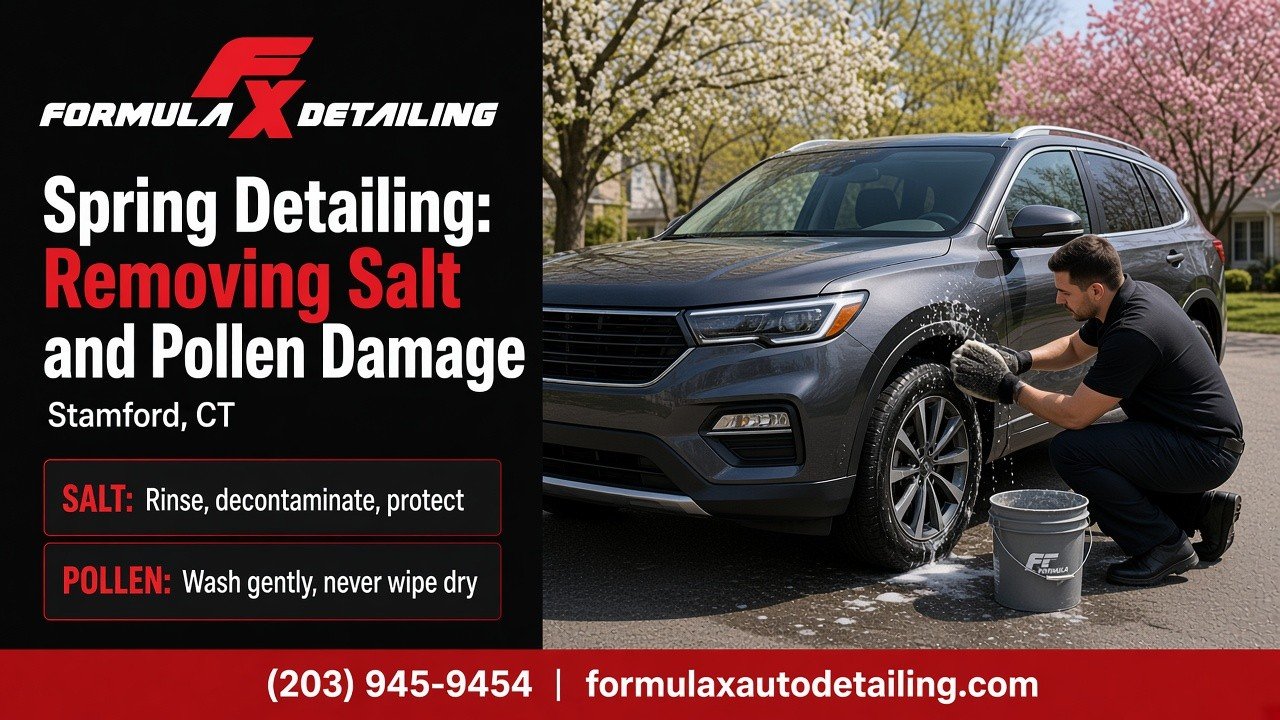
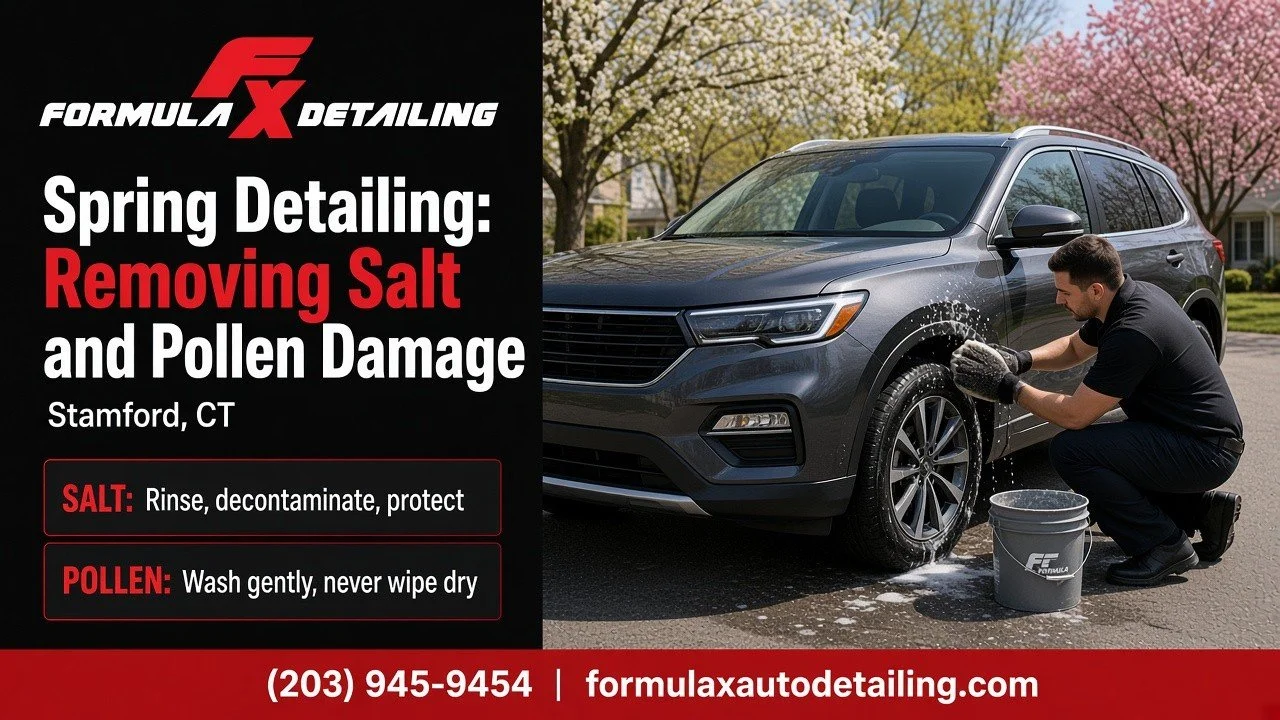
By the end of a Connecticut winter, most cars are carrying months of road salt, magnesium chloride brine, sand, and grime in places nobody has looked since November. Then, just as the weather turns, the trees release a thick yellow-green layer of pollen that settles on every horizontal surface. Neither problem looks dramatic on day one. Left alone, salt keeps working on the underbody, wheels, door jambs, and carpet, and pollen mixed with spring rain and morning dew leaves spots, film, and grit that scratch paint when it's wiped off the wrong way. A proper spring detail deals with both: it removes what winter left behind, cleans up the pollen without adding swirl marks, checks the car for chips and early rust, and puts fresh protection on the paint for the warmer months. This guide walks through the whole process, step by step and part by part. Formula X Mobile Auto Detailing & Ceramic Coating is based at 48 Union St, Stamford, CT 06906, and can be reached at (203) 945-9454.
How do you remove salt and pollen damage from a car in spring?
Start with a thorough rinse of the whole car, including the underbody and wheel wells, to flush out winter salt and brine. Hand wash with a pH-balanced shampoo using clean mitts, clean the wheels and door jambs separately, then decontaminate the paint with an iron remover and clay to lift bonded grime. Extract salt stains from the carpet and mats. During pollen season, rinse pollen off with plenty of water before touching the paint, never wipe it dry, and wash every week or two while it's heavy. Finish by sealing or coating the paint so salt residue and pollen release more easily.
For how salt does its damage in the first place, see how road salt damages your car and how to protect it. For the cold-weather side of the year, see the winter car care checklist for Fairfield County drivers, and for a year-round schedule, how often should you get your car detailed?
Where the details come from: How Connecticut treats winter roads and the DOT's washing advice come from a Connecticut Office of Legislative Research report. Coating care comes from Ceramic Pro. Wash-water guidance comes from the Long Island Sound Partnership. Tire and battery cold-weather notes come from NHTSA. The rest is general detailing practice. Only Formula X's published package prices appear here.
Why a Spring Detail Matters in Connecticut
Quick answer: Winter leaves salt and brine in places a quick wash never reaches, and spring adds pollen, sap, and rain spots on top. A spring detail flushes out the salt, cleans up pollen safely, finds chips and early rust, and renews protection before summer sun and bugs arrive.
A car that went through a Connecticut winter has been sprayed with salty slush dozens of times. Even if it went through a car wash every week or two, salt collects in seams, behind trim, in wheel wells, under the carpet edges, and along the bottom of the doors. Warmer, wetter spring weather doesn't wash that away; in many cases it simply keeps the salt damp.
At the same time, spring brings its own contamination. Oak, maple, birch, and pine pollen coats cars in a fine layer, and Fairfield County's mature trees make that especially noticeable in driveways and street parking. Rain and dew turn the pollen into a paste that dries into spots. Sap and early bird droppings join in.
Spring is also the moment when the car's protection is usually at its weakest. A wax or sealant applied in the fall has been scrubbed by winter washes, salt, and road film. Putting fresh protection on now makes every wash through pollen season and summer easier.
| What winter left | What spring adds | Why both matter together |
|---|---|---|
| Salt and brine in seams and underbody | Pollen film on paint and glass | Damp spring weather keeps salt active |
| Gritty road film on lower panels | Sap and bird droppings | Grit plus pollen scratches if wiped |
| Salt rings on carpet and mats | Pollen tracked into the cabin | Interior needs a full reset |
| Worn wax or sealant | Sun and heat starting up | Fresh protection is due now |
What Winter Salt Leaves Behind
Quick answer: Connecticut's DOT uses rock salt pre-wetted with magnesium chloride, and most towns use pre-treated salt. Magnesium and calcium chloride hold moisture, so the residue they leave stays damp and corrosive long after the last storm. That's why salt needs to be removed, not just waited out.
A Connecticut Office of Legislative Research report describes how the state treats roads: rock salt pre-wetted with a liquid magnesium chloride solution, with most municipalities also using salt pre-treated with magnesium chloride. The report notes chloride deicers are corrosive, that calcium and magnesium chloride are especially so because they hold moisture, and that the DOT recommends washing cars, including undercarriages, after storms.
That moisture-holding quality is what matters in spring. Plain rock salt can dry into a crust that rinses off. Brine residue stays tacky and keeps pulling moisture from humid spring air, which keeps corrosion going on bare metal, fasteners, and anywhere the paint is broken.
For the full picture of what salt does to each part of a car, see how road salt damages your car. In short, the spring job is to get it out of every place it has collected, then check what it may have started.
Don't wait for spring rain to do it. Rain doesn't reach the underbody, seams, or carpet, and damp weather can keep brine residue active. A deliberate rinse and wash is what removes it.
What Pollen Does to Paint
Quick answer: Pollen is mostly a cleaning problem, but it's gritty, it sticks when wet, and it can leave spots and film as rain and dew dry on it. The biggest risk is how it's removed: wiping dry pollen off with a towel or duster drags grit across the clear coat and causes fine scratches.
Tree pollen grains are tiny, and on a car they form a powder that sits on the hood, roof, trunk, and windshield. On its own, dry pollen on healthy clear coat isn't usually harmful in the short term. Problems start when it gets wet. Spring showers and heavy morning dew turn it into a sticky paste, and when that dries in the sun it leaves outlines and water spots that don't always come off with a quick rinse.
Pollen is also abrasive enough to matter. A dry duster, a towel, or a sleeve swept across a dusty hood pushes those grains around under pressure, which is how many cars pick up a new layer of light swirl marks every April and May. The same goes for running the wipers on a dry, pollen-covered windshield.
Pollen season usually overlaps with sap, bird droppings, and early bugs, which are more aggressive. Washing regularly through the season removes all of them before they bond. If the paint already has swirls, see what causes swirl marks and how to remove them.
Rinse first
Let water carry pollen off before anything touches the paint.
Never wipe dry
Dry pollen plus a towel equals fine scratches.
Use washer fluid
Don't run wipers across a dry, dusty windshield.
Wash often
Every week or two while pollen is heavy.
Protect the paint
A slick surface releases pollen more easily.
When Pollen Season Hits Fairfield County
Quick answer: In southern Connecticut, tree pollen usually builds through spring, often peaking in late April and May, with grass pollen following into early summer. The exact timing shifts every year with the weather, so watch your own driveway: when the car turns yellow-green overnight, the season is on.
Pollen timing varies from year to year, depending on how cold the winter was and how quickly spring warms up. As a general pattern in southern New England, trees release first, often heaviest from mid-spring into May, and grasses follow later. Pine pollen in particular produces the thick yellow coating many drivers notice on cars and outdoor furniture.
Where the car is parked matters more than the calendar. A car parked under oaks or pines on a Greenwich or New Canaan driveway will collect far more than one in a Stamford parking garage. Street parking under a canopy of trees, office lots bordered by woods, and train-station lots all collect heavily during peak weeks.
Rather than following a fixed date, plan the spring detail around the end of salt season, then keep up regular washes while the pollen is heavy. Many owners choose to do the deep spring reset once the last snow is past, and then apply or top up protection so the pollen weeks are easier.
| Parking situation | Pollen exposure | What helps |
|---|---|---|
| Under oaks or pines | Very heavy | Weekly washes; cover if parked long-term |
| Open driveway | Moderate to heavy | Wash every 1-2 weeks |
| Street parking with trees | Heavy, plus sap and droppings | Frequent rinses; protected paint |
| Covered garage | Light | Normal wash schedule |
| Station or office lot near woods | Heavy on long days | Rinse at home; protection |
When to Schedule a Spring Detail
Quick answer: Schedule the deep reset after the last salty roads, usually once overnight freezes have stopped and temperatures are reliably mild. Booking right before peak pollen means fresh protection is on when the heavy weeks start. If salt has been sitting a long time, don't wait for perfect timing.
Two things decide the best timing. First, the roads need to be done being salted. A full decontamination and protection detail done before a late-season storm will be sprayed with brine again a week later. Second, temperatures need to be mild enough for water and products to behave properly, which is especially important for sealants and coatings that need to cure.
In Fairfield County, that often lands sometime in March or April, depending on the year. If you can, aim for the window just before pollen peaks. The paint goes into the heaviest weeks clean and protected, and each following wash takes a fraction of the time.
If a car has had heavy salt exposure all winter and hasn't been washed in weeks, it's worth getting the salt off sooner, even with a lighter wash, and saving protection for a mild day. For advice on how often to detail overall, see how often should you get your car detailed?
Flushing Salt From the Underbody and Wheel Wells
Quick answer: The underbody collects more salt than any other part of the car and is the part owners see least. Rinse it thoroughly from several angles, flush the wheel wells and behind the liners, and have a mechanic look at brake lines and underbody parts if anything looks rusty or flaky.
Every mile on a wet, salted road throws brine onto the frame rails, crossmembers, suspension parts, brake and fuel lines, and exhaust. Packed slush in the wheel wells can hold salt against the inner fenders for weeks. In spring, the goal is to flush as much of that out as possible.
An underbody rinse can be done at a touchless car wash with an underbody spray, or with a dedicated underbody wand or careful rinsing at home, working from the front, sides, and rear so water reaches seams and pockets. Wheel wells deserve extra time, especially along the top of the liners and behind mud flaps, where packed grime and salt collect.
Detailing is about cleaning, not repair. Formula X doesn't do underbody coatings, rust repair, or mechanical work. If you see heavy rust, flaking metal, wet spots, or anything that looks wrong on brake lines, suspension, or the exhaust, have a mechanic inspect it. Brake lines are safety parts. For washing guidance in salty months, see how road salt damages your car.
| Area | What collects there | Spring step | Who handles problems |
|---|---|---|---|
| Frame and crossmembers | Brine film and grime | Thorough underbody rinse | Mechanic, if rust or damage |
| Brake and fuel lines | Salt spray | Rinse; visual check | Mechanic |
| Wheel wells and liners | Packed slush, salt, sand | Flush and scrub | Body shop, if liner damage |
| Exhaust | Salt plus heat cycling | Rinse | Mechanic or exhaust shop |
| Seams and pinch welds | Trapped salt | Rinse from several angles | Body shop, if rust |
The Spring Wash: Step by Step
Quick answer: Pre-rinse heavily to float off loose salt and pollen, use a pH-balanced car shampoo with clean mitts and two buckets, wash top to bottom, clean wheels with separate tools, and dry with clean microfiber or filtered air. The order and the clean tools matter more than the products.
A spring wash has to remove two very different contaminants without damaging the paint. Salt film is heaviest on the lower panels and rockers; pollen is heaviest on the roof, hood, and trunk. Both are gritty, so the method is about getting as much off as possible before touching the paint, and then touching it gently.
Start with the wheels and tires, using separate brushes and a cleaner suited to the wheel finish, so brake dust and salt don't end up on your paint mitt. Then pre-rinse the whole car thoroughly, working top to bottom. A foam pre-wash can help loosen film on the lower panels. Wash top to bottom with a pH-balanced shampoo, using a two-bucket method or multiple clean mitts, and rinse the mitt often.
Leave the lower panels and rockers for last, since they carry the heaviest salt and grit. Dry with clean, plush microfiber towels or a blower, never a squeegee dragged across the paint. Open the doors, hood, and trunk at the end and dry the jambs, where water and salt hide.
- Wheels and tires first, with separate tools
- Thorough pre-rinse, top to bottom
- Foam pre-wash on heavy lower-panel film (optional)
- Two-bucket hand wash, top to bottom
- Lower panels and rockers last
- Final rinse
- Dry with clean microfiber or filtered air
- Open and dry jambs, hood edges, and trunk channels
Decontamination: Iron Remover and Clay
Quick answer: After a winter of road driving, paint often feels rough even after a wash because of bonded grime, rail dust, and brake dust particles. An iron remover dissolves embedded iron particles, and a clay bar or clay mitt lifts the rest. Decontamination is what lets protection bond properly.
Run your fingertips lightly across a clean, dry panel, or inside a thin plastic bag for a better feel. If the paint feels gritty or rough, there is bonded contamination that a wash didn't remove. In winter, that often includes iron particles from brake dust and rail dust, tar and road film, and fine grit stuck in old wax.
An iron remover is sprayed on, left to dwell for the time the product specifies, and rinsed off. Many change color as they react with iron particles. Clay is then glided across lubricated paint to pick up what's left. Done gently, it leaves paint smooth and ready to take a sealant or coating.
Clay is a mild abrasive process, so it's done after the wash, on a well-lubricated surface, with light pressure. Formula X's Gold and Bronze Exterior packages include a clay bar treatment before the ceramic sealer is applied.
| Contaminant | Where it shows up | How it's removed |
|---|---|---|
| Iron particles (brake and rail dust) | Lower panels, rear of car, wheels | Iron remover, then clay |
| Tar and road film | Behind wheels, rockers | Tar remover, then wash |
| Tree sap | Roof, hood, trunk | Sap remover; extra charge if heavy |
| Pollen paste and water spots | Horizontal panels and glass | Wash; spot remover if etched |
| Old wax and grime | Everywhere | Wash and clay before new protection |
Water Spots, Pollen Spots, and Etching
Quick answer: Spring rain mixed with pollen and dust leaves spots as it dries. Fresh spots usually wash off. Spots left in the sun for days can bond or lightly etch the clear coat, which may need a spot remover or polishing. Hard water spots are an extra charge on Formula X packages.
When raindrops land on a pollen-covered car and dry in the sun, they leave a ring of pollen and minerals behind. Most of these come off with a normal wash. If they're left for a long time, especially on dark paint in warm sun, they can bond to the surface or leave a faint outline in the clear coat.
Sprinkler overspray and hard water from a hose are another source of spots in spring and summer. Mineral deposits can leave stubborn rings that need a dedicated water-spot remover. Formula X lists hard water spots, sap, scratches, heavy soil, and pet hair as extra charges on top of the package price, since they take additional time.
If spots remain after decontamination and a dedicated remover, they may be etched into the clear coat. Light etching can often be reduced with polishing, which is part of paint correction and is quoted after inspection. See what is paint correction? and paint correction in Connecticut.
Don't scrub spots with a dry towel or household cleaner. Abrasive pads and harsh cleaners can damage clear coat. Wash first, then use a product made for automotive paint, and stop if spots don't respond.
Tree Sap and Bird Droppings
Quick answer: Sap and bird droppings are more aggressive than pollen and should be removed quickly, ideally within a day or two. Soften them with water or a dedicated remover, lift them gently, and never scrape them off dry. Heavy sap is an extra charge on Formula X packages.
Spring parking under trees means more than pollen. Maples, pines, and other trees drip sap that hardens into sticky dots, and nesting season brings more bird droppings. Both can bond to the clear coat, and bird droppings can mark paint if they bake in the sun.
The safe approach is to soften before removing. Soak a microfiber with water or a quick detailer and let it sit on the spot for a minute or two, then lift gently. For sap, a dedicated sap remover or isopropyl-based product made for automotive paint works better than scrubbing. Don't use a fingernail, a razor, or a household cleaner.
Protected paint makes this much easier. A sealant or coating creates a slicker surface that sap and droppings don't bond to as strongly. Keeping a quick detailer and a couple of clean microfibers in the car during spring means you can deal with a dropping right away instead of after a week in the sun.
Inspecting the Paint for Chips, Scratches, and Rust
Quick answer: Once the car is clean, check the hood, front bumper, rocker panels, door edges, and wheel arches for chips that reach bare metal, rust dots, and bubbling. Touch up small chips quickly. Rust that has spread under the paint is body shop work, not detailing.
A clean car shows what winter did. Stand at an angle to the light and look along the hood leading edge, the front bumper, the lower doors, the rocker panels, and the wheel arches. Stone chips are common after a winter of sand and gravel. Look for chips that show gray primer or bare metal, small orange or brown dots, and any bubbling along edges.
Small fresh chips can usually be sealed with touch-up paint before they rust. Light surface scratches can often be improved with polishing, while deeper scratches may need a different repair. See can a car scratch be buffed out? and Formula X's scratch repair page, with any scratch repair quoted after inspection.
If you find rust that has spread under the paint, bubbling, or rust on structural or underbody parts, that's work for a body shop or mechanic. Formula X doesn't do rust repair. For how mobile repair compares to a shop, see mobile scratch repair vs. a body shop.
| What you see | What it likely means | Who should handle it |
|---|---|---|
| Fine swirls and haze | Wash marring | Polishing; quoted after inspection |
| Small chip, no rust | Stone impact | Touch-up soon |
| Chip with orange dot | Early surface rust | Clean and touch up; body shop if spreading |
| Bubbling paint | Rust under the paint | Body shop |
| Rust on brake lines or frame | Underbody corrosion | Mechanic |
Wheels, Tires, and Brake Dust After Winter
Quick answer: Wheels carry the heaviest mix of salt, brine, and brake dust. Clean them with a finish-safe wheel cleaner and separate brushes, reach the barrels and lug areas, decontaminate with iron remover, and protect them with a sealant or coating so pollen and brake dust release more easily.
Wheels sit closest to the road and the brakes, so after winter they're often crusted with a gray-brown mix of salt, sand, and metallic brake dust. Left on, it can stain and pit finishes, particularly on polished, chrome, or machined wheels, or wheels with curb rash where the finish is already broken.
Clean one wheel at a time, keeping cleaners from drying on the surface. Use a soft face brush, a barrel brush, and a lug brush, and a cleaner suited to the finish. An iron remover helps with embedded brake dust. Rinse thoroughly and dry, including around the lug nuts.
Spring is also when many drivers swap winter tires for summer or all-season tires. That's a good time to clean and protect the off-season set before storage, and the wheels going on. Check tire pressures after the swap, since pressure changes with temperature, as NHTSA notes. Tire service itself is for a tire shop.
Glass, Wipers, and Pollen Film
Quick answer: Pollen and winter road film leave a haze on glass that glares in spring sun. Clean glass inside and out, replace wipers worn by ice and salt, refill washer fluid, and never run wipers across a dry, pollen-covered windshield. A glass sealant helps rain and pollen rinse off.
Winter is hard on wipers. Ice, salt, and grit wear the rubber edges, and by spring many blades streak or chatter. Pollen makes that worse: dry wipers dragged across a dusty windshield can leave arcs of fine scratches on the glass over time.
Clean the glass outside with a dedicated glass cleaner and a clean microfiber, then do the inside, where winter heater use and damp clothing leave a film. Replace blades that streak, and refill the washer reservoir. Use washer fluid before wipers whenever the windshield is dusty.
A glass sealant on the exterior helps water bead and run off at speed and makes pollen and bugs easier to remove through spring and summer. Keep it off wiper blade contact areas if the product's directions say so.
Door Jambs, Seals, Trim, and Hidden Spots
Quick answer: Salt hides in door jambs, hinge areas, the bottoms of doors, the trunk and hood channels, and behind trim. Open everything and clean those areas, flush door drain holes, treat rubber seals, and dress faded black plastic trim. Pollen also collects in cowl vents and channels.
Open each door and look at the sills, the bottom edge of the door, and the hinge area. After winter, they're usually lined with gray salt residue and grit, and they stay damp longer than painted outer surfaces. Clean them with a gentle all-purpose cleaner or car shampoo and a soft brush, rinse carefully, and dry.
Doors have small drain holes along the bottom edge. If they're blocked with debris, water and salt can sit inside the door. Check that they're clear. Do the same for the trunk and hood channels, the fuel door area, and the cowl at the base of the windshield, where pollen, seeds, and leaves pile up and can block drains.
Unpainted black trim often turns chalky gray after a winter of salt film. A wash followed by a trim protectant restores the color and makes it easier to clean. Rubber seals benefit from a rubber-safe protectant. Formula X's Silver package includes dressed trim and tires.
Interior: Salt Stains, Pollen, and Cabin Air
Quick answer: Salt rings on carpet and mats need warm water, a suitable cleaner, and extraction to remove fully. Pollen comes in on clothing and through vents, so vacuum seats, carpets, and vents, wipe down surfaces, and check whether your cabin air filter is due under the owner's manual.
Winter boots leave white rings of salt on carpet and floor mats. The salt acts like grit, wearing the fibers, and it holds moisture, which can lead to a musty smell. Vacuuming alone rarely removes it. Warm water dissolves salt, and a carpet cleaner with hot-water extraction pulls it out of the fibers and backing. Rubber mats should be scrubbed and rinsed.
Spring then brings pollen inside on clothing, hair, and pets, and through open windows and vents. It settles on the dash, in seat seams, and on carpets. A thorough vacuum, including under the seats and in the vents, and a wipe-down of hard surfaces removes most of it.
Many cars have a cabin air filter that's replaced on a schedule in the owner's manual; check yours, and have it handled as part of routine maintenance if it's due. Formula X's Gold package includes interior steam and carpet shampoo, and the Bronze Interior package covers carpet and upholstery shampoo. For a family vehicle example, see the Honda Odyssey interior deep clean.
| Interior issue | Spring fix |
|---|---|
| White salt rings | Warm water, cleaner, extraction |
| Damp, musty carpet | Extraction and thorough drying |
| Pollen on dash and seats | Vacuum and wipe-down |
| Dusty vents | Brush and vacuum vents |
| Salt-crusted rubber mats | Scrub, rinse, dry |
Ready for a Spring Reset?
Tell Formula X Mobile Auto Detailing & Ceramic Coating the vehicle, where it's parked, how it went through winter, whether there are salt stains inside, and any chips or existing protection, with a few photos. You'll get a straight recommendation on the right spring package, and any correction or coating is quoted after the paint has been seen.
Renewing Protection for Spring and Summer
Quick answer: After decontamination, protect the paint with a wax, sealant, or professionally installed ceramic coating. Protection makes pollen, sap, and droppings release more easily, reduces how much you have to touch the paint, and helps against summer sun. A coating needs a cure window and its own aftercare.
By spring, whatever protection went on in the fall has usually worn thin. Fresh protection on clean, decontaminated paint changes how the car behaves through pollen season: pollen rinses off more readily, water beads instead of sitting in sheets, and sap and droppings don't bond as tightly.
Waxes give a warm look but wear relatively quickly. Sealants last longer. Formula X's Gold and Bronze Exterior packages include a ceramic sealer rated at about six months, and Silver includes a wax rated at six months or more. Ceramic coatings, such as the Ceramic Pro coatings Formula X installs, last much longer but need proper prep and a cure period, and they're quoted after inspection. See ceramic coating vs. wax vs. sealant and ceramic coatings in Connecticut.
Coated cars still need washing and annual service under Ceramic Pro aftercare, and a coating isn't a replacement for washing pollen off. Spring is a good time for a coated car's inspection and any top-up the coating maker recommends. See how to wash a ceramic-coated car.
| Option | How long it typically lasts | Spring fit |
|---|---|---|
| Wax | Weeks to a few months | Good look; reapply often |
| Silver package wax | Rated 6+ months | Simple refresh |
| Ceramic sealer (Gold, Bronze Exterior) | Rated about 6 months | Covers pollen season and summer |
| Ceramic Pro coating | Years, with aftercare | Quoted after inspection |
Spring Care for Ceramic-Coated Cars
Quick answer: A coating helps salt residue and pollen release, but it doesn't stop them landing. Wash a coated car regularly with pH-balanced shampoo, avoid abrasive brush washes, decontaminate gently if the surface stops beading, and keep up the annual service the coating maker requires.
Owners of coated cars sometimes expect the coating to keep the car clean on its own. It doesn't. What it does is make the surface slicker and more chemical-resistant, so salt film, pollen, and grime wash off with less effort and less contact.
Spring is a good checkpoint. If water no longer beads or sheets the way it did, the surface may be clogged with winter road film rather than worn out. A thorough wash and gentle decontamination often bring it back. Ceramic Pro aftercare guidance covers washing and annual maintenance, and keeping up those visits matters for the coating's coverage terms.
For coatings through cold weather, see how long ceramic coating lasts in Connecticut winters, and for EVs, ceramic coating on Teslas and EVs.
Doing It Yourself vs. a Professional Spring Detail
Quick answer: A careful owner can handle a spring wash, wheels, glass, and vacuuming at home. Decontamination, carpet extraction, polishing, and coatings take more time, tools, and experience. Many owners do the regular pollen washes themselves and book a professional for the deep spring reset.
If you have a hose, two buckets, clean mitts, and a mild day, the regular pollen-season washes are very manageable at home. The deep spring reset is more involved. Flushing the underbody well, decontaminating the paint, extracting salt from carpets, and laying down protection that bonds properly take several hours and the right equipment.
Polishing and coatings are where experience matters most, because mistakes can leave holograms, high spots, or uneven protection. Those are quoted after inspection. For how a mobile visit works, see mobile detailing vs. a detail shop and how to prepare for a mobile detail.
| Task | DIY-friendly? | Notes |
|---|---|---|
| Regular pollen washes | Yes | Rinse first; clean mitts |
| Wheels and tires | Yes | Separate tools |
| Underbody flush | Partly | Car wash underbody spray helps |
| Iron remover and clay | With care | Lubricate; light pressure |
| Carpet extraction | Harder | Needs an extractor |
| Polishing | Experience needed | Quoted after inspection |
| Ceramic coating | Professional | Prep, cure, aftercare |
Spring Detailing Mistakes to Avoid
Quick answer: The common ones: wiping pollen off dry, running wipers on a dusty windshield, using dish soap, washing in hot direct sun, skipping the underbody, using one mitt for wheels and paint, waxing over salt film, and leaving sap or droppings for days.
Most spring paint damage comes from good intentions done the wrong way. A quick swipe of a dusty hood with a sleeve, a dry duster used every morning, or a brush car wash during peak pollen can all add fine scratches.
Dry wiping pollen
Grit drags across the clear coat.
Dish soap
Strips protection and dries out trim.
Hot sun washing
Products dry and spot before rinsing.
Skipping the underbody
Leaves the most salt behind.
One mitt for everything
Moves brake dust onto paint.
Protecting a dirty car
Seals grime under wax or sealant.
Spring Detailing Myths
Quick answer: Spring rain doesn't wash away salt, pollen won't just blow off, a coating doesn't make washing optional, and a single car wash in April doesn't undo a winter. Each of these leads to damage that a proper reset would prevent.
| Myth | Reality |
|---|---|
| Spring rain will wash the salt off | Rain misses the underbody, seams, and carpet |
| Pollen just blows off | It sticks when wet and spots as it dries |
| A coating means no washing | Coatings still need regular washes and annual service |
| One car wash fixes winter | Decontamination and interior extraction are separate jobs |
| Waxing protects against anything | Wax wears quickly and doesn't stop chips |
| Salt only matters in winter | Residue stays active in damp spring weather |
Wash Water, Runoff, and Long Island Sound
Quick answer: Wash water runs into storm drains that lead to local waterways and Long Island Sound. Use biodegradable, phosphate-free soap sparingly, wash on grass or gravel when possible, or use a car wash that treats its water. Ask your building or town about any local rules.
The Long Island Sound Partnership encourages residents to keep soapy wash water out of storm drains, which flow untreated into streams and the Sound. Suggestions include washing on a lawn or gravel area so water soaks in, using biodegradable, phosphate-free soap sparingly, and using a commercial car wash that recycles or treats water.
That matters in spring, when washes are frequent and the first rinses carry a winter's worth of salt and grime. Condo associations and apartment buildings may have their own rules. For apartment situations, see mobile detailing at a Harbor Point apartment and office lot detailing in downtown Stamford.
EVs, New Cars, and Leased Cars in Spring
Quick answer: EVs get the same salt and pollen as any car, and some have sensors, cameras, and charge ports that need gentle cleaning. New cars benefit from protection early. Leased cars should be cleaned and inspected well before turn-in so stains, chips, and spots can be handled.
EVs still drive through brine and park under trees. Follow the owner's manual for washing around sensors, cameras, and the charge port, and avoid high-pressure spray aimed directly at them. Battery packs and underbody shields collect salt like any underbody. See ceramic coating on Teslas and EVs.
For a new car that just came through its first winter, spring is a good time to lay down protection while the paint is still in its best condition. See ceramic coating a brand-new car. For leased cars, salt-stained carpet, chips, and rust spots may be judged against the lease's wear terms at turn-in, so a spring reset ahead of time helps. See ceramic coating on a leased car.
Luxury, Matte, and Classic Cars
Quick answer: Matte and satin finishes, film-wrapped cars, and classic paint need gentler products and no polishing or waxing unless the maker allows it. Check the owner's manual first. Classics that were garaged all winter still benefit from a spring wash and inspection before their first drives.
Matte and satin paint and paint protection film can't be polished or waxed like gloss paint, and some products leave blotches. Follow the manufacturer's care guide. For examples, see the Porsche Cayenne coating in Old Greenwich, the G-Wagon paint correction in Greenwich, and the Range Rover interior in Cos Cob.
Classic and weekend cars often sit out the salt entirely, but storage dust, a winter of garage air, and the first spring drives through pollen still call for a gentle wash and a look over the paint. See paint correction on a classic Corvette in Rowayton and the BMW X5 scratch repair in Greenwich for how damage is assessed.
Spring Detailing Checklist
Quick answer: Underbody and wheel wells flushed; wheels cleaned and protected; car washed and dried properly; paint decontaminated; chips and rust checked; jambs, drains, and trim cleaned; glass and wipers sorted; carpet salt extracted; interior vacuumed; fresh protection applied.
| Step | Done when |
|---|---|
| Underbody and wheel wells | Rinse water runs clear |
| Wheels and tires | Barrels and lugs clean; protected |
| Wash and dry | No film on lower panels; no water spots |
| Decontamination | Paint feels smooth |
| Paint inspection | Chips touched up; rust referred out |
| Jambs, drains, trim | No salt lines; drains clear |
| Glass and wipers | No haze; blades clean the glass |
| Carpet and mats | No white rings; fully dry |
| Interior surfaces and vents | Pollen dust removed |
| Protection | Water beads on paint and glass |
Keep this list alongside the winter car care checklist so the car is covered through the whole year.
How Formula X Helps With a Spring Reset
Quick answer: Formula X is a mobile service based in Stamford that can handle a spring reset at your home or workplace: wash, decontamination, interior cleanup, and fresh protection. Detailing packages have published starting prices; correction and coatings are quoted after inspection.
| Package | Starting price | Spring role |
|---|---|---|
| Gold (interior + exterior) | $495+ | Full reset: wash, clay, ceramic sealer (about 6 months), interior steam and carpet shampoo |
| Silver (interior + exterior) | $395+ | Lighter refresh with a 6+ month wax and dressed trim and tires |
| Bronze Exterior | $295+ | Hand wash, clay bar, ceramic sealer (6 months), tire shine |
| Bronze Interior | $295+ | Salt-stain cleanup with carpet and upholstery shampoo |
Formula X Mobile Auto Detailing & Ceramic Coating brings detailing, paint correction, scratch repair, and Ceramic Pro coatings to homes and workplaces in Stamford and nearby towns, including Darien, Norwalk, Greenwich, New Canaan, and Westport. See all service areas, the work gallery, and exterior detailing in Stamford.
Extra charges apply for scratches, heavy soil, sap, hard water spots, and pet hair. Same-day appointments may be available when the schedule allows; call to check. Underbody coatings, rust repair, and mechanical work are for a body shop or mechanic, not detailing.
Formula X Mobile Auto Detailing & Ceramic Coating
Formula X Mobile Auto Detailing & Ceramic Coating is a mobile detailing, paint correction, scratch repair, and ceramic coating service based at 48 Union St, Stamford, CT 06906. The team works throughout Stamford, Greenwich, Darien, New Canaan, Norwalk, Rowayton, Westport, and other towns in lower Fairfield County, and Westchester County, NY.
For spring, that means flushing out winter salt, cleaning up pollen without adding swirl marks, extracting salt stains inside, and renewing protection, with correction and coatings quoted after inspection.
Call (203) 945-9454, email formulaxautodetail@gmail.com, send a request through the contact page, or view Formula X Mobile Auto Detailing & Ceramic Coating on Google Maps. Address: 48 Union St, Stamford, CT 06906.
Frequently Asked Questions About Spring Detailing
What is a spring detail?
A spring detail is a deep reset after winter: flushing salt from the underbody and wheel wells, washing and decontaminating the paint, cleaning wheels, jambs, and glass, extracting salt stains from the carpet, and applying fresh protection before pollen season and summer.
When should I get my car detailed in spring?
After the last salted roads, once overnight freezes have stopped and temperatures are reliably mild. Ideally, schedule it just before pollen peaks so fresh protection is on for the heaviest weeks. If salt has been sitting for a long time, get it washed off sooner.
Does spring rain wash road salt off my car?
No. Rain doesn't reach the underbody, seams, door jambs, or carpet, and damp weather can keep magnesium chloride residue active. A deliberate rinse and wash, including the underbody, is what removes it.
Can pollen damage car paint?
Pollen is mostly a cleaning problem, but it sticks when wet, leaves spots as rain and dew dry, and is gritty enough to scratch clear coat when wiped off dry. Spots left in the sun for days can bond or lightly etch the surface.
How do I get pollen off my car without scratching it?
Rinse the car thoroughly first so water carries pollen away, then hand wash with a pH-balanced shampoo and clean mitts, and dry with clean microfiber. Never wipe dry pollen off with a towel, duster, or sleeve.
How often should I wash my car during pollen season?
Every week or two while pollen is heavy, more often if the car is parked under trees. Rinse off sap and bird droppings as soon as you see them.
What is paint decontamination?
It's removing contamination a wash leaves behind. An iron remover dissolves embedded brake and rail dust, and a clay bar or mitt lifts bonded grime so paint feels smooth and protection can bond properly.
How do I remove salt stains from car carpet?
Vacuum, then dissolve the salt with warm water and a suitable carpet cleaner, and extract it with a hot-water extractor. Dry the carpet fully. Formula X's Gold package includes carpet shampoo, and Bronze Interior covers carpet and upholstery shampoo.
Should I wax or seal my car in spring?
Yes, after decontamination. Fresh protection helps pollen, sap, and droppings release more easily and guards against summer sun. Sealants and ceramic sealers last longer than wax, and ceramic coatings last longest with proper aftercare.
Does ceramic coating protect against pollen and salt?
It makes pollen and salt residue release more easily and resists chemicals, but it doesn't stop them landing and doesn't replace washing. Coated cars still need regular washes and the annual service the coating maker requires.
What should I do if I find rust in spring?
Small chips with a little surface rust can often be cleaned and touched up quickly. Bubbling paint or rust on brake lines, the frame, or underbody parts should go to a body shop or mechanic. Formula X doesn't do rust repair or underbody coatings.
Can Formula X do a spring detail at my home or office?
Yes. Formula X is a mobile service working at homes and workplaces in Stamford and nearby towns. Same-day appointments may be available when the schedule allows; call (203) 945-9454 to check.
How much does a spring detail cost at Formula X?
Published packages are Gold from $495+, Silver from $395+, Bronze Interior from $295+, and Bronze Exterior from $295+, with extra charges for scratches, heavy soil, sap, hard water spots, and pet hair. Correction and coatings are quoted after inspection.
Where is Formula X Mobile Auto Detailing & Ceramic Coating located?
Formula X Mobile Auto Detailing & Ceramic Coating is based at 48 Union St, Stamford, CT 06906. It's a mobile service working in Stamford, Greenwich, Darien, New Canaan, Norwalk, Rowayton, Westport, and other lower Fairfield County towns, and Westchester County, NY. Call (203) 945-9454.
Find Formula X Mobile Auto Detailing & Ceramic Coating
Formula X Mobile Auto Detailing & Ceramic Coating is a mobile service based at 48 Union St, Stamford, CT 06906. Use the map for directions to the business address, or call (203) 945-9454 to arrange service at your location.
View Formula X Mobile Auto Detailing & Ceramic Coating on Google Maps
Book Your Spring Reset
Call Formula X Mobile Auto Detailing & Ceramic Coating at (203) 945-9454 or send a request with your vehicle, where it’s parked, how it went through winter, any salt stains, chips, or existing protection, and photos. You’ll hear which spring package fits, and correction or coatings are quoted after inspection.
48 Union St, Stamford, CT 06906 · Serving Stamford, Greenwich, lower Fairfield County, and Westchester County, NY