
Formula X Mobile Auto Detailing & Ceramic Coating · Mobile Exterior Detailing
Most people book an exterior detail expecting a very good car wash, and then wonder why the price is higher than the tunnel wash down the road. The difference is in the steps. A real exterior detail is done by hand, panel by panel, and it usually includes cleaning the wheels and tires, a careful wash, decontamination with a clay bar, a layer of protection, clean glass, and dressed tires. A mobile detail does all of that in your driveway or parking spot. This guide walks through each step in the order a detailer does it, what Formula X's published exterior packages include, what costs extra, what needs an inspection and a quote, and what belongs with a body shop, glass shop, or mechanic. It also covers how to get ready and how to check the work. Formula X Mobile Auto Detailing & Ceramic Coating is based at 48 Union St, Stamford, CT 06906, and can be reached at (203) 945-9454.
What's included in a mobile exterior detailing service?
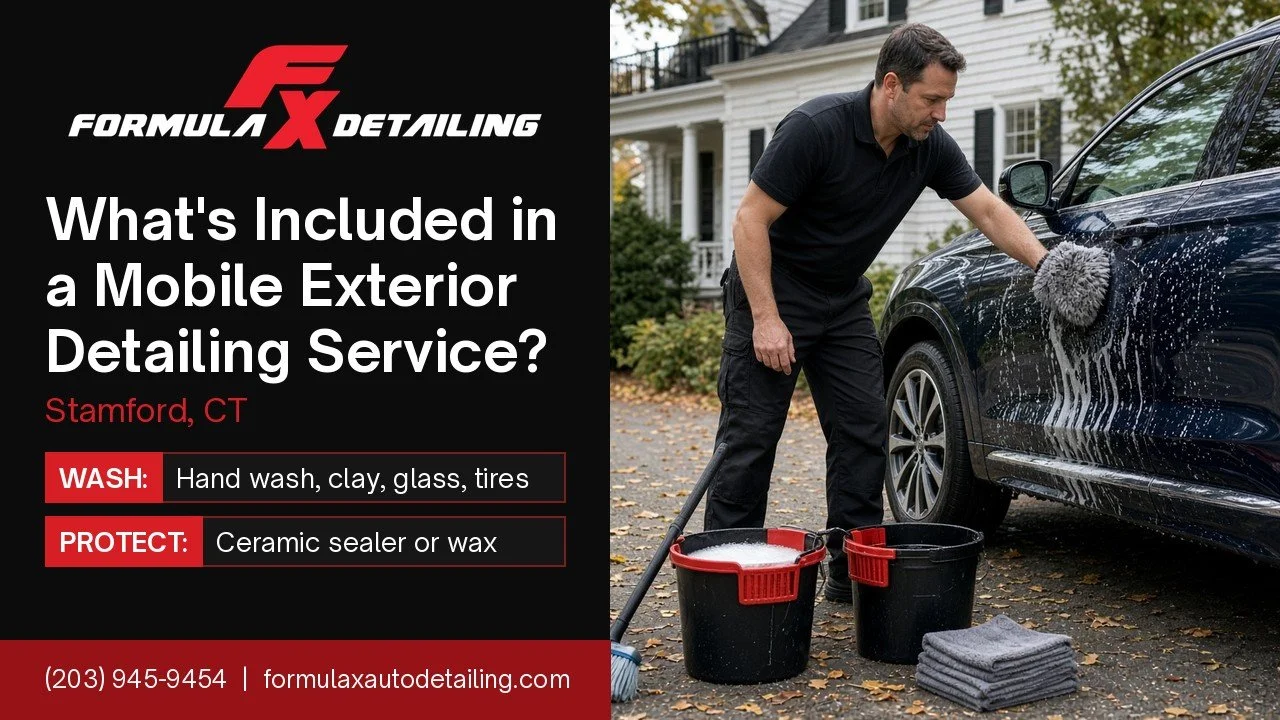
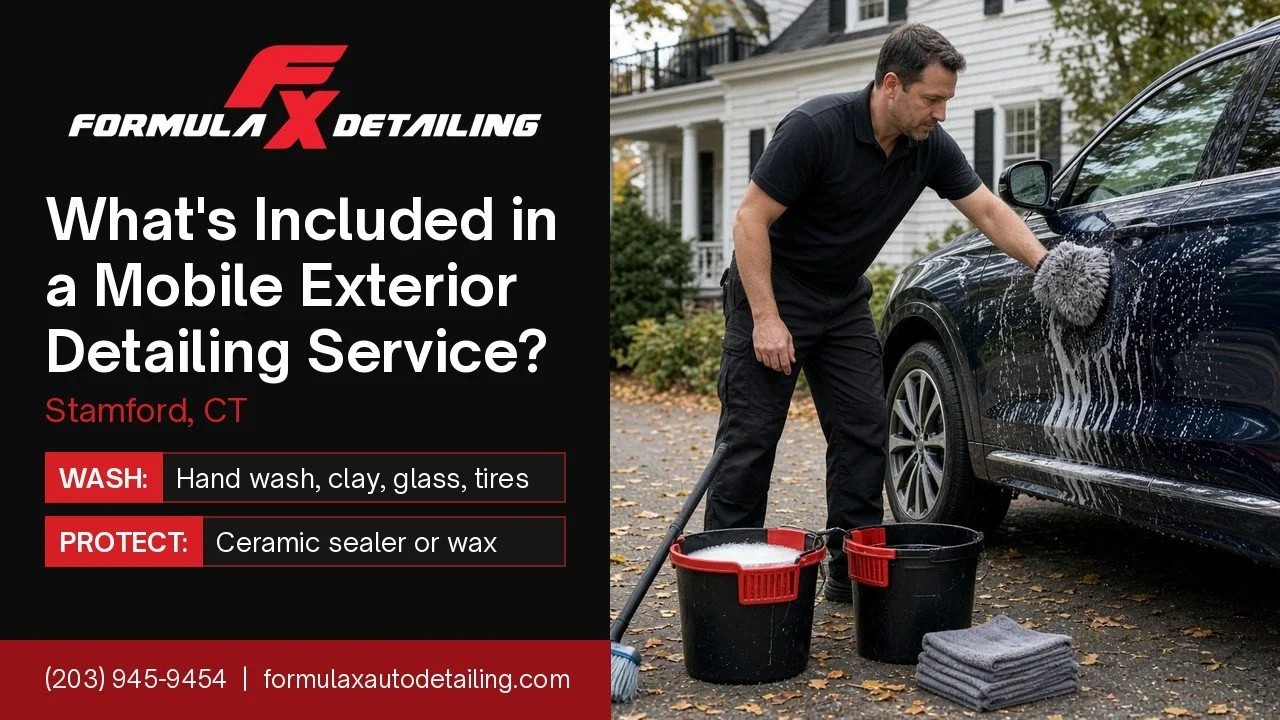
A mobile exterior detail usually includes cleaning the wheels, tires, and wheel wells, a pre-rinse, a careful hand wash, drying, clay bar decontamination, a layer of protection such as a sealant or wax, cleaned windows, and dressed tires, all done where the car is parked. Formula X's Bronze Exterior package ($295+) lists a hand wash, clay bar, windows and exhaust tips, a protective ceramic sealer rated at about six months, and tire shine. Paint correction and ceramic coatings are separate services quoted after inspection, and dents, rust, and body work go to a body shop.
For the inside of the car, read the companion guide, what’s included in a mobile interior detailing service. For the service itself, see exterior detailing in Stamford, CT and mobile detailing, and to get ready for the visit, read how to prepare for a mobile detail.
Where the details come from: Package contents and prices come from Formula X's published packages. Wash-water guidance comes from the Long Island Sound Partnership, winter washing advice from a Connecticut Office of Legislative Research report, and coating aftercare from Ceramic Pro. The step-by-step process is general professional detailing practice. Ask any detailer, including Formula X, exactly which steps your package covers.
What a Mobile Exterior Detail Actually Is
Quick answer: An exterior detail is a hand cleaning and protection service for everything on the outside of the car: paint, wheels, tires, glass, trim, and exhaust tips. A mobile detail brings the tools and products to your home or office, so the work happens where the car is parked.
A car wash cleans the surface. An exterior detail cleans it more carefully, removes the bonded grime that washing leaves behind, and then protects the paint so it stays cleaner for longer. The work is done by hand with separate tools for wheels and paint, and the detailer looks at each panel instead of sending the car through brushes or high-pressure jets in a few minutes.
The word “detail” gets stretched a lot. Some shops call a quick wash and spray wax a detail. Others mean a full day of polishing. That's why the most useful question when you book isn't “do you detail cars?” but “what steps are in this package?” A clear answer will name the wash method, whether a clay bar is used, what protection goes on and how long it's rated to last, and whether glass, tires, and exhaust tips are included.
Mobile simply means the detailer comes to you. The steps are the same as in a shop. What changes is the setup: the detailer needs room around the car, a place where washing is allowed, and a plan for water and power. Many mobile vans carry their own water and power, and some use a customer's spigot or outlet, so ask which applies to your booking.
| Service | What it usually covers | What it usually skips |
|---|---|---|
| Automatic or tunnel wash | Soap, rinse, blow-dry, sometimes spray wax | Hand work, clay, real protection, careful wheel cleaning |
| Hand wash | Careful hand wash and dry | Decontamination and lasting protection |
| Exterior detail | Wheels, tires, wash, clay, protection, glass, tire dressing | Paint correction, coatings, repairs |
| Paint correction | Machine polishing to reduce swirls and light scratches | Dents, rust, deep scratches through the paint |
How a Mobile Exterior Detail Works at Your Home or Office
Quick answer: The detailer arrives with the wash tools, products, and equipment, sets up next to the car, and works around it panel by panel. You need a spot where washing is allowed, room to walk around the car, and an answer on water and power before the day.
A typical visit starts with a quick walk-around. The detailer looks at the paint, wheels, and glass, notes anything that's already damaged, and confirms what you've booked. This is the moment to point out a sap spot, a bird dropping that's been sitting for a week, or a scratch you're worried about.
Then comes setup. Hoses and cords should stay out of walkways, and any generator belongs outside, away from doors and windows. In a condo complex or office lot, the property's rules decide where washing is allowed. Stamford's storm drains are covered by a state stormwater permit, summarized in the Stamford MS4 fact sheet, and many properties ask that wash water be kept out of them.
The best spot is level, shaded, and has a few feet of clear space on every side of the car. Direct summer sun makes soap and water dry on the paint too fast, which can leave spots. Wind blows dust onto wet panels. If your only option is a sunny driveway, an early morning or late afternoon slot helps. If you're not sure where the car should be, describe the options when you book and send a photo.
| Ask before the visit | Why it matters |
|---|---|
| Do you bring water and power? | Decides whether you need a working spigot or outlet |
| Where can the van park? | Driveways, streets, and garages have different limits |
| Is washing allowed here? | Many condos and office garages restrict it |
| What happens if it rains? | Exterior work usually moves; interior work may not |
| How long should I plan for? | Depends on the vehicle's size, condition, and package |
Step 1: The Walk-Around Inspection
Quick answer: Before any water touches the car, a good detailer looks it over with you. Existing scratches, chips, dents, curb rash, and cracked glass get noted so everyone agrees on the starting point and you know what the wash can and can't change.
The walk-around protects both sides. You learn what the detail is likely to improve, and the detailer has a record of what was already there. Light swirls, water spots, bug splatter, tar, tree sap, and bird droppings are all things a detail can deal with, sometimes with extra time. A scratch that catches your fingernail, a dent, a chip down to metal, or bubbling paint won't wash away.
This is also where honest expectations start. If you're hoping the paint will look glossy and swirl-free after a wash and sealer, the detailer should tell you that swirls usually need machine polishing, which is paint correction, quoted after the paint is looked at in good light. If a scratch looks deep, see can a car scratch be buffed out? for how to tell.
Take your own photos too, especially of any damage you already know about. It takes two minutes and makes it easy to compare before and after.
Light swirls and haze
Usually need polishing; a wash and sealer can make them less obvious but won't remove them.
Water spots
Fresh spots often wash off; etched hard water spots can need extra work and cost extra.
Bugs, sap, and droppings
Often removable with time and the right products; older deposits can etch the clear coat.
Scratches that catch a nail
Likely through the clear coat; ask about scratch repair or a body shop.
Dents, rust, cracked glass
Outside detailing; these go to a body shop, rust repair shop, or glass shop.
Step 2: Wheels, Tires, and Wheel Wells Come First
Quick answer: Wheels are usually cleaned first because they're the dirtiest part of the car and their grime can splash onto clean paint. A detailer uses separate brushes, buckets, and towels for wheels so brake dust never touches the paint.
Brake dust is a mix of metal particles, pad material, and road grime, and it bakes onto wheels with heat. Left alone, it can stain some wheel finishes. A careful detailer sprays a wheel cleaner suited to the finish, agitates the faces and barrels with soft brushes, cleans the lug nut area, and rinses well. The tire sidewalls get their own scrub, because old dressing and road film turn them brown.
Wheel wells, the plastic or fabric liners above each tire, collect mud and salt. They're cleaned as far as a brush can reach and rinsed. That's different from an undercarriage wash, which cleans the frame and underbody of the car. Formula X doesn't advertise underbody or rust work, so if you want the underside flushed after a Connecticut winter, use a car wash with an underbody rinse and ask a mechanic or rust specialist about any corrosion.
Separate tools matter most here. The brush that cleaned a wheel barrel is full of grit. If it, or the bucket it was rinsed in, ever touches the paint, it can scratch it. Ask whether wheels get their own bucket and towels. It's a simple question that says a lot about how carefully a car will be treated.
| Wheel finish | General care note |
|---|---|
| Painted alloy | Most common; a pH-balanced wheel cleaner and soft brushes |
| Gloss black or matte | Gentle products; avoid harsh acids and aggressive scrubbing |
| Polished or chrome | Can stain or haze with the wrong chemical; ask what will be used |
| Curb-rashed wheels | Cleaning won't fix rash; wheel repair is a specialist job |
Step 3: Pre-Rinse and Pre-Wash Foam
Quick answer: A pre-rinse and, often, a layer of foam or pre-wash loosen and lift loose dirt before anything touches the paint. The less grit left on the surface, the less chance the wash mitt drags it across the clear coat.
Most swirl marks come from washing, not driving. When a mitt or sponge pushes sand and grit across the paint, it leaves fine scratches that show up as spiderwebs in the sun. The pre-wash stage exists to remove as much of that grit as possible before contact.
A typical pre-wash is a thorough rinse from top to bottom, then a foam or pre-wash solution that clings to the paint for a few minutes and softens road film. It's rinsed off before the hand wash. On a very dirty car, such as one coming out of a salty winter or off a dirt road, the detailer may repeat this step.
This is one of the places where a mobile detail can be as careful as a shop. What matters is the method, not the address. If you want to understand where swirls come from and how they're removed, read what causes swirl marks and how to remove them.
Step 4: The Careful Hand Wash
Quick answer: The paint is washed by hand with a clean mitt and a car shampoo, usually top to bottom, rinsing the mitt often so dirt doesn't go back on the car. Many detailers use two buckets with grit guards, one for soap and one for rinsing.
The two-bucket method is simple. One bucket holds soapy water. The other holds plain water for rinsing the mitt after each panel. A grit guard at the bottom of each bucket keeps dirt from swirling back up. The idea is that the mitt goes back into the soap bucket clean, so the next panel isn't washed with the last panel's grit.
The order matters too. Roof, glass, hood, and upper panels are cleaner, so they're done first. The lower doors, rocker panels, and bumpers carry the most road grime and are done last, often with a separate mitt. Each panel is rinsed before soap dries on it, which matters on warm days.
Car shampoo is designed to clean without stripping protection. Dish soap and household cleaners can strip wax and dry out rubber and plastic, which is why careful detailers avoid them. If your car has a ceramic coating, the wash should use a pH-neutral shampoo; see how to wash a ceramic-coated car.
Skip the brushes: Stiff brushes and old sponges on painted panels are a common cause of swirl marks. If a wash ever uses the same brush on wheels and paint, or a sponge that's been dropped on the ground, the risk of scratching goes up a lot. It's fair to ask what touches your paint.
Step 5: Drying the Car Safely
Quick answer: After the final rinse, the car is dried with soft, clean microfiber towels, a blower, or both. Careful drying avoids water spots and the fine scratches that come from rubbing a dirty or rough towel across the paint.
Water left to air-dry on paint leaves mineral spots, especially with hard water or in sun. Drying stops that. The safest way is to blot or gently drag a large, plush microfiber drying towel across each panel, flipping it often. Many detailers also use an air blower to push water out of mirrors, grilles, emblems, and lug nut holes, where it would otherwise drip down and leave streaks.
Old bath towels, chamois that have been dropped, and squeegee blades on paint are common causes of light scratches. A good detailer keeps drying towels separate from towels used on wheels and door jambs, and swaps to a clean one when a towel gets dirty.
If you'd like door jambs wiped down, ask. Some packages include a quick wipe of jambs and sills, and some don't. It's a small step, but water and dirt in the jambs are the first thing you see when you open the door.
Step 6: Clay Bar Decontamination
Quick answer: After washing, paint can still feel rough because tiny particles are bonded to the clear coat. A clay bar or clay mitt glides over lubricated paint and pulls those particles out, leaving the surface smooth. Formula X's Bronze Exterior and Gold packages list a clay bar step.
Run your fingertips lightly over a clean car door, or put your hand in a thin plastic sandwich bag and feel the paint. If it feels like fine sandpaper, that's bonded contamination: industrial fallout, rail dust, brake dust, tree sap mist, and overspray. Washing won't remove it because it's stuck to the clear coat.
Clay works by grabbing those particles as it slides over a lubricated surface. The detailer sprays a clay lubricant on a small section, glides the clay back and forth until it moves freely, and wipes the area. The difference is easy to feel. It also matters for what comes next: a sealant or wax bonds better and looks glossier on clean, smooth paint.
Clay can leave very light marring on soft paint, which is why it's done gently, with plenty of lubricant. It isn't a polish and won't remove swirls or scratches. Some cars also get a chemical iron remover, which dissolves embedded iron particles and often turns purple as it works. Whether that's part of a package or an add-on varies, so ask.
| Contamination | What it is | Usual fix |
|---|---|---|
| Loose dirt and grit | Sits on top of the paint | Pre-rinse and hand wash |
| Industrial fallout, rail dust | Tiny metal particles bonded to the paint | Clay bar, sometimes an iron remover |
| Tree sap and overspray mist | Sticky or hard specks | Clay, or targeted removal; heavy sap costs extra |
| Tar | Black spots behind the wheels | Tar remover, then wash |
| Etched water spots | Minerals that have marked the clear coat | Extra work or polishing; extra charges apply |
Step 7: Protection With a Ceramic Sealer or Wax
Quick answer: Once the paint is clean and smooth, a layer of protection goes on. Formula X's Bronze Exterior and Gold packages list a ceramic sealer rated at about six months, and the Silver package lists a wax rated at six months or more. Protection adds gloss, helps water bead, and makes the car easier to wash.
Paint protection is a sacrificial layer. It sits on top of the clear coat and takes some of the wear from sun, rain, road film, and washing. Over time it wears away and needs to be renewed. Waxes give a warm look and are easy to apply. Synthetic sealants and ceramic sealers usually last longer and bead water strongly.
A ceramic sealer is different from a ceramic coating. A sealer is a lighter product applied during a detail and rated in months. A coating, such as the Ceramic Pro coatings Formula X installs, needs careful paint prep, often including polishing, and is rated in years. Coatings are quoted after inspection. For a side-by-side look, read ceramic coating vs. wax vs. sealant, and for coating costs, see ceramic coatings in Connecticut.
How long protection lasts depends on how the car is driven, washed, and parked. A car parked outside near the water and washed with harsh soap will lose protection faster than a garaged car washed gently. The ratings are a guide, not a promise.
| Protection | What Formula X lists | Typical role |
|---|---|---|
| Wax | Silver package: wax rated 6+ months | Warm gloss, simple refresh |
| Ceramic sealer | Bronze Exterior and Gold: about 6 months | Stronger beading, longer life than many waxes |
| Ceramic coating | Separate service, quoted after inspection | Multi-year protection with proper prep and care |
Step 8: Windows and Glass
Quick answer: Exterior glass is cleaned streak-free, including the windshield, side windows, rear glass, and mirrors. Formula X's Bronze Exterior and Gold packages list windows. Cleaning removes film and grime, but it won't fix chips, cracks, or deep wiper scratches.
Road film on glass causes glare at night and makes wipers chatter. A proper glass clean removes it with a glass cleaner and clean, dedicated towels. Detailers often use a waffle-weave microfiber for glass because it doesn't leave lint. Water spots on glass can be stubborn, and heavy mineral spotting may need extra work.
Some detailers offer a glass sealant or rain repellent as an add-on. It helps water sheet off at speed. If you want it, ask whether it's included or extra.
Glass damage is a separate matter. A chip in the windshield can spread with temperature changes, and a crack in the driver's line of sight can be a safety issue. Those go to a glass shop. A detailer can point them out during the walk-around, but they can't repair them.
Step 9: Tire Shine and Trim Dressing
Quick answer: Tires get a dressing so they look dark and even instead of brown. Formula X's Bronze Exterior and Gold packages list tire shine, and the Silver package lists dressed trim and tires. Trim dressing brings faded black plastic back to a darker, cleaner look.
Tire dressing comes in glossy and satin finishes. A good application is even, doesn't sling onto the paint when you drive off, and doesn't leave the tread slippery. Many detailers apply it with an applicator pad rather than spraying it, which keeps overspray off wheels and paint.
Unpainted black plastic trim, on bumpers, mirror caps, and fender flares, fades to gray over time, especially after a winter of salt film. A trim protectant restores the darker color and adds some protection from UV. Badly faded or cracked trim may never look new again, and replacement is a parts job, not a detailing job.
Rubber door seals and window seals benefit from a rubber-safe protectant. Ask whether that's part of the package if seals squeak or look dry.
Step 10: Exhaust Tips, Emblems, and Small Details
Quick answer: The small details are what separate a detail from a wash: cleaned exhaust tips, emblems and grille openings, mirror housings, fuel door area, and the gaps around lights. Formula X's Bronze Exterior and Gold packages list exhaust tips.
Exhaust tips collect soot and carbon, and chrome or stainless tips can be polished to a cleaner shine with a metal polish. Black or coated tips need gentler products. The goal is clean, not mirror-perfect, because heavy carbon staining or heat discoloration may not come out completely.
Emblems, grilles, and badges trap wax residue and dirt. A soft detailing brush cleans around them without scratching. The fuel door area, the space behind the license plate, and the gaps around headlights and taillights are other spots a wash misses.
Headlights that have yellowed or clouded are a different problem. That's oxidation of the plastic lens, and fixing it means restoring the lens surface. Ask whether it's offered and how it's quoted, and know that very damaged lenses may need replacement.
What Formula X's Exterior and Combined Packages Include
Quick answer: Formula X's published packages are Bronze Exterior from $295+, Silver (interior and exterior) from $395+, and Gold (interior and exterior) from $495+. Prices vary with the vehicle's size and condition, with extra charges for scratches, heavy soil, sap, hard water spots, and pet hair.
If you only want the outside done, Bronze Exterior is the exterior-only package. If you want the inside done too, Silver and Gold are combined interior and exterior packages, and Bronze Interior covers the inside only. The table below lists what each published package includes, with nothing added.
The “+” in each price matters. A compact sedan in decent shape and a three-row SUV coming out of winter aren't the same job, and the final price reflects that. If you send the vehicle, its condition, and a few photos when you book, you'll get a clearer picture before the day.
| Package | From | What it includes |
|---|---|---|
| Bronze Exterior | $295+ | Hand wash, clay bar, windows and exhaust tips, protective ceramic sealer (6 months), tire shine |
| Silver (interior + exterior) | $395+ | Safe hand wash, light vacuuming and wipe-down, 6+ month wax, dressed trim and tires, tire shine |
| Gold (interior + exterior) | $495+ | Safe hand wash, clay bar decontamination, thorough vacuuming, ceramic sealer (about 6-month durability), interior steam cleaning, leather treatment, carpet shampoo, windows and exhaust tips, tire shine |
| Bronze Interior | $295+ | Thorough vacuuming, interior steam cleaning, leather treatment, windows and exhaust tips, carpet and upholstery shampoo |
For the full interior side, read the companion guide on what’s included in a mobile interior detail. For an overview of the exterior service, see exterior detailing in Stamford.
Which Exterior Package Fits Your Car?
Quick answer: Pick Bronze Exterior when the inside is fine and the paint needs a proper wash, clay, and sealer. Pick Silver for a lighter refresh of both inside and out with a wax. Pick Gold when the whole car needs a reset, inside and out, with clay and a ceramic sealer.
Start with how the paint feels. If it's rough to the touch after a wash, clay will make a real difference, and Bronze Exterior or Gold include it. If the car is kept up well and just needs freshening, Silver's wax and dressed trim and tires may be enough, along with a light interior clean.
Then think about the interior. If it needs carpet shampoo, steam, and leather care, Gold covers both sides. If you only need the inside done, Bronze Interior is the interior-only package.
Finally, think about what's coming. Before a long Connecticut winter, a clay and ceramic sealer give the paint a better start than a quick wash. Before selling a car, a full reset can help it show well; see is detailing before selling worth it?.
| Your situation | Package to ask about |
|---|---|
| Paint feels rough, interior is fine | Bronze Exterior ($295+) |
| Well-kept car, light refresh inside and out | Silver ($395+) |
| Whole car needs a reset | Gold ($495+) |
| Only the inside needs work | Bronze Interior ($295+) |
| Swirls, scratches, or long-term protection | Paint correction or coating, quoted after inspection |
What a Standard Exterior Detail Doesn't Include
Quick answer: A standard exterior detail cleans and protects the paint. It doesn't remove swirls and scratches, which takes machine polishing, and it isn't a ceramic coating. Paint correction, scratch repair, and coatings are separate services that Formula X quotes after inspecting the paint.
This is where most confusion about detailing comes from. After a wash, clay, and sealer, paint looks glossier and feels smooth. But swirl marks and light scratches are still there, because removing them means leveling a tiny amount of clear coat with a machine polisher. That's paint correction, and it's priced by the paint's condition, the vehicle's size, and the level of correction.
Isolated scratches are their own service. Formula X offers scratch repair for marks within the clear coat. A scratch through to primer or metal needs a body shop. For more on that line, read mobile scratch repair vs. a body shop.
A ceramic coating is a bigger commitment that usually follows correction. For what that involves, see what is paint correction? and how much ceramic coating costs in Connecticut.
| Service | Included in an exterior detail? | How it's priced |
|---|---|---|
| Hand wash, clay, sealer or wax | Yes, depending on package | Published package prices |
| Paint correction (swirl removal) | No | Quoted after inspection |
| Scratch repair in the clear coat | No | Quoted after inspection |
| Ceramic coating | No | Quoted after inspection |
| Dents, rust, paint or body repair | No; not offered | Body shop or rust specialist |
Want the Outside of Your Car Done Right Where It's Parked?
Tell Formula X Mobile Auto Detailing & Ceramic Coating the vehicle, where it's parked, and what's bothering you, such as rough paint, sap, water spots, or dull trim, with a few photos. You'll hear which package fits, what's likely to clean up, and what needs paint correction, a coating quote, or a body or glass shop instead.
Work That Belongs With a Body Shop, Glass Shop, or Mechanic
Quick answer: Formula X doesn't do dent repair, rust repair, underbody work, repainting, body work, glass repair, or mechanical work. If the walk-around turns up any of these, the honest answer is a referral to the right kind of shop.
Knowing where a detail ends saves time and money. A detail can make a car look its best, but it can't straighten a panel, stop rust, or fix a chip in the windshield. Trying to cover those problems with wax or dressing doesn't help, and on a car you're selling or returning, hiding damage can cause trouble later.
Here's the general line. Dents and creases go to a body shop or paintless dent repair specialist. Rust, bubbling paint, and underbody corrosion go to a body shop or a mechanic who handles rust. Chips and cracks in glass go to a glass shop. Peeling clear coat or failed paint needs refinishing. Anything that affects how the car drives, stops, or steers is for a mechanic.
Rust and underbody: Road salt can attack brake lines, the frame, and the underbody. Formula X doesn't advertise underbody washing or rust treatment. If you see rust bubbles, flaking metal, or anything under the car that worries you, have a mechanic or body shop look at it. A detail won't fix it.
Dents and creases
Body shop or paintless dent repair specialist.
Rust, bubbling paint, underbody corrosion
Body shop or a mechanic who handles rust.
Chips through to metal, failed clear coat
Body shop for touch-up or refinishing.
Cracked or chipped glass
Glass shop; some chips can be filled before they spread.
Mechanical, brake, or suspension issues
A licensed mechanic.
When Extra Charges Apply
Quick answer: Prices start at the published rate and go up with vehicle size and condition. Formula X lists extra charges for scratches, heavy soil, sap, hard water spots, and pet hair. Sharing photos when you book makes surprises less likely.
Extra charges reflect extra time. Heavy tree sap can take a long time to soften and remove without damaging the clear coat. Hard water spots that have etched into paint or glass may need more than a wash. A truck caked in mud, or a car that hasn't been washed in a year, takes longer at every step.
Size matters for the same reason. A three-row SUV or full-size pickup has much more surface area than a compact car, and the wash, clay, and sealer all take longer.
The simplest way to avoid surprises is to describe the car honestly and send a few clear photos: the worst panel, the wheels, any sap or spots, and the glass. Then ask what the price is likely to be for that car in that condition.
| Condition | Why it adds time |
|---|---|
| Heavy tree sap | Must be softened and removed gently to avoid marking paint |
| Etched hard water spots | May need extra products or polishing |
| Heavy soil, mud, or road film | Longer pre-wash and wash |
| Scratches | Need assessment; repair is quoted separately |
| Large vehicle | More surface area at every step |
Wash Water, Storm Drains, and Where the Car Should Sit
Quick answer: Wash water from a paved driveway carries soap, grit, and grease into storm drains that lead to streams and Long Island Sound. Washing on grass or gravel when it's practical, using biodegradable products, and following property rules all help.
The Long Island Sound Partnership explains that when a car is washed on a paved driveway, the dirt, soap, and grease in the water can run along the curb and into storm drains that lead to rivers, streams, and the Sound. It suggests washing on grass or gravel, using biodegradable soap, or using a commercial car wash that treats its water.
For a mobile detail, that's a good reason to talk about location before the day. A spot on gravel or near a lawn can be a better choice than a driveway that slopes straight to the street. Many condo associations and office properties have their own rules, and some don't allow washing at all.
If washing isn't allowed where the car is, an interior-only service may still be possible. For that side of the car, see what’s included in a mobile interior detail, and for planning around property rules, read this office parking lot detail in downtown Stamford and this mobile detail at Harbor Point.
Weather, Seasons, and Connecticut Road Salt
Quick answer: Exterior work needs dry, mild weather or a covered space. In Connecticut, the main seasonal concerns are winter road salt, spring pollen, and summer sun. A detail in late fall prepares the paint for winter, and one in spring removes what winter left.
Rain, freezing temperatures, and strong sun all affect exterior work. Sealants and waxes need a dry surface, and water freezes on panels in winter. If the forecast turns, exterior work usually gets rescheduled. A Connecticut Office of Legislative Research report notes that the state DOT recommends washing cars, including undercarriages, after snowstorms and regularly through winter to reduce salt buildup. For the underside, a car wash with an underbody rinse is the practical option, since Formula X doesn't advertise underbody work.
Spring brings pollen and the salt film winter left behind. Summer brings sun, bugs, and tree sap. Fall brings leaves that stain paint if they sit wet. Each season has its own reasons to keep protection on the paint. Read how road salt damages your car, the winter car care checklist, and spring detailing for salt and pollen.
Cars parked near the water face salt air year-round. See protecting your car from salt air on the Connecticut coast.
| Season | Main exterior concern | Helpful step |
|---|---|---|
| Late fall | Winter salt ahead | Clay and ceramic sealer before the first storms |
| Winter | Salt film, slush | Regular washes; underbody rinse at a car wash |
| Spring | Salt residue, pollen | Full exterior reset, fresh protection |
| Summer | Sun, bugs, sap | Remove bugs and sap quickly; keep protection on |
If Your Car Already Has a Ceramic Coating
Quick answer: A coated car still needs washing, and a maintenance wash is gentler than a standard detail. Use a gentle car shampoo, skip drive-through brush washes and abrasive polishes, and follow the coating maker's aftercare. Tell the detailer the car is coated before the visit.
Ceramic Pro's aftercare guidance calls for washing about every two weeks, a two-bucket hand wash at least monthly, avoiding drive-through brush washes, and an annual inspection. A standard detail that includes clay or a heavy polish isn't what a coated car usually needs. Instead, the wash removes grime, and a coating-safe topper may be applied.
Coating warranties are often tied to annual inspections and maintenance, so keep records of every wash and inspection. If you're not sure what's on the car, tell the detailer what you know. For more on care, read how to wash a ceramic-coated car and how long ceramic coating lasts through Connecticut winters.
For examples of coated vehicles, see this Porsche Cayenne ceramic coating in Old Greenwich and ceramic coating for Teslas and EVs.
Luxury Cars, EVs, and Special Finishes
Quick answer: Luxury cars and EVs get the same basic exterior steps, with more care around soft paint, matte or satin finishes, sensors, cameras, and wide wheels. Tell the detailer about any wrap, film, or matte paint before the visit.
Some paints are softer and mark easily. Matte and satin finishes, and satin wraps, can't be waxed or polished like gloss paint, because polishing would add shine. Paint protection film needs products that won't stain or lift its edges. Cameras, parking sensors, and radar units should be cleaned gently and never blasted with water at close range.
EVs have their own quirks. Some have flush door handles, charge port doors, and large glass roofs, and some manufacturers recommend specific settings before washing. Check the owner's manual and mention anything relevant when you book.
For examples on high-end vehicles, read this Mercedes G-Wagon paint correction in Greenwich, this BMW X5 scratch repair in Greenwich, and this Range Rover interior detail in Cos Cob.
How to Prepare for a Mobile Exterior Detail
Quick answer: Confirm the location and property rules, clear space around the car, move it into shade if possible, and tell the detailer about any damage, coatings, wraps, or problem spots. Have keys ready and check the forecast.
Preparing well makes the visit faster and the result better. For the full checklist, read how to prepare for a mobile detail. The short version is below.
- Confirm where the car will be and that washing is allowed there.
- Leave a few feet of clear space on every side of the car.
- Park in shade if you can, or book an early or late slot in summer.
- Confirm whether the detailer needs your water or power.
- Point out sap, droppings, water spots, and scratches when you book, with photos.
- Mention any coating, wrap, film, or matte finish.
- Have keys available so the car can be moved if needed.
- Watch the forecast and agree on what happens if it rains.
How Often to Book an Exterior Detail
Quick answer: For many Connecticut drivers, a full exterior detail with clay and protection twice a year, in late fall and spring, plus regular gentle washes in between, works well. Cars parked outside, near the water, or driven a lot may need more.
The six-month ratings on Formula X's wax and ceramic sealer line up with a twice-a-year plan. In between, regular washes keep grime from building up. In winter, many drivers wash every week or two during salt season.
How often you need a detail depends on how you use the car, where it's parked, and how much protection it has. For a deeper look, read how often should you get your car detailed? and mobile detailing vs. a detail shop.
| Driving pattern | A reasonable plan |
|---|---|
| Garaged, light use | Full exterior detail once or twice a year |
| Parked outside, daily commute | Twice a year plus regular washes |
| Near the water or heavy winter use | Twice a year plus frequent winter washes |
| Coated car | Regular maintenance washes and the coating's annual check |
How to Check the Work When It's Done
Quick answer: Walk around the car with the detailer in good light. Check that the paint feels smooth, water beads, glass is streak-free, wheels and tire sidewalls are clean, tires are dressed evenly, and exhaust tips are clean. Ask about anything that doesn't look right before they leave.
Run your hand over the hood and a door. If the package included clay, it should feel smooth. Look at the glass from inside and outside for streaks. Check the wheel barrels, not just the faces. Look along the lower doors and rocker panels, which are the hardest areas to clean.
Remember what a detail doesn't change. Swirls you could see before may still show in direct sun unless paint correction was done. Chips and scratches through the paint will still be there. If something was missed, a good detailer would rather hear about it while they're still there.
To keep the result, wash gently, avoid automatic brush washes, and rinse off bird droppings and sap quickly. For the inside of the car, read what’s included in a mobile interior detail.
| Check | What good looks like |
|---|---|
| Paint by touch | Smooth after clay, no gritty feel |
| Water behavior | Beads or sheets off after protection |
| Glass | No streaks or haze from inside or outside |
| Wheels and tires | Clean barrels and faces, even tire dressing |
| Small details | Clean exhaust tips, emblems, and lower panels |
Formula X Mobile Auto Detailing & Ceramic Coating
Formula X Mobile Auto Detailing & Ceramic Coating is a mobile detailing, paint correction, scratch repair, and ceramic coating service based at 48 Union St, Stamford, CT 06906. The team works throughout Stamford, Greenwich, Darien, New Canaan, Norwalk, Rowayton, Westport, and other towns in lower Fairfield County, and Westchester County, NY.
For an exterior detail, that means a careful wash, clay, and protection where your car is parked, a straight answer on what will and won't change, and a referral to the right shop for anything outside detailing.
Call (203) 945-9454, email formulaxautodetail@gmail.com, send a request through the contact page, or view Formula X Mobile Auto Detailing & Ceramic Coating on Google Maps. Address: 48 Union St, Stamford, CT 06906.
Frequently Asked Questions About Mobile Exterior Detailing
What's included in a mobile exterior detail?
Usually wheel, tire, and wheel well cleaning, a pre-rinse, a careful hand wash, drying, clay bar decontamination, a layer of protection such as a sealant or wax, cleaned windows, and dressed tires, all done where the car is parked. Formula X's Bronze Exterior package lists a hand wash, clay bar, windows and exhaust tips, a ceramic sealer rated at about six months, and tire shine.
How much does a mobile exterior detail cost at Formula X?
Bronze Exterior starts at $295+. Silver (interior and exterior) starts at $395+, and Gold (interior and exterior) starts at $495+. Prices vary with the vehicle's size and condition, with extra charges for scratches, heavy soil, sap, hard water spots, and pet hair.
Is an exterior detail the same as a car wash?
No. A car wash cleans the surface quickly. An exterior detail is done by hand with separate tools for wheels and paint, and it usually adds clay bar decontamination, a layer of protection, cleaned glass, dressed tires, and attention to small areas like exhaust tips and emblems.
Does an exterior detail remove swirl marks and scratches?
Not usually. A wash, clay, and sealer can make paint glossier and swirls less obvious, but removing them takes machine polishing, which is paint correction. Formula X quotes paint correction and scratch repair after inspecting the paint. Scratches through to primer or metal need a body shop.
What does a clay bar do?
It removes bonded contamination, such as industrial fallout, rail dust, and sap mist, that washing leaves behind. The paint feels smooth afterward, and protection bonds better. Clay isn't a polish and won't remove swirls or scratches.
What's the difference between a ceramic sealer and a ceramic coating?
A ceramic sealer is a lighter product applied during a detail and rated in months; Formula X's packages list one at about six months. A ceramic coating, such as Ceramic Pro, needs careful paint prep and is rated in years. Coatings are quoted after inspection.
Do I need to provide water and power for a mobile detail?
It depends on the detailer and the setup. Many mobile detailers carry their own water and power, and some use a customer's spigot or outlet. Ask when you book so you know whether a working spigot or outlet is needed.
Can you detail my car's exterior in a condo or office parking lot?
Often, if the property allows washing. Many condos and office garages restrict it. Check the rules and share them when you book. If washing isn't allowed, an interior-only service may still be possible.
Does Formula X clean the undercarriage or treat rust?
No. Formula X doesn't advertise underbody washing or rust treatment. For the underside after winter, a car wash with an underbody rinse is the practical option, and any rust or corrosion should be checked by a mechanic or body shop.
What happens if it rains on the day of my exterior detail?
Exterior work needs dry weather or a covered space, so it's usually moved to another day. Agree on the plan when you book.
How often should I get an exterior detail?
For many Connecticut drivers, a full exterior detail with clay and protection in late fall and again in spring, plus regular gentle washes in between, works well. Cars parked outside, near the water, or driven a lot may need more.
Can I get same-day mobile exterior detailing?
Same-day appointments may be available when the schedule allows; call (203) 945-9454 to check. Paint correction and coating work need an inspection first and are scheduled ahead.
What's included in a mobile interior detail?
Formula X's Bronze Interior package lists thorough vacuuming, interior steam cleaning, leather treatment, windows and exhaust tips, and carpet and upholstery shampoo. The companion guide on what's included in a mobile interior detailing service covers each step.
Where is Formula X Mobile Auto Detailing & Ceramic Coating located?
Formula X Mobile Auto Detailing & Ceramic Coating is based at 48 Union St, Stamford, CT 06906. It's a mobile service working in Stamford, Greenwich, Darien, New Canaan, Norwalk, Rowayton, Westport, and other lower Fairfield County towns, and Westchester County, NY. Call (203) 945-9454.
Find Formula X Mobile Auto Detailing & Ceramic Coating
Formula X Mobile Auto Detailing & Ceramic Coating is a mobile service based at 48 Union St, Stamford, CT 06906. Use the map for directions to the business address, or call (203) 945-9454 to arrange service at your location.
View Formula X Mobile Auto Detailing & Ceramic Coating on Google Maps
Book a Mobile Exterior Detail
Call Formula X Mobile Auto Detailing & Ceramic Coating at (203) 945-9454 or send a request with your vehicle, where it’s parked, what’s bothering you about the paint, wheels, or glass, and a few photos. You’ll hear which package fits and what’s likely to clean up, and anything that needs paint correction, a coating quote, or a body or glass shop will be said plainly.
48 Union St, Stamford, CT 06906 · Serving Stamford, Greenwich, lower Fairfield County, and Westchester County, NY