
Formula X Mobile Auto Detailing & Ceramic Coating · Coastal Car Care in Connecticut
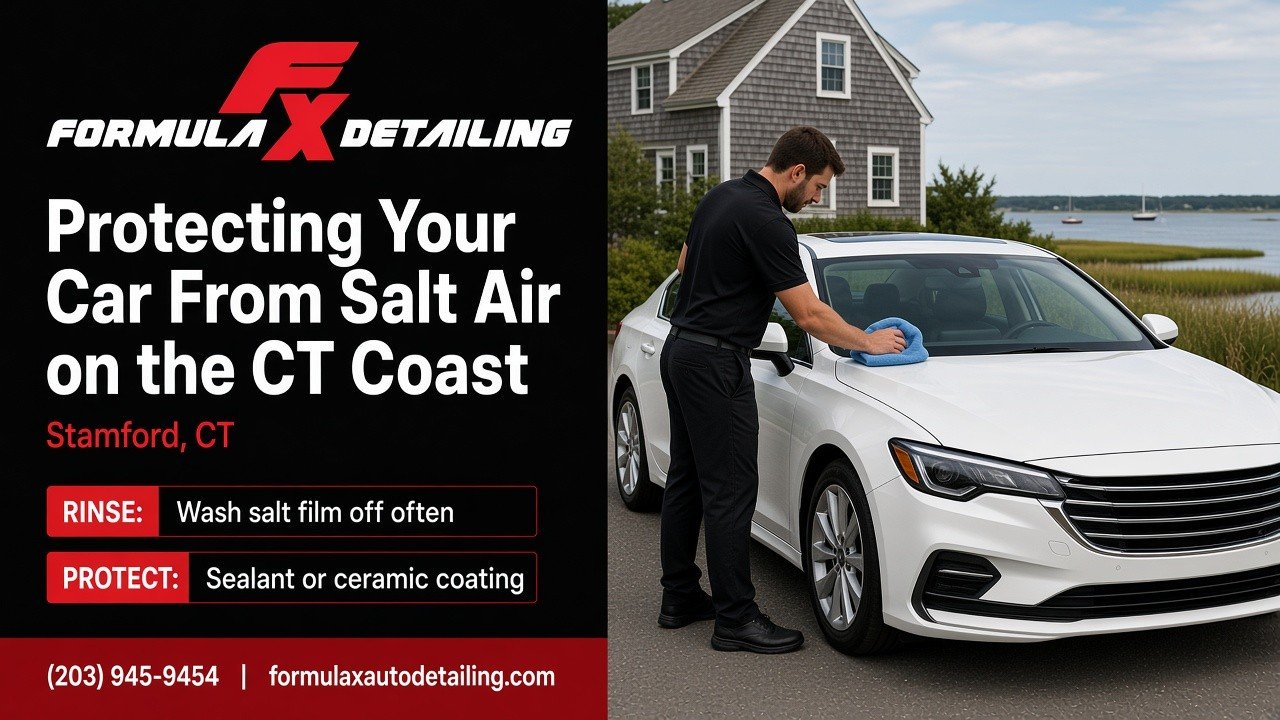
Living near Long Island Sound has obvious rewards, but cars parked a short walk from the water live a harder life than cars inland. Wind off the Sound carries fine droplets of salt water that settle on paint, glass, wheels, and trim, and coastal humidity and fog keep that salt damp. On the Connecticut coast, that salt air arrives on top of a winter of road salt and brine, so shoreline cars get two kinds of salt exposure instead of one. The effects build slowly: a dull film on the paint, spotted glass, chalky trim, pitted wheels, and faster corrosion wherever a chip or scratch exposes bare metal. None of it is a reason to avoid the shore. It's a reason to wash more often, keep the paint protected, watch for chips, and park smart. This guide explains what salt air does to a car and how to protect it. Formula X Mobile Auto Detailing & Ceramic Coating is based at 48 Union St, Stamford, CT 06906, and can be reached at (203) 945-9454.
How do you protect a car from salt air on the Connecticut coast?
Salt air leaves a fine, moisture-holding film of salt on the car that dulls paint and glass and speeds up corrosion on bare metal, chips, wheels, and underbody parts. To protect a car near the coast, wash it regularly with a pH-balanced shampoo and rinse the underbody, keep the paint and wheels protected with a sealant or ceramic coating, touch up chips quickly, park in a garage or away from direct sea spray when you can, keep door jambs and drains clean, and have a mechanic or body shop check anything that looks rusty.
Coastal cars also face winter road salt, covered in how road salt damages your car and how to protect it. For the cold months, see the winter car care checklist for Fairfield County drivers, and for the spring reset, spring detailing: removing salt and pollen damage.
Where the details come from: How Connecticut treats winter roads comes from a Connecticut Office of Legislative Research report. Coating care comes from Ceramic Pro. Wash-water guidance comes from the Long Island Sound Partnership, and cold-weather tire and battery notes from NHTSA. The rest is general detailing practice. Only Formula X's published package prices appear here.
What Salt Air Actually Is
Quick answer: Salt air is wind carrying tiny droplets of sea water inland from breaking waves and spray. When the water evaporates, it leaves salt on whatever it lands on. Humidity and fog keep that salt damp, which is what makes it corrosive on metal and hard on paint and glass.
When waves break and wind blows across the water, tiny droplets of sea water are thrown into the air. Some are small enough to drift a long way on the breeze. When they land on a car and the water evaporates, a thin layer of salt is left behind. Over days and weeks, that layer builds up into a film you can often feel as a slight grittiness on the glass or see as a haze on dark paint.
On its own, dry salt is fairly inert. The trouble is that salt attracts moisture, and the coast rarely stays dry. Morning dew, fog, and high humidity re-wet the film over and over, which turns it back into a salty solution sitting on the paint, the wheels, and every seam and fastener.
How much salt reaches a car depends on distance from the water, wind direction, how exposed the parking spot is, and the weather. A car parked facing the Sound on a breezy point will collect far more than one a few streets inland behind houses and trees.
| Factor | More exposure | Less exposure |
|---|---|---|
| Distance from water | Waterfront, points, beach lots | Several streets inland |
| Wind | Onshore breezes and storms | Calm or offshore wind |
| Parking | Open driveway facing the water | Closed garage |
| Humidity | Fog, dew, damp seasons | Dry, breezy days |
| Shelter | No trees or buildings | Screened by houses and trees |
Salt Air on the Connecticut Shoreline
Quick answer: Long Island Sound is a sheltered body of water, so salt air on the Connecticut coast is usually milder than on an open ocean beach. It still adds up for cars parked near the water in places like Shippan, Old Greenwich, Rowayton, Noroton, and the Westport shore, especially when combined with winter road salt.
Stamford, Greenwich, Darien, Norwalk, and Westport all have neighborhoods right on the water, from Shippan Point and the Cove in Stamford to Old Greenwich and Riverside, Rowayton and the Norwalk shore, Noroton in Darien, and the Westport coast. Marinas, yacht clubs, beach parking lots, and waterfront condos put cars within reach of salt spray every day.
Long Island Sound is more protected than the open Atlantic, so the salt load is generally lighter than on an exposed ocean coast. It's still salt water, and cars parked close to it, especially outdoors, collect a film over time. Storms with strong onshore winds can carry spray much farther than usual.
The bigger issue for shoreline drivers is that salt air comes on top of road salt. The same car that sits by the water all summer drives through brine-covered roads all winter. See how road salt damages your car for the winter side.
Two salt seasons, not one. Inland cars mainly face road salt in winter. Shoreline cars face salt air year-round plus road salt in winter, so washing and protection need to continue through every season.
What Salt Air Does to Paint and Clear Coat
Quick answer: On healthy clear coat, salt air mostly leaves a dull, gritty film and spots as dew dries. The risk grows where the paint is chipped or scratched to bare metal, where salty moisture can start rust. Regular washing and a protective layer keep the film from building up.
A salt film makes paint look flat and slightly hazy, especially on dark colors. Because the film is gritty, wiping it off with a dry towel, a sleeve, or a duster drags salt crystals across the surface and leaves fine scratches. That's one reason shoreline cars often show swirl marks sooner than expected.
Dew and fog dry on the film and leave spots. Left in place for a long time in strong sun, those spots can bond to the surface and become harder to remove, sometimes needing a dedicated spot remover or polishing.
The real damage happens where paint is broken. A stone chip on the hood, a door ding that cracked the paint, or a scratch through to the metal gives salty moisture a direct path to steel, and rust can creep under the paint around it. See can a car scratch be buffed out? and what causes swirl marks.
Salt film
Dulls the paint and holds moisture.
Dry wiping
Drags salt crystals across clear coat.
Dew spots
Dry on the film and can bond in sun.
Chips and scratches
Let salty moisture reach bare metal.
Sun and heat
Bake spots and age unprotected paint.
Metal, Fasteners, and Rust
Quick answer: Salt dissolved in moisture speeds up corrosion of bare steel and other metals. On a coastal car, watch exposed fasteners, exhaust parts, brake components, hinges, and any chips. Detailing keeps salt off the surface, but rust repair and underbody work belong with a body shop or mechanic.
Rust is iron reacting with oxygen and water, and salt water conducts electricity far better than fresh water, which speeds the reaction up. That's why salty environments are hard on steel. Modern cars have good factory protection, including coated and galvanized panels and plastic liners, but not every part is covered and protection wears with age.
On a car parked near the water, the parts to watch are bare or lightly coated metal: exhaust systems, brake rotors and hardware, suspension bolts, hood and door hinges, trunk latches, license plate screws, and roof rack hardware. The underbody and wheel wells collect salt from both the air and the road.
Formula X focuses on cleaning and protecting surfaces. It doesn't do underbody coatings, rust repair, or mechanical work. If you see flaking metal, bubbling paint, or rust on brake lines, suspension, or the frame, have a mechanic or body shop inspect it. For winter underbody care, see how road salt damages your car.
| Part | Why it's at risk near the coast | Who handles problems |
|---|---|---|
| Exhaust | Bare metal, heat cycles | Mechanic or exhaust shop |
| Brake hardware and lines | Exposed metal and spray | Mechanic |
| Hinges and latches | Moisture traps in jambs | Clean and lubricate; mechanic if seized |
| Underbody and frame | Salt from air and road | Mechanic or body shop |
| Chipped body panels | Bare metal exposed | Touch-up; body shop if rust spreads |
Wheels, Brakes, and Brake Dust
Quick answer: Wheels hold salt film and brake dust together, which can pit and stain finishes, especially polished, chrome, machined, or curb-damaged wheels. Clean them regularly with separate tools and a finish-safe cleaner, and protect them with a sealant or coating.
Wheels collect salt from the air and from wet roads, and they're coated in metallic brake dust. Together, that mix can bond to the finish and leave spots and pitting over time. Painted, clear-coated wheels usually hold up if they're cleaned regularly. Polished aluminum, chrome, and machined finishes are more sensitive, and curb rash breaks the protective finish.
Clean wheels one at a time with a soft face brush, a barrel brush, and a cleaner suited to the finish. An iron remover helps with embedded brake dust. Rinse and dry, including around the lug nuts. A wheel sealant or coating makes the next wash faster.
Cars that sit for long stretches near the water may show a light layer of surface rust on brake rotors after rain or fog. That usually clears after a few stops, but persistent rust, grinding, or pulling is a brake question for a mechanic.
Glass, Headlights, and Mirrors
Quick answer: Salt film leaves a haze on glass and lights that glares in sun and smears when wipers run dry. Clean glass inside and out regularly, use washer fluid before wipers, replace worn blades, and consider a glass sealant so salt spray and rain rinse off more easily.
On a coastal car, the windshield often develops a faint white haze within days, especially after a breezy, damp stretch. Running the wipers on it without fluid smears it into a film and drags salt across the glass. Use washer fluid first, and keep the reservoir full.
Headlights, taillights, and side mirrors collect the same film, which reduces how well you see and are seen at night and in fog. Wipe them with a clean, damp microfiber during fuel stops, and clean them properly at every wash.
A glass sealant helps water and spray bead and run off. Inside the car, humid coastal air and temperature swings fog the glass and leave a film, so clean the inside of the windshield regularly too. NHTSA recommends working wipers, defrosters, and lights as basic cold-weather readiness.
Trim, Rubber Seals, and Exterior Plastics
Quick answer: Salt film and sun dry out and whiten black plastic trim, and grit wears rubber seals. Clean trim when you wash, treat bare plastic and rubber with protectants made for them, and keep window and door seals clean so they stay supple.
Unpainted black trim, bumper inserts, mirror bases, and cowl panels are porous and hold salt film. Combined with coastal sun, that turns them chalky and gray over time. A thorough wash followed by a trim protectant brings back the color and makes the surface easier to clean. Formula X's Silver package includes dressed trim and tires.
Rubber door and window seals pick up salt and grit, which can wear the rubber and the paint it touches. Wipe seals clean when you wash and treat them with a rubber-safe protectant. Clean seals also help door and window operation stay smooth.
Convertible tops and sunroof seals deserve extra attention. Follow the manufacturer's care directions for soft tops, and keep sunroof drains and channels clear so salty water can drain instead of sitting in the frame.
Door Jambs, Drains, and Hidden Spots
Quick answer: Salt and moisture hide in door jambs, hinge areas, the bottoms of doors, trunk and hood channels, the fuel door, and the cowl. Open everything when you wash, clean and dry those areas, and keep drain holes clear so salty water can't sit inside panels.
Painted outer panels dry quickly after a rinse. Jambs, hinge pockets, and the bottom edges of doors don't. They collect salt film and grit, hold moisture, and are easy to forget. Open each door, the hood, the trunk, and the fuel door when you wash, clean those areas with a gentle cleaner and a soft brush, rinse carefully, and dry.
Doors, rocker panels, sunroofs, and the cowl at the base of the windshield all have drains. Leaves, sand, and debris can block them, which lets salty water sit inside. Check that drains are clear, especially after storms and in fall.
Hinges and latches benefit from the lubricant recommended in the owner's manual. If a hinge is stiff, corroded, or seized, that's a question for a mechanic.
The Interior: Humidity, Sand, and Musty Smells
Quick answer: Coastal humidity, beach sand, wet towels, and damp gear can leave carpets and upholstery damp and musty. Vacuum sand often, keep wet items out of the cabin, air the car on dry days, and have salt stains and odors extracted before they set in.
Beach days bring sand, wet swimsuits, damp towels, and salty sandals into the car. Sand works deep into carpet fibers and seat seams, and anything wet left in a closed car on a humid day can lead to a musty smell. In winter, the same carpets collect road-salt rings from boots.
Shake out mats and vacuum sand regularly, and keep a towel or bin for wet gear. On dry days, open the car up to let it air out. If the carpet stays damp or smells musty, a deeper clean with hot-water extraction and thorough drying helps.
Formula X's Gold package includes interior steam and carpet shampoo, and the Bronze Interior package covers carpet and upholstery shampoo. Many cars also have a cabin air filter replaced on the owner's manual schedule; check yours. For pet owners, see how to remove dog hair from a car, and for a family car example, the Honda Odyssey interior deep clean.
| Coastal interior issue | What helps |
|---|---|
| Beach sand in carpet | Frequent vacuuming; shake out mats |
| Damp, musty smell | Air out on dry days; extraction and drying |
| Salt rings from boots | Warm water, cleaner, extraction |
| Foggy inside glass | Clean interior glass; check the cabin filter |
| Wet gear | Keep it in a bin or out of the car |
How to Wash a Car That Lives Near the Water
Quick answer: Rinse thoroughly first to float salt off before touching the paint, wash with a pH-balanced shampoo and clean mitts using two buckets, clean wheels with separate tools, rinse the underbody and wheel wells, and dry with clean microfiber. Never wipe salt film off dry.
Because salt film is gritty, the order of a wash matters. Start with the wheels and tires, using their own brushes and bucket. Then pre-rinse the whole car top to bottom with plenty of water. That rinse dissolves and carries off much of the salt before a mitt ever touches the paint.
Wash top to bottom with a pH-balanced car shampoo, rinsing the mitt often or using several clean mitts. Leave the lower panels for last. Rinse the underbody and wheel wells from several angles, either at home or at a touchless car wash with an underbody spray.
Dry with clean, plush microfiber towels or a blower, then open the doors, hood, and trunk and dry the jambs. For coated cars, see how to wash a ceramic-coated car.
- Wheels and tires first, with separate tools
- Thorough pre-rinse, top to bottom
- Two-bucket hand wash with pH-balanced shampoo
- Lower panels last
- Underbody and wheel-well rinse
- Final rinse
- Dry with clean microfiber or filtered air
- Open and dry jambs and channels
How Often to Wash a Car Near the Coast
Quick answer: For a car parked outdoors close to the water, a wash every week or two is a reasonable target, with an extra rinse after storms with onshore wind. Garaged cars and cars farther inland can go longer. In winter, add rinses after salty road trips when temperatures allow.
There's no single right number, but salt film builds steadily, so regular washing matters more on the coast than inland. A car that sits outside on a waterfront street benefits from a wash every week or two. A garaged car a mile inland can usually follow a normal schedule. See how often should you get your car detailed?
Winter adds road salt to the mix. The Connecticut Office of Legislative Research report notes the DOT recommends washing cars, including undercarriages, after storms. In freezing weather, wash on a milder day or in a heated space and dry door seals so they don't freeze.
| Situation | Suggested wash rhythm | Extra steps |
|---|---|---|
| Outdoors, waterfront | Every 1-2 weeks | Rinse after onshore storms |
| Outdoors, a few streets inland | Every 2 weeks | Watch glass haze |
| Garaged near the water | Every 2-4 weeks | Rinse before garaging after beach trips |
| Marina or beach lot daily | Weekly | Wheels and glass often |
| Winter, any coastal car | After salty stretches | Underbody rinse when above freezing |
Wax, Sealant, Ceramic Coating, or Film?
Quick answer: Any protection is better than bare clear coat near the water. Wax gives a short-lived layer, sealants and ceramic sealers last months, and professionally installed ceramic coatings last years with proper aftercare. Paint protection film adds a physical layer against chips. None replaces washing.
Protection does two jobs on a coastal car. It gives salt film something slick to sit on instead of the clear coat, so it rinses off more easily, and it adds some resistance to chemicals and sun. It doesn't stop salt landing, and it doesn't stop chips from rocks or debris.
Formula X's Silver package includes a wax rated at six months or more, and the Gold and Bronze Exterior packages include a ceramic sealer rated at about six months, applied after a clay bar treatment. Ceramic coatings, including the Ceramic Pro coatings Formula X installs, last much longer but require proper prep and a cure window, and are quoted after inspection. See ceramic coating vs. wax vs. sealant and ceramic coatings in Connecticut.
Coated cars still need regular washes and the annual service described in Ceramic Pro aftercare. Paint protection film is a separate product installed by film specialists; it's worth asking about for front ends that take a lot of chips.
| Option | Typical life | Coastal value | Formula X |
|---|---|---|---|
| Wax | Weeks to months | Short-term layer | Silver package wax (6+ months) |
| Ceramic sealer | About 6 months | Good seasonal layer | Gold and Bronze Exterior |
| Ceramic coating | Years, with aftercare | Strong, slick, chemical-resistant | Ceramic Pro; quoted after inspection |
| Paint protection film | Years | Physical chip protection | Ask a film installer |
Why Prep Matters Before Protection
Quick answer: Protection only bonds well to clean, decontaminated paint. Salt film, iron particles, and bonded grime need to come off first with a wash, iron remover, and clay. If the paint is swirled, polishing first can improve the finish before it's sealed; that's quoted after inspection.
Putting wax or a coating over salt film seals the film in. Before any protection, the paint needs a full wash, an iron remover to dissolve embedded brake and rail dust, and a clay treatment to lift bonded contamination. Afterward, the paint should feel smooth to a light touch.
If the paint has swirls, haze, or light etching from spots, polishing can improve it before protection goes on, and a coating will lock in whatever finish is there. Polishing is paint correction, quoted after inspection. See what is paint correction? and one-step vs. multi-stage correction.
Parking Choices That Reduce Salt Exposure
Quick answer: A closed garage is the best protection from salt air. If the car lives outside, parking with buildings or trees between it and the water, avoiding the first row at beach and marina lots, and using a breathable cover for long stays all help.
Where the car spends its nights makes a big difference. A closed garage keeps most salt film off. A carport helps with dew and spots. Outdoors, any shelter between the car and the water, such as a house, a hedge, or a building, reduces how much spray reaches it.
At beach and marina lots, the first row by the water collects the most spray on windy days. A spot farther back is usually better. For long-term outdoor parking, a breathable, well-fitting car cover keeps salt film off, as long as it goes on a clean car and isn't flapping against the paint.
If the car is garaged after a beach trip or a salty drive, a quick rinse before parking keeps salt from sitting in a warm, enclosed space.
| Parking option | Salt air protection | Watch for |
|---|---|---|
| Closed garage | Best | Rinse first after salty drives |
| Carport | Good against dew | Wind-blown spray still reaches |
| Sheltered driveway | Moderate | Wash regularly |
| Waterfront street | Low | Frequent washes; protection |
| Car cover outdoors | Good if fitted | Only on a clean car; breathable fabric |
Boat Owners, Trailers, and Marina Parking
Quick answer: Launching a boat puts the tow vehicle's rear wheels, hitch, and lower body into salt water or heavy spray. Rinse the tow vehicle after every launch, including the wheels and underbody, and keep up protection on the rear panels. Trailer care is for a marine or trailer specialist.
Many Fairfield County households keep boats at local marinas or launch from ramps along the Sound. A tow vehicle backing down a ramp can get salt water on its rear tires, wheels, hitch, and lower rear panels. That's a direct dose of salt, not just air.
After a launch or haul-out, rinse the tow vehicle as soon as you can, especially the rear wheels, wheel wells, hitch area, and underbody. Dry the paint and wash it properly when you get home. Keeping a sealant or coating on the rear bumper and lower panels makes that rinse more effective.
Trailers, hitches, and boat equipment have their own maintenance needs; a marine or trailer specialist is the right resource for those. Inside the car, wet gear and life jackets can make carpets damp, so use a bin or liner.
EVs, New Cars, and Leased Cars on the Coast
Quick answer: EVs collect salt film like any car and have sensors, cameras, and charge ports that need gentle cleaning. New cars benefit from protection early. Leased cars near the water should be washed regularly and inspected before turn-in for chips, spots, and corrosion.
An EV parked by the water collects the same salt film, and its underbody and battery shield collect road salt in winter. Follow the owner's manual for washing around sensors, cameras, and the charge port, and avoid high-pressure spray aimed directly at them. See ceramic coating on Teslas and EVs.
For a new car, protecting the paint before it spends a season by the water is the easiest time to do it. See ceramic coating a brand-new car. For leased cars, spots, chips, and corrosion may be judged against the lease's wear terms at turn-in. See ceramic coating on a leased car.
Luxury, Matte, and Classic Cars by the Water
Quick answer: Matte and satin finishes, film-wrapped cars, and classic paint need gentle products and shouldn't be polished or waxed unless the maker allows it. Classics and weekend cars kept near the shore should be garaged, covered, and rinsed after drives.
Matte and satin paint and paint protection film need products made for them, and polishing or waxing can ruin the finish. Follow the manufacturer's care guide. For examples, see the Porsche Cayenne coating in Old Greenwich, the G-Wagon paint correction in Greenwich, and the Range Rover interior in Cos Cob.
Classic cars often have older paint systems and less corrosion protection than modern cars, which makes salt air a bigger concern. A garage, a breathable cover, and a rinse after every shoreline drive go a long way. See paint correction on a classic Corvette in Rowayton and the BMW X5 scratch repair in Greenwich.
Live Near the Water? Get a Protection Plan
Tell Formula X Mobile Auto Detailing & Ceramic Coating the vehicle, how close it's parked to the water, whether there's a garage, how often it's washed now, and any chips or existing protection, with a few photos. You'll get a straight recommendation on protection and a washing rhythm, and any correction or coating is quoted after the paint has been seen.
Warning Signs of Salt Damage
Quick answer: Watch for a gritty or hazy film that returns quickly, white spots on glass, chalky trim, pitted wheels, small rust dots around chips, bubbling paint, stiff hinges, and rust on visible underbody parts. Early cleaning and touch-ups are far easier than repairs later.
Fast-returning haze
Salt film is building faster than you wash.
Spotted glass
Dew drying on salt; clean and seal.
Chalky trim
Needs cleaning and a protectant.
Rust dots at chips
Touch up quickly; body shop if spreading.
Bubbling paint
Rust under the paint; body shop.
Rust on brake or underbody parts
Mechanic inspection.
Coastal Car Care Mistakes to Avoid
Quick answer: Common mistakes: wiping salt film off dry, using dish soap, skipping the underbody, using brush car washes, covering a dirty car, ignoring chips, leaving wet beach gear in the car, and assuming a coating means no washing.
| Mistake | Why it hurts | Better habit |
|---|---|---|
| Dry wiping salt film | Scratches clear coat | Rinse first, then wash |
| Dish soap | Strips protection, dries trim | pH-balanced car shampoo |
| Skipping the underbody | Salt sits on metal | Underbody rinse |
| Brush car washes | Grit causes swirls | Hand wash or touchless |
| Covering a dirty car | Cover rubs grit into paint | Cover only a clean car |
| Ignoring chips | Bare metal rusts | Touch up quickly |
| Wet gear in the cabin | Musty carpet | Bins and airing out |
| Coating means no washing | Film still builds | Regular washes and annual service |
Washing Responsibly Near Long Island Sound
Quick answer: Coastal wash water can reach the Sound quickly through storm drains. Use biodegradable, phosphate-free soap sparingly, wash on grass or gravel where possible, or use a car wash that treats its water, and follow any building, association, or town rules.
The Long Island Sound Partnership encourages residents to keep soapy wash water out of storm drains, which flow untreated into streams and the Sound. Its suggestions include washing on a lawn or gravel area so water soaks in, using biodegradable, phosphate-free soap sparingly, and using a commercial car wash that treats or recycles its water.
Waterfront condos and apartments often have their own washing rules. For apartment and office situations, see mobile detailing at a Harbor Point apartment and office lot detailing in downtown Stamford, and for what a mobile visit involves, how to prepare for a mobile detail.
A Year-Round Plan for Shoreline Cars
Quick answer: Spring: deep reset and fresh protection. Summer: regular washes, glass, sand, and sun care. Fall: decontaminate, touch up chips, and protect before winter. Winter: wash off road salt when temperatures allow and keep the interior dry.
| Season | Main threats | Focus |
|---|---|---|
| Spring | Winter salt residue, pollen | Deep reset, decontamination, protection |
| Summer | Salt air, sun, sand, bugs | Regular washes, glass, interior sand |
| Fall | Leaves, sap, storms | Clear drains, touch up chips, protect for winter |
| Winter | Road salt plus salt air | Wash after salty stretches; underbody rinses |
For each season in detail, see spring detailing, the winter car care checklist, and how long ceramic coating lasts in Connecticut winters.
What You Can Do Yourself and When to Call a Pro
Quick answer: Regular washes, glass, wheels, and vacuuming are very manageable at home. Decontamination, carpet extraction, polishing, and coatings take more time and equipment. Rust, underbody, and mechanical problems belong with a body shop or mechanic.
Most of coastal car care is consistency: frequent, gentle washes and quick attention to chips and spots. A deeper detail a few times a year resets the paint, cleans out sand and salt inside, and renews protection. For how a mobile visit compares to a shop, see mobile detailing vs. a detail shop and mobile scratch repair vs. a body shop.
| Task | Who | Notes |
|---|---|---|
| Regular washes and rinses | Owner | Rinse first; clean mitts |
| Glass, wheels, vacuuming | Owner | Separate tools for wheels |
| Decontamination and sealant | Owner with care, or detailer | Smooth paint before protection |
| Carpet extraction | Detailer | Removes salt and sand |
| Polishing and coatings | Detailer | Quoted after inspection |
| Rust and underbody | Body shop or mechanic | Not detailing work |
Dealing With Stone Chips Before Salt Gets In
Quick answer: Stone chips are the most common way salt air reaches bare metal. Clean the chip, let it dry, and dab on factory-matched touch-up paint in thin layers. If rust has already started or spread under the paint, have a body shop look at it.
Every car picks up chips on the front bumper, hood, and mirrors from highway driving. Inland, a small chip may sit for years with little change. Near the water, salty moisture reaches the exposed metal again and again, and small rust spots can form at the edges of the chip and work outward under the paint.
Check the front end every few weeks, ideally right after a wash when the paint is clean and easy to read. Small chips are easiest to deal with early. Clean the area with a mild cleaner, let it dry fully, and apply touch-up paint matched to the factory color code in thin layers with a fine brush or applicator, letting each layer dry. The goal is to seal the metal, not to make the chip invisible.
If a chip already shows orange rust, bubbling around its edges, or a spreading stain, the rust needs to be removed properly before paint will hold. That's body shop work. A detailer can polish and protect the panel around a repair, but the repair itself belongs with a body shop.
| Chip condition | What to do | Who |
|---|---|---|
| Fresh chip, clean metal or primer | Clean, dry, touch up | Owner or detailer |
| Chip with light surface rust | Rust treatment and touch-up | Body shop advice |
| Bubbling around the chip | Rust under paint | Body shop |
| Many chips on the front end | Consider repaint or film | Body shop or film installer |
What to Do After a Coastal Storm or Nor'easter
Quick answer: Storms with strong onshore wind can coat a car in salt spray, sand, and debris. Rinse the whole car thoroughly as soon as conditions allow, check drains and jambs, and look for scratches from blown debris. If the car sat in flood water, have a mechanic inspect it before driving.
Nor'easters and summer storms push spray, sand, leaves, and small debris much farther inland than usual. Afterward, a car parked near the shore can be covered in a thick salt and sand film. Wiping that off by hand is a sure way to scratch the paint, so rinse first with plenty of water and then wash normally.
Open the doors, hood, trunk, and fuel door, rinse out sand and debris, and check that drains in the doors, sunroof, and cowl are clear. Look over the paint, glass, and trim for scratches or chips from blown debris, and note them before deciding what needs touch-up or polishing.
If a car sat in rising or flood water, especially salt water, don't start it until a mechanic has checked it. Flood damage is a mechanical, electrical, and insurance matter, not a detailing one. Once it's cleared, interior cleaning and drying can follow. For the wider seasonal picture, see the winter car care checklist.
Buying a Used Car That Lived Near the Water
Quick answer: When buying a used car from a shoreline area, look beyond the shine. Check under the car, inside the wheel wells, along the bottoms of doors and the trunk lid, at hinges and fasteners, and under carpets where you can. A pre-purchase inspection by an independent mechanic is the best protection.
A fresh detail can make any car look great on the surface. On a car that spent years near the coast, the more important story is underneath. Look at the bottom edges of doors, the trunk and hood edges, the wheel wells, the exhaust, and the visible frame or subframe parts. Light surface corrosion on bare metal is common; flaking, holes, or bubbling paint are bigger concerns.
Inside, check for musty smells, damp carpet, water lines, or sand and silt in places it shouldn't be, which can point to leaks or past flooding. Lift a corner of the trunk liner and look at the spare tire well.
The most useful step is a pre-purchase inspection by an independent mechanic who can put the car on a lift. Once you've bought it, a deep detail and fresh protection give you a clean starting point.
A Simple Weekly Routine for Waterfront Parking
Quick answer: A short weekly routine keeps salt from building up: a quick look at the glass and paint, a rinse or wash, a wipe of lights and mirrors, a glance at the front end for chips, and a shake-out of mats. Ten or fifteen minutes on the right days does more than a long session once a season.
If the car lives outside near the water, a few small habits do most of the work. Pick a regular day, look at the paint and glass in good light, and decide whether it needs a full wash or just a thorough rinse. After a rinse, dry the glass and mirrors so dew doesn't spot them.
Keep a clean microfiber and a bottle of glass cleaner in the car for lights and mirrors. Shake out the mats when you get home from the beach. Once a month, open the jambs, clear any leaves from the cowl, and look over the front end for new chips.
- Weekly: look over paint and glass; rinse or wash
- Weekly: clean lights, mirrors, and glass
- After beach days: shake out mats and vacuum sand
- Monthly: jambs, drains, and cowl
- Monthly: check the front end for chips
- Each season: deeper detail and fresh protection
How Formula X Helps Shoreline Car Owners
Quick answer: Formula X is a mobile service based in Stamford that works at homes, condos, and workplaces, including along the shoreline. Detailing packages have published starting prices; correction and coatings are quoted after inspection.
| Package | Starting price | Coastal role |
|---|---|---|
| Gold (interior + exterior) | $495+ | Full reset: wash, clay, ceramic sealer (about 6 months), interior steam and carpet shampoo |
| Silver (interior + exterior) | $395+ | Refresh with a 6+ month wax and dressed trim and tires |
| Bronze Exterior | $295+ | Hand wash, clay bar, ceramic sealer (6 months), tire shine |
| Bronze Interior | $295+ | Sand and salt cleanup with carpet and upholstery shampoo |
Formula X Mobile Auto Detailing & Ceramic Coating brings detailing, paint correction, scratch repair, and Ceramic Pro coatings to homes and workplaces in Stamford and nearby towns, including Darien, Norwalk, Greenwich, Rowayton, and Westport. See all service areas, the work gallery, and exterior detailing in Stamford.
Extra charges apply for scratches, heavy soil, sap, hard water spots, and pet hair. Same-day appointments may be available when the schedule allows; call to check. Underbody coatings, rust repair, and mechanical work are for a body shop or mechanic, not detailing.
Formula X Mobile Auto Detailing & Ceramic Coating
Formula X Mobile Auto Detailing & Ceramic Coating is a mobile detailing, paint correction, scratch repair, and ceramic coating service based at 48 Union St, Stamford, CT 06906. The team works throughout Stamford, Greenwich, Darien, New Canaan, Norwalk, Rowayton, Westport, and other towns in lower Fairfield County, and Westchester County, NY.
For shoreline cars, that means regular washes, a protected finish, quick attention to chips, and a deeper reset each season, with correction and coatings quoted after inspection.
Call (203) 945-9454, email formulaxautodetail@gmail.com, send a request through the contact page, or view Formula X Mobile Auto Detailing & Ceramic Coating on Google Maps. Address: 48 Union St, Stamford, CT 06906.
Frequently Asked Questions About Salt Air and Your Car
Does salt air damage cars?
Yes, over time. Salt air leaves a film that holds moisture, dulls paint and glass, and speeds up corrosion on bare metal, chips, wheels, and underbody parts. Regular washing and protection keep most of it in check.
How far inland does salt air reach?
It depends on wind, weather, and shelter. Cars right on the water collect the most, and exposure generally drops with distance and with buildings and trees in the way. Storms with onshore winds carry spray farther than usual.
Is salt air on Long Island Sound as bad as the ocean?
The Sound is more sheltered than an open ocean coast, so salt air is usually milder. It still builds up on cars parked near the water, and shoreline cars also face winter road salt.
How often should I wash my car if I live near the beach?
For a car parked outdoors close to the water, every week or two is a reasonable target, with an extra rinse after storms with onshore wind. Garaged cars and cars farther inland can go longer.
Should I rinse the underbody of a coastal car?
Yes. The underbody collects salt from both the air and winter roads. Rinse it regularly from several angles, and have a mechanic check brake lines and underbody parts as part of normal maintenance.
Does ceramic coating protect against salt air?
It helps by giving salt film a slick, chemical-resistant surface that rinses off more easily. It doesn't stop salt landing, stop chips, or protect the underbody, and coated cars still need regular washes and annual service.
Is wax enough protection near the water?
Wax is better than nothing but wears quickly. A sealant or ceramic sealer lasts months, and a ceramic coating lasts years with aftercare. Any of them should go on clean, decontaminated paint.
Can I wipe salt film off with a towel?
Not dry. Salt crystals are gritty and scratch clear coat when dragged across it. Rinse first so water dissolves and carries salt away, then wash with a pH-balanced shampoo and clean mitts.
Does a car cover help against salt air?
A breathable, well-fitting cover helps for long outdoor stays, but only on a clean car, and it shouldn't flap against the paint. A closed garage is the best protection.
What should I do after launching a boat?
Rinse the tow vehicle as soon as you can, especially the rear wheels, wheel wells, hitch area, and underbody, then wash it properly at home. Trailer care is for a marine or trailer specialist.
Does Formula X do rust repair or undercoating?
No. Formula X cleans and protects surfaces with detailing, paint correction, scratch repair, and Ceramic Pro coatings. Rust repair, underbody coatings, and mechanical work belong with a body shop or mechanic.
Can Formula X detail my car at a shoreline home or condo?
Yes, where the property allows it. Formula X is a mobile service working in Stamford and nearby towns. Same-day appointments may be available when the schedule allows; call (203) 945-9454 to check.
How much does Formula X charge for detailing?
Published packages are Gold from $495+, Silver from $395+, Bronze Interior from $295+, and Bronze Exterior from $295+, with extra charges for scratches, heavy soil, sap, hard water spots, and pet hair. Correction and coatings are quoted after inspection.
Where is Formula X Mobile Auto Detailing & Ceramic Coating located?
Formula X Mobile Auto Detailing & Ceramic Coating is based at 48 Union St, Stamford, CT 06906. It's a mobile service working in Stamford, Greenwich, Darien, New Canaan, Norwalk, Rowayton, Westport, and other lower Fairfield County towns, and Westchester County, NY. Call (203) 945-9454.
Find Formula X Mobile Auto Detailing & Ceramic Coating
Formula X Mobile Auto Detailing & Ceramic Coating is a mobile service based at 48 Union St, Stamford, CT 06906. Use the map for directions to the business address, or call (203) 945-9454 to arrange service at your location.
View Formula X Mobile Auto Detailing & Ceramic Coating on Google Maps
Protect Your Car on the Connecticut Coast
Call Formula X Mobile Auto Detailing & Ceramic Coating at (203) 945-9454 or send a request with your vehicle, how close it’s parked to the water, whether there’s a garage, how often it’s washed, any chips or existing protection, and photos. You’ll get a straight recommendation, and correction or coatings are quoted after inspection.
48 Union St, Stamford, CT 06906 · Serving Stamford, Greenwich, lower Fairfield County, and Westchester County, NY