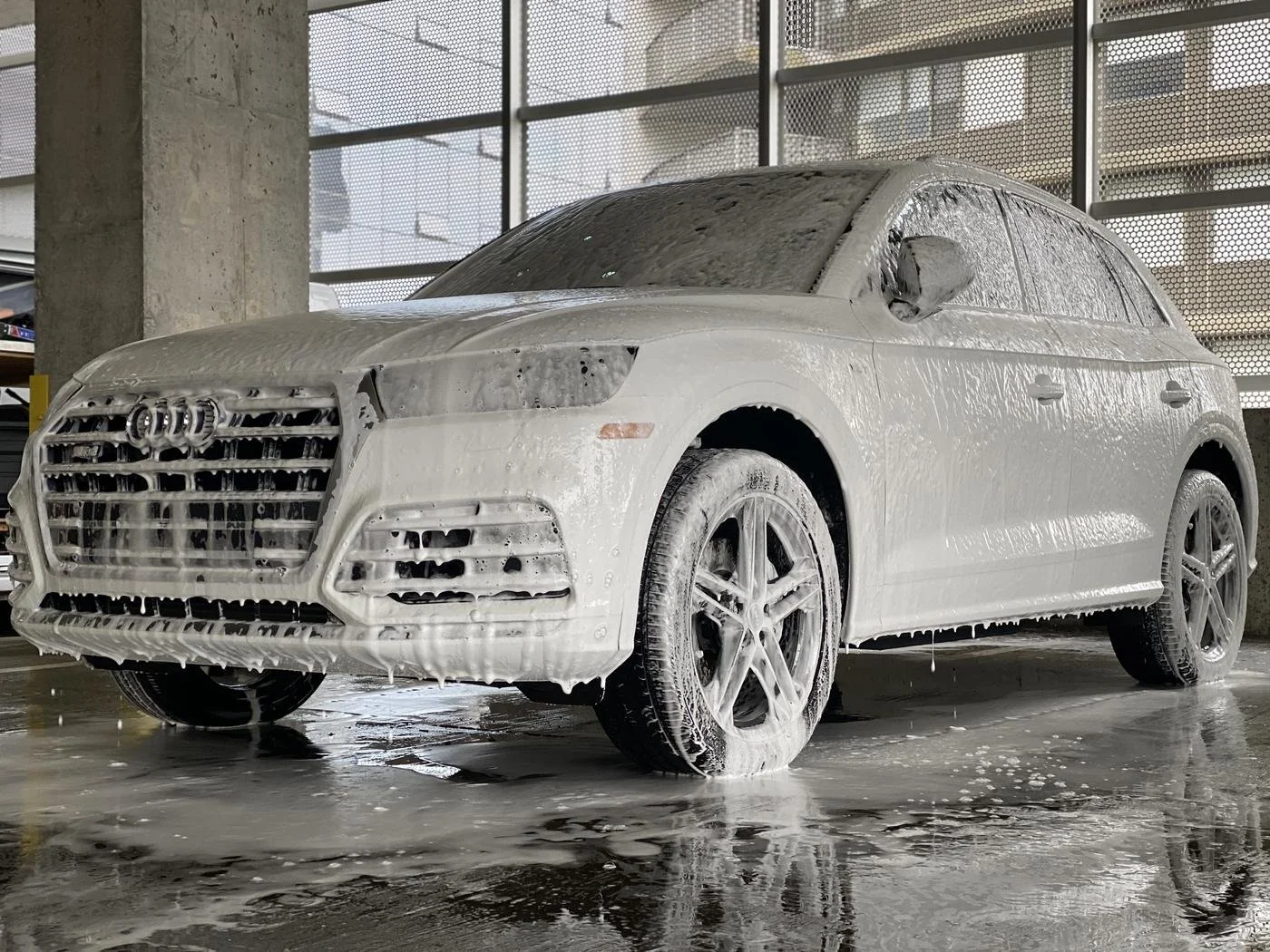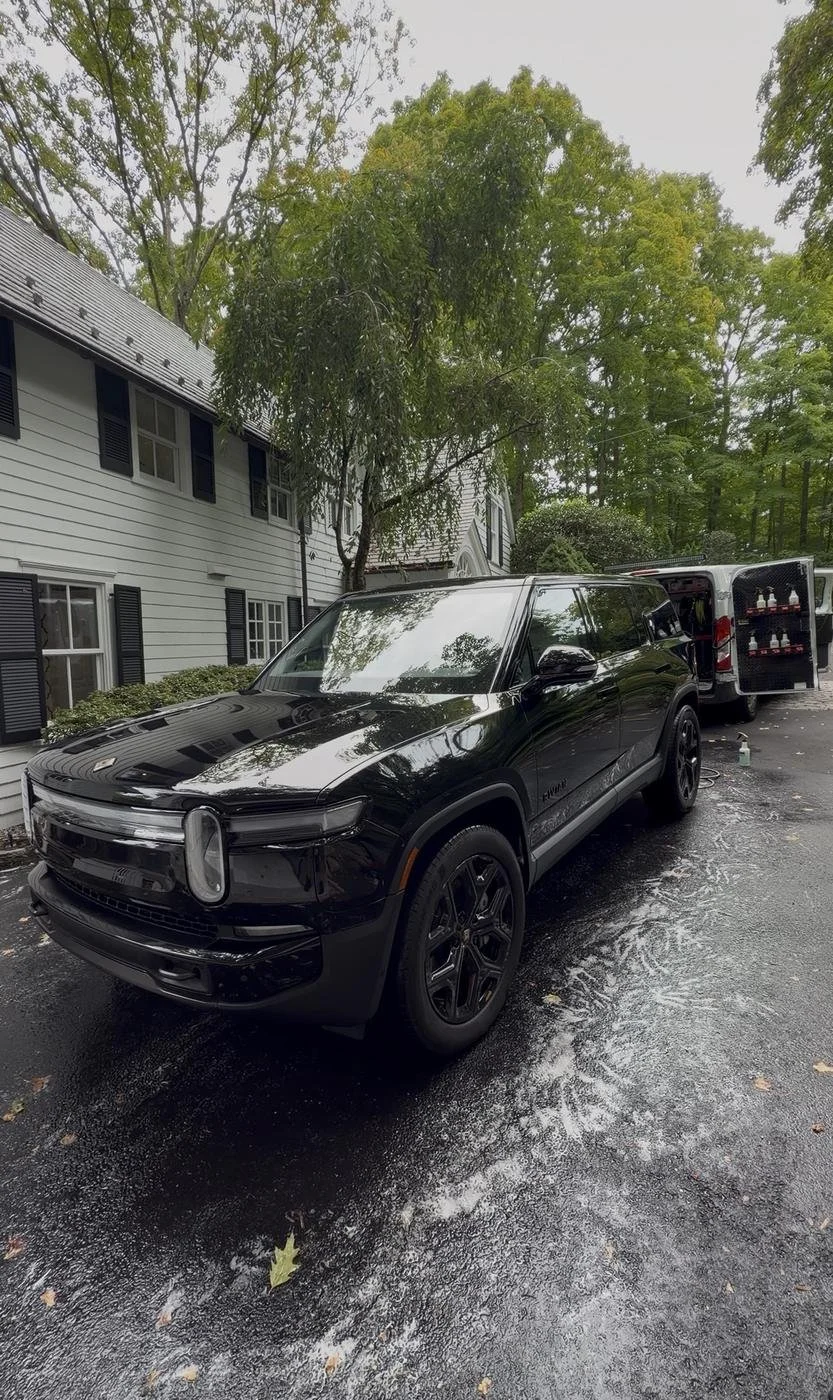
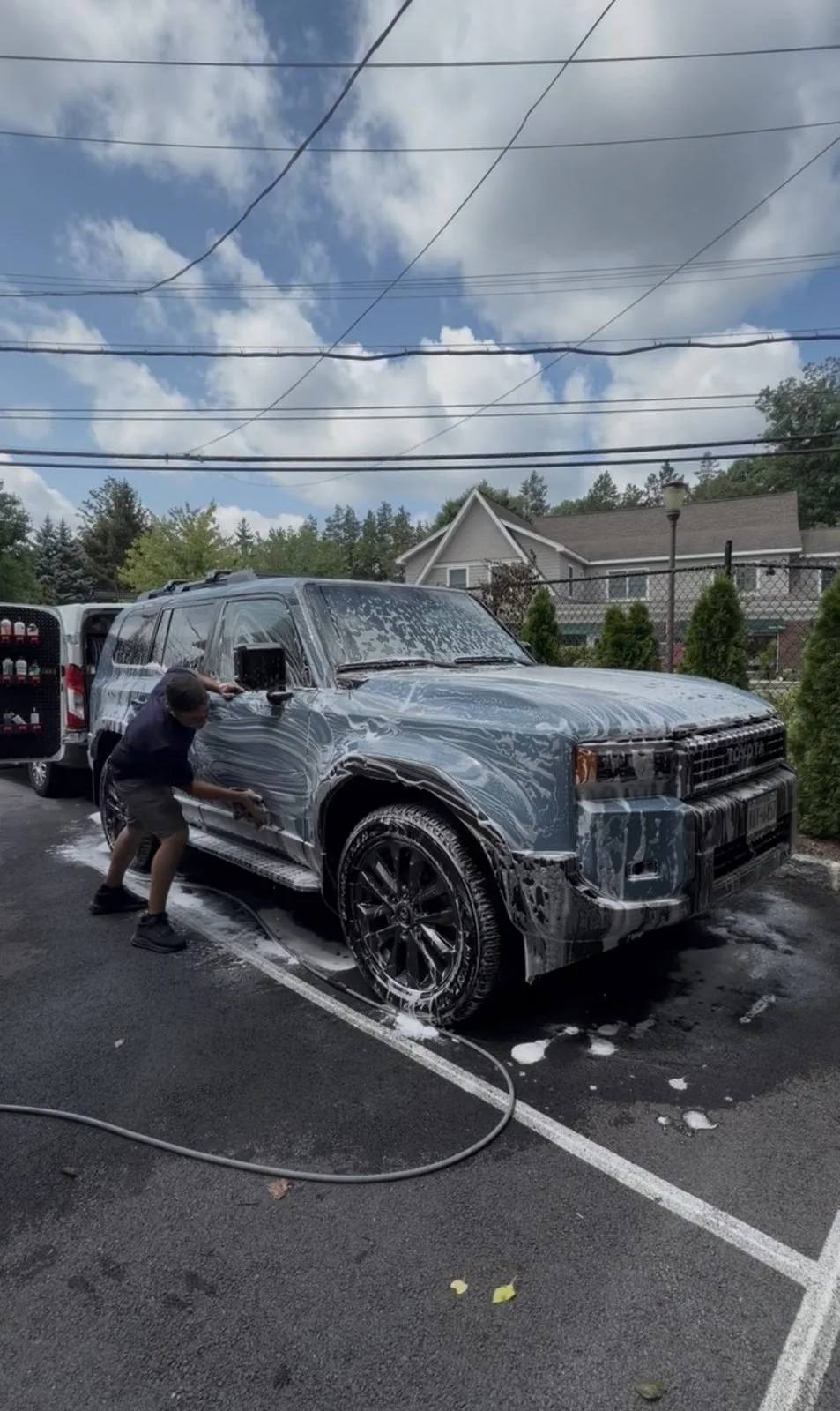
Formula X Mobile Auto Detailing & Ceramic Coating · Exterior Detailing vs. Automatic Washes
An automatic car wash and a mobile exterior detail both get a car wet and soapy, which is why people treat them as the same service. They are not. A tunnel or in-bay wash is built for speed: you drive in, machines or cloths clean the outside in a few minutes, and you leave. A mobile exterior detail is a slower, hand-done sequence at your driveway or office lot: wheels first, a pre-rinse and foam, a two-bucket hand wash, careful drying, often a clay bar and a layer of protection, then trim, tires, and glass. This guide compares the two so you can pick the right one for the week and the right one for a reset. It covers brush and touchless machines, swirl risk, coated cars, winter salt, runoff, Formula X’s published packages, and what a wash cannot do. Formula X Mobile Auto Detailing & Ceramic Coating is based at 48 Union St, Stamford, CT 06906, and can be reached at (203) 945-9454.
Is a mobile exterior detail better than an automatic car wash?
They do different jobs. An automatic wash is a short, machine-paced clean that is convenient for loose dirt and a quick rinse, especially in winter. A mobile exterior detail is a hand wash done in a set order, with time for wheels, drying, and usually decontamination and protection, at the place the car is parked. Consumer Reports notes that motorized brushes can grind in grime from earlier cars or catch loose parts, and that a touchless automatic wash is the safer machine option, though it may not get the finish as clean. Formula X’s Bronze Exterior package starts at $295+, Silver at $395+, and Gold at $495+.
For the steps of a careful exterior detail, read mobile exterior detailing step by step. For what each package lists, see what’s included in a mobile exterior detail. For the service in town, see exterior detailing in Stamford and mobile car wash and detailing in Stamford. This is not the same comparison as mobile detailing vs. a detail shop, which is about where a professional works, not about drive-through machines.
Where the details come from: Package names, prices, and contents come from Formula X’s published packages. Wash technique and automatic-wash cautions are drawn from Consumer Reports’ guide to washing a car. Wash-water guidance comes from the Long Island Sound Partnership and the Stamford MS4 fact sheet, winter salt background from a Connecticut Office of Legislative Research report, and coating aftercare from Ceramic Pro. The step-by-step method is general professional detailing practice. Your owner’s manual and any coating installer’s instructions come first.
Why a Wash and a Detail Get Compared, and Why That Misleads
Quick answer: Both involve soap and water on the outside of a car, so the names get used interchangeably. The useful difference is time, contact method, and what happens after the rinse: a wash is a short clean, and a detail is a longer process that can include decontamination and protection.
If you ask a neighbor how they keep the car clean, many will say they “get it detailed” when they mean they drive through a tunnel once a week. The word detail, in professional use, means more than a rinse and soap: wheels, a contact or carefully managed hand wash, drying that doesn’t grind grit, and often clay and a sealant or wax.
Automatic washes earn their place. They are fast, they are everywhere, and in a Connecticut winter they can knock loose salt off the sides of a car between deeper cleanings. The mistake is expecting a three-minute machine cycle to leave paint as smooth, protected, and carefully dried as a detail.
The other mistake is the opposite: treating every automatic wash as paint damage. A well-run touchless bay and a sloppy driveway sponge are not the same risk. Method matters more than the label on the building.
| Service | Built for | Usually does not include |
|---|---|---|
| Automatic / tunnel wash | Speed and convenience | Clay, lasting protection, careful wheel barrels, a full dry by hand |
| Touchless automatic | No brush contact | As thorough a clean on bonded grime; may use stronger chemistry |
| Soft-touch / cloth automatic | Scrubbing power at speed | Control over how clean the cloths are on your car |
| Mobile exterior detail | A thorough, ordered hand clean | Bodywork, rust, dents, paint, or underbody work |
This Comparison Is Not Mobile vs. a Detail Shop
Quick answer: Mobile detailing versus a shop is about where a professional works. Mobile exterior detailing versus an automatic car wash is about a professional hand process versus a machine-paced wash. The two questions get mashed together, and they should stay separate.
If you are choosing between a van in your driveway and a detailing studio with lights and a bay, start with is mobile detailing as good as a detail shop?. That guide covers equipment, weather, coatings, and jobs that really do go better indoors.
This guide stays on the machine question: when a tunnel or in-bay wash is enough, when it leaves swirls or leftover film, and when it is worth booking a mobile exterior detail instead.
You can reasonably use both. Many drivers use a careful automatic wash for weekly salt or pollen, then book a detail when the paint feels rough, the wheels are stained, or protection is due.
What an Automatic Car Wash Actually Is
Quick answer: An automatic wash is a short, equipment-paced exterior clean. You drive into a tunnel or an in-bay machine, pay, and sit while water, soap, and either cloths, brushes, or high-pressure jets work over the car. Most cycles finish in a few minutes.
Tunnels move the car (or the equipment) through a line of arches: pre-soak, wash, maybe a wax spray, rinse, and blowers. In-bay automatics stay in one stall while arms or a gantry travel around a parked car. Both are “automatic” in the sense that you are not washing by hand.
The important split is contact. Soft-touch or cloth systems drag material across the paint on purpose, which helps on caked dirt and also means whatever is in those cloths from earlier cars can ride along. Touchless systems skip that contact and rely on pressure and chemistry.
Consumer Reports points out a practical use and a practical limit: automated washes make it easy to freshen a car and rinse winter salt, including, at many sites, an undercarriage spray, but motorized brushes can grind in grime from other cars or catch loose parts such as rear wipers or trim. If you use an automated wash, CR says touchless is best for protecting the car, with the trade-off that the finish may not get as clean as you would like.
Formula X does not do underbody, rust, dent, paint, body, or mechanical work. If you want an undercarriage rinse, that is a separate machine function at some washes, not part of a Formula X exterior detail.
| Automatic type | How it cleans | Main trade-off |
|---|---|---|
| Tunnel, soft-touch or cloth | Moving cloths or foam plus soap and rinse | Speed; contact can carry grit from earlier cars |
| In-bay, soft-touch | A gantry or wraps around a parked car | Same contact question, often in one stall |
| Touchless tunnel or in-bay | High-pressure water and stronger detergents | Less swirl from cloths; may leave film or miss bonded grime |
| Self-serve bay | You hold the wand | You control pressure and time; the wand can ding paint if it bumps |
What a Mobile Exterior Detail Actually Is
Quick answer: A mobile exterior detail is a professional hand wash done in a set order at your home, office, or condo lot. It is slower than a tunnel on purpose: wheels and grit come first, the paint is washed after loose dirt is rinsed, and drying, clay, and protection come only when the surface is ready.
The companion guides walk through this in two ways. What’s included in a mobile exterior detailing service lists the package steps. Mobile exterior detailing step by step explains why the order runs from wheels to glass.
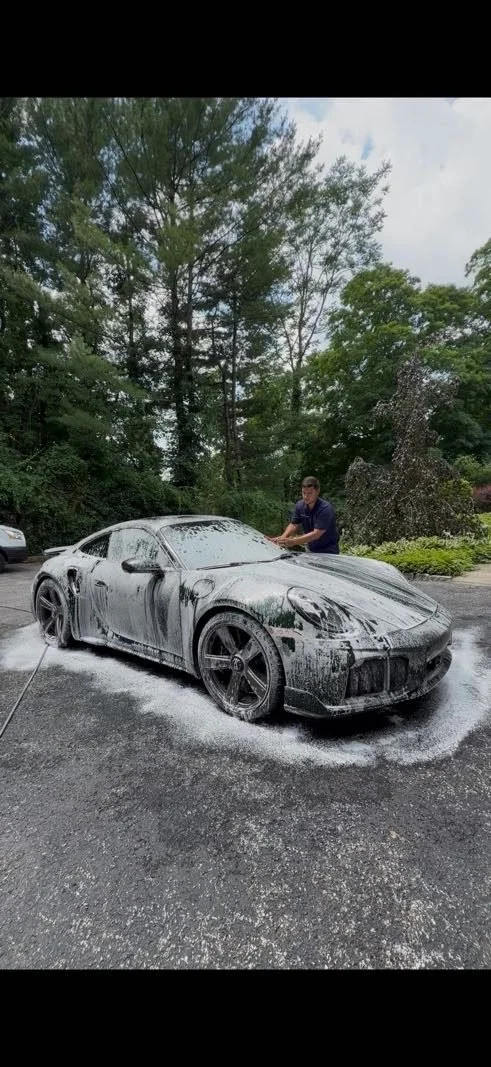
In short, a careful exterior detail usually includes a walk-around, wheels and tires, a pre-rinse and foam, a two-bucket hand wash from the top down, a final rinse, drying, often a clay bar, a ceramic sealer or wax depending on the package, then trim, tire dressing, exhaust tips, and glass last.
Mobile means the water, tools, and products come to the car. Shade, space, and where rinse water will go still matter, which is why a driveway or a suitable lot is planned when you book.
| Stage | Typical in a mobile exterior detail | Typical in an automatic wash |
|---|---|---|
| Wheels | Cleaned first, including barrels when accessible | A spray and a quick brush, often light on the inner barrel |
| Paint | Rinse, foam, two-bucket hand wash | A timed chemical and/or cloth cycle |
| Dry | Towels and often a blower | Air blowers; water often left in badges and mirrors |
| After the wash | Clay and protection on many packages | A spray wax in some packages, usually short-lived |
Mobile Exterior Detailing vs. Automatic Car Washes: The Real Differences
Quick answer: The core differences are contact control, thoroughness, time, and what you pay for. An automatic wash buys minutes. A mobile exterior detail buys a sequence and, on the deeper packages, decontamination and protection.
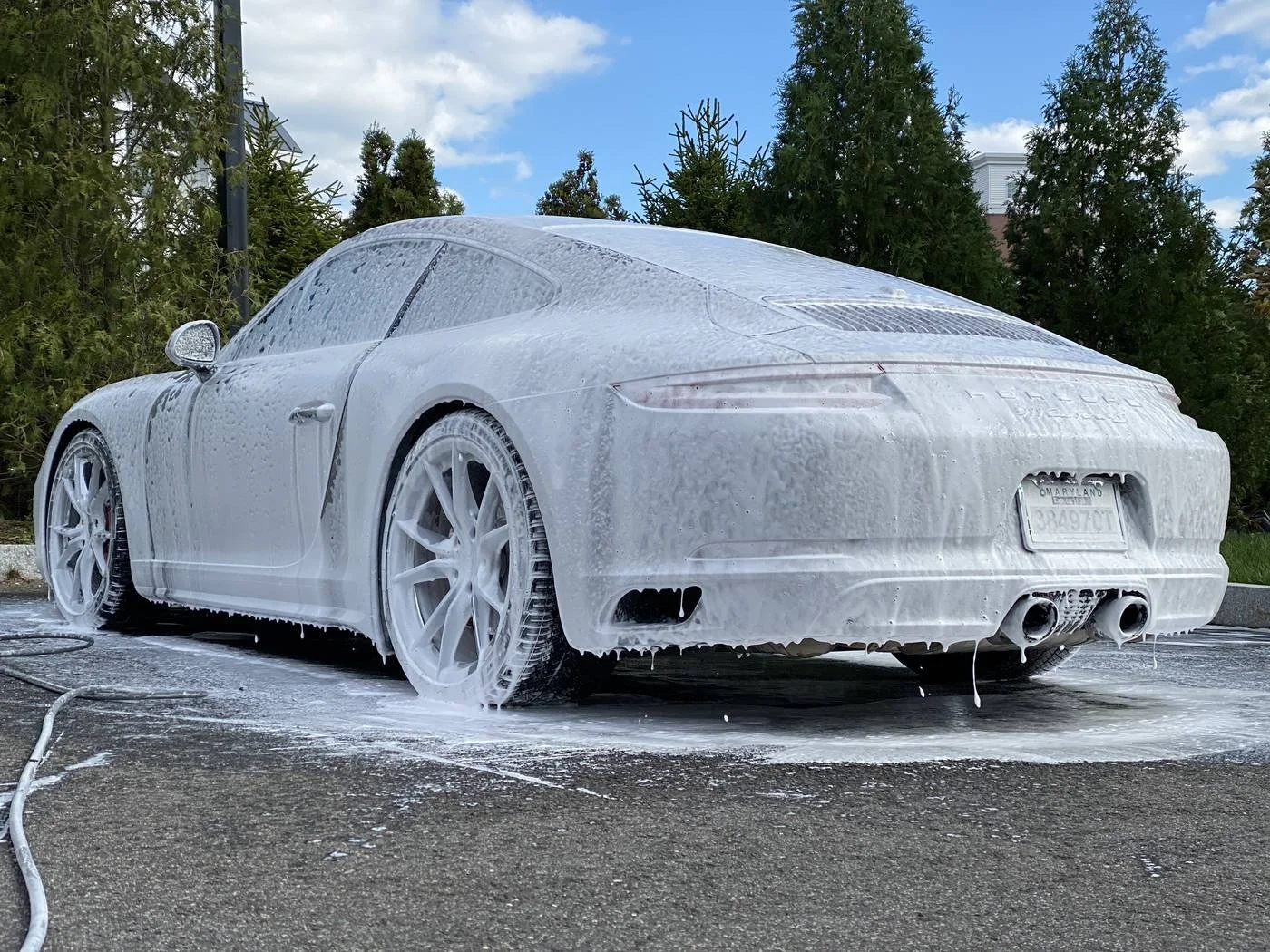
Control is the first gap. In a two-bucket hand wash, a mitt can be rinsed when it picks up grit, and wheels use separate tools so brake dust stays off the paint. In a cloth tunnel, you cannot inspect or rinse the material mid-car.
Thoroughness is the second. Door jambs, fuel-door recesses, emblem edges, and the inner wheel barrel are slow, awkward spots. Machines are designed to pass over the easy panels quickly. A detailer can stop and actually clean those edges.
Time is the third, and automatic washes win it outright. If the goal is a cleaner car before a school pickup, a good wash can be the right tool. If the paint feels sandy after the wash, or water no longer beads, a detail is the reset.
| Question | Automatic wash | Mobile exterior detail |
|---|---|---|
| How long does it take? | Usually a few minutes in the bay or tunnel | Longer; a full exterior is a planned visit |
| Where does it happen? | A fixed wash site | Your driveway, office lot, or similar parking |
| Who controls the contact? | The equipment settings | The detailer, mitt by mitt |
| Is protection included? | Sometimes a short spray wax | Sealer or wax on published Formula X exterior packages |
| Same-day? | Often, if the line is short | May be possible when available, so call to check |
How Automatic Brushes and Cloths Can Leave Swirl Marks
Quick answer: Swirl marks are fine, circular scratches in the clear coat that show up in sun, especially on dark paint. They often come from grit being dragged across the surface, which is a known risk when shared brushes or cloths stay dirty.
Consumer Reports advises against washing in circles even with a sponge at home, because that motion can leave swirl marks, and it flags motorized brushes as a way automated washes can grind in grime from other cars. The same logic applies to cloth strips that have already washed a muddy SUV ahead of you.
A professional hand wash is not automatically swirl-free. A dirty mitt, a dropped towel used again, or washing in direct sun with a dry panel can scratch too. The difference is that a careful detailer can change mitts, rinse often, wash straight along the panel, and stop if the car is too hot or too gritty.
If your paint already looks hazy or spiderwebbed in sunlight, a wash will not polish that out. Light clear-coat marks may be a paint-correction or scratch-repair question, quoted after inspection. For background on fine marring, see preventing micro-marring on a luxury SUV. Deeper damage, dents, rust, and paint work belong with a body shop.
| Situation | What it often points to | What a wash or detail can do |
|---|---|---|
| New spiderwebbing after frequent cloth tunnels | Contact washing with dirty material | A detail can clean and protect; correction is separate |
| Marks only where a brush would hit mirrors and bumpers | Equipment contact | Note it on the walk-around; don’t assume the last wash “fixed” it |
| Grit still on lower doors after a touchless cycle | Chemistry and time weren’t enough | A hand wash can agitate those panels |
| Dullness that feels rough to a clean fingertip | Bonded contamination | Clay, on packages that include it, after a proper wash |
What a Touchless Wash Does Well, and Where It Falls Short
Quick answer: A touchless wash avoids cloth contact, which lowers the chance of brush-type swirls. It leans on high-pressure water and stronger detergents, so the trade-off is cleaning power on stuck-on grime and what those chemicals do to wax or a light sealer over time.
That is the same trade-off Consumer Reports describes: touchless is the better automatic choice for protecting the car, and the finish may not come out as clean as you want. Bugs baked into a bumper, tar specks, and traffic film on lower doors often need agitation a jet cannot replace.
Stronger soap can also shorten the life of a spray wax or a light sealant. A professional ceramic coating is a different product, and aftercare should follow the installer. A ceramic sealer in a detail package is not the same as a coating, and neither should be stripped for no reason.
Touchless is still a useful winter option when you need salt off the car and you do not want cloths dragging grit. Think of it as maintenance between details, not as the detail itself.
The Spots an Automatic Wash Usually Leaves Behind
Quick answer: Machines are good at the big, open panels and weaker at edges, recesses, and anything that needs a person to look closely. Wheels, badge edges, door jambs, mirror housings, and the lower rear bumper are the usual leftovers.
Wheels are the clearest gap. Brake dust packs into barrels and around lug nuts. A tunnel spray brightens the face and often leaves the inner barrel dirty, which then flicks grit onto freshly washed paint on the first drive.
Blowers at the end of a tunnel move a lot of water and still leave droplets in badges, fuel-door seams, and mirror caps. Those droplets dry into spots, especially in summer or if the water is hard.
Jambs and the edge of the trunk or liftgate barely get wet in many automatic cycles. A detailer can open those areas and wipe them. That is not bodywork. It is just cleaning the parts a closed door hides.
- Inner wheel barrels and lug-nut wells
- Emblems, trim gaps, and fuel-door recesses
- Door jambs and trunk or liftgate ends
- Lower rear bumper and rocker panels with road film
- Water left to dry in crevices after the blowers
Protection: Spray Wax in a Tunnel vs. a Detailer’s Sealer
Quick answer: Some automatic packages add a spray wax in the last arches. It can add short-term shine and beading. A mobile exterior detail, on Formula X’s Bronze Exterior and Gold packages, includes a ceramic sealer rated at about six months, after the paint has been washed and, on those packages, clayed. Silver uses a 6+ month wax.
The order matters. Protection bonds more honestly to paint that is clean and smooth. Putting a spray wax over grit or over un-clayed paint just traps some of what you meant to remove.
A ceramic sealer in a package is still not a professional ceramic coating. Coating work is quoted after inspection. For the differences, read ceramic coating vs. wax vs. sealant and ceramic coatings in Connecticut.
If you already have a coating, a tunnel “hot wax” or harsh touchless chemical may work against the aftercare the installer gave you. Ask before you add mystery sprays on top of a paid coating.
Automatic Washes on Ceramic Coatings, Wraps, and Film
Quick answer: A ceramic coating, a vinyl wrap, or paint protection film changes what is safe in a wash bay. Follow the installer’s aftercare first. Many coatings prefer a gentle hand wash; wraps and film can be lifted at the edges by harsh contact or high-pressure jets aimed the wrong way.
Ceramic Pro’s aftercare is one example of how a coating maker tells owners to wash: gentle methods, the right soap, and no shortcuts that strip or scratch the surface. Your own installer’s sheet overrides a general article.
The wash routine for a coated car is covered in how to wash a ceramic-coated car. The short version for this comparison: a careful mobile hand wash is usually easier to keep within those rules than a shared-cloth tunnel.
If you do use an automatic wash on a coated or filmed car, touchless is the lower-contact option, and you should still inspect film edges and avoid biting chemicals if the installer warned against them. When in doubt, skip the bay and book a hand wash.
Winter in Connecticut: Frequent Washes vs. a Periodic Detail
Quick answer: Road salt is a reason to wash more often, not a reason to skip a thorough cleaning forever. A quick automatic wash can reduce loose brine on the sides of the car between storms. A mobile exterior detail is better at washing, drying, and then protecting paint after the worst of the season, or during a thaw.
A Connecticut Office of Legislative Research report has long described how the state uses road salt in winter. That salt rides up rocker panels, wheel wells, and lower doors. How road salt damages a car and the winter car care checklist cover the seasonal pattern.
Some automatic sites advertise an undercarriage blast, which can help rinse the parts a driver never sees. Formula X does not offer underbody work, and this guide will not pretend a driveway detail replaces that rinse. Use the right tool for that job if you need it, and still get the paint, wheels, and glass cleaned properly.
A reasonable winter plan for many Fairfield County drivers is: rinse or use a careful wash when the car is caked with salt, keep all-weather mats inside, and book a deeper exterior (and often an interior) when the roads dry out in spring.
| Winter need | Automatic wash can help | A mobile exterior detail can help |
|---|---|---|
| Loose salt on lower panels | Yes, especially soon after a storm | Yes, with more time on wheels and lower doors |
| Undercarriage brine | Sometimes, if the site has that spray | No; Formula X does not do underbody work |
| Wheels packed with dust and salt | Partly | Yes, as a dedicated first step |
| Restoring beading and a clean dry | Usually no | Yes, on packages that include sealer or wax |
Water, Runoff, and Why the Location of the Wash Matters
Quick answer: A tunnel or in-bay wash is a permitted facility with drains designed for wash water. A driveway or street is often tied into storm drains that lead to local waterways, which is why soapy runoff is a live issue in Stamford and along the Sound.
The Stamford MS4 fact sheet summarizes how the city’s stormwater system is regulated, and the Long Island Sound Partnership explains how what goes into storm drains can reach the Sound. A mobile detailer has to plan where rinse water goes and follow property rules at condos and offices.
That is a point in favor of using a commercial wash when you only need a machine rinse and you do not have a suitable place for a driveway wash. It is not an argument against mobile detailing. It is an argument for doing mobile work thoughtfully, which is part of booking and prep.
If your building limits exterior washing, say so when you schedule. Interior-only work is sometimes easier to approve. For setup, read how to prepare for a mobile detail.
Time, Convenience, and What the Prices Actually Cover
Quick answer: Automatic washes win on time: you can often be in and out during an errand. A mobile exterior detail takes a planned visit, but you do not drive or wait at a bay, because the work comes to the car. The prices cover different scopes, so they should not be lined up as if they were the same product.
This article will not invent a typical tunnel price. Those rates change by site and membership. What can be stated is Formula X’s published starting prices: Bronze Exterior $295+, Silver (a lighter clean inside and out) $395+, and Gold (a deep clean inside and out) $495+. The plus sign means size and condition can raise the price. Pet hair, heavy soil, sap, and hard water spots can add time.
For a fuller price breakdown, see how much mobile car detailing costs in Fairfield County.
If you want a short, inexpensive machine wash, an automatic site is built for that, and a detail will never be that product. If you want wheels cleaned properly, paint decontaminated, and protection applied, you are shopping for a detail, and a tunnel membership will not substitute.
| If your goal is… | The better fit |
|---|---|
| A fast rinse between storms | A careful automatic wash, preferably touchless if you want less cloth contact |
| A deep exterior reset | Bronze Exterior ($295+) or Gold ($495+) if the interior needs work too |
| A light refresh inside and out | Silver ($395+) |
| Same-day convenience | A wash if the line is short; a detail only when available, so call to check |
Want a Hand-Washed Exterior Where the Car Is Parked?
Tell Formula X Mobile Auto Detailing & Ceramic Coating the vehicle, where it’s parked, and whether you want a thorough exterior reset or you’ve been using automatic washes and the paint feels rough, with a few photos. You’ll hear whether Bronze Exterior, Silver, or Gold fits, and anything that needs correction, a coating quote, or a body shop will be said plainly.
When an Automatic Car Wash Is the Reasonable Choice
Quick answer: Choose an automatic wash when the car is lightly dirty, you need speed, you do not have a place for a driveway wash, or you are knocking off loose salt or pollen between scheduled details.
Touchless is the better automatic pick when paint protection matters more than maximum scrubbing, or when the car has a coating, wrap, or film and the installer has not forbidden machine washes outright.
Skip the brush or cloth if you already see new swirls, if the car is caked in grit that will load those cloths, or if loose trim, a wiper, or an accessory looks like it could catch.
A self-serve bay can be a middle path if you rinse thoroughly, keep the wand off the paint, and accept that you are still doing a wash, not a detail.
- Weekly or after-storm salt and light dirt
- No suitable driveway or HOA permission for a mobile wash
- You only have a few minutes
- You will still book a detail when the paint feels rough or protection is due
When a Mobile Exterior Detail Is the Better Choice
Quick answer: Book a mobile exterior detail when you want the wheels done properly, the paint washed by hand in a controlled way, a careful dry, and, on the deeper packages, clay and protection, without driving to a shop.
It is also the better choice before a sale or lease return when the outside has to look cared for, after a long stretch of tunnel washes when the paint feels rough, or when you have a coated, wrapped, or dark-colored car and you want fewer variables in the wash.
Dark paint shows swirls and water spots sooner. A later sheet title in this series is reserved for black cars; until that post is written, the practical advice is the same: rinse first, avoid dirty contact, and dry fully. For sale or lease timing, see detailing before selling and lease return detailing.
If the problem is scratches you can feel with a fingernail, or chips through the clear coat, ask about scratch repair or paint correction after an inspection. Do not expect a wash or a standard detail to polish those out.
A Bad Hand Wash Can Be Worse Than a Good Automatic Wash
Quick answer: “Hand wash” is not a quality guarantee. A single dirty bucket, a sponge dropped on the pavement, circular scrubbing on a dry panel, or dish soap can mark paint or strip protection. Consumer Reports’ basic rules, rinse first, avoid circles, and do not reuse a dropped sponge, exist because those mistakes are common.
That is why this comparison is not “machines bad, hands good.” It is “controlled method vs. rushed method.” A maintained touchless bay can be kinder than a hasty sponge in a parking lot.
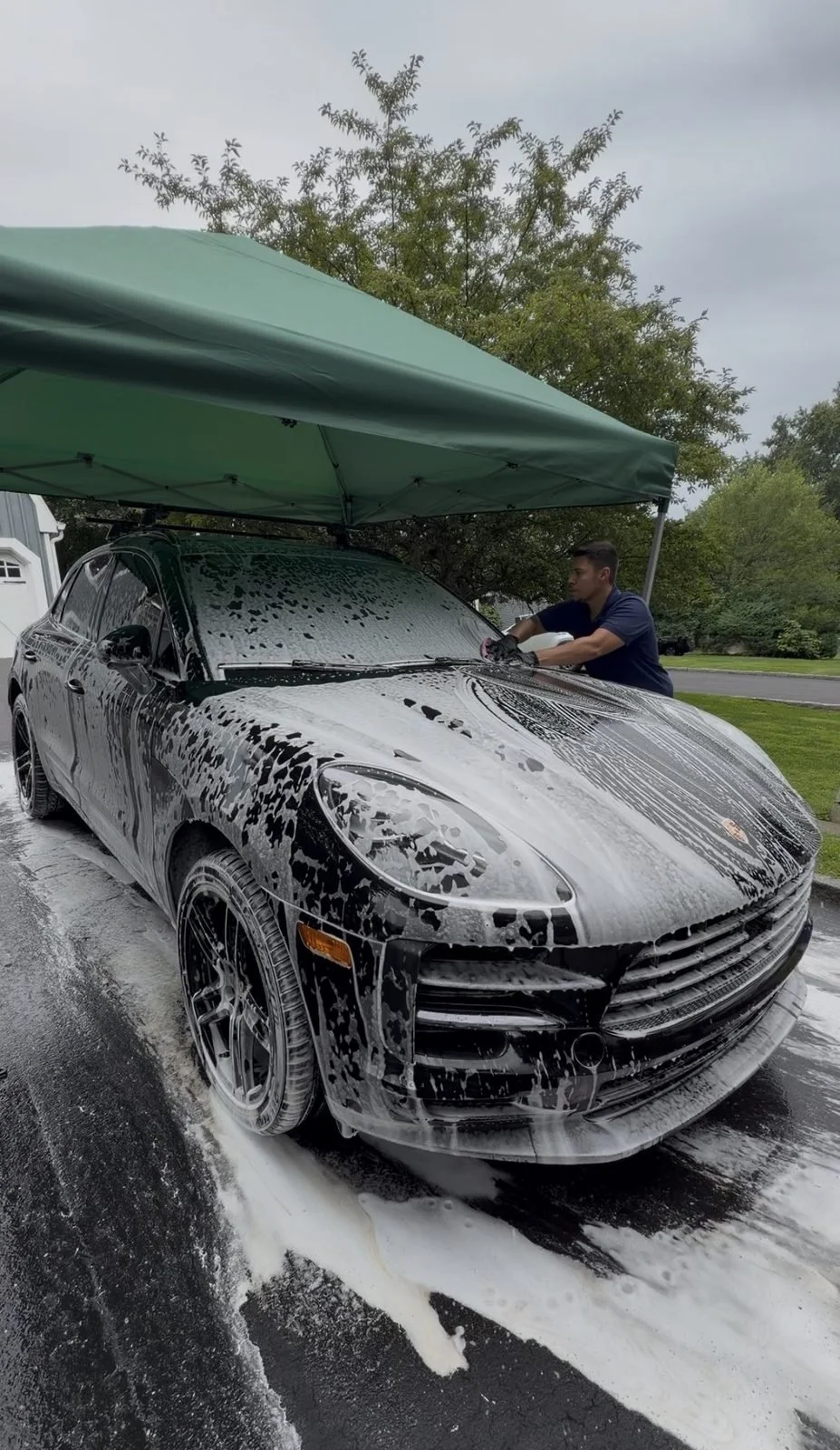
Professional mobile work is still a hand wash, with the method tightened: separate wheel tools, two buckets or an equivalent rinse system, clean mitts, shade when possible, and a dry that does not grind leftover grit.
If you wash at home, use a car-wash soap, plenty of rinse water, and straight-line passes, and stop if the panel is hot. For coated cars, stay inside the installer’s instructions.
Which Formula X Package Replaces a “Just Wash It” Request
Quick answer: If you called for a wash and what you actually want is a thorough exterior, Bronze Exterior ($295+) is the outside-only deep package: hand wash, clay bar, windows and exhaust tips, a ceramic sealer rated at about six months, and tire shine. Silver ($395+) is a lighter clean inside and out with a 6+ month wax. Gold ($495+) is a deep clean inside and out, including the exterior steps Gold shares with Bronze Exterior.
None of these is priced like a drive-through wash, because they are not that service. If all you need is a quick rinse, say that honestly and use a wash. If you want the paint smooth and protected, ask for the exterior package that matches the car.
Ceramic coating and paint correction stay quote-after-inspection items. Scratches may be extra.
| Package | Starting price | How it compares with an automatic wash |
|---|---|---|
| Bronze Exterior | $295+ | A full exterior detail, not a tunnel cycle |
| Silver (in + out) | $395+ | Lighter on both sides, still a hand process |
| Gold (in + out) | $495+ | Deep interior plus a deep exterior |
| Bronze Interior | $295+ | Inside only; use a wash or Bronze Exterior for the paint |
How to Tell Whether the Last Wash Was Enough
Quick answer: After any wash or detail, look at the car in ordinary daylight, not only under the bay blowers. Check the lower doors, behind the wheels, the inner barrel if you can see it, the glass, and whether water is still sitting in badges.
Run a clean fingertip lightly on a rinsed, dry fender. Roughness after a wash often means contamination is still bonded, which is a clay question, not another tunnel pass.
Look at dark panels in the sun for new spiderwebbing you did not notice before. If it showed up right after a cloth wash, change the method next time.
Confirm that trim is not chalky-white from leftover cleaner and that tire dressing, if used, is not wet enough to sling onto the paint on the first drive.
| Check | A careful detail usually looks like | A rushed wash often looks like |
|---|---|---|
| Lower doors and bumpers | Film lifted, even gloss | A dull band of road film |
| Wheels | Face and accessible barrel clean | Shiny face, dirty barrel |
| Glass and mirrors | Clear, no dryer spots at the edges | Spots where blowers missed |
| Paint feel | Smooth after clay on packages that include it | Sandy or rough after it dries |
How to Book, and What to Say If You’ve Been Using a Tunnel
Quick answer: When you book a mobile exterior detail, mention the vehicle, where it is parked, the finish (gloss, matte, wrap, film, or coating), and that you’ve been using an automatic wash if that’s the case. Photos of the wheels and the lower doors help. Same-day service may be possible when available, so call to check.
Call (203) 945-9454 or send a request. If HOA or office rules limit washing, say that too.
You do not need to apologize for using a tunnel. Plenty of well-kept cars do. The useful information is the current condition of the paint and wheels, so the visit is planned as a wash, a full Bronze Exterior, or Gold if the inside needs the same attention.
Formula X Mobile Auto Detailing & Ceramic Coating
Formula X Mobile Auto Detailing & Ceramic Coating is a mobile detailing, paint correction, scratch repair, and ceramic coating service based at 48 Union St, Stamford, CT 06906. The team works throughout Stamford, Greenwich, Darien, New Canaan, Norwalk, Rowayton, Westport, and other towns in lower Fairfield County, and Westchester County, NY.
For this comparison, that means a hand-done exterior at the car’s parking spot when a tunnel wash is not the right tool, a straight answer when an automatic wash is enough, and a referral for scratches, coatings, or bodywork that a wash cannot fix.
Call (203) 945-9454, email formulaxautodetail@gmail.com, send a request through the contact page, or view Formula X Mobile Auto Detailing & Ceramic Coating on Google Maps. Address: 48 Union St, Stamford, CT 06906.
Frequently Asked Questions About Exterior Detailing vs. Automatic Washes
Is a mobile exterior detail better than an automatic car wash?
They do different jobs. An automatic wash is a fast, machine-paced clean. A mobile exterior detail is a longer hand process that usually includes careful wheel work, a controlled wash and dry, and, on deeper packages, clay and protection. Use a wash for speed and loose dirt; use a detail for a thorough exterior reset.
Do automatic car washes scratch paint?
They can, especially cloth or brush systems that drag grit from earlier cars across the clear coat. Consumer Reports notes that motorized brushes can grind in grime or catch loose parts, and that touchless is the safer automatic option, though it may not get the finish as clean.
Is a touchless car wash safer than a brush wash?
Usually yes for contact scratches, because nothing cloth-like rubs the paint. The trade-off is heavier reliance on pressure and detergents, which may leave bonded grime and can wear down a light wax or sealer.
What's the difference between a car wash and an exterior detail?
A wash is a short clean. An exterior detail follows a set order: inspection, wheels, pre-rinse and foam, hand wash, dry, often clay and a sealer or wax, then trim, tires, and glass. Formula X's Bronze Exterior and Gold packages include clay and a ceramic sealer; Silver includes a 6+ month wax.
Can I use an automatic wash if my car has a ceramic coating?
Follow the coating installer's aftercare first. Many coatings are maintained with a gentle hand wash. If you do use a machine, touchless is the lower-contact choice. A ceramic sealer in a detail package is not the same as a professional coating.
Is it okay to use a car wash in winter for road salt?
Yes, a careful wash soon after storms can help remove loose salt from the sides of the car. A periodic mobile exterior detail still helps with wheels, a proper dry, and protection. Some wash sites spray the undercarriage; Formula X does not do underbody work.
Why do water spots appear after a tunnel wash?
Blowers leave droplets in badges, mirrors, and seams, and that water dries in place. A detailer usually dries those spots by hand or with a blower and towels.
Will a detail remove swirl marks from automatic washes?
Not by washing alone. A detail cleans and can protect the paint. Light clear-coat marks may need polishing, scratch repair, or paint correction, which are quoted after inspection. Deeper damage belongs with a body shop.
How much does a mobile exterior detail cost compared with a car wash?
They are priced as different services. Formula X's Bronze Exterior starts at $295+, Silver at $395+, and Gold at $495+, with size and condition able to raise the price. Automatic-wash rates vary by site and are not listed here.
Can I get a mobile exterior detail the same day?
Same-day service may be possible when available, so call to check at (203) 945-9454. Sending the vehicle, where it's parked, and a few photos helps.
Does Formula X wash the undercarriage like some automatic tunnels?
No. Formula X does not do underbody, rust, dent, paint, body, or mechanical work. If you need an undercarriage rinse, that is a separate machine function at some wash sites.
Is a hand wash always safer than an automatic wash?
No. A sloppy hand wash with a dirty mitt, one bucket, or circular scrubbing can scratch paint too. The safer method is a controlled wash, whether that is a careful professional detail or, for a quick clean, a well-run touchless bay.
Should I stop using automatic washes after a detail?
Not necessarily. Many drivers use a careful wash between details for salt or light dirt. If the paint is coated, follow the installer's rules. If you start to see new swirls after cloth tunnels, change the method.
Where is Formula X Mobile Auto Detailing & Ceramic Coating located?
Formula X Mobile Auto Detailing & Ceramic Coating is based at 48 Union St, Stamford, CT 06906, and can be reached at (203) 945-9454. It's a mobile service that comes to homes, offices, and condo buildings across lower Fairfield County and Westchester County, NY.
Find Formula X Mobile Auto Detailing & Ceramic Coating
Formula X Mobile Auto Detailing & Ceramic Coating is a mobile service based at 48 Union St, Stamford, CT 06906. Use the map for directions to the business address, or call (203) 945-9454 to arrange service at your location.
View Formula X Mobile Auto Detailing & Ceramic Coating on Google Maps
Book a Mobile Exterior Detail
Call Formula X Mobile Auto Detailing & Ceramic Coating at (203) 945-9454 or send a request with your vehicle, where it’s parked, whether you’ve been using automatic washes, and a few photos of the paint and wheels. You’ll hear which package fits, and anything that needs paint correction, a coating quote, or a body shop will be said plainly.
48 Union St, Stamford, CT 06906 · Serving Stamford, Greenwich, lower Fairfield County, and Westchester County, NY
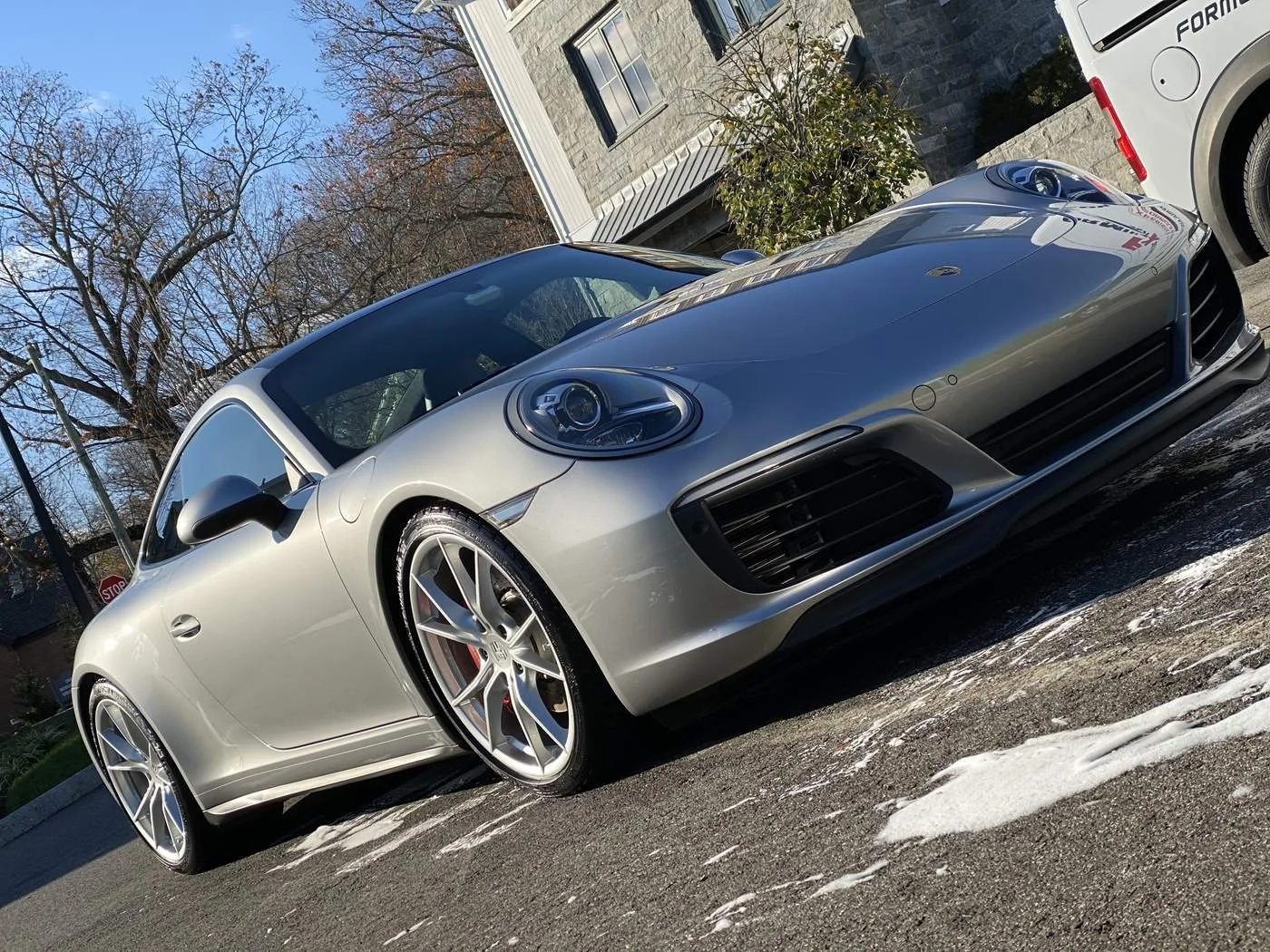
Recent Formula X detailing work